


What Is the Social Security Earnings Limit and Why Does It Matter in 2026?
The Social Security Earnings Limit is the maximum amount of work income you can earn before the SSA starts reducing your monthly Social Security benefits — and in 2026, hitting that threshold by accident could cost you thousands of dollars.
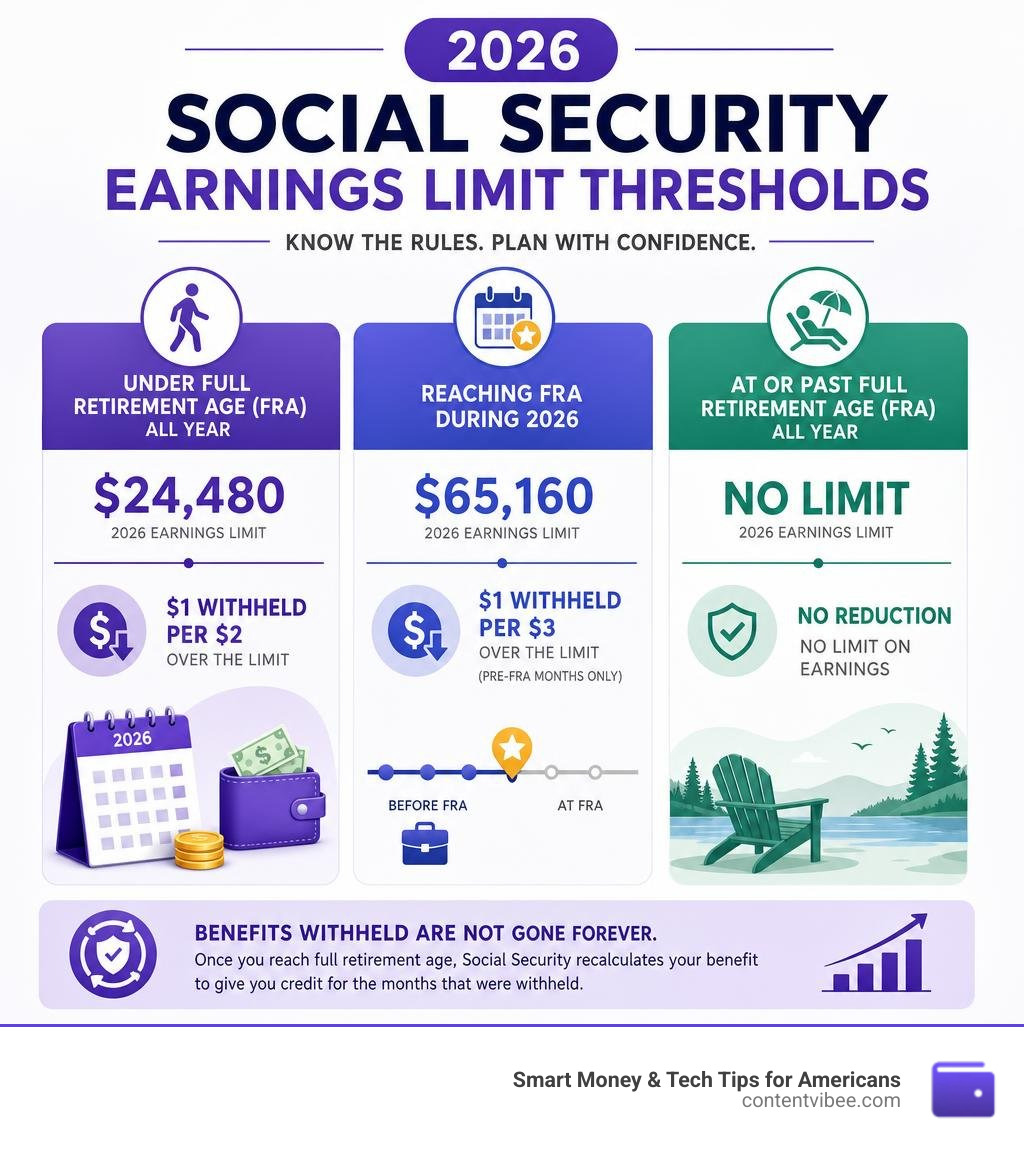
Here is a quick summary of the 2026 limits:
| Your Situation | 2026 Earnings Limit | Benefit Reduction |
|---|---|---|
| Under full retirement age (FRA) all year | $24,480 | $1 withheld per $2 over the limit |
| Reaching FRA during 2026 | $65,160 | $1 withheld per $3 over the limit (pre-FRA months only) |
| At or past full retirement age all year | No limit | No reduction |
This rule catches a lot of people off guard — especially working spouses who claim spousal Social Security benefits while still bringing home a paycheck.
The good news? Benefits withheld due to the earnings limit are not gone forever. Once you reach full retirement age, the SSA recalculates your benefit upward to give you credit for the months that were withheld. But that doesn’t mean the short-term cash flow hit is painless, and there are smart ways to plan around it.
Whether you are already collecting benefits or deciding when to claim, understanding exactly how this rule works — and what income actually triggers it — can make a real difference in your retirement income strategy.
Understanding the Social Security Earnings Limit and How It Affects You
Navigating the transition into retirement can feel like walking through a regulatory minefield. One of the most common surprises for early retirees is how working affects their monthly checks. If you claim your benefits before reaching your full retirement age (FRA) and continue to work, your benefits are subject to the retirement earnings test.
According to the Official SSA guidelines on working while receiving benefits, the Social Security Administration (SSA) temporarily withholds a portion of your benefits if your earned income exceeds the annual limit. This rule is designed to ensure that Social Security functions primarily as a replacement for lost wages rather than an additional bonus on top of a full-time salary.
If you claim benefits early, you already face a permanent reduction in your monthly payment. For example, if your full retirement age is 67 and you claim at age 62, your monthly benefit is permanently reduced by about 30%. Layering the Social Security Earnings Limit on top of this early claiming penalty can severely restrict your short-term cash flow.
However, it is crucial to recognize that the reduction caused by the earnings limit is temporary. The SSA does not keep this money forever; instead, they pause or reduce your payments now and return them to you later in the form of higher monthly checks once you reach FRA.
What Income Counts Toward the Limit?
Not all money landing in your bank account is treated equally by the SSA. When calculating whether you have exceeded the annual threshold, the government only looks at active work income. This includes:
- Gross wages: Your pre-tax salary, hourly pay, and any overtime.
- Net self-employment profit: Your net earnings after business expenses if you run your own business or work as an independent contractor.
- Bonuses and commissions: Any performance-based pay or sales commissions earned during the calendar year.
- Vacation and sick pay: Accumulated leave paid out by your employer.
If you are an employee, the SSA relies on the gross wages recorded on your W-2 form. If you are self-employed, they look at your net earnings from Schedule SE on your federal tax return.
What Income Is Excluded From the Limit?
Fortunately, passive income and retirement distributions do not count toward the earnings limit. You can enjoy unlimited amounts of the following income types without triggering a benefit reduction:
- Pensions and annuities: Regular payouts from a former employer’s pension plan or a private annuity.
- Investment income: Dividends, capital gains, and interest earned on your savings accounts, brokerage accounts, or CDs.
- Retirement account withdrawals: Traditional or Roth distributions from your 401(k), 403(b), or IRA.
- Veterans benefits and government assistance: Disability payments, pensions, or other state and federal aid.
- Inheritances and gifts: Lump-sum windfalls or personal gifts.
By understanding this distinction, you can strategically structure your cash flow. If you need extra income in early retirement, drawing from an IRA or a taxable brokerage account is often safer than taking on a high-paying part-time job that pushes you past the limit.
How the Earnings Test Reduces Your Benefits in 2026

In 2026, the specific rules and thresholds dictating your benefit reductions depend entirely on your age. The SSA divides beneficiaries into three distinct categories based on how close they are to their full retirement age.
To see how these rules compare side-by-side, let’s look at the official guidelines outlined in the Exempt amounts under the earnings test:
| Rule Type | 2026 Annual Limit | Reduction Rate | Which Months Count? |
|---|---|---|---|
| Under FRA All Year | $24,480 | $1 for every $2 over | All 12 months of the year |
| Year You Reach FRA | $65,160 | $1 for every $3 over | Only the months before you reach FRA |
| At or After FRA | No Limit | No Reduction | None |
The Under Full Retirement Age Rule
If you are under your full retirement age for the entire calendar year of 2026, you are subject to the strictest version of the earnings test. The annual limit is set at $24,480. For every $2 you earn above this cap, the SSA will withhold $1 of your benefits.
For example, imagine you are 64 years old and receive a monthly Social Security benefit of $1,500 ($18,000 annually). You decide to work a part-time consulting job that pays you $34,480 in 2026.
- Determine your excess earnings: $34,480 – $24,480 = $10,000.
- Calculate the reduction: $10,000 / 2 = $5,000.
- Determine your net benefit: The SSA will withhold $5,000 of your benefits, leaving you with $13,000 for the year.
Because the SSA withholds whole monthly checks rather than partial amounts, they will stop your monthly payments entirely for the first few months of the year until the $5,000 reduction is satisfied. If you are considering early claiming, we highly recommend estimating your monthly retirement benefits first to see how a potential work penalty might impact your household budget.
The Year You Reach Full Retirement Age Rule
The year you transition to your full retirement age brings a much more generous set of rules. In 2026, the earnings limit for this transition year is $65,160. Furthermore, the reduction rate drops to $1 withheld for every $3 earned over the limit, and the SSA only counts the money you earn in the months before the month you reach your FRA.
Suppose you turn 67 (your FRA) in September 2026. From January through August, you earn $71,160 at your job.
- Determine your excess earnings: $71,160 – $65,160 = $6,000.
- Calculate the reduction: $6,000 / 3 = $2,000.
- Apply the reduction: The SSA will withhold $2,000 from your benefits during those pre-FRA months.
Starting in September, the month you turn 67, you can earn an unlimited amount of money without facing any reductions. When planning this transition, calculating your Social Security benefit accurately ensures you don’t face unexpected cash flow gaps in the months leading up to your birthday.
What Happens to Withheld Benefits at Full Retirement Age?
One of the most persistent myths about the Social Security Earnings Limit is that withheld benefits are gone forever. This is simply not true.
When you reach your full retirement age, the SSA will automatically recalculate your monthly benefit amount. They do this through a process known as the Adjustment of Reduction Factor (ARF). The SSA looks at all the months your benefits were withheld due to your earnings and adjusts your claiming age upward.
For instance, if you claimed benefits at 62 but had 12 full months of benefits withheld over the next few years, when you reach age 67, the SSA recalculates your benefit as if you had claimed at age 63 instead of 62. This permanently increases your monthly check for the rest of your life. For a deeper dive into how timing dictates your lifetime payouts, read the definitive guide to claiming age.
How the Social Security Earnings Limit Impacts Spousal and Family Benefits

If you are working and your benefits are reduced, it is not just your personal retirement check that is affected. The earnings test also applies to any family benefits paid on your record.
If you claim a retirement benefit and your spouse collects spousal benefits based on your work history, any reductions triggered by your excess earnings will also reduce your spouse’s payments. This is a vital consideration for couples planning a joint retirement. We have covered this dynamic extensively in our guide on working in retirement and spousal benefit reductions.
However, if your spouse is receiving spousal benefits on your record but they are the ones working and earning over the limit, only their spousal benefit is reduced. Your personal retirement check remains untouched. If you are navigating these complex rules, you may also find our guides on Double the Fun: A Guide to Social Security Spousal Benefits for Couples and Can a Married Couple Both Collect Social Security? helpful.
Tax Implications of Exceeding the Social Security Earnings Limit
Working while collecting benefits can also expose you to a double tax hit. First, you will continue to pay the standard 6.2% OASDI payroll tax on your wages up to the 2026 Contribution and Benefit Base limit of $184,500.
Second, your earned income can make your Social Security benefits taxable. The IRS determines the taxability of your benefits using a metric called “combined income” (also known as provisional income), calculated as:
$$\text{Combined Income} = \text{Adjusted Gross Income (AGI)} + \text{Tax-Exempt Interest} + 50\% \text{ of your Social Security Benefits}$$
If your combined income exceeds certain thresholds, you will pay federal income taxes on up to 50% or 85% of your benefits:
- Single Filers:
- $25,000 to $34,000: Up to 50% of benefits are taxable.
- Over $34,000: Up to 85% of benefits are taxable.
- Married Filing Jointly:
- $32,000 to $44,000: Up to 50% of benefits are taxable.
- Over $44,000: Up to 85% of benefits are taxable.
Special Rules for the First Year of Retirement and Self-Employment
To protect people who retire mid-year, the SSA has established special administrative rules. Without these rules, someone who retires in June after earning a high salary all year would have their Social Security checks completely withheld for the rest of the year.
The SSA policy on the earnings test dictates that during your first year of retirement—often called your “grace year”—the SSA applies a monthly earnings test instead of the annual test.
The First-Year Monthly Earnings Test
Under the monthly earnings test, you can receive a full Social Security check for any month you are considered retired, regardless of how much you earned earlier in the year.
In 2026, the monthly exempt amount is $2,040 (which is exactly 1/12 of the $24,480 annual limit). If you earn $2,040 or less in a given month and do not perform substantial services in self-employment, you are entitled to your full benefit check for that month.
- Example: You retire on June 30, 2026, having earned $80,000 as a corporate executive from January to June. In July, you start collecting Social Security and earn just $500 a month working part-time at a local library. Even though your annual earnings ($83,000) far exceed the $24,480 annual limit, you will receive your full monthly Social Security checks for July through December because your monthly earnings are below the $2,040 threshold.
Self-Employment and the 45-Hour Rule
If you are self-employed, the monthly earnings test operates a bit differently. Because business owners can easily manipulate their monthly salaries, the SSA looks at the time you devote to your business rather than just your net profit.
This is known as the 45-hour rule:
- Under 15 hours: You are generally considered retired.
- 15 to 45 hours: You may be considered retired if you do not work in a highly skilled occupation or manage a complex business.
- Over 45 hours: You are not considered retired, and your monthly benefit will be withheld regardless of your actual net earnings for that month.
Frequently Asked Questions About the Social Security Earnings Limit
Can I work and still get Social Security if I am over full retirement age?
Yes! Once you reach your full retirement age, the earnings limit completely disappears. You can earn millions of dollars a year and still receive your full monthly Social Security checks.
In fact, continuing to work after reaching your FRA can actually increase your monthly benefit. The SSA automatically reviews your earnings record every year. If your new earnings are higher than one of the 35 years originally used to calculate your benefit, they will recalculate your payment and increase your monthly check retroactively. You can read more about this on the Official SSA planner on working after retirement age.
Does the earnings limit apply to Social Security disability benefits?
No, the retirement earnings test does not apply to Social Security Disability Insurance (SSDI). However, SSDI has its own strict set of work rules.
To qualify for SSDI, you must not be able to engage in “Substantial Gainful Activity” (SGA). If you earn more than the SGA limit, your disability benefits could be terminated entirely. The SSA does offer incentives like the Trial Work Period (TWP) to help disabled beneficiaries transition back into the workforce safely, but these rules are entirely distinct from the retirement earnings test.
How do I report changes in my estimated earnings to the SSA?
If you are under your full retirement age and expect your annual earnings to exceed the limit, you are legally required to report your estimated earnings to the SSA.
You can report changes by calling the SSA toll-free at 1-800-772-1213 or by visiting your local Social Security office. Failing to report your earnings promptly can lead to overpayments, which the SSA will claw back by withholding 100% of your future checks until the debt is settled. For step-by-step instructions on keeping your records up to date, review the How work affects your benefits PDF.
Conclusion
Working in retirement can be a fantastic way to stay active, connected, and financially secure. However, if you plan to claim benefits before your full retirement age, navigating the Social Security Earnings Limit is essential to avoid frustrating payment pauses and unexpected tax bills.
At ContentVibee, we believe that strategic retirement planning is the key to maximizing your hard-earned wealth. By aligning your work schedule, retirement withdrawals, and claiming age, you can build a reliable income stream that supports the lifestyle you deserve. For a complete blueprint to master your retirement, check out our A Comprehensive Guide to Social Security Benefits.


