What Is the Social Security Primary Insurance Amount — and Why It Matters for Your Retirement
Your Social Security primary insurance amount is the foundation of every benefit check you’ll ever receive from the program. It’s the monthly dollar figure you’d get if you claimed benefits at exactly your full retirement age — no reductions, no increases.
Here’s the quick answer:
- What it is: Your PIA is your baseline Social Security benefit, calculated from your lifetime earnings history.
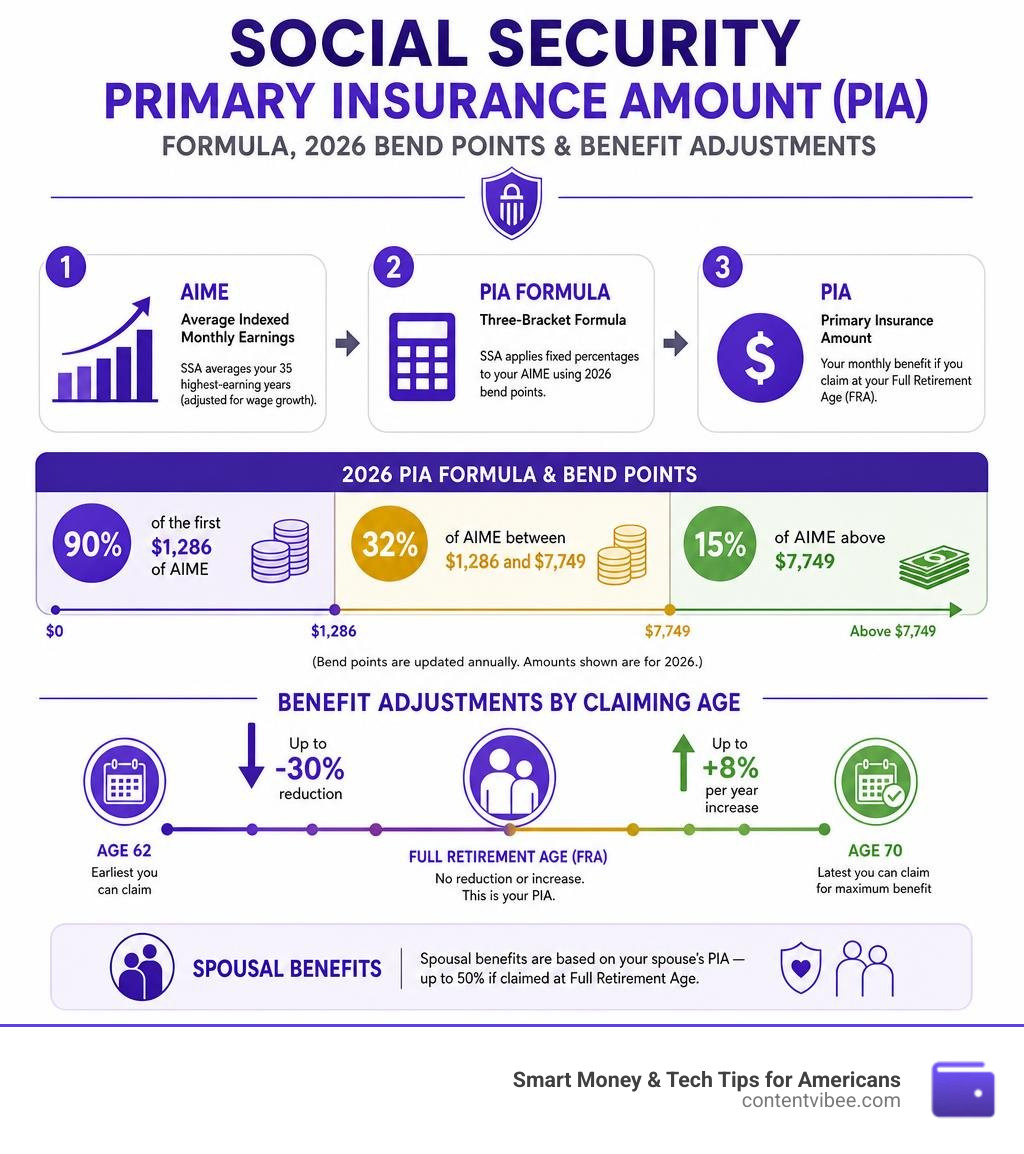
- How it’s calculated: SSA averages your 35 highest-earning years (adjusted for wage growth), then applies a three-bracket formula using fixed percentages and annually updated dollar thresholds called bend points.
- 2026 formula:
- 90% of the first $1,286 of your average indexed monthly earnings (AIME)
- 32% of AIME between $1,286 and $7,749
- 15% of AIME above $7,749
- Claiming early (age 62) reduces your benefit by up to 30%. Claiming late (up to age 70) increases it by up to 8% per year.
- Spousal benefits are based on your spouse’s PIA — up to 50% if claimed at full retirement age.
Understanding your PIA isn’t just a math exercise. For a working spouse nearing retirement, it directly determines how much you — and your partner — will receive every single month. Getting this number right can mean thousands of dollars over a lifetime.
Demystifying the Social Security Primary Insurance Amount
When you start planning for retirement, the acronyms fly fast and thick. You will hear about AIME, FRA, COLA, and, of course, PIA. Let’s strip away the bureaucratic jargon and look at what the Social Security primary insurance amount actually represents.
Think of your PIA as your “base camp” benefit. It is the exact amount of money the Social Security Administration (SSA) determines you are owed each month, assuming you wait until your Normal Retirement Age (NRA) to start collecting.
No matter when you actually decide to claim your benefits, the SSA always starts with this base figure. If you claim early, they shave a percentage off your PIA. If you delay, they add a bonus to your PIA. But the starting point is always the same. As outlined in the Primary Insurance Amount (PIA): Benefits and Examples, your PIA is calculated before rounding down to the next lower whole dollar, serving as the foundational building block for all family and individual benefits.

What is the Normal Retirement Age (NRA)?
Your Normal Retirement Age (often called Full Retirement Age, or FRA) is the age at which you are eligible to receive 100% of your PIA.
The SSA determines your NRA based strictly on the year you were born:
- If you were born between 1943 and 1954: Your NRA is exactly 66.
- If you were born between 1955 and 1959: Your NRA increases gradually by two months for each birth year (e.g., 66 and 2 months, 66 and 4 months).
- If you were born in 1960 or later: Your NRA is exactly 67.
If you claim your benefit even one month before this milestone, you will receive less than your full PIA. If you wait until after your NRA, your benefit will exceed your PIA. You can explore how these age thresholds fit into your broader retirement strategy in A Comprehensive Guide to Social Security Benefits.
How Your Lifetime Earnings Become Your Base Benefit
Your Social Security benefit isn’t a gift; it is a payout based on your career earnings. To determine your PIA, the government looks at your covered employment—meaning jobs where you paid Social Security (FICA) taxes.
The SSA tracks your earnings throughout your life, up to the annual maximum taxable limit. To calculate your base benefit, they use a 35-year average of your highest-earning years. If you worked more than 35 years, they throw out the lowest-earning years. If you worked fewer than 35 years, the empty years are factored in as zeros, which can significantly drag down your final PIA.
Step 1: Calculating AIME for Your Social Security Primary Insurance Amount
Before the SSA can apply its benefit formula, it must convert your raw earnings history into a single, manageable monthly figure. This figure is called your Average Indexed Monthly Earnings (AIME).
Because a dollar in 1985 bought a lot more than a dollar does in June 2026, the SSA doesn’t just add up your actual historical earnings. Instead, they use a process called “wage indexing.” This adjusts your past wages upward to account for overall wage growth in the national economy over your working life.
The indexing process works like this:
- The SSA lists your earnings for each year of your career.
- They multiply your actual earnings for each year prior to age 60 by an indexing factor (which is tied to the national average wage index). Earnings after age 60 are recorded at their actual value.
- They select the 35 years with the highest indexed earnings.
- They sum these 35 years of indexed earnings and divide the total by 420 (the number of months in 35 years) to get your AIME.
If you want a step-by-step breakdown of how to prepare these numbers, check out How to Calculate Your Social Security Benefit in 5 Simple Steps and review the official guidelines on Social Security Retirement Benefit Calculation.
How the 2026 Bend Points Shape Your Social Security Primary Insurance Amount
Once the SSA has calculated your AIME, they apply a highly progressive three-bracket formula to determine your PIA. The dollar thresholds that separate these brackets are known as bend points. These bend points are adjusted annually to keep pace with national wage inflation.
For workers who first become eligible for retirement benefits (reach age 62) in 2026, the formula bend points are $1,286 and $7,749.
The formula is designed to be progressive, meaning it replaces a higher percentage of lifetime earnings for lower-income earners than it does for higher-income earners. The three brackets apply as follows:
| Portion of Your AIME | Percentage Applied | What It Means for Your Benefit |
|---|---|---|
| First $1,286 | 90% | You keep 90 cents of every dollar in this bracket. |
| Over $1,286 up to $7,749 | 32% | You keep 32 cents of every dollar in this middle bracket. |
| Anything over $7,749 | 15% | You keep 15 cents of every dollar above this upper threshold. |
Let’s look at a practical example of how this formula works for a worker retiring in 2026 with a calculated AIME of $5,825:
- First Bracket: 90% of the first $1,286 = $1,157.40
- Second Bracket: 32% of the remaining AIME ($5,825 – $1,286 = $4,539) = $1,452.48
- Third Bracket: 15% of any amount over $7,749 = $0.00 (since this worker’s AIME is below the second bend point)
Adding these portions together gives us: $$\$1,157.40 + \$1,452.48 = \$2,609.88$$
After rounding down to the next lower multiple of ten cents (as required by law), this worker’s final baseline Social Security primary insurance amount is $2,609.80. You can verify these formulas and track historical shifts directly via the official Primary Insurance Amount resource page.
The Role of the National Average Wage Index
You might wonder where those odd numbers—like $1,286 and $7,749—come from. They are not pulled out of thin air. They are calculated using the national average wage index.
The original bend points were established in 1979 at $180 and $1,085. Each year, the SSA updates these figures by multiplying the original 1979 bend points by the ratio of the national average wage index from two years prior to the 1977 average wage index.
To calculate the 2026 bend points, the SSA used the following data points:
- 1977 Average Wage Index: $9,779.44
- 2024 Average Wage Index: $69,846.57
- First Bend Point Calculation: $\$180 \times \frac{\$69,846.57}{\$9,779.44} = \$1,285.59$ (rounds to $1,286)
- Second Bend Point Calculation: $\$1,085 \times \frac{\$69,846.57}{\$9,779.44} = \$7,749.27$ (rounds to $7,749)
This indexing system ensures that the purchasing power of your future Social Security benefits remains tied to the actual standard of living of the American workforce. For more details on wage indexing and annual adjustments, read the SSA page on Social Security Benefit Amounts.
How Claiming Age and COLAs Adjust Your PIA
Your PIA is your baseline, but it is rarely the exact amount of the check that hits your bank account. The actual amount you receive depends heavily on two factors: when you claim your benefits and inflation adjustments (COLAs).
How Claiming Age Affects Your Final Monthly Payout
You can choose to start receiving retirement benefits as early as age 62, or you can delay claiming all the way up to age 70.
- Claiming Early: If you claim before your Normal Retirement Age, your monthly benefit is permanently reduced. For a worker with an NRA of 67 who claims at age 62, the benefit is reduced by 30%. This actuarial reduction is applied directly to your PIA. For example, if your PIA is $2,609.80 and you claim at 62, your actual monthly check will be reduced to $1,826.00.
- Claiming Late: If you delay claiming past your NRA, you earn Delayed Retirement Credits. For anyone born in 1943 or later, your benefit increases by 8% per year (or $\frac{2}{3}$ of 1% for each month) you delay, up to age 70. If your NRA is 67 and you wait until age 70 to claim, your monthly check will be 124% of your PIA.
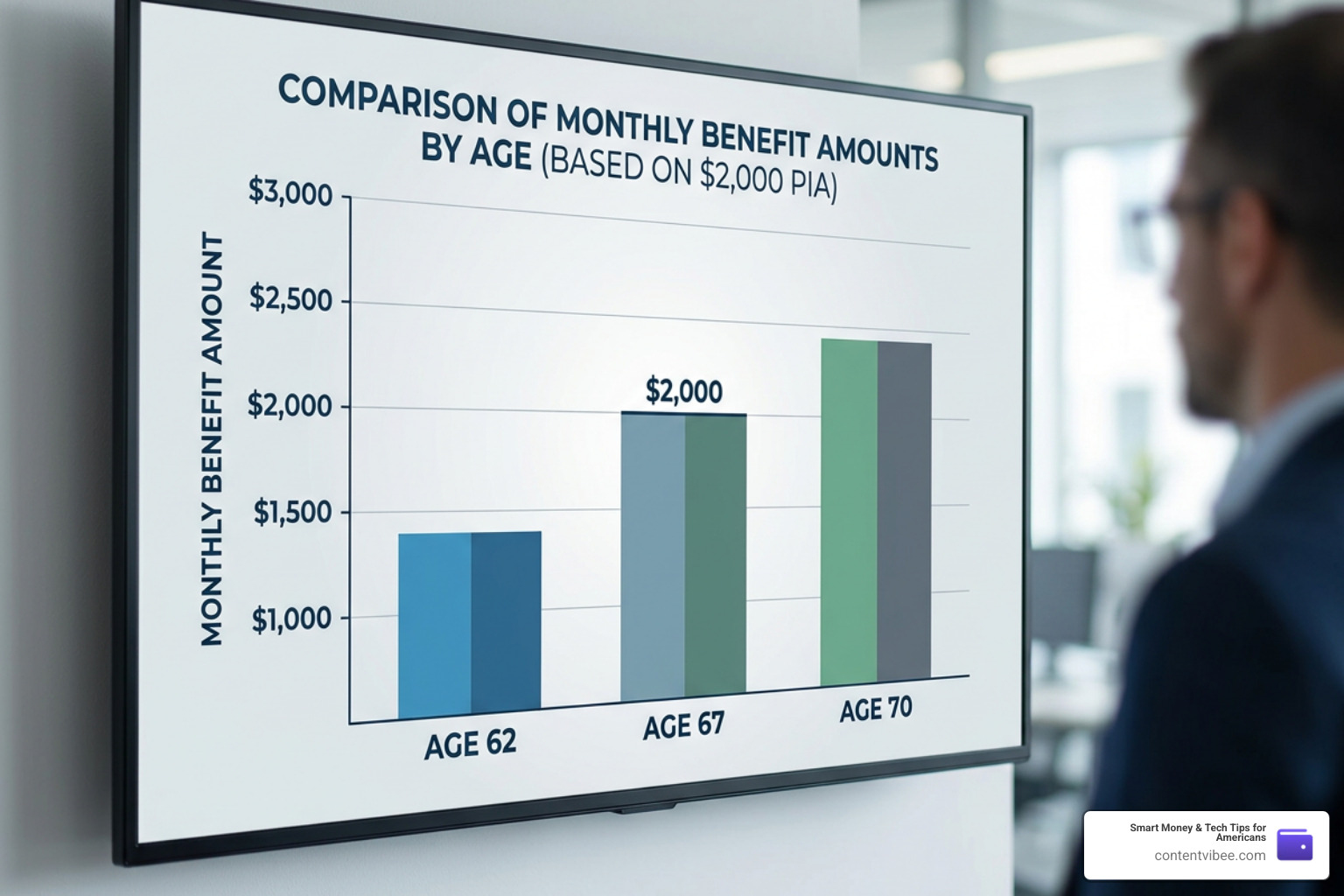
Deciding when to claim is one of the most critical decisions in retirement planning. We break down the math and strategies behind this choice in The Definitive Guide to Social Security Claiming Age. You can also review real-world calculations on the official Benefit Calculation Examples for Workers Retiring in 2026 page.
The Impact of Eligibility Year and COLAs
A common point of confusion is how Cost-of-Living Adjustments (COLAs) interact with your PIA.
Your year of “first eligibility” is the year you turn 62. This is the year your PIA formula is locked in, using the bend points for that specific year. Even if you don’t plan to claim your benefits until age 67 or 70, your baseline PIA is calculated using the formula from the year you turned 62.
Once you reach age 62, you become eligible for all annual COLAs that are enacted, even if you have not claimed benefits yet. The SSA calculates your initial PIA using your eligibility year’s formula, and then they apply any subsequent annual COLAs to that base amount. This ensures that your delayed benefit doesn’t lose its purchasing power to inflation while you wait to claim. The statutory foundation for these calculations is codified in federal law under 42 USC 415: Computation of primary insurance amount.
Wage Indexing vs. the Old-Start Benefit Method
If you look into the history of Social Security, you might run across mention of the “old-start benefit method” or the “Average Monthly Earnings” (AME) method.
Before 1979, the SSA did not use wage indexing. Instead, they calculated benefits using the old-start method, which relied on actual, unindexed historical earnings (AME). This older system was less equitable because it did not adjust past wages to reflect decades of economic growth and inflation.
The modern wage indexing method was introduced in 1979 to ensure that retirement benefits reflect changes in the national standard of living over a worker’s career. Today, the old-start method is obsolete for almost all new retirees. It is only used in rare transitional cases or for individuals who became disabled, died, or turned 62 prior to 1979. For a historical dive into these older methods and how they compare to modern rules, you can refer to the SSA Handbook § 700.
Spousal, Survivor, and Family Maximum Benefits
Your PIA doesn’t just dictate your own retirement check—it also serves as the anchor for benefits paid to your family members.
- Spousal Benefits: If you are married, your spouse may be eligible to claim benefits based on your earnings record. A spouse can receive up to 50% of your PIA if they claim at their own full retirement age. This spousal benefit does not reduce your own retirement check.
- Survivor Benefits: If you pass away, your surviving spouse can receive up to 100% of your actual benefit (which is based on your PIA, plus any delayed retirement credits you earned).
- Family Maximum Benefit: There is a limit to how much a single family can draw from one worker’s earnings record. The family maximum benefit typically ranges from 150% to 180% of the worker’s PIA. If the total benefits owed to your spouse and children exceed this limit, their individual benefits are scaled down proportionally (your own personal retirement check is never reduced).
Understanding how these benefits interact is essential for married couples. For a deep dive into coordinating benefits with your partner, see our guide Do the Math: Top Social Security Calculators for Married Couples. You can also read the Congressional Research Service’s policy brief on How Social Security Benefits Are Computed: In Brief.
Frequently Asked Questions about the PIA
Navigating Social Security can feel like trying to solve a puzzle in a dark room. Here are clear answers to some of the most common questions about the PIA.
What is the maximum Social Security benefit in 2026?
The maximum benefit depends on the age at which you claim. For a worker retiring in 2026 who earned the maximum taxable earnings limit for their entire 35-year career, the maximum AIME is $14,358, resulting in a maximum baseline PIA of $4,216.90.
If this maximum earner claims early at age 62 in 2026, their monthly benefit is reduced to $2,951.00 (reflecting a 30% reduction). If they wait until age 70 to claim, they will receive the absolute maximum possible benefit, which is significantly higher due to delayed retirement credits. For comparison, back in 2024, the maximum benefit was $2,710 at age 62 and $4,873 at age 70. You can learn more about maximizing your personal earnings record in Estimate Your Monthly Retirement Benefits in 5 Easy Steps.
How can I estimate my own PIA and benefits?
The easiest and most accurate way to find your estimated PIA is to create a personal account on the official Social Security website:
- Go to ssa.gov and log in to your my Social Security account.
- Review your official Earnings Record to ensure all your working years are documented correctly.
- Use the built-in Retirement Estimator tool, which automatically pulls your real earnings history to calculate your estimated AIME and PIA.
For external planning, you can explore independent tools. Check out our reviews in How Much Social Security Will I Get Calculator and Best Free Social Security Calculator Options: Your No-Cost Retirement Roadmap.
Does working after age 62 increase my PIA?
Yes, it can. Because your PIA is calculated using your highest 35 years of indexed earnings, working after age 62 can increase your benefit if your current earnings are higher than one of the 35 years currently used in your calculation.
Each year, the SSA automatically reviews your earnings record. If your new earnings replace a lower-earning year from your past, they will recompute your PIA and increase your monthly benefit check. To see how post-62 work fits into your overall retirement savings goals, try out our Retirement Calculator: Estimate Savings Needed.
Conclusion
At first glance, the Social Security primary insurance amount looks like a maze of complex math, bend points, and wage indexing factors. But when you strip away the technical jargon, it is simply your baseline benefit—the foundation upon which your entire retirement income strategy is built.
At ContentVibee, we believe that taking control of your financial future shouldn’t require an advanced degree in mathematics. By understanding how your 35 highest-earning years shape your PIA, and how your claiming age can scale that number up or down, you can make informed decisions that secure your family’s financial future.
Ready to take the next step and design your custom claiming strategy? Dive into our comprehensive resource, The Definitive Guide to Social Security Claiming Age, to maximize your lifetime benefits.