Will a Car Accident Lawyer Really Take All Your Money?
Understanding attorney fees for auto accident cases is simpler than most people think — and the answer to the headline question is: no, a lawyer will not take all your money.
Here’s the quick version:
| Situation | Typical Attorney Fee |
|---|---|
| Case settles before lawsuit | ~33% of your settlement |
| Case goes to litigation or trial | ~40% of your settlement |
| You lose the case | $0 in attorney fees |
| Upfront cost to hire a lawyer | $0 |
The most important things to know right away:
- Most car accident lawyers work on a contingency fee — they only get paid if you win
- The standard fee is 33% before a lawsuit is filed, and up to 40% if it goes to trial
- You pay nothing upfront
- Additional case expenses (like filing fees and medical records) are usually advanced by the lawyer and deducted from your settlement
- Studies show that people with lawyers recover up to 3.5 times more than those who go it alone — meaning you typically take home more money even after paying fees
That said, your final take-home amount depends on more than just the attorney’s percentage. Medical liens, case expenses, and when those costs are deducted can all shift what lands in your pocket by hundreds — or even thousands — of dollars.
This guide breaks it all down in plain language so you know exactly what to expect before you sign anything.
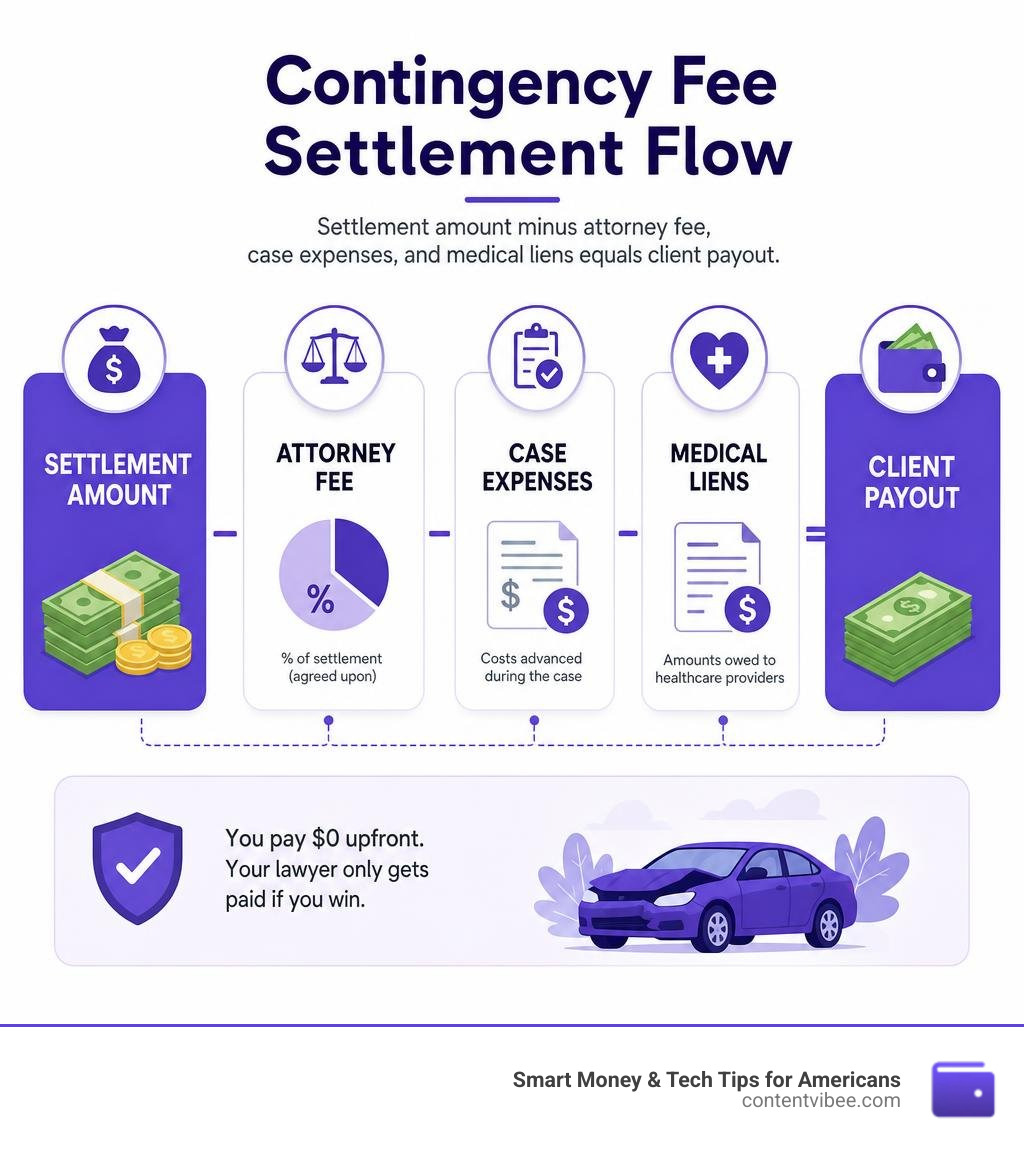
What is a Contingency Fee and How Does It Work?
If you have ever had to hire a lawyer for a divorce, a business contract, or a criminal defense matter, you probably remember the painful tick of the hourly clock. Traditional legal billing can feel like a taxi meter running in heavy traffic—every phone call, email, and minute of research costs you money.
Thankfully, personal injury law works on a completely different model: the contingency fee.
A contingency fee means the attorney’s payment is contingent (dependent) upon them winning your case. If they recover money for you through a settlement or a court verdict, they receive a pre-agreed percentage of that recovery. If they do not win your case, you owe them absolutely nothing in attorney fees.
This is often marketed as the “no win, no fee” guarantee. But why does this system exist?
At its core, the contingency fee model is an access-to-justice tool. After a serious car crash, you are likely facing a mountain of medical bills, vehicle repair costs, and lost wages from missed work. If you had to pay an hourly retainer of $350 to $500 just to get a lawyer to look at your case, most people simply could not afford representation.
By shifting the financial risk from the injured victim to the law firm, contingency fees level the playing field. They allow everyday citizens to go toe-to-toe with multi-billion-dollar insurance corporations.
To understand how this fits into your overall legal journey, check out our How Much Does a Personal Injury Lawyer Cost guide, which dives deeper into the different types of fee arrangements.
Furthermore, because the consultation is completely free, you can have an attorney review your accident details without spending a dime. You can learn more about what to expect during this initial meeting in our Car Accident Lawyer Free Consultation Guide 2026.
To see how these concepts are applied in specific legal markets, you can read about How Contingency Fees Work for Car Accident Lawyers in New York, where state regulations strictly govern how contingency fee agreements must be drafted and presented to clients.
Average Attorney Fees for Auto Accident Claims
Now that we know how contingency fees work conceptually, let’s talk numbers. What is the typical percentage a lawyer will take from your settlement?

In the vast majority of personal injury cases across the United States, the average contingency fee ranges from 33% to 40% of the final recovery.
However, this is not always a fixed number. Many personal injury attorneys use a sliding scale structure based on the complexity and stage of your case. For example, a standard sliding scale agreement might look like this:
- 25% to 30% if the case is resolved exceptionally fast, such as immediately after a demand letter is sent and before intensive negotiations begin.
- 33.3% (one-third) if the case is resolved during the standard pre-litigation phase (negotiating with the insurance adjuster before a formal lawsuit is filed in court).
- 40% if a lawsuit must be formally filed, which kicks off the litigation phase (depositions, court hearings, and trial preparation).
This sliding scale exists because the amount of work required of your legal team increases exponentially once a case enters the court system.
To get a clearer picture of how these percentages translate to real-world dollars and what is considered standard practice, take a look at our guide on The Truth About Lawyer Fees and What Percentage They Actually Take.
You can also read more about the general cost expectations in How Much Do Lawyers Charge for Accident Claims. For a broader lookup, you can check out this resource on Car Accident Lawyer Fees to see how standard rates compare across different regions.
How State Laws Regulate Attorney Fees for Auto Accident Cases
While the 33% to 40% range is the national standard, individual states have different rules, caps, and ethical guidelines governing attorney fees for auto accident claims. Let’s look at how some of the largest states handle these regulations.
Texas
In the Lone Star State, personal injury lawyers typically charge between 33% and 40% of the final settlement. The Texas State Bar requires that all contingency fees be reasonable, but it does not set hard statutory caps on personal injury cases. If you want to dive deeper into how Texas-specific laws and firm practices impact your wallet, check out this detailed guide on How Much Does a Car Accident Lawyer Cost in Texas?. Additionally, you can learn about the exact distribution process in this article on Texas Car Accident Lawyer Fees.
Florida
Florida has some of the most strict, consumer-friendly regulations in the nation. Under the Florida Bar’s Rule 4-1.5(f)(4)(B), contingency fees are capped on a sliding scale:
- Up to 33.3% of any recovery up to $1 million if the case settles before an answer to the lawsuit is filed.
- Up to 40% of the first $1 million if the case goes to trial (specifically, after an answer to the lawsuit is filed).
- 30% of any portion of the recovery between $1 million and $2 million.
- 20% of any portion of the recovery exceeding $2 million.
California
Most car accident attorneys in California charge between 30% and 40% of the final settlement. The California State Bar requires that all contingency fee contracts be in writing and clearly state how disbursements and expenses will affect the client’s net payout. There are generally no hard caps on auto accident contingency percentages in California, except in cases involving minors, which usually require court approval and are often capped at 25%.
Georgia
In Georgia, the standard pre-litigation fee is typically 33.3%. If your attorney has to file a lawsuit—which is common in tougher cases throughout Atlanta and surrounding counties—the fee usually increases to 40% to cover court filings, depositions, and trial preparation.
Here is a quick comparison table summarizing how these states stack up:
| State | Standard Pre-Litigation Fee | Standard Litigation/Trial Fee | Special State Regulations & Caps |
|---|---|---|---|
| Texas | 33.3% | 40% | Fees must be “reasonable” under State Bar guidelines. |
| Florida | 33.3% (up to $1M) | 40% (up to $1M) | Strictly capped by Florida Bar Rule 4-1.5; lower percentages for recoveries over $1M. |
| California | 30% – 33.3% | 40% | Contracts must be in writing; fees for minors are usually capped at 25% and require court approval. |
| Georgia | 33.3% | 40% | Follows standard sliding scale; governed by Georgia Rules of Professional Conduct Rule 1.5. |
Are Attorney Fees for Auto Accident Claims Negotiable?
Yes, attorney fees can theoretically be negotiated. However, whether a lawyer will agree to a lower percentage depends on several factors:
- Clear Liability: If the other driver was clearly at fault (for example, they were arrested for DUI at the scene or rear-ended you while you were stopped at a red light) and there is a large commercial insurance policy, the risk to the lawyer is lower. They might agree to a slightly lower fee, such as 30% instead of 33.3%.
- Quick Settlement: If you approach an attorney with a policy-limit offer already on the table from the insurance company, you can negotiate a reduced fee structure. It would be unfair for a lawyer to take a full 33.3% just to process paperwork for an offer you secured yourself.
- Attorney Experience: Highly sought-after trial lawyers with a track record of multi-million-dollar verdicts rarely negotiate their fees because their reputation alone forces insurance companies to offer higher settlements.
If you are preparing to speak with a lawyer and want to know how to approach this conversation, read our guide on How Much Does a Personal Injury Lawyer Charge to learn the best strategies for fee negotiation.
Pre-Litigation vs. Litigation Fees: Why the Cost Changes
Many clients are surprised to see their fee contract jump from 33.3% to 40% if a lawsuit is filed. This change can seem like a penalty, but it actually reflects a massive shift in the amount of work, time, and financial risk your lawyer must take on.
Let’s look at what happens in both phases:
The Pre-Litigation Phase (The 33.3% Stage)
During this initial phase, your lawyer is gathering evidence, retrieving medical records, obtaining police accident reports, and submitting a “demand letter” to the insurance company. The goal is to negotiate a fair settlement without going to court. This phase is relatively low-cost and can often be resolved within a few months.
The Litigation Phase (The 40% Stage)
If the insurance company refuses to offer a fair settlement, your lawyer must file a formal lawsuit. Once this happens, the case enters the litigation phase. This is where the heavy lifting begins:
- Court Filings: Drafting and filing complaints, motions, and legal briefs.
- Discovery: The formal exchange of evidence, which includes written questions (interrogatories) and requests for documents.
- Depositions: Sworn out-of-court testimony where lawyers question witnesses, the other driver, and medical experts. Depositions require court reporters and can cost thousands of dollars per session.
- Trial Prep: Building exhibits, practicing opening and closing arguments, and preparing witnesses.
Because litigation can drag on for months—or even years—and requires hundreds of hours of intense work, the attorney fee increases to 40%. To understand how this works in practice and how these phases are managed financially, check out this guide on How Much Does an Attorney Cost? Car Accident Lawyers.
Case Expenses and Settlement Math: What Do You Actually Keep?
To understand how much money actually lands in your bank account, you must understand the difference between attorney fees and case expenses. They are two entirely separate things.
- Attorney Fees: The payment for the lawyer’s time and legal expertise (usually the 33.3% or 40% percentage).
- Case Expenses: The actual out-of-pocket costs required to build and prove your case.

Most personal injury lawyers will “advance” these case expenses so you don’t have to pay them out of pocket during your recovery. Once your settlement check arrives, the lawyer is reimbursed for these advanced costs before the remaining money is distributed.
Common case expenses include:
- Medical Record Retrieval: Doctors and hospitals charge fees to copy and send medical files.
- Police Reports: Small administrative fees to get the official accident report.
- Court Filing Fees: Typically $150 to $300 to file a lawsuit.
- Process Server Fees: Fees to have a professional serve the lawsuit papers to the defendant.
- Deposition Transcript Costs: Court reporters charge by the page, which can cost $400 to $800 per deposition.
- Expert Witness Fees: Medical specialists, accident reconstructionists, and economic life-care planners charge $250 to $500+ per hour to analyze your case and testify. In complex cases, expert fees alone can run into the tens of thousands of dollars.
Gross vs. Net: The Critical Difference in Fee Calculations
When reviewing a retainer agreement, you must look for how the attorney fee is calculated relative to case expenses. There are two methods:
- Fees Calculated on Gross Recovery (Most Common): The attorney fee is calculated on the total settlement amount before expenses are deducted.
- Fees Calculated on Net Recovery (Client-Friendly): Case expenses are deducted from the total settlement first, and the attorney fee is calculated on the remaining balance.
Let’s look at how this math works out in a real-world scenario.
The $100,000 Settlement Math Breakdown
Imagine you secure a $100,000 settlement after a moderate car accident. Your attorney’s contract specifies a 33.3% pre-litigation fee, and your case accumulated $5,000 in case expenses (for medical records, a private investigator, and an accident reconstruction expert). You also have $20,000 in outstanding medical bills and liens.
Here is how the payout is calculated under both methods:
Method 1: Fee Calculated on Gross Recovery (Standard)
- Gross Settlement: $100,000
- Attorney Fee (33.3% of $100,000): -$33,333.33
- Case Expenses Reimbursement: -$5,000.00
- Medical Liens/Bills Paid: -$20,000.00
- Your Net Take-Home Payout: $41,666.67
Method 2: Fee Calculated on Net Recovery (Client-Friendly)
- Gross Settlement: $100,000
- Case Expenses Deducted First: -$5,000.00
- Net Settlement Balance: $95,000.00
- Attorney Fee (33.3% of $95,000): -$31,666.67
- Medical Liens/Bills Paid: -$20,000.00
- Your Net Take-Home Payout: $43,333.33
In this scenario, the client-friendly “net recovery” calculation puts an extra $1,666.66 directly into your pocket! Always ask your attorney which method they use before signing.
To understand how medical bills are handled and negotiated during this process, read The Ultimate Guide to Paying Medical Bills After a Car Wreck.
For a complete breakdown of what to expect during the final distribution of your funds, consult our Car Accident Settlement Guide 2026.
If you want to run your own numbers based on your specific medical bills and property damage, try our interactive Car Accident Settlement Calculator.
Is It Worth Hiring a Lawyer for a Car Accident?
At this point, you might be thinking: “If a lawyer is going to take a third of my settlement, wouldn’t I be better off just handling this myself and keeping 100% of the money?”
It’s a fair question. But the data consistently shows that hiring a lawyer actually puts more money in your pocket, even after paying attorney fees.
According to data from the Insurance Research Council (IRC), accident victims who hire personal injury attorneys recover settlements that are, on average, 3.5 times higher than those who handle their claims alone.
Let’s look at the real math behind this “multiplier effect”:
- Scenario A (No Lawyer): You handle the claim yourself. The insurance adjuster uses delay tactics and lowballs you, knowing you don’t know the law. You accept their “final” offer of $15,000. You keep 100% of it. After paying your $5,000 medical bills, you walk away with $10,000.
- Scenario B (With Lawyer): You hire an experienced attorney. The attorney gathers proper medical evidence, documents your pain and suffering, and threatens a lawsuit. The insurance company settles for $60,000.
- Attorney Fee (33.3%): -$20,000
- Case Expenses: -$1,500
- Medical Bills (Negotiated down by lawyer to $4,000): -$4,000
- Your Net Take-Home Payout: $34,500
Even after paying the attorney’s fee and expenses, you walk away with more than triple what you would have received on your own.
Why does this happen? Insurance adjusters are trained negotiators. Their job is to settle claims for as little money as possible. They use a standard playbook to minimize your payout:
- The Quick Offer: Offering a fast check of $1,000 to $2,000 right after the accident before you realize how badly you are injured.
- The Recorded Statement Trap: Getting you to say “I’m feeling okay today” on a recorded line, then using that to deny your future medical claims.
- Delay Tactics: Slowing down the process until the statute of limitations is about to expire, forcing you to accept a lowball offer.
A lawyer acts as your shield against these tactics. To help you decide whether your specific case warrants legal representation, read our guide To Hire or Not to Hire When a Car Accident Lawyer is Actually Worth It.
If you are still on the fence and want to compare the pros and cons of handling your claim solo, check out DIY vs Attorney Can You Handle Your Car Accident Settlement Alone.
Frequently Asked Questions About Auto Accident Attorney Fees
What happens to attorney fees if we lose the case?
If your attorney works on a standard contingency fee agreement and you lose your case, you owe zero dollars in attorney fees. The risk is entirely on the lawyer.
However, you must read the contract carefully regarding case expenses. Some agreements state that if the case is lost, the client is still responsible for reimbursing the firm for out-of-pocket expenses (like filing fees and expert witness costs). Most reputable personal injury firms will waive these expenses if they lose, but you must confirm this in writing before signing.
What red flags should I watch for in a fee agreement?
When reviewing a retainer agreement, run away if you see any of the following red flags:
- Upfront Retainer Requests: If a personal injury lawyer asks you for money upfront to “start working” on your car accident case, find another lawyer.
- Unilateral Settlement Authority: The contract should never give the lawyer the right to accept a settlement without your explicit, written approval. The decision to settle is always yours.
- Hidden Administrative Fees: Watch out for clauses that charge extra for photocopying, long-distance phone calls, or file storage. These should be covered under standard office overhead.
How are medical liens paid from my settlement?
A medical lien is a legal claim filed by a healthcare provider, health insurance company, or government program (like Medicare or Medicaid) to get paid back for the medical care you received after your accident.
When your case settles, the insurance company will typically issue a check made out to both you and your attorney. Your attorney will deposit this into a secure trust account. Before writing you a check, the attorney is legally required to resolve any outstanding medical liens.
Fortunately, experienced attorneys are often able to negotiate these liens down significantly—sometimes by 30% to 50%—which increases your final take-home payout.
Conclusion
Navigating the aftermath of a car wreck is stressful enough without worrying about hidden legal costs. We hope this guide has shown you that attorney fees for auto accident claims are designed to protect you, not drain your bank account. By utilizing the contingency fee model, you can secure top-tier legal representation without paying a single dollar upfront.
At ContentVibee, we believe that financial and legal literacy is the key to making smart decisions when life gets complicated. By understanding the mechanics of contingency fees, gross vs. net calculations, and case expenses, you are now equipped to advocate for yourself and protect your financial future.
Before you sign any legal contract, make sure you know exactly what you are agreeing to. For a deeper dive into evaluating lawyer contracts and ensuring you get a fair deal, read our comprehensive guide on How Much Does a Personal Injury Lawyer Charge. Use your knowledge, ask the right questions, and secure the compensation you truly deserve!