


Voloridge Investment Management Fund Performance and Fees are a top concern for institutional investors and self-directed investors researching elite quantitative hedge funds in 2026.
Here’s a quick snapshot of the key numbers:
| Metric | Value |
|---|---|
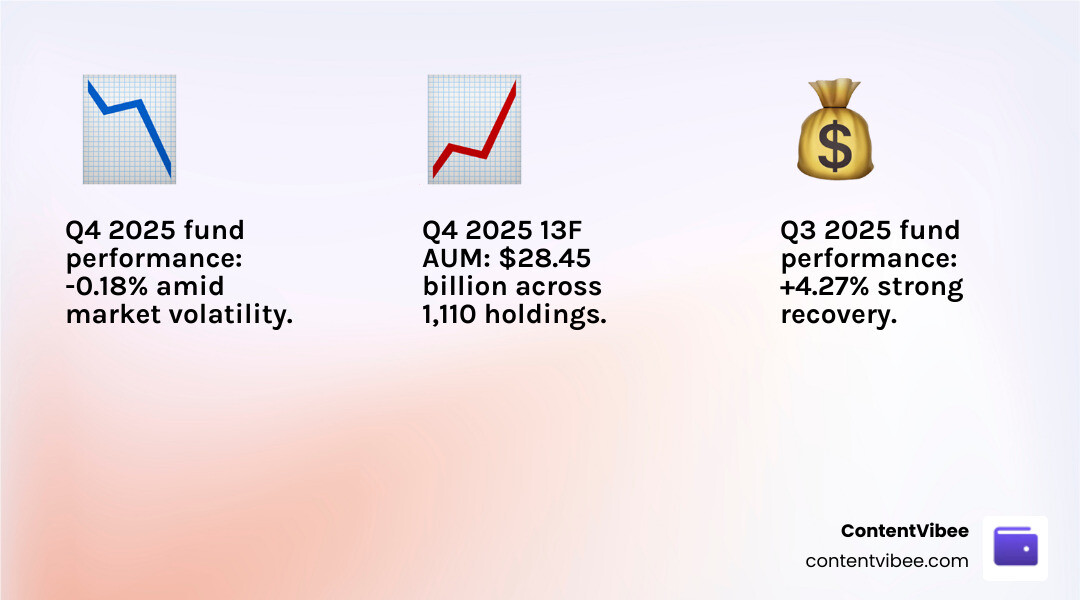
| Q4 2025 Performance | -0.18% |
| Q3 2025 Performance | +4.27% |
| AUM (13F, Q4 2025) | $28.45 billion |
| Number of Holdings (Q4 2025) | 1,110 stocks |
| Management Fee | 1.5% per annum |
| Voloridge Trading Aggressive Fund (1-Year) | 34.32% |
| Voloridge Fund (1-Year) | 23.49% |
Voloridge is a quantitative hedge fund founded in 2009 and based in Jupiter, Florida. It uses proprietary math-driven models to trade across a massive, diversified equity portfolio.
The firm manages tens of billions in assets — primarily for institutional clients like pension funds. Its strategy involves extremely active trading, with an average holding period of under half a quarter.
For self-directed investors evaluating where to put serious capital — or simply trying to benchmark against the best — understanding how Voloridge performs, what it charges, and how it compares to the S&P 500 is genuinely useful.
This article breaks all of that down clearly.
Voloridge Investment Management Fund Performance and Fees: A 2026 Analysis
As we navigate the financial landscape of April 2026, Voloridge Investment Management remains a titan in the quantitative space. However, the last few quarters have shown us that even the most sophisticated algorithms aren’t immune to market jitters. When we look at the Voloridge Investment Management Fund Performance and Fees, the most striking detail is the sheer scale of the operation.
In Q4 2025, the fund reported a slight dip with a return of -0.18%. This followed a much more robust Q3 2025, where the fund gained 4.27%. While a negative quarter might raise eyebrows, it’s important to view this in the context of their massive Assets Under Management (AUM). As of the end of 2025, Voloridge’s 13F AUM stood at approximately $28.45 billion.
We’ve observed some interesting fluctuations in their capital base. In Q3 2025, the 13F AUM was slightly higher at $29.79 billion. This minor contraction in the final quarter of the year often signals either a shift in market valuations or a strategic pivot into non-reportable assets like shorts, futures, or cash—a common move for “quant” shops looking to hedge against volatility.
To understand the broader context of how these assets are handled, it’s helpful to explore the differences in professional oversight. You can learn more about this in our guide on Why Asset Management vs Investment Management. For a deeper dive into the numbers, the Voloridge Performance History and Annualized Returns provides a longitudinal view of how David Vogel’s team has scaled from a $10 million start-up in 2010 to the multibillion-dollar powerhouse it is today.
Voloridge Investment Management Fund Performance and Fees vs. S&P 500 Benchmarks
How does Voloridge stack up against the “gold standard” of the S&P 500? In high-finance, we call this the search for “alpha”—returns that beat the market average.
In 2025, the S&P 500 saw significant swings. Voloridge’s Q3 return of 4.27% was a solid performance, but the Q4 slip to -0.18% shows that their market-neutral or quantitative strategies sometimes diverge from the broader index. This divergence isn’t necessarily a bad thing; in fact, many institutional investors pay Voloridge specifically because they don’t want to move in lockstep with the S&P 500.
Risk-adjusted metrics, such as the Sharpe ratio, are where Voloridge typically shines. By using vast amounts of data to find “micro-opportunities,” they aim to deliver smoother returns over time, even if they underperform the index during a massive bull run. This is a classic example of why sophisticated investors look toward Understanding Traditional vs Alternative Investments to balance their portfolios.
Evaluating Voloridge Investment Management Fund Performance and Fees for High-Net-Worth Recovery
For high-net-worth individuals and institutional offices, the focus isn’t just on the gains—it’s on the security and the structure of the investment. Voloridge manages over $10 billion in discretionary AUM across a limited number of accounts, primarily serving corporations and pension plans.
When we talk about “recovery” in a financial sense, we often look at how a fund bounces back from market drawdowns. Voloridge’s high turnover rate (which reached a staggering 197.7% in a recent quarter) suggests they are incredibly agile. They don’t sit on losing positions; their models are designed to exit quickly and reallocate capital where the math says the next win is. This agility is a key component of their risk management strategy.
Portfolio Composition and Top Stock Holdings in 2026
If you took a peek inside Voloridge’s digital “vault” at the start of 2026, you would find a massive, bustling city of stocks. With 1,110 holdings, the portfolio is incredibly diverse, yet it has very clear “neighborhoods” where the firm likes to spend its money.
Sector Allocation: Where the Math Points
Voloridge is currently heavily weighted toward high-growth and high-liquidity sectors. This makes sense for a quantitative firm that needs to move in and out of positions without moving the market price too much.
- Technology (19.4%): With over 150 holdings valued at $5 billion, tech is the bedrock of the portfolio.
- Consumer Discretionary (>25%): This is where they often find the most “noise” to exploit through technical analysis.
- Industrials & Financials: Both sectors hold a significant roughly 14% share of the pie.

The Heavy Hitters: Top Holdings
Despite having over a thousand stocks, a few names carry significant weight. As of the latest filings, their top conviction plays included:
- Costco (COST): 2.51% of the portfolio ($712.9M)
- Netflix (NFLX): 1.82% ($518.4M)
- Microsoft (MSFT): 1.64% ($466.9M)
- Amazon (AMZN): 1.34%
- Palantir (PLTR): 1.25%
Recent Trades: The “Buy and Sell” Carousel
Voloridge’s turnover is legendary. In the most recent reported quarter, they opened 251 new positions and completely closed 294 others. This isn’t “investing” in the traditional sense; it’s high-speed data processing.
| Action | Top Stocks Involved (Q4 2025) |
|---|---|
| Largest Buys | Netflix (NFLX), Palantir (PLTR), Apple (AAPL) |
| Largest Sells | NVIDIA (NVDA), Meta Platforms (META), Alphabet (GOOGL) |
Institutional Impact: The NYC Police Pension Fund and Aggressive Growth
Perhaps the most ringing endorsement of Voloridge’s strategy comes from the New York City Police Pension Fund. This multi-billion dollar entity doesn’t gamble; it allocates based on rigorous performance reviews.
Within the NYC Police Pension Fund’s portfolio, Voloridge has a prominent seat. Specifically, the Voloridge Trading Aggressive Fund has posted eye-popping numbers. As of May 2025, it reported a 1-year return of 34.32%. To put that in perspective, the total fund’s policy benchmark was around 10.66%. Voloridge wasn’t just beating the benchmark; it was lapping it.
This “Aggressive” fund is a different beast compared to their standard Global Fund. It uses higher leverage and more concentrated quantitative bets to chase higher returns. The growth of this specific fund is documented in the Voloridge Trading Aggressive Fund SEC Filing, showing it raised over $1.6 billion by 2026, up from just $18 million in 2013.
For those wondering about the career paths that lead to managing such massive institutional flows, our article on Why Wealth Management vs Investment Banking explains the different roles these professionals play in the financial ecosystem.
Understanding the Quantitative Investment Approach and Fee Structure
So, what does it cost to have David Vogel and his team of scientists manage your money? Voloridge follows a fairly standard, yet premium, hedge fund fee structure.
The 1.5% Management Fee
Voloridge charges a 1.5% annual management fee on the month-end Net Asset Value (NAV). This is paid monthly in arrears. This fee covers the “lights and sirens”—the massive computing power, the data feeds, and the salaries of the PhDs running the models.
Incentive Allocation
In addition to the management fee, there is an “incentive allocation” (often called a performance fee). While the exact percentage can vary based on the specific fund and share class, it typically follows the industry standard of 20% of new profits. This ensures that the firm only gets truly wealthy if its investors do too.
The “Science” of the Strategy
Voloridge doesn’t hire traditional stock pickers who “feel” good about a company’s CEO. They are a scientific R&D firm that happens to trade stocks. Their culture is built on:
- Collaborative R&D: Insights from the accounting and sales teams are fed into the same research loop as the traders.
- Proprietary Algorithms: They use moving averages, trend-lines, and complex math to find patterns that the human eye (and most other computers) miss.
- Short Holding Periods: With an average holding period of just 0.42 quarters, they are essentially the “day traders” of the institutional world, but with billions of dollars and supercomputers.
Frequently Asked Questions about Voloridge Investment Management
What is the current AUM of Voloridge Investment Management as of 2026?
As of early 2026, Voloridge Investment Management handles approximately $28.45 billion in reportable 13F assets. However, their total regulatory AUM, which includes non-equity holdings and discretionary accounts, is estimated to be even higher, having grown steadily from just $10 million in 2010.
How does the Voloridge Trading Aggressive Fund perform compared to standard hedge funds?
The Voloridge Trading Aggressive Fund is a high-performer in the quant space. While many hedge funds struggle to beat the S&P 500, this fund posted a 34.32% 1-year return (as of May 2025). Its historical performance is even more dramatic, with a 61.58% return for the fiscal year ending June 2024. It is significantly more volatile and “aggressive” than the standard Voloridge Global Fund.
What are the primary management and performance fees for Voloridge investors?
Voloridge typically charges a 1.5% annual management fee, billed monthly. They also utilize an incentive allocation (performance fee) based on the net profits generated for the investor. Withdrawal terms generally require a 30-day to 90-day written notice, depending on the specific fund complex.
Conclusion
Voloridge Investment Management represents the pinnacle of the “math-meet-money” era. By consistently delivering high risk-adjusted returns and maintaining a transparent (if expensive) fee structure, they have secured their place as a favorite for major institutional players like the NYC Police Pension Fund.
Whether you are an institutional allocator or a self-directed investor looking to understand the “smart money,” keeping an eye on Voloridge Investment Management Fund Performance and Fees is essential. In an era where data is the new oil, Voloridge has the best refinery in the business.
For more insights into protecting your own financial future—from choosing the right advisor to guarding against unauthorized bank transaction fraud—explore our financial categories at ContentVibee. We are dedicated to helping you navigate the complexities of the 2026 financial markets with clarity and security.


