


Why a Medicare Attorney Legal Consultation Can Change Everything
A Medicare attorney legal consultation could be the single most important step you take to protect your healthcare benefits in retirement.
Here’s a quick answer if you need it fast:
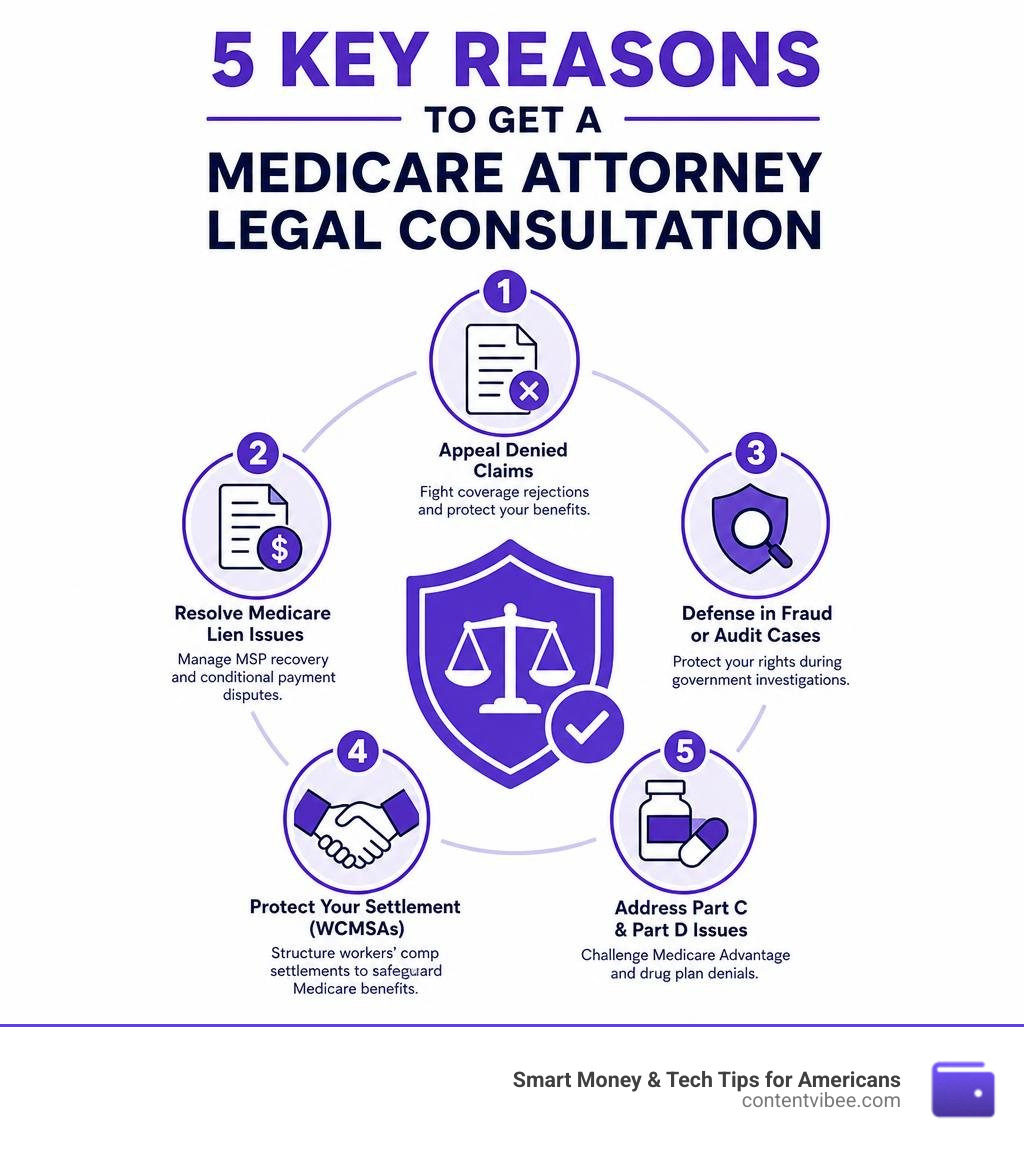
What does a Medicare attorney do for you?
- Denied claims – Appeals coverage rejections on your behalf
- MSP recovery – Manages Medicare liens and conditional payment disputes
- Fraud or audits – Defends providers facing government investigations
- WCMSAs – Structures workers’ compensation settlements to protect Medicare benefits
- Part C & D issues – Fights back against Medicare Advantage and drug plan denials
- Representation – Acts as your official representative at ALJ hearings and appeals
Medicare is not simple. In fact, 3 out of 4 Medicare beneficiaries describe the program as difficult to understand. The rules fill thousands of pages. Deadlines are strict. And a single missed step in an appeal can cost you coverage you’ve earned.
The financial stakes are real, too. More than 1 in 3 seniors have gone without basic necessities like food to cover healthcare costs. Nearly 1 in 4 older adults skip medications because they can’t afford them.
That’s not a coverage problem. That’s a legal problem — one that the right attorney can often fix.
Whether you’re a retiree fighting a denied claim, a provider facing an audit, or someone settling a workers’ comp case with Medicare involved, knowing when and how to get legal help makes all the difference.
When to Seek a Medicare Attorney Legal Consultation

Many people assume Medicare is a self-service program. You sign up, present your card at the doctor’s office, and let the system handle the rest. But when the system breaks down—whether through a sudden coverage denial, a complex billing error, or a dispute over a medical necessity determination—navigating it alone can feel like trying to read a foreign language without a dictionary.
Seeking a Medicare attorney legal consultation is highly recommended when you face complex administrative roadblocks, high-dollar coverage denials, or situations where Medicare overlaps with other legal matters.
For many seniors, Medicare issues do not exist in a vacuum. They frequently intersect with elder law, estate planning, and long-term care strategy. If you are trying to coordinate your healthcare benefits while protecting your assets, planning for nursing home care, or establishing a guardianship, a specialized attorney can help you look at the big picture.
If you are currently struggling with a coverage issue or need personalized guidance on your rights, you can explore specialized support through resources like the Free Consultation at Senior Advocate Center or obtain localized, non-profit guidance from organizations like Medicare & Health Insurance Support.
How a Medicare Attorney Legal Consultation Resolves Coverage Denials
When Medicare issues a denial for a service, treatment, or piece of medical equipment, it is not necessarily the final word. In fact, many denials are triggered by minor coding errors or overly rigid automated review systems. However, overturning these denials requires moving through a highly structured, five-level federal appeals process.
A Medicare attorney understands the precise evidentiary requirements needed at each phase:
- Redetermination: A review by your Medicare Administrative Contractor (MAC).
- Reconsideration: An independent review by a Qualified Independent Contractor (QIC).
- Administrative Law Judge (ALJ) Hearing: This is where an attorney’s advocacy is most critical. At the ALJ level, you finally have the opportunity to present testimony, bring in expert medical witnesses, and argue your case before an independent judge.
- Medicare Appeals Council Review: A higher administrative review of the ALJ’s decision.
- Federal District Court Judicial Review: Filing a lawsuit in federal court to dispute the final agency decision.
The appeals process differs significantly depending on whether you have Original Medicare (Parts A and B) or a private Medicare Advantage Plan (Part C).
| Feature | Original Medicare (Parts A & B) Appeals | Medicare Advantage (Part C) Appeals |
|---|---|---|
| Primary Decision Maker | Federal government contractors (MACs, QICs) | Private health insurance companies |
| Prior Authorization | Rarely required for standard treatments | Frequently required for specialists and procedures |
| First Step of Appeal | Request Redetermination within 120 days | Request Reconsideration directly from the plan |
| Independent Review | Sent to a QIC if first level is denied | Sent automatically to an Independent Review Entity (IRE) |
| Key Legal Challenge | Proving medical necessity under national guidelines | Overcoming restrictive internal network rules |
Preparing for Your Medicare Attorney Legal Consultation
To make the absolute most of your initial consultation, you should arrive prepared with organized documentation. Because Medicare appeals and disputes are heavily dependent on written evidence, having your files in order allows an attorney to quickly assess the strength of your case.
Before your meeting, gather the following:
- The Denial Notice: Bring the official Medicare Summary Notice (MSN) or the Explanation of Benefits (EOB) showing the specific denied claim.
- Medical Records: Request comprehensive medical charts, physician notes, and treatment plans related to the denied service.
- Letters of Medical Necessity: Any written statements from your treating physicians explaining why the service or equipment was vital to your health.
- Plan Documents: Your Medicare card, Medigap policy details, or your Medicare Advantage Evidence of Coverage (EOC) booklet.
If you are an employer or a legal professional assisting an employee or client with retirement transitions, partnering with dedicated Medicare advisors can help clarify these requirements early on. For administrative and advisory support, you can explore the services offered by Law Firms | Plan Medicare.
Appointing a Representative for Medicare Claims and Appeals
If you decide to hire an attorney to handle your Medicare claims or appeals, you must formally authorize them to act on your behalf. Medicare will not disclose your protected health information or allow a third party to submit appeals without official documentation.
To appoint an attorney or advocate as your official representative, you must complete Form CMS-1696 (Appointment of Representative). This form requires signatures from both you (the beneficiary) and your chosen representative. Once submitted, the appointment is valid for one year from the date both parties sign, unless revoked earlier.
You can access and download the official forms directly through these resources:
- For standard submissions: Appointment of Representative Form
- For visually impaired beneficiaries: Appointment of Representative Large Print
- For plan-specific submissions: Sharp Medicare Appointment of Representative
Note: Under federal rules, if your representative is a healthcare provider or supplier who furnished the items or services in question, they must waive any right to charge you a fee for representing them in the appeal.
Navigating Medicare Secondary Payer (MSP) Recovery and WCMSAs
Medicare is, by law, a “secondary payer” in many situations. This means that if you are injured in an accident, a slip-and-fall, or a work-related incident, the insurance carrier responsible for that accident (such as liability insurance, no-fault insurance, or workers’ compensation) must pay your medical bills first.
By federal statute, Medicare cannot make final payments for services when payment has already been made—or can reasonably be expected to be made—under a primary insurance plan. For detailed rules on how attorneys must coordinate these benefits, you can refer to the official CMS guide on Attorney Services.
Managing Conditional Payments and Medicare Liens
When you are injured and awaiting a personal injury settlement or a workers’ compensation ruling, medical providers cannot wait months or years for payment. To ensure you receive necessary care, Medicare will often step in and pay your bills conditionally.
However, these are “conditional payments,” meaning they are subject to recovery once you receive your settlement, judgment, or award.
- The Recovery Process: The Benefits Coordination & Recovery Center (BCRC) tracks these conditional payments. Once your case is reported, the BCRC issues a Conditional Payment Letter (CPL) detailing the medical claims it believes are related to your injury.
- The “Lien” Myth: While commonly referred to as a “Medicare lien,” the government actually holds a statutory recovery claim. Unlike standard liens, Medicare’s recovery claim is incredibly powerful. The government has the right to recover payments directly from the beneficiary, the primary insurer, and even the personal injury attorney who distributes the settlement funds without satisfying the debt.
- The Demand Letter: Once your legal case settles, you or your attorney must report the final settlement amount to the BCRC. The BCRC will then issue a formal Demand Letter specifying the exact amount that must be paid back to Medicare.
- Waivers and Appeals: If paying the demand causes extreme financial hardship or is fundamentally unfair, an attorney can help you request a waiver of recovery or formally appeal the demand amount.
Workers’ Compensation Medicare Set-Aside Arrangements (WCMSAs)
If you are settling a workers’ compensation case that involves ongoing medical care, you must protect Medicare’s future interests. You cannot simply take a lump-sum settlement, spend the money, and then expect Medicare to immediately start paying for your work-related injury treatments.
This is where a Workers’ Compensation Medicare Set-Aside Arrangement (WCMSA) comes in.
A WCMSA is a financial agreement that earmarks a portion of your workers’ compensation settlement specifically to pay for future medical services that are related to your work injury and would otherwise be covered by Medicare.
- CMS Approval: For settlements over certain dollar thresholds, the plan is submitted to the Centers for Medicare & Medicaid Services (CMS) for review and approval. Once CMS approves the set-aside amount, you must pay for your injury-related care out of that specific set-aside account.
- Settlement Exhaustion: Once the WCMSA funds are completely exhausted and properly accounted for, Medicare will step in and begin covering your work-injury-related medical expenses. If you do not set up a WCMSA or fail to administer it correctly, Medicare can refuse to pay for your injury-related care indefinitely.
Medicare vs. Medicaid Reimbursement Disputes for Healthcare Providers
If you are a healthcare provider, managing government reimbursement is a constant regulatory balancing act. Billing errors, shifting compliance guidelines, and administrative audits can threaten your practice’s financial stability and professional licensure.
For providers navigating these complex payor conflicts, seeking counsel from specialized firms is essential. You can learn more about state-specific provider representation through resources like Florida Medicare & Medicaid Reimbursement Disputes.
Responding to Audits, Investigations, and Fraud Allegations
Federal agencies have aggressively ramped up efforts to combat healthcare fraud, waste, and abuse. Providers are frequently subjected to audits and investigations triggered by automated billing anomalies, peer-group comparison data, or whistleblower complaints.
These audits are conducted by a variety of contractors and agencies, including:
- Recovery Audit Contractors (RACs): Focused on identifying and recovering retroactive overpayments.
- Zone Program Integrity Contractors (ZPICs) & Unified Program Integrity Contractors (UPICs): Focused specifically on identifying potential fraud, waste, and abuse.
- The Office of Inspector General (OIG): The federal agency authorized to investigate criminal healthcare fraud and exclude non-compliant providers from federal programs.
If federal agents visit your practice or issue a subpoena, you must take it seriously. It is a federal crime to make false statements to a federal agent, and attempting to resolve an audit or investigation without counsel can expose you to severe civil and criminal liability.
To understand how to protect your practice during a federal inquiry, you can review specialized guidance on Medicare Investigations – Attorney Lynette Byrd of Oberheiden P.C..
Key Differences in Reimbursement Dispute Resolution
While Medicare and Medicaid sound similar, the legal avenues for resolving billing and reimbursement disputes under these two programs are entirely different.
- Medicare Disputes: Because Medicare is a federal program, disputes are handled through a uniform federal administrative process. Appeals go through federal contractors, Administrative Law Judges within the Office of Medicare Hearings and Appeals (OMHA), and ultimately to Federal District Court.
- Medicaid Disputes: Medicaid is a joint federal and state program administered individually by each state. Consequently, Medicaid reimbursement disputes are governed by state-specific administrative procedures, state courts, and local managed care organization (MCO) contracts.
- The Exclusion Risk: For both programs, the OIG has the authority to permanently exclude providers from participating in any federally funded healthcare programs. A Medicare or Medicaid exclusion is often a professional death sentence, making robust compliance programs and rapid legal response to overpayment notices absolutely critical.
Frequently Asked Questions About Medicare Legal Services
What is the Jimmo v. Sebelius settlement and how does it affect my coverage?
For years, Medicare providers and contractors denied coverage for physical therapy, occupational therapy, and skilled nursing care under the assumption that a patient must show continuous physical improvement to qualify for benefits. This was known as the “improvement standard.”
The landmark class-action settlement Jimmo v. Sebelius completely overturned this practice. The settlement established that Medicare coverage is available for skilled nursing and therapy services designed to maintain a patient’s current condition or slow down physical decline. If you have a chronic, progressive, or degenerative condition (such as Parkinson’s disease, Multiple Sclerosis, or ALS), you cannot be legally denied skilled care simply because your condition will not improve. A Medicare attorney can help you enforce your Jimmo rights if a provider or insurer attempts to cut off your maintenance therapy.
How do Medicare Advantage and Part D plans impact my appeal rights?
Medicare Advantage (Part C) and Prescription Drug Plans (Part D) are run by private insurance companies rather than the federal government. Because these are private businesses, they often use cost-saving measures like prior authorizations, restrictive provider networks, and drug formularies.
If a private plan denies coverage for a drug or procedure, your initial appeal goes directly through the private insurance company’s internal review department. If they uphold the denial, the appeal is automatically forwarded to an Independent Review Entity (IRE). While the subsequent steps eventually lead to the same federal ALJ hearings used in Original Medicare, navigating the initial private-insurer hurdles requires a deep understanding of managed care contracts and state insurance regulations.
What recent changes in Medicare law should I be aware of in 2026?
As we navigate July 2026, several major regulatory shifts are reshaping the Medicare landscape:
- Prescription Drug Price Negotiations: Under recent federal legislation, Medicare is actively negotiating prices directly with manufacturers for some of the most expensive brand-name medications, with negotiated prices continuing to roll out over the coming years.
- The Part D Out-of-Pocket Cap: The annual out-of-pocket spending limit for Medicare Part D prescription drugs remains capped at $2,000, providing immense financial relief to beneficiaries taking high-cost medications.
- Telehealth Expansion: Many of the flexible telehealth provisions established during the pandemic have been permanently integrated into Medicare guidelines, ensuring continued access to virtual specialist consultations.
Conclusion
Navigating the complex world of Medicare is not something you have to do alone. Whether you are an individual trying to secure essential medical care, a family coordinating long-term elder care, or a healthcare provider defending your professional livelihood, professional legal guidance can help you make smart money decisions and protect your rights.
At ContentVibee, we are dedicated to helping Americans optimize their retirement strategies, navigate tax complexities, and make informed financial decisions. If your Medicare dispute stems from an accident, personal injury, or workplace injury, finding the right legal representation is the first step toward recovery.
To find specialized legal help for your injury-related Medicare issues, explore our comprehensive guide to Accident and Injury Lawyers.


