


Why a Commercial Loan Calculator Can Save You Thousands Before You Sign
A commercial loan calculator is one of the most powerful tools a business owner or real estate investor can use before committing to a property purchase or refinance.
Quick Answer: What Does a Commercial Loan Calculator Tell You?
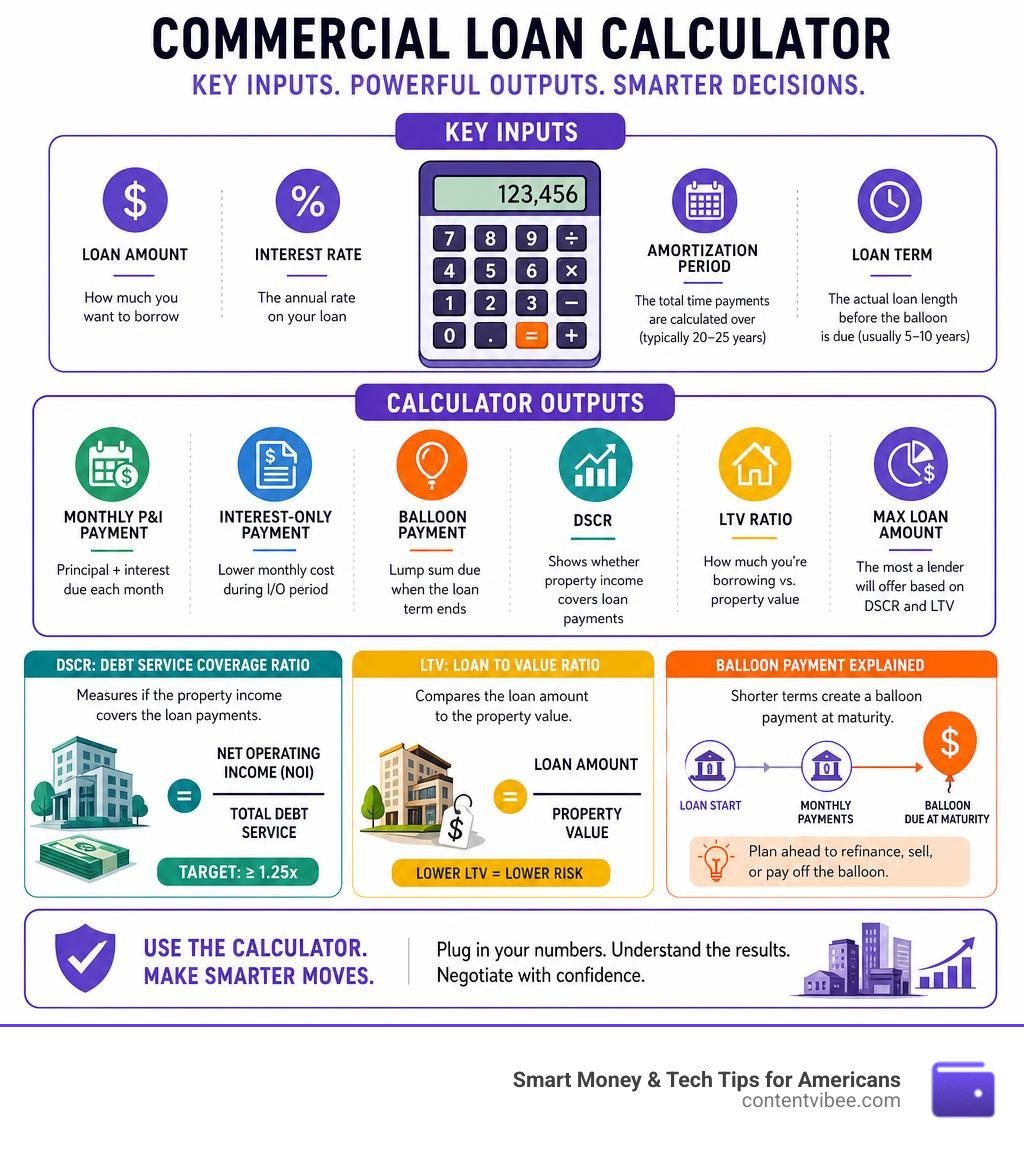
| Output | What It Means |
|---|---|
| Monthly P&I Payment | Principal + interest due each month |
| Interest-Only Payment | Lower monthly cost during I/O period |
| Balloon Payment | Lump sum due when the loan term ends |
| DSCR | Whether property income covers loan payments |
| LTV Ratio | How much you’re borrowing vs. property value |
| Max Loan Amount | The most a lender will offer based on DSCR and LTV |
Simply enter your loan amount, interest rate, amortization period, and loan term to instantly see estimated payments and key ratios.
Commercial real estate financing works very differently from a home mortgage. Terms are shorter — often 5 to 10 years — but payments are calculated over 20 to 25 years. That gap creates a balloon payment at maturity that many borrowers don’t fully plan for.
Rates also run higher. In 2026, commercial mortgage rates range from roughly 5.5% to 12% depending on the loan type and lender — compared to lower residential rates.
And lenders don’t just look at your credit score. They scrutinize the income the property generates, typically requiring a Debt Service Coverage Ratio (DSCR) of at least 1.25x — meaning the property must earn 25% more than the loan payments cost.
For a retiree or pre-retiree considering commercial real estate as a source of stable income, understanding these numbers before talking to a lender is critical. A calculator lets you stress-test a deal in minutes — no application, no commitment.
How a Commercial Loan Calculator Differs from Residential Tools
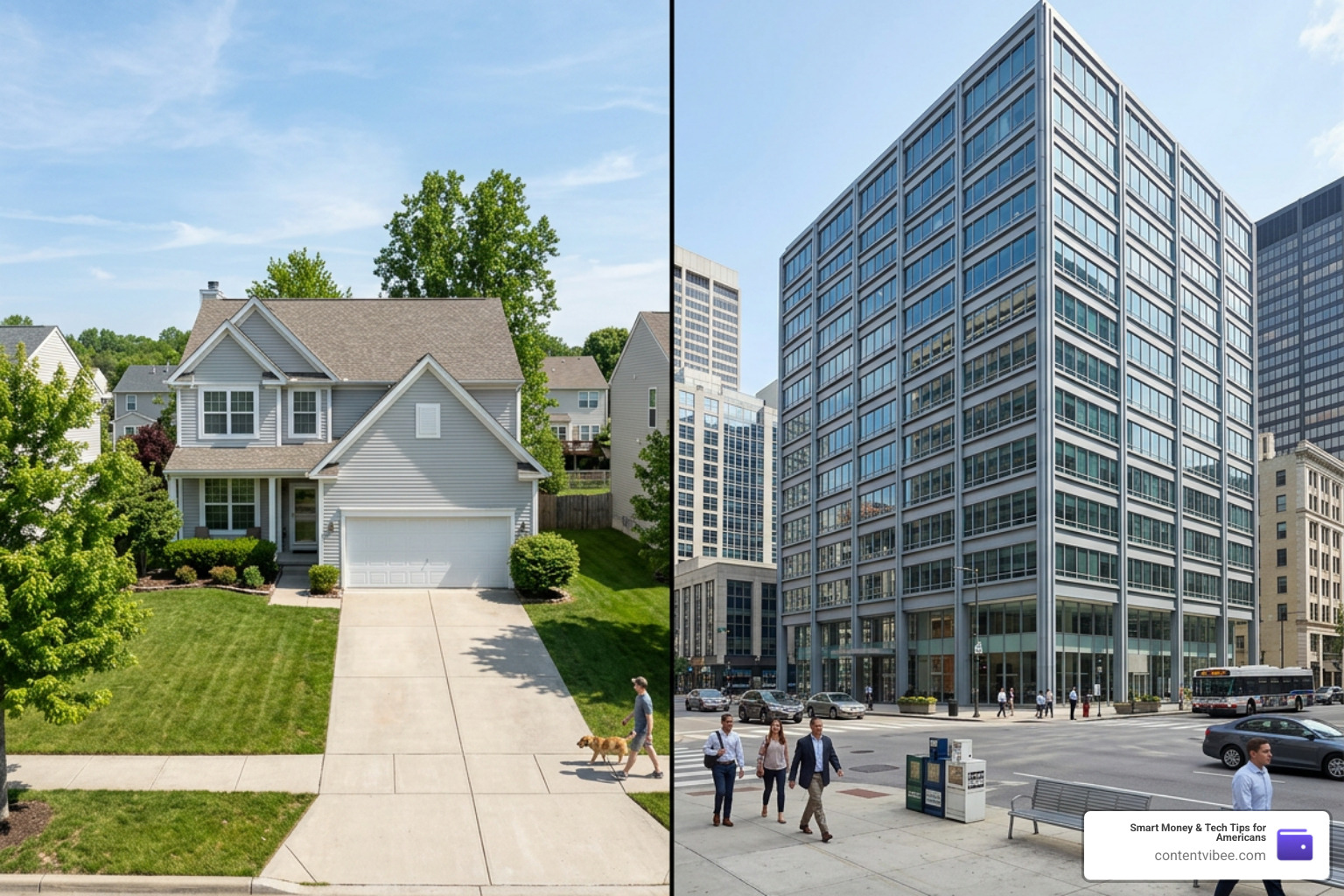
When you buy a home, you probably use a standard residential mortgage calculator. You put in the home price, down payment, and a 30-year fixed rate. The tool spits out a single monthly payment, and you are done. If only commercial real estate were that simple!
Securing a commercial mortgage is fundamentally different from getting a home loan. The risk profiles, underwriting standards, and loan structures are entirely separate beasts.
- The Borrower Profile: In residential lending, the lender looks almost exclusively at your personal income, debt-to-income (DTI) ratio, and personal credit score. In commercial lending, while your personal credit matters (lenders typically prefer a FICO score of at least 680, with 700 preferred for the best rates), the star of the show is the property itself. The property’s ability to generate cash flow is what primarily secures the loan.
- Loan Structure: Residential mortgages are almost always fully amortizing over 15 or 30 years. Commercial loans, however, are highly customized. They often feature shorter loan terms (such as 3, 5, or 10 years) paired with longer amortization schedules (such as 20 or 25 years). This structural difference is why a specialized commercial loan calculator is required to model payments accurately.
- Property Valuation and Risk: Commercial properties are considered higher-risk, illiquid assets because there is no highly organized, instant secondary market for them. Because of this risk, lenders require larger down payments and lower Loan-to-Value (LTV) limits than they do for residential homes.
Before deciding whether to buy a property or lease space for your business, it is vital to weigh the financial implications. You can read more about this in our guide on Everything You Need to Know About Lease vs Finance. If you decide that purchasing is the right move, using a dedicated Commercial Property Loan Calculator will help you model the real numbers.
Key Inputs for an Accurate Commercial Loan Calculator
To get a realistic payment estimation from a commercial loan calculator, you cannot just guess the numbers. You need to gather several key inputs:
- Loan Amount (Principal): The total amount of money you need to borrow.
- Interest Rate: The annual percentage rate (APR) charged by the lender.
- Amortization Term (Years): The period over which the loan payments are calculated (typically 20 to 25 years).
- Balloon Term / Loan Term (Years): The actual duration of the loan before the remaining balance is due in full (commonly 5, 7, or 10 years).
- Property Value: The purchase price or appraised value of the commercial asset.
- Net Operating Income (NOI): The property’s annual income minus its operating expenses (excluding mortgage payments).
How to Use a Commercial Loan Calculator to Estimate Payments
Using a calculator to model your monthly debt service and cash flow is straightforward once you have your inputs.
First, enter your principal loan amount and the estimated interest rate. Next, set your amortization term. The calculator will use these three numbers to determine your monthly principal and interest (P&I) payment.
However, because many commercial loans feature an initial interest-only period, a robust calculator like the Commercial Mortgage Calculator | CommLoan allows you to factor in a set number of interest-only months. During this time, your monthly payment will be significantly lower, helping you preserve cash flow during property transitions or renovations.
Finally, you must review the “dual-constraint” reality of commercial underwriting. Lenders will calculate your maximum loan eligibility using both your property’s cash flow and its appraised value. To see how these constraints interact to limit your borrowing capacity, you can test your numbers using the Commercial Mortgage Calculator 2025: Payments & Limits.
Understanding Commercial Loan Structures and Payment Types
Commercial loans do not come in a one-size-fits-all package. Depending on your business model, property type, and cash flow needs, you might employ several different payment structures.
- Principal and Interest (P&I) Payments: This is the standard repayment method where each monthly payment goes toward reducing the loan balance while covering the interest accrued.
- Interest-Only Options: Common in value-add real estate projects or bridge financing, this structure requires you to pay only the interest charges each month. It keeps your monthly debt service minimal but does not reduce your principal balance.
- Capital Stacking: For larger deals (often over $1 million), a single bank loan might not cover the entire purchase. Investors frequently stack multiple products—such as a primary commercial mortgage, a secondary equipment loan, or a business line of credit—to fund the project. To see how multiple payment obligations fit together, you can model combined products using the Commercial Funding Calculator — $250K–$20M+ Loan Cost Estimator.
If you are managing shorter-term business expenses alongside your real estate goals, you might also want to read our article on Everything You Need to Know About On Deck Business Line of Credit.
Amortization vs. Loan Term
One of the most confusing aspects of commercial real estate for beginners is the difference between the amortization period and the loan term.
The amortization period is the timeline used to calculate your monthly payment. For example, if you amortize a loan over 25 years, your monthly payments are calculated as if you will take 300 months to pay off the debt. This keeps your monthly payments relatively low and manageable.
The loan term (or maturity) is the actual lifespan of the loan. In commercial lending, this is typically much shorter than the amortization period—often 5, 7, or 10 years.
When the loan term ends, the loan matures, and the remaining unpaid principal balance must be paid back to the lender in one lump sum.
Balloon Payments and Refinancing Risks
This remaining balance due at maturity is known as a balloon payment.
Let’s look at a real-world example. If you take out a $2,000,000 commercial mortgage at a 7% interest rate with a 25-year amortization schedule and a 7-year loan term, your monthly P&I payment will be approximately $14,136. However, because the loan matures after just 7 years, you will not have paid off the principal. At the end of year 7, you will owe a balloon payment of roughly $1,718,939.
This structure introduces maturity risk. If interest rates rise dramatically by the time your loan matures, or if the property value drops, refinancing that balloon payment can become incredibly difficult.
To plan ahead, smart borrowers begin negotiating a refinancing strategy or exit plan at least 12 to 18 months before the balloon payment is due. You can use the Commercial Mortgage Calculator — DSCR, Balloon & Maturity to calculate exactly what your balloon obligation will be so you are never caught off guard.
The Core Metrics Lenders Evaluate: DSCR and LTV

Before a lender approves your application, they run your deal through a rigorous underwriting process. While they will review your personal financial statements, their primary focus is on two core risk metrics: DSCR and LTV.
If you are planning to transition capital from another investment into a commercial property, you can use our 1031 Exchange Calculator to estimate your tax-deferred reinvestment funds before running these metrics.
Debt Service Coverage Ratio (DSCR) Explained
The Debt Service Coverage Ratio (DSCR) measures a property’s ability to pay its own mortgage. It is the single most important metric for commercial mortgage approval.
The formula is simple:
$$\text{DSCR} = \frac{\text{Net Operating Income (NOI)}}{\text{Annual Debt Service}}$$
Where:
- Net Operating Income (NOI) is the gross rental income minus operating expenses (taxes, insurance, maintenance, property management, and vacancy reserves).
- Annual Debt Service is the total sum of your mortgage payments (principal and interest) over a year.
Most conventional commercial lenders require a minimum DSCR of 1.25x. This means the property’s net income must be 25% higher than the annual mortgage payments, providing a safety cushion for the lender. A DSCR of 1.0x means the property only breaks even, while a DSCR below 1.0x means the property is losing money and cannot support the debt.
To calculate your required NOI and test your coverage ratios, check out the Commercial Loan Calculator – F&M Bank. If you are a business owner or accountant trying to optimize your business’s overall profitability to qualify for these loans, you might also find our Margin Calculator for Accountants: Stop Undercharging and Start Multiplying Your Profits highly useful.
Loan-to-Value (LTV) Ratios by Property Type
The Loan-to-Value (LTV) ratio compares the loan amount to the appraised value of the property. It determines the size of the down payment you must provide.
$$\text{LTV} = \frac{\text{Loan Amount}}{\text{Property Value}} \times 100$$
While residential buyers can sometimes secure home loans with as little as 3% to 5% down, commercial lenders typically accept a maximum LTV of 60% to 80%, meaning you must supply a 20% to 30% down payment (and sometimes up to 50% for high-risk property types like hotels or raw land).
Typical maximum LTVs by property type in 2026:
- Multifamily (5+ units): Up to 80% LTV (considered the safest commercial asset class)
- Office and Retail: 65% to 75% LTV
- Industrial/Warehouse: 70% to 75% LTV
- Specialty/Hospitality: 50% to 60% LTV
To model different LTV scenarios and see how they impact your required down payment, you can use the Commercial Mortgage Calculator. If you are using real estate strategies like the Buy, Rehab, Rent, Refinance, Repeat method for commercial portfolio building, our BRRRR Method Calculator can help you map out your equity steps.
Comparing Commercial Loan Types and Interest Rates in 2026
Commercial mortgage rates are typically 0.25% to 0.75% higher than residential mortgage rates, reflecting the higher risk of business properties. In 2026, rates vary widely depending on the loan product you choose:
| Loan Type | Typical 2026 Rates | Max LTV | Best For |
|---|---|---|---|
| Conventional Bank Loan | 6.0% – 8.0% | 65% – 75% | Strong relationship borrowers, standard assets |
| SBA 7(a) Loan | 7.0% – 9.5% | Up to 90% | Owner-occupied businesses, working capital |
| SBA 504 Loan | 5.5% – 7.0% | Up to 90% | Owner-occupied real estate, heavy equipment |
| CMBS (Conduit) Loan | 6.0% – 8.5% | 70% – 75% | Non-recourse, stabilized income properties |
| Bridge / Hard Money | 8.0% – 12.0% | 60% – 70% | Value-add, quick closing, transitional assets |
Indexes and Fees Influencing Commercial Mortgage Rates
Commercial interest rates are tied to major financial indexes. Lenders will take a base index rate and add a margin (such as “SOFR + 2.50%”) to determine your final interest rate. The most common indexes used in 2026 include:
- SOFR (Secured Overnight Financing Rate): The standard replacement for LIBOR.
- U.S. Treasury Yields: Particularly the 5-year and 10-year Treasury bonds, which influence fixed-rate commercial loans.
- Prime Rate: Often used for variable-rate SBA loans.
In addition to the interest rate, you must factor in commercial closing costs and fees, which are significantly higher than residential fees:
- Origination Fees: Typically 1% to 3% of the loan amount. On a $3 million deal, a 2% fee equals $60,000!
- Appraisal Fees: Commercial appraisals are complex and often cost between $3,000 and $6,000.
- Environmental Reports (Phase I ESA): Lenders require this to ensure the property isn’t contaminated. This costs $2,000 to $4,000.
- Title and Legal Fees: Commercial transactions require extensive legal documentation, often costing several thousand dollars.
To see how these fees impact the true APR of your loan, you can run a scenario with the Commercial Loan Calculator – Dime Community Bank™.
Frequently Asked Questions about Commercial Financing
What is a good DSCR for a commercial loan?
Most conventional lenders require a minimum DSCR of 1.25x. This means the property generates 25% more net operating income than the annual mortgage payments. Highly stable asset classes like multifamily properties can sometimes qualify with a 1.15x to 1.20x ratio, while riskier assets like hotels or restaurants may require a DSCR of 1.35x to 1.40x.
How much down payment is required for a commercial mortgage?
Commercial lenders typically require a down payment of 20% to 30% (resulting in a 70% to 80% LTV). For riskier or specialized properties, lenders may require up to 50% down. The main exception is owner-occupied properties financed through SBA 504 or 7(a) loans, which can allow down payments as low as 10%.
How long does it take to close a commercial loan?
The median processing time for a commercial mortgage application is 93 days (approximately 3 months). Construction loans or highly complex files can take up to 6 months. This timeline is driven by the need for third-party reports, including commercial appraisals, Phase I environmental site assessments, and structural property condition reports.
Conclusion
Navigating commercial real estate can feel like learning a completely new language. However, by using a commercial loan calculator early in your planning phase, you can demystify the numbers and approach lenders with confidence.
At ContentVibee, we are dedicated to helping Americans make smart money decisions and optimize their long-term financial strategies. Whether you are looking to purchase an office space for your growing business or acquire a multifamily property for retirement cash flow, taking the time to model your DSCR, LTV, and balloon payment risks is the smartest move you can make.
Ready to test your numbers and explore more financial tools? Explore ContentVibee Finance Tools to keep optimizing your wealth-building journey today!


