


Why Using an Auto Loan Rates Calculator Can Save You Thousands
An auto loan rates calculator is one of the most powerful tools you can use before signing any car financing deal — and most people skip it entirely.
Here’s how to use one in 5 simple steps:
- Enter the vehicle price — the full sticker price or negotiated price
- Add your down payment — and trade-in value if you have one
- Input your interest rate (APR) — based on your credit score tier
- Select your loan term — typically 36, 48, 60, 72, or 84 months
- Include taxes and fees — sales tax, title, and registration costs
The calculator then shows your monthly payment, total interest paid, and total loan cost — instantly.
Here’s the reality: the average new car costs $48,699, the average monthly payment is $748, and the average loan runs 69 months. That’s a lot of money committed over a long time — often without buyers fully understanding what they’re agreeing to.
A small difference in your interest rate matters more than most people think. Borrowers with excellent credit (781-850) can qualify for rates around 4.88% on a new car. Borrowers with poor credit can face rates as high as 15.85% — on the same car. That gap can mean thousands of dollars in extra interest over the life of the loan.
This guide walks you through exactly how to use a car loan calculator to make smarter, more confident financing decisions.
Understanding Auto Loans and How Calculators Work
Before we dive into the step-by-step process, let’s demystify what actually goes on under the hood of an auto loan. When you borrow money to buy a car, you aren’t just paying back the price of the vehicle. You are entering into a legally binding amortization schedule where your monthly payment is split between paying off the actual car and paying the lender for the privilege of borrowing their money.
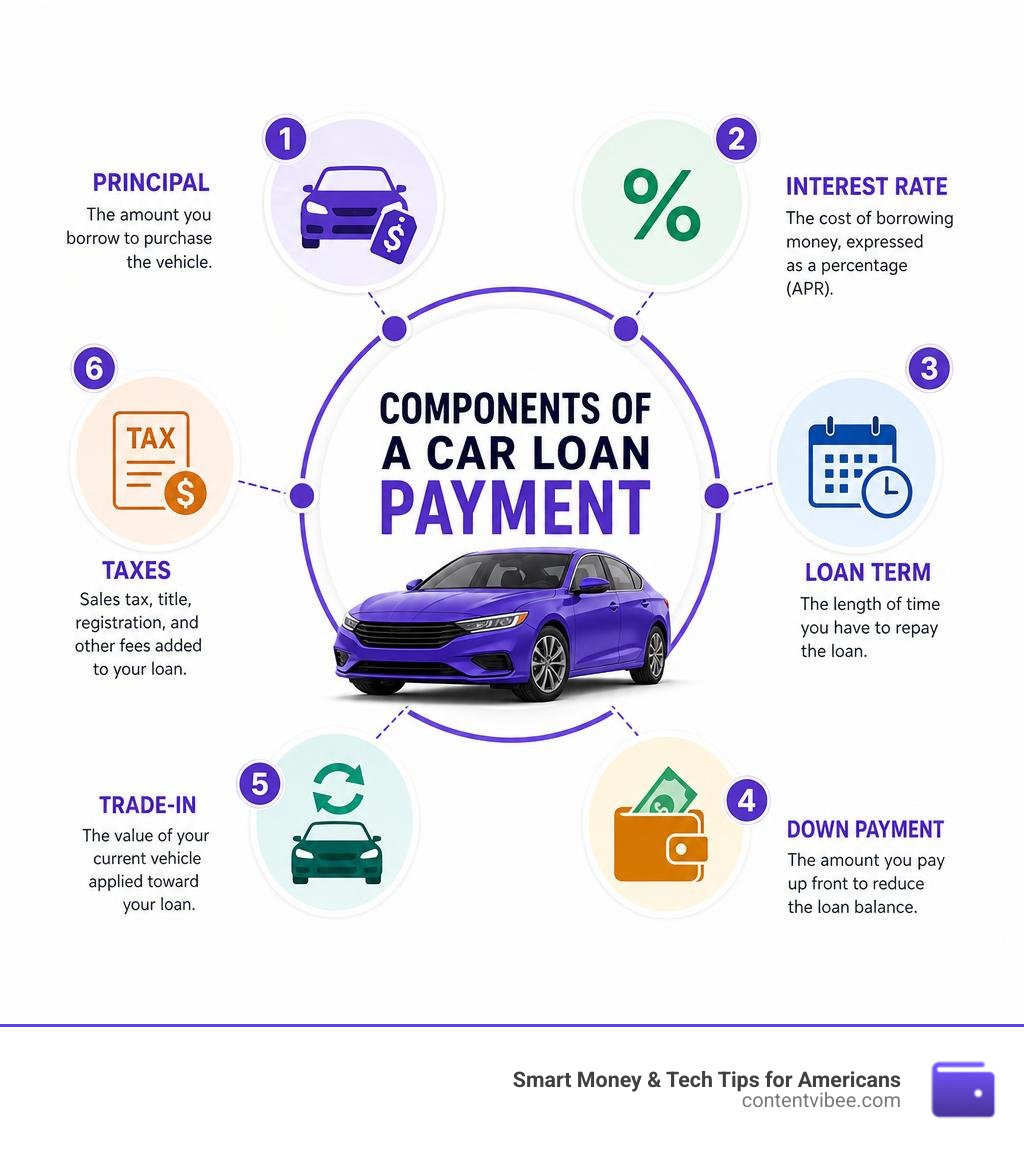
To make sense of the math, an auto loan rates calculator relies on four core pillars:
- Principal: This is the total amount of money you borrow to buy the vehicle. It is calculated by taking the purchase price of the car, adding taxes and fees, and subtracting your down payment and trade-in value.
- Interest Rate (APR): The Annual Percentage Rate is the cost of borrowing the money, expressed as a yearly percentage. Unlike a simple interest rate, the APR includes both the interest rate and any prepaid finance charges or fees required by the lender, giving you a truer picture of your yearly cost.
- Loan Term: This is the length of time you have to pay back the loan, typically structured in 12-month increments (such as 36, 48, 60, 72, or 84 months).
- Amortization: This is the process of spreading out your loan payments over time. In the beginning, a larger portion of your monthly payment goes toward paying off interest. As the principal balance drops, less interest accrues, and more of your payment goes directly toward the principal.
By understanding how these elements interact, you can use our tools to model different scenarios. We highly recommend that you calculate your payments using an online tool before ever stepping foot on a dealership lot.

Step-by-Step: How to Use an Auto Loan Rates Calculator
Using a car payment calculator is straightforward, but its accuracy depends entirely on the quality of the information you feed it. To get a realistic estimate, follow this breakdown of the key inputs you will need:
- Purchase Price: This is the negotiated price of the vehicle, not necessarily the manufacturer’s suggested retail price (MSRP). If you are shopping for a used car, the average price in July 2026 sits around $25,512, whereas a new car averages $48,699.
- Down Payment: This is the upfront cash you pay toward the purchase. A larger down payment reduces the principal amount you need to borrow, which instantly lowers your monthly payments and total interest costs.
- Trade-In Value: If you are trading in your old vehicle, its value acts exactly like a down payment. If you still owe money on your trade-in, you must subtract the remaining loan balance from the trade-in offer to find your net trade-in equity.
- Sales Tax: Sales tax is based on your primary residence, not where you buy the car. Most states tax auto purchases, though five states (Alaska, Delaware, Montana, New Hampshire, and Oregon) do not. Some states also offer a tax credit on your trade-in value, meaning you only pay sales tax on the net difference.
- Registration and Fees: Dealerships charge documentation fees (doc fees), and states charge title and registration fees. These typically add several hundred to over a thousand dollars to your final bill. You can choose to pay these upfront or roll them into the loan principal.
To see how these variables come together in real-time, you can use an online auto loan calculator to model different scenarios and find the best payment plan for your budget.
The 20/4/10 Rule of Car Affordability
How much car can you actually afford? While a lender might approve you for a massive loan, relying on their approval limit is a common financial trap. Instead, personal finance experts recommend using the 20/4/10 rule to keep your transportation budget in check:
- 20% Down Payment: Put at least 20% down on a new car (or 10% on a used car). This helps you avoid immediately falling “underwater” (owing more than the car is worth) due to off-the-lot depreciation.
- Four-Year Loan Term: Limit your financing term to no more than 48 months (four years). While longer terms are tempting because they lower your monthly payment, they drastically increase the total interest you pay over the life of the loan.
- 10% of Gross Income: Keep your total monthly transportation costs under 10% of your gross monthly income. Crucially, this 10% limit must cover not just your car payment, but also auto insurance, fuel, maintenance, and parking.
Using an auto loan rates calculator helps you quickly test if your dream car fits within these healthy boundaries. If the numbers don’t align, it’s a clear sign you should look for a more affordable vehicle or save up a larger down payment.
How Credit Scores and Vehicle Types Determine Your Rates
Your credit score is the single most influential factor determining the interest rate a lender will offer you. Lenders group borrowers into credit tiers, and the rate difference between the top and bottom tiers is staggering.
To give you an idea of how your credit tier affects your monthly budget, look at the benchmark rates and monthly payments below.
Auto Loan Rates and Payments by Credit Tier (July 2026)
This table illustrates the average APRs and estimated monthly payments for a $30,000 loan over a 60-month term across different credit score ranges.
| Credit Tier | Credit Score Range | Average New Car APR | Monthly Payment (New) | Average Used Car APR | Monthly Payment (Used) |
|---|---|---|---|---|---|
| Super Prime | 781–850 | 4.88% | $565 | 7.80% | $606 |
| Prime | 661–780 | 6.40% | $586 | 9.70% | $633 |
| Near Prime | 601–660 | 9.50% | $630 | 14.20% | $701 |
| Subprime | 501–600 | 12.90% | $681 | 18.50% | $770 |
| Deep Subprime | 300–500 | 15.85% | $727 | 21.90% | $826 |
As you can see, a deep subprime borrower will pay $162 more per month than a super prime borrower for the exact same $30,000 new car loan. Over 60 months, that adds up to an extra $9,720 in interest payments!
To explore how your specific credit tier translates to real-world rates, you can use an online auto loan calculator to test different interest rates and see how they impact your monthly payment.
Comparing New vs. Used Car Financing with an Auto Loan Rates Calculator
When shopping for a vehicle, you will quickly notice that used car interest rates are consistently higher than new car interest rates—often by 1 to 3 percentage points. Why is this?
Lenders view used cars as riskier collateral. If a borrower defaults on a used car loan, the lender has to repossess a vehicle with an unpredictable history, wear and tear, and a faster path to mechanical failure. New cars, on the other hand, are highly predictable assets with clear valuation metrics and manufacturer warranties.
However, don’t let higher interest rates scare you away from used cars entirely. Used cars have already gone through their steepest depreciation phase. A new car typically loses 20% to 30% of its value in the first year alone, and roughly 60% over five years. A 2- to 3-year-old certified pre-owned (CPO) vehicle often represents the financial “sweet spot” because the previous owner absorbed that massive initial drop in value.
To figure out whether a new or used vehicle makes the most sense for your wallet, you should estimate your used car payments and compare the total cost of ownership over the years.
How to Maximize Savings with an Auto Loan Rates Calculator
Many buyers walk into a dealership and negotiate based solely on the monthly payment. This is a massive mistake. Dealership finance managers can easily lower your monthly payment by stretching your loan term out to 72 or 84 months, which actually increases the total interest you pay.
Instead, you should focus on minimizing the total cost of the loan.

Choosing the Right Loan Term: 60 vs. 72 Months
Let’s look at the math of extending your loan term. Imagine you are taking out a $30,000 loan at an average rate of 6.56% APR:
- 60-Month Term: Your monthly payment is $588, and you will pay a total of $5,280 in interest.
- 72-Month Term: Your monthly payment drops to $506, but your total interest jumps to $6,432.
By extending the loan by just one year, you save $82 a month but hand over an extra $1,152 in interest to the lender.
The risk becomes even more severe with 84-month (7-year) loans. On a $30,000 loan at 7% APR, extending the term from 60 to 84 months adds approximately $2,100 in total interest. More importantly, because cars depreciate rapidly, a long-term loan practically guarantees that you will be “upside-down” (carrying negative equity) for the first several years of ownership. If you need to sell the car or if it gets totaled in an accident, you will have to pay the difference out of pocket just to close out the loan.
Down Payment Impact and Trade-In Equity
The absolute easiest way to combat high interest rates and short-term payment shock is to bring a larger down payment or valuable trade-in to the table.
Consider a $45,000 car financed at 6.40% APR for 60 months:
- With a $9,000 down payment (20%), your monthly payment is $703 and total interest is $6,170.
- With a $12,000 down payment (27%), your monthly payment drops to $664 and total interest drops to $5,656.
By putting down an extra $3,000 upfront, you save $39 per month and keep $514 in interest in your own pocket. Additionally, a lower loan-to-value (LTV) ratio makes you a much safer bet for lenders, which can occasionally help you qualify for a lower interest rate tier altogether.
Manufacturer Rebates vs. Low-Interest Financing Deals
When car shopping, you will often face a choice: take a cash rebate (e.g., $3,000 cash back) or choose promotional low-interest financing (e.g., 0.9% APR through the manufacturer’s captive lending arm).
Which is the better deal? You can easily solve this with an auto loan rates calculator:
- Option A (Cash Rebate): Subtract the cash rebate from the purchase price, and calculate the loan payments using a standard competitive interest rate from your bank or credit union.
- Option B (Low APR): Keep the purchase price high (no rebate) and calculate the payments using the promotional low APR.
In many cases, taking the upfront cash rebate and financing through an affordable outside lender yields a lower total cost of ownership than choosing the promotional rate. Always run the numbers both ways before deciding.
Smart Financing Strategies: Dealer Financing vs. Direct Lending
When it comes to securing your loan, you have two primary paths: direct lending and dealer financing.
- Direct Lending: You apply for a loan directly from a bank, credit union, or online lender. We highly recommend getting pre-approved by at least two or three direct lenders before you visit the dealership. Credit unions are particularly competitive, often undercutting traditional bank rates by 1 to 2 percentage points.
- Dealer Financing: The dealership’s finance and insurance (F&I) office handles the paperwork and submits your profile to a network of lenders. While convenient, dealers often add a “markup” (frequently 1% to 3%) to the interest rate the lender actually approved you for. This markup is pure profit for the dealer.
By walking into the dealership with a firm pre-approval in hand, you hold the ultimate negotiating card. You can tell the dealer, “I am already approved at 5.5% through my credit union. If you can beat that rate, I’ll finance through you. If not, I’ll use my own check.” To get a baseline of what major financial institutions are offering, you can check out the Bank of America Auto Loan Calculator to preview their current direct rates.
When to Consider Refinancing Your Auto Loan
If you already have a car loan, you aren’t stuck with your current rate forever. Refinancing involves replacing your existing auto loan with a new one, ideally at a lower interest rate or with a more favorable term.
Refinancing is an excellent strategy if:
- Your credit score has improved: If you bought your car when your credit was bruised but have made on-time payments for 6 to 12 months, you might qualify for a much lower rate.
- Market rates have dropped: If macroeconomic conditions have driven average auto rates down, refinancing can capture those savings.
- Your debt-to-income (DTI) ratio has improved: A lower DTI ratio makes you a safer borrower, giving you access to better rates.
Just be sure not to extend your loan term significantly when refinancing, as doing so can erase your interest savings and keep you in debt longer.
Beyond the Monthly Payment: The True Cost of Car Ownership
Your monthly car loan payment is only one part of your ongoing transportation expenses. To avoid becoming “car poor,” you must account for the total cost of ownership (TCO).
- Auto Insurance: Lenders require you to carry full coverage insurance (collision and comprehensive) as long as you have an active loan. Full coverage is significantly more expensive than basic liability and easily exceeds $1,000 to $2,000 per year depending on your driving record and vehicle type.
- Maintenance and Repairs: Tires, brakes, oil changes, and unexpected repairs add up quickly. Used cars out of warranty have higher maintenance costs, which can offset their lower monthly payments.
- Depreciation: While not an out-of-pocket monthly expense, depreciation is the silent killer of vehicle wealth. Understanding how fast your car loses value is critical for managing your overall net worth.
- Gap Insurance: If you put down less than 20% on a new car, you should consider gap insurance. If your car is totaled, standard auto insurance only pays out the actual cash value of the vehicle. Gap insurance covers the “gap” between the insurance payout and what you still owe on the loan. Pro tip: Buy gap insurance from your regular auto insurer; dealerships often charge 3x to 5x more for the exact same coverage.
To run a clean estimation of your overall car budget, you can use the comprehensive Kelley Blue Book Auto Loan Calculator to factor in real-world vehicle valuations.
Frequently Asked Questions About Auto Loans
What is a good interest rate for a car loan in 2026?
A “good” rate depends entirely on your credit score and whether the car is new or used. In July 2026, a super prime borrower (781+ score) can expect excellent rates around 4.88% for new cars and 7.80% for used cars. For prime borrowers (661-780), rates around 6.40% (new) and 9.70% (used) are highly competitive. Anything below the national average for your specific credit tier is considered a good deal.
How does negative equity affect my new car loan?
Negative equity occurs when you owe more on your trade-in vehicle than it is worth. If you roll that negative equity into your new loan, you are borrowing more than the new car’s actual value. This raises your loan principal, increases your monthly payments, and costs you significantly more in total interest. It also puts you at immediate risk of being severely upside-down on the new vehicle.
Can I pay off my auto loan early without penalties?
In most cases, yes. Most modern auto loans do not have prepayment penalties, but you should always double-check your loan agreement before signing. Making extra payments directly to your principal balance reduces the outstanding debt faster, alters your amortization schedule, and saves you money on total interest.
Conclusion
Navigating the car-buying process doesn’t have to be overwhelming or financially draining. By utilizing an auto loan rates calculator before you ever step foot on a dealership lot, you put yourself firmly in the driver’s seat. You will know exactly what you can afford, what your interest rate should be, and how to avoid the common traps of long-term financing.
At Smart Money & Tech Tips, we are dedicated to helping Americans make smart, actionable financial decisions. Take control of your car-buying journey today and explore our comprehensive suite of financial tools to secure the best possible deal for your wallet.


