

What Is a Self Managed Portfolio (and Should You Build One)?
A self managed portfolio puts you in the driver’s seat of your own financial future — you decide what to buy, when to sell, and how to allocate your money, without paying an advisor to do it for you.
Here’s a quick snapshot of what that means in practice:
- What it is: You build and manage your own investments using a brokerage account, IRA, or other account type.
- Who it’s for: Anyone willing to spend a few hours learning the basics and reviewing their portfolio periodically.
- Key benefit: You eliminate advisor fees (often 1% or more annually), which can add up to hundreds of thousands of dollars over a lifetime.
- Core approach: Most DIY investors use low-cost index funds or ETFs, rebalance once a year, and stay the course through market ups and downs.
- Biggest risk: Emotional decisions — buying high, selling low, or overcomplicating things.
The idea that investing is too complex for regular people? That’s largely a myth perpetuated by an industry that profits from your uncertainty. As one well-known investing philosophy puts it, if you can follow a recipe, you can manage your own portfolio.
That said, self-directed investing isn’t right for everyone. It takes some baseline knowledge, a clear plan, and the discipline to stick with it — especially when markets get rocky.
This guide walks you through everything you need to know: from setting goals and choosing accounts, to picking investments, managing taxes, and avoiding the most common mistakes.
The Blueprint for a Self Managed Portfolio
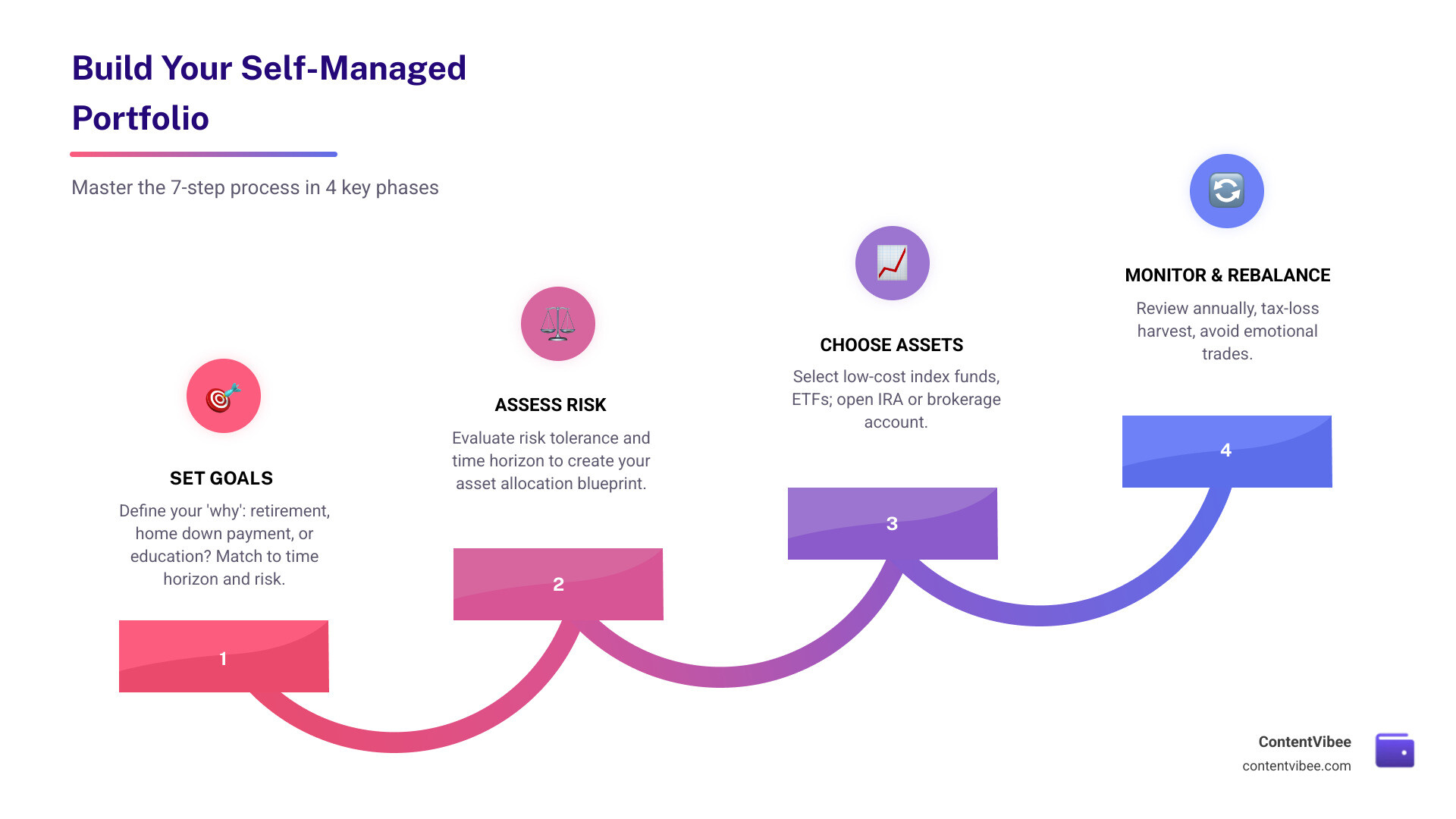
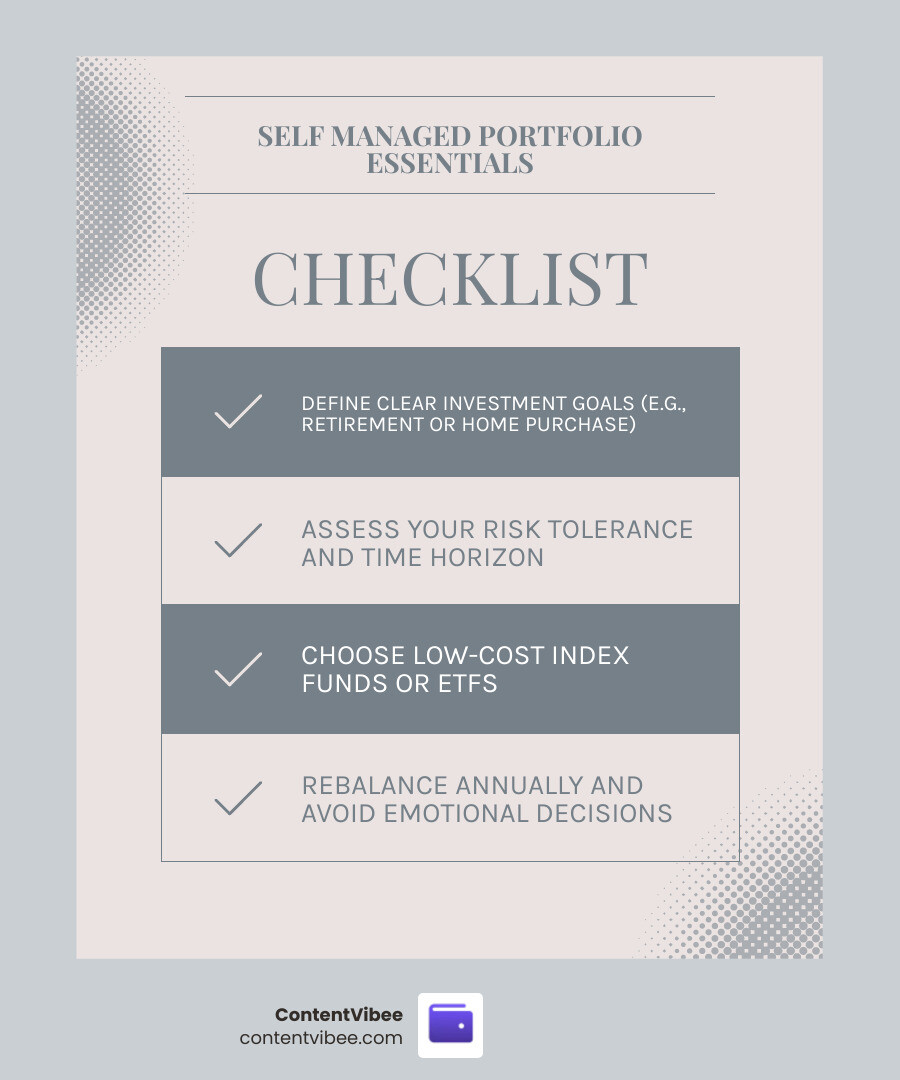
Building a self managed portfolio is like building a house; you wouldn’t start hammering nails without a blueprint. In finance, that blueprint consists of four pillars: your investment goals, your risk tolerance, your time horizon, and your asset allocation.
First, we must define the “why.” Are you saving for a down payment on a home in Richmond, or is this your “I’m never working again” retirement fund? Your goal dictates your investment asset allocation strategy risk management. For example, money needed in two years for a house shouldn’t be in the volatile stock market; it belongs in safer vehicles like CDs or short-term bonds.
Next, consider your risk tolerance. This isn’t just about how much money you want to make, but how much you can stand to see your account drop before you start losing sleep—or worse, panic-selling. Market corrections (drops of 10%+) happen roughly once a year, and bear markets (drops of 20%+) occur about every three years. Knowing this helps us stay disciplined.
Finally, we look at costs. One of the biggest advantages of a self managed portfolio is the ability to keep more of your returns.
As of May 2026, the data shows that the industry average expense ratio for mutual funds and ETFs is around 0.44%. However, by choosing low-cost index funds, you can get that down to an average of 0.07%. That difference might seem small, but over 30 years, it can mean the difference of hundreds of thousands of dollars in your pocket.
Self-Directed vs. Advisor-Managed: Which Path is Yours?
The main difference between self-directed and advisor-managed investing is who holds the “discretionary management” power. In a self-managed setup, you make every buy and sell decision. With an advisor, you pay an agency fee—often around 1% of your total assets annually—for them to handle the trades and provide fiduciary duty (acting in your best interest).
Advisors can provide valuable behavioral coaching, preventing you from making emotional mistakes during market swings. However, many investors find that they can achieve similar results by following a simple why choosing the right portfolio management strategy. Since 2015, managed active funds have consistently lost cash to index funds, as more people realize that “beating the market” is incredibly difficult even for professionals.
Pros and Cons of a Self Managed Portfolio
Taking total control is empowering, but it comes with a weight of responsibility.
The Pros:
- Fee Reduction: You stop paying for “expert” advice that often underperforms the market anyway.
- Empowerment: You understand exactly what you own and why.
- Tax Control: You decide when to realize gains or losses, which is crucial for high earners.
The Cons:
- Time Consumption: It requires a few hours a month for research and maintenance.
- Emotional Bias: It’s hard to stay calm when your own “hard-earned” money is dipping. Every investor faces risk, but DIYers face the unique risk of their own impulses.
- Decision Fatigue: With thousands of ETFs and stocks available, “analysis paralysis” is real.
Essential Steps to Launch Your Self Managed Portfolio
Before you buy your first share, we recommend getting your financial house in order.
- Emergency Savings: Build a cushion of three to six months of expenses.
- High-Interest Debt: Pay down credit cards or loans with interest rates above 7-8%. It’s hard to out-invest high-interest debt.
- Choose a Platform: Major brokerages like Schwab, Vanguard, Merrill Edge, and J.P. Morgan now offer $0 online equity and ETF commissions. Merrill Edge, for instance, offers $0 trades with no annual account fees.
- Educate Yourself: Resources like Bogleheads.org are gold mines for learning the “Three-Fund Portfolio” strategy. Understanding why managing your portfolio manually works helps you stick to the plan during the inevitable market storms.
Choosing the Right Accounts and Assets
Where you put your money is just as important as what you buy.
- Brokerage Accounts: These are flexible and allow you to withdraw money at any time, but you’ll pay taxes on dividends and realized gains.
- IRAs (Traditional and Roth): These offer massive tax advantages for retirement. A Roth IRA allows your money to grow tax-free, while a Traditional IRA may give you a tax break today.
- 529 Plans: If you are in Virginia and saving for education, these are excellent for tax-advantaged growth.
For the actual assets, most successful DIY investors stick to index funds or ETFs. These “pool” hundreds of stocks together, giving you instant diversification. Some advanced investors may try passively managing individual stocks to harvest specific tax losses, but for most, a total market ETF is the way to go. why choosing the right investment portfolio depends on your specific life stage.
Tax Efficiency and Rebalancing Strategies
Tax efficiency is the “secret sauce” of a self managed portfolio. In a taxable account, you want to be mindful of “capital gains.” If you hold an investment for more than a year, you qualify for lower long-term capital gains tax rates.
You should also look into “tax-loss harvesting.” This involves selling an investment that is at a loss to “offset” the taxes you owe on investments that made a profit. Just be careful of the “wash sale” rule—you can’t buy the same (or substantially identical) investment back within 30 days, or the tax benefit is voided.
Rebalancing is the act of bringing your portfolio back to its target. If your goal was 80% stocks and 20% bonds, but a great year in the market pushed stocks to 90%, you need to sell some stocks and buy bonds. We recommend doing this once a year or every six months. Using a why a portfolio risk management tool? can help you track these percentages without doing manual math.
Avoiding Common DIY Pitfalls
The biggest enemy of the self managed portfolio isn’t the market—it’s the person in the mirror.
- Chasing Performance: Don’t buy an investment just because it did well last year. Usually, by the time you hear about a “hot” stock, the gains have already been made.
- Ignoring Market Noise: The 24-hour news cycle is designed to make you feel like you need to “do something.” Usually, the best thing to do is nothing.
- Overtrading: Frequent trading leads to higher taxes and potential mistakes.
- Underestimating Time: Understand why the investment time horizon impact is your greatest ally. Compound interest needs decades, not days, to work its magic.
If the idea of doing all this manually feels overwhelming, you might wonder is automated portfolio management right for you?. Robo-advisors can handle the rebalancing and tax-loss harvesting for a small fee (usually around 0.25%), which is a great middle-ground for many.
Conclusion: Mastering Your Financial Future

Taking control of a self managed portfolio is one of the most rewarding financial moves you can make. By cutting out the middleman and focusing on low-cost, diversified index funds, you are keeping more of your wealth for your own future.
At ContentVibee, we believe that financial literacy is the key to autonomy. It doesn’t require a PhD in finance to be a successful investor; it requires a simple plan, a bit of discipline, and the patience to let the market work for you over the long term.
Whether you are just starting your journey in Virginia or looking to optimize an existing nest egg, the tools and resources available today make it easier than ever to manage your own path. For more practical advice on building wealth and navigating the modern financial landscape, explore our other Smart Money & Tech Tips for Americans.
Your future self will thank you for the fees you didn’t pay and the discipline you did show. Start small, stay consistent, and take the reins today.