


The Answer Most Retirees Get Wrong: At What Age Do RMDs Stop?
At what age does RMD stop is one of the most common retirement questions — and the answer surprises most people.
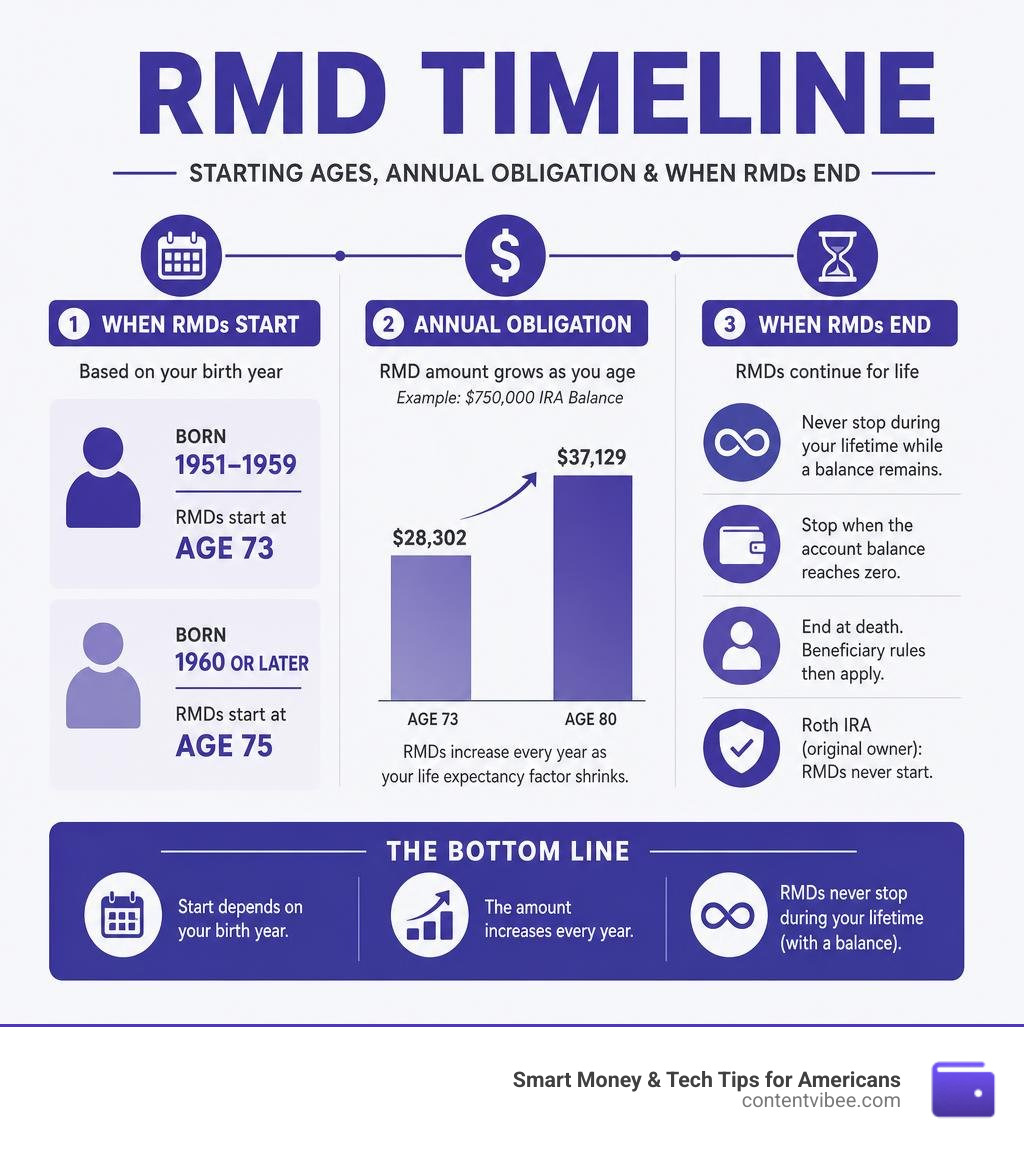
RMDs never stop during your lifetime. There is no maximum age. Once required minimum distributions begin, you must take them every single year for as long as you hold a balance in a tax-deferred retirement account.
Here is a quick summary:
| Situation | When RMDs Stop |
|---|---|
| Account owner alive, balance remaining | Never — RMDs continue indefinitely |
| Account balance reaches zero | RMDs stop (nothing left to withdraw) |
| Account owner dies | Owner’s RMDs end; beneficiary rules begin |
| Roth IRA (original owner) | RMDs never start — exempt for life |
The IRS designed RMDs specifically to prevent tax-advantaged accounts from becoming permanent tax shelters. The government wants its share of those pre-tax dollars — and it collects every year until the money is gone or you are.
What does change over time is when RMDs begin, which depends on your birth year under the SECURE 2.0 Act:
- Born 1951–1959: RMDs start at age 73
- Born 1960 or later: RMDs start at age 75
For many retirees, the real shock is not just that RMDs never stop — it is that the amount you must withdraw grows larger every year as your life expectancy factor shrinks. A 73-year-old with a $750,000 IRA owes roughly $28,302. That same balance at age 80 triggers a withdrawal closer to $37,129.
This guide covers everything you need to know: when RMDs start, why they never stop, how to calculate them, and the smartest strategies to reduce their tax bite.
The Lifetime Rule: At What Age Do RMDs Finally Stop for Retirees?

When we set up our first retirement accounts, we are usually focused on saving as much as possible. We watch our balances grow, celebrate the tax deductions, and dream of the day we can finally stop working. But as we enter our golden years, the rules of the game change.
According to the official Retirement topics – Required minimum distributions (RMDs) | Internal Revenue Service), you cannot keep your tax-deferred retirement funds in your account indefinitely. The government wants its cut of your hard-earned savings, and they have established strict rules to ensure they get it.
Why There Is No Age at Which RMD Stops During Your Lifetime
The hard truth of retirement planning is that there is no magical age where the IRS says, “Congratulations, you have paid enough taxes. You can keep the rest.” Once you cross the starting threshold, RMDs are an annual, lifetime obligation.
The policy reason behind this is simple: tax-deferred accounts like Traditional IRAs and 401(k)s were created to help you save for your own retirement, not to serve as a permanent, multi-generational tax shelter. If the IRS allowed you to leave that money untouched forever, wealthy families could pass tax-deferred fortunes down through generations without Uncle Sam ever collecting ordinary income tax on those funds.
By forcing annual withdrawals, the IRS guarantees that the pre-tax money you saved during your working years is eventually distributed and taxed as ordinary income. This is why, even if you live to be 105, you will still have to calculate and withdraw your RMD every single year. For a deeper look at how these age milestones have shifted over time, check out our guide on Mastering the SECURE Act 2.0 RMD Age Shifts.
The Only True Stop: Account Depletion or Death
While there is no age limit that halts RMDs, there are two scenarios where your personal obligation to make these withdrawals will end:
- Account Depletion: If your traditional retirement accounts run out of money and your balance reaches exactly $0, your RMDs stop. You cannot calculate a percentage of zero.
- Your Death: Your personal obligation to take RMDs ends when you pass away. However, this does not mean the tax-deferred money escapes the IRS. Instead, the responsibility is transferred to your beneficiaries, who must then navigate inherited IRA rules.
As you plan your estate, understanding that RMDs continue for life is crucial. If you do not need these distributions to cover your daily living expenses, you must still withdraw them, pay the taxes, and find another place to put the leftover cash. For more insights on this lifetime rule, you can read the analysis on At what age does RMD stop?.
When Do RMDs Start Under SECURE 2.0?
While the ending age for RMDs is nonexistent, the starting age has been a moving target over the last few years. Thanks to the SECURE 2.0 Act, the age at which you must begin taking these withdrawals has been pushed back, giving your investments more time to grow tax-deferred.
To help you visualize where you stand, here is a breakdown of the RMD starting ages based on your birth year:
| Birth Year | RMD Starting Age | First RMD Deadline |
|---|---|---|
| 1950 or earlier | 72 (or 70½ under older rules) | Already taking RMDs |
| 1951 – 1959 | 73 | April 1 of the year following the year you turn 73 |
| 1960 or later | 75 | April 1 of the year following the year you turn 75 |
Keeping track of these changes is essential to avoid massive IRS penalties. You can stay ahead of the curve by reading our article, Don’t Get Caught Off Guard by the 2026 RMD Changes.
Birth Year Rules and the Age 73 vs. Age 75 Shift
The transition from age 73 to age 75 is one of the most significant updates in recent tax history. If you were born between 1951 and 1959, you fall under the age 73 rule. For example, if you turn 73 in 2026, you must begin taking your RMDs for this year.
However, if your birth year is 1960 or later, you get a longer tax reprieve. Your RMDs will not begin until you reach age 75. This legislative shift was designed to account for increased longevity and the fact that many Americans are working and saving far later into their lives.
The First-Year Delay Trap: April 1 vs. December 31
When you reach your designated RMD starting age, the IRS gives you a one-time grace period. You can delay your very first RMD until April 1 of the calendar year following the year you reach that age.
While this sounds like a great deal, it is often a financial trap. If you choose to delay your first distribution to April 1 of the following year, you must still take your second RMD by December 31 of that same year.
Taking two major distributions in a single tax year can easily push you into a higher tax bracket, trigger higher Medicare premiums (known as IRMAA surcharges), and increase the taxation of your Social Security benefits. For most retirees, it is far better to take the first RMD by December 31 of the year they turn their starting age to keep their taxable income level.
How RMDs Are Calculated and Which Accounts Are Affected

Calculating your RMD might seem intimidating, but the basic formula is relatively straightforward. Every year, your RMD is calculated using two numbers: your account balance at the end of the previous year and an IRS life expectancy factor.
To find more detailed calculators and step-by-step math, you can check out the resource on How do I calculate my required minimum distribution?.
The IRS Life Expectancy Tables and the RMD Formula
To calculate your annual distribution, you take the fair market value of your retirement account as of December 31 of the previous year and divide it by the “distribution period” factor provided by the IRS.
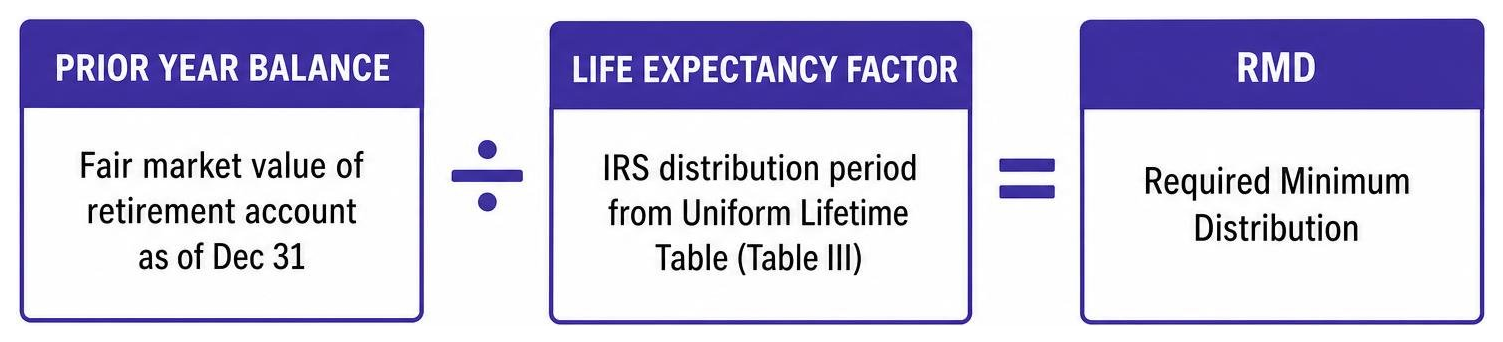
Most unmarried retirees and married retirees whose spouses are not more than 10 years younger use the IRS Uniform Lifetime Table (Table III). This table lists a distribution period for every age. As you get older, your life expectancy factor decreases, which means your required withdrawal percentage increases.
For example, let’s look at how the math changes over time for a flat account balance of $500,000:
- At age 73: The IRS factor is 26.5. Your RMD is $18,868 (about 3.77% of your balance).
- At age 80: The IRS factor drops to 20.2. Your RMD rises to $24,752 (about 4.95% of your balance).
- At age 90: The IRS factor drops to 12.2. Your RMD jumps to $40,984 (about 8.20% of your balance).
As you can see, even if your account balance stays exactly the same, your tax burden will naturally grow heavier as you age. For a comprehensive look at these tables and how to prepare for this climbing tax curve, read our deep dive on The Essential RMD Age Table Guide for Smart Retirees.
Accounts Subject to RMDs vs. Exempt Roth Accounts
Not all retirement accounts are treated equally by the IRS. It is vital to know which of your buckets are subject to RMDs and which are exempt. You can find official guidance on this in the Retirement plan and IRA required minimum distributions FAQs | Internal Revenue Service.
Here is a quick reference list:
- Subject to RMDs: Traditional IRAs, SEP IRAs, SIMPLE IRAs, traditional 401(k) plans, 403(b) plans, and 457(b) plans.
- Exempt from RMDs (during your lifetime): Roth IRAs. Because Roth IRAs are funded with after-tax dollars, the IRS does not require you to take lifetime distributions.
- Designated Roth Accounts in Employer Plans: Thanks to SECURE 2.0, Roth 401(k) and Roth 403(b) accounts are also exempt from lifetime RMDs. This aligns them with standard Roth IRAs and eliminates the need to roll over your Roth 401(k) into a Roth IRA just to avoid RMDs.
Strategies to Reduce or Avoid the Tax Impact of RMDs
Because RMDs can quickly drive up your taxable income, proactive planning in your 60s is essential. If you wait until you turn 73 to think about RMDs, you may miss out on your best opportunities to save.
To build a comprehensive plan, refer to The Essential RMD Age Table Guide for Smart Retirees.
Qualified Charitable Distributions (QCDs) and Roth Conversions
Two of the most powerful tools in your retirement planning toolkit are QCDs and Roth conversions.
- Qualified Charitable Distributions (QCDs): If you are age 70½ or older, you can utilize a QCD to transfer up to $111,000 per year (for 2026) directly from your Traditional IRA to an eligible charity. The beauty of a QCD is that the transferred amount counts toward satisfying your annual RMD, but it is completely excluded from your adjusted gross income (AGI). This keeps your taxable income low and can protect you from Medicare premium surcharges.
- Roth Conversions: A Roth conversion involves moving funds from a Traditional IRA or 401(k) into a Roth IRA. You must pay ordinary income tax on the converted amount in the year of the transfer, but once the money is inside the Roth IRA, it grows tax-free and is completely exempt from lifetime RMDs. Performing strategic Roth conversions during lower-income years (such as the gap between retirement and starting Social Security) is an excellent way to shrink your future RMD tax burden.
The Still-Working Exception and Pre-1987 403(b) Rules
If you are still working past your RMD starting age, you might be able to catch a break:
- The Still-Working Exception: If you are still employed past age 73 (or 75) and do not own 5% or more of the company you work for, you can generally delay taking RMDs from your current employer’s 401(k) or 403(b) plan until April 1 of the year after you finally retire. This exception does not apply to Traditional IRAs or retirement plans from previous employers.
- Pre-1987 403(b) Contributions: If you participated in a 403(b) plan before 1987, those older contributions may be exempt from the standard RMD rules. You may be allowed to delay distributions on that specific pre-1987 portion until you reach age 75 or retire, provided your plan has kept separate, meticulous records of those balances.
Rules for Beneficiaries and Inherited Accounts
While your personal RMDs end when you pass away, the tax-deferred accounts you leave behind will still be subject to IRS rules. The rules for beneficiaries changed dramatically with the passage of the original SECURE Act in 2019, eliminating the lifetime “stretch” IRA for most non-spouse heirs.
At What Age Does RMD Stop for Inherited Accounts?
For beneficiaries, RMDs do not stop based on age. Instead, they stop when the inherited account is completely emptied. Under current rules, most non-spouse beneficiaries must withdraw the entire balance of an inherited tax-deferred account within 10 years of the original owner’s death.
Whether the beneficiary must take annual distributions during those 10 years depends on whether the original owner had already started taking their own RMDs. If the owner died after their required beginning date, the beneficiary must take annual RMDs based on their own life expectancy in years 1 through 9, and then fully deplete the account by the end of year 10.
The 10-Year Rule and Eligible Designated Beneficiary Exceptions
The strict 10-year depletion rule applies to most heirs, but there are exceptions for “Eligible Designated Beneficiaries” (EDBs). These individuals are allowed to take distributions over their own lifetimes rather than facing the 10-year limit:
- Spouse Beneficiaries: Surviving spouses have the most flexibility. They can roll the inherited account into their own IRA and delay RMDs until they reach their own starting age.
- Disabled or Chronically Ill Individuals: Heirs who meet strict IRS definitions for disability or chronic illness are exempt from the 10-year rule.
- Minor Children of the Account Owner: Minor children can use their own life expectancy for withdrawals, but once they reach the age of majority (usually 18 or 21 depending on the state), the 10-year countdown clock begins.
Frequently Asked Questions About RMD Age Limits
What is the penalty for missing an RMD under SECURE 2.0?
Before the SECURE 2.0 Act, the penalty for failing to take your RMD was one of the harshest in the entire tax code: a whopping 50% excise tax on the amount you failed to withdraw.
Thankfully, SECURE 2.0 reduced this penalty to 25%. Furthermore, if you correct the mistake and file Form 5329 within the correction window (generally within two years), the penalty is reduced to 10%. Even with this reduction, it is a penalty worth avoiding through careful automation and planning.
Do RMD rules apply differently to Defined Benefit plans?
Yes. Defined Benefit plans (traditional pensions) handle RMDs differently than Defined Contribution plans (like 401ks) and IRAs. Instead of calculating a percentage of a fluctuating account balance, Defined Benefit plans satisfy RMD requirements by paying out a series of structured, periodic annuity payments over your lifetime (or the joint lives of you and your beneficiary). These distributions must begin by your required beginning date, but the calculation is handled entirely by the plan administrator.
Can I roll over an RMD to another tax-deferred account?
No. The IRS is very strict on this point: RMDs cannot be rolled over into another tax-deferred account, such as another Traditional IRA or 401(k). The first money distributed from your retirement account in a year you owe an RMD is automatically deemed to be your required distribution. It must be taken as a taxable payout, and any attempt to roll it over will result in an excess contribution penalty in the receiving account.
Conclusion
Navigating the landscape of retirement tax rules can feel like trying to solve a puzzle where the pieces keep changing shape. While the answer to at what age does rmd stop is a definitive “never during your lifetime,” understanding this rule allows you to plan proactively.
At ContentVibee, we are dedicated to providing clear, actionable personal finance guidance to help Americans secure their financial independence. By coordinating Roth conversions, utilizing Qualified Charitable Distributions, and keeping a close eye on the calendar, you can keep your hard-earned savings out of the highest tax brackets.
For a complete breakdown of the tables and to customize your personal withdrawal plan, read our comprehensive The Essential RMD Age Table Guide for Smart Retirees today. Let us help you keep your retirement simple, secure, and tax-efficient!