What You Need to Know About the New Retirement Tax Rules in 2026
The new retirement tax rules taking effect in 2026 are the most significant changes for retirees in nearly a decade — and they could directly affect how much of your savings you keep.
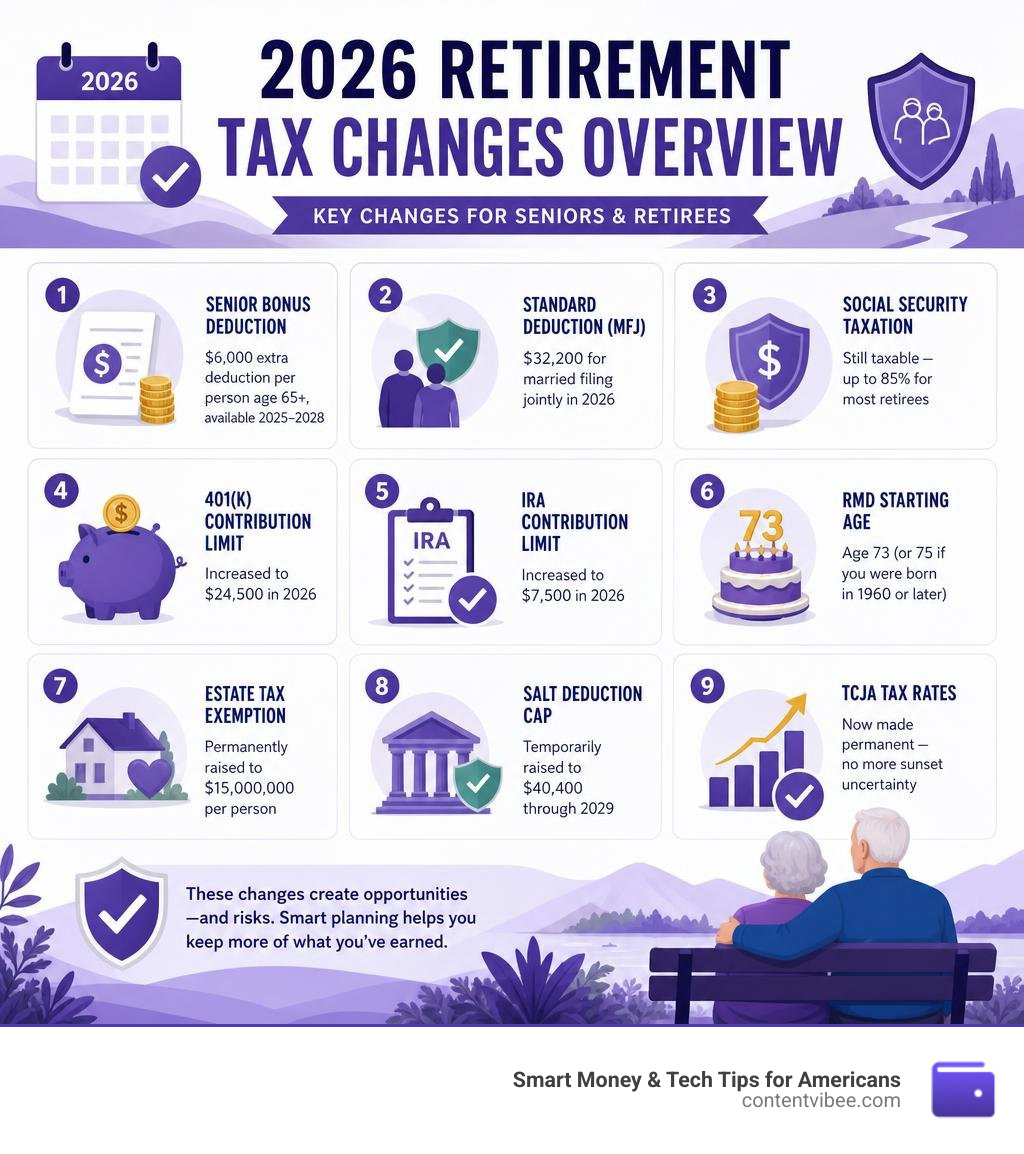
Here is a quick summary of the biggest changes:
| Change | Key Detail |
|---|---|
| Senior Bonus Deduction | $6,000 extra deduction per person age 65+, available 2025–2028 |
| Standard Deduction (MFJ) | $32,200 for married filing jointly in 2026 |
| Social Security Taxation | Still taxable — up to 85% for most retirees |
| 401(k) Contribution Limit | Increased to $24,500 in 2026 |
| IRA Contribution Limit | Increased to $7,500 in 2026 |
| RMD Starting Age | Age 73 (or 75 if you were born in 1960 or later) |
| Estate Tax Exemption | Permanently raised to $15,000,000 per person |
| SALT Deduction Cap | Temporarily raised to $40,400 through 2029 |
| TCJA Tax Rates | Now made permanent — no more sunset uncertainty |
Congress passed the One Big Beautiful Bill Act (OBBBA) in 2025, locking in lower tax rates permanently and adding new temporary breaks specifically for seniors. For retirees and people approaching retirement, this creates both real opportunities and real risks — depending on how you plan.
The changes touch nearly every part of retirement income: Social Security, pensions, IRAs, 401(k)s, capital gains, and even your estate. Getting them wrong could mean paying thousands more in taxes than you need to.
This guide breaks down every major change in plain language so you know exactly where you stand.
Understanding the New Retirement Tax Rules Under the OBBBA
For years, retirees lived under a cloud of tax uncertainty. The individual tax cuts introduced by the Tax Cuts and Jobs Act (TCJA) of 2017 were set to expire at the end of 2025. Had they sunsetted, millions of seniors would have faced automatic tax hikes as rates rebounded to their pre-2018 levels.
Fortunately, the passage of the One Big Beautiful Bill Act (OBBBA) completely reshaped the landscape. The OBBBA made the lower TCJA federal income tax rates permanent. This means the current tax brackets (10%, 12%, 22%, 24%, 32%, 35%, and 37%) are here to stay, with income thresholds continuing to adjust annually for inflation.
For a detailed look at how this transition affects your overall financial plan, check out our guide on the TCJA Expiration Date and What It Means for Your Wallet.
While tax rate permanence is a massive win for long-term planning, the OBBBA also introduced several temporary deductions and adjustments. These new provisions are designed to provide immediate relief but are scheduled to expire after 2028. Navigating this mix of permanent rates and temporary breaks is the key to mastering the new retirement tax rules.
How the New Retirement Tax Rules Reshape the Standard Deduction
The standard deduction is the foundation of most retirees’ tax returns, especially since the vast majority of seniors do not itemize. For 2026, the baseline standard deductions have been adjusted upward for inflation:
- Single Filers: $16,100
- Married Filing Jointly: $32,200
- Heads of Household: $24,150
In addition to these base amounts, the IRS continues to offer an extra standard deduction for taxpayers who are blind or age 65 and older. However, the OBBBA has added a brand-new layer of savings on top of these existing rules, creating a highly lucrative window for seniors over the next few years.
The Senior Bonus Deduction and New Retirement Tax Rules for Adults 65+
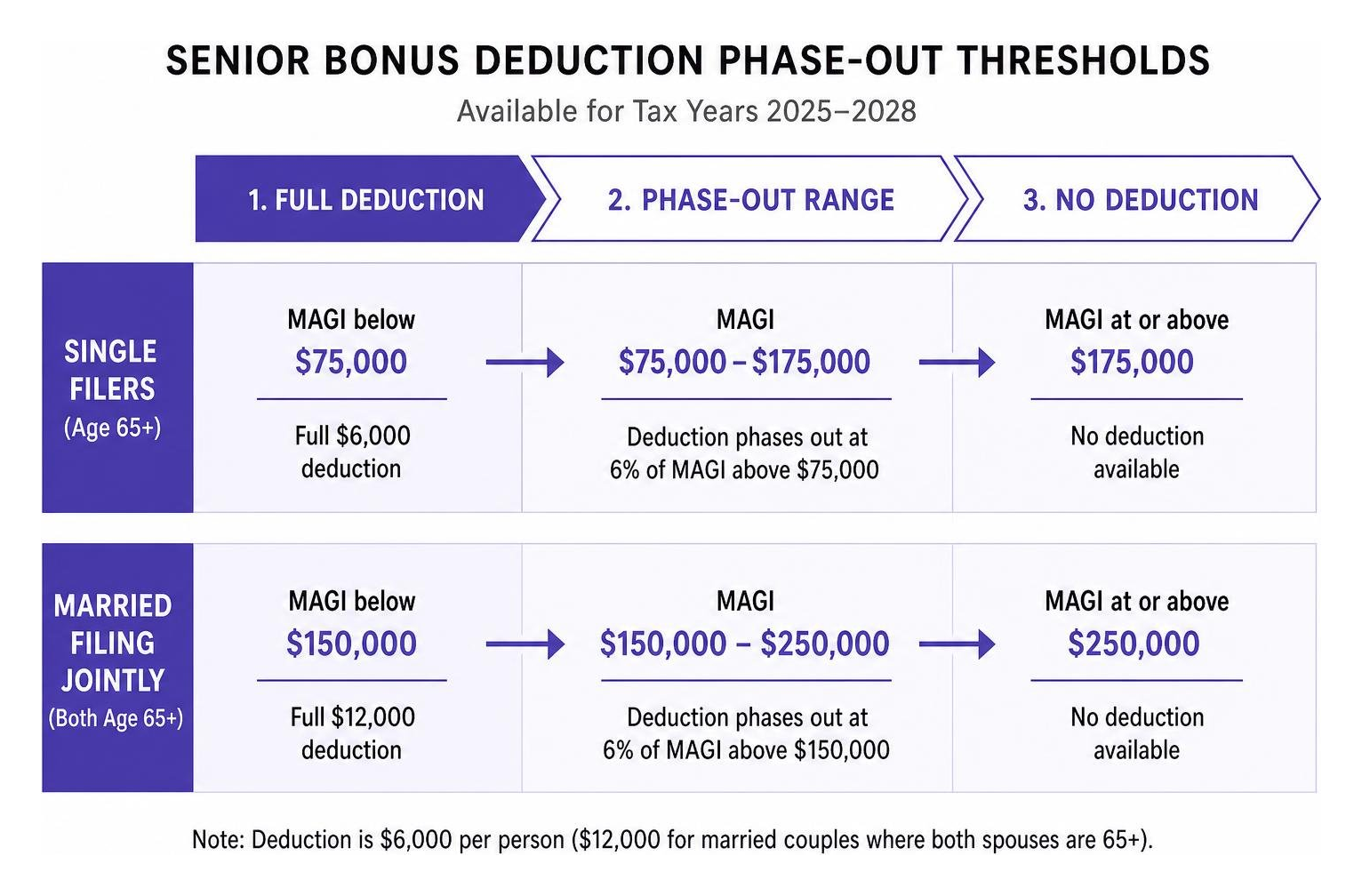
If you are 65 or older, the OBBBA introduces a powerful new tax-saving tool: the Senior Bonus Deduction. Available for tax years 2025 through 2028, this provision allows eligible seniors to claim an additional $6,000 deduction per person ($12,000 for a married couple where both spouses are 65+).
This bonus deduction stacks directly on top of your baseline standard deduction and the existing age-65 addition. For example, a married couple over 65 taking the standard deduction in 2026 can now shield a massive portion of their income from federal taxes.
However, this bonus deduction is designed to help lower- and middle-income seniors, meaning it is subject to strict Modified Adjusted Gross Income (MAGI) phase-out rules:
- Single Filers: The full $6,000 deduction is available for those with a MAGI below $75,000. The deduction phases out at a rate of 6% of MAGI above this threshold, disappearing entirely once MAGI reaches $175,000.
- Married Filing Jointly: The full $12,000 deduction is available for couples with a MAGI below $150,000. It phases out completely at $250,000 MAGI.
To put this into perspective, let’s look at a real-world scenario. Consider a single retiree over age 65 with a $30,000 pension, $10,000 in investment income, and $24,000 in Social Security benefits. By claiming the new $6,000 Senior Bonus Deduction, this individual can reduce their federal tax bill by $720 (assuming they are in the 12% marginal tax bracket).
Federal Income Tax Brackets and Capital Gains in 2026
With federal tax brackets now permanently locked in, retirees can plan their income withdrawals with much greater precision. For 2026, the top marginal tax rate of 37% applies only to high earners—specifically, single filers with taxable income above $640,600 and married couples filing jointly with taxable income above $768,700.
For most retirees, however, the focus is on the lower brackets (10%, 12%, and 22%) and how they interact with investment income.

Capital Gains and the Net Investment Income Tax (NIIT)
If you rely on a taxable brokerage account to fund your retirement, the tax treatment of long-term capital gains and qualified dividends remains highly favorable. In 2026, the 0% capital gains tax bracket extends up to $98,900 in taxable income for married couples filing jointly. If you can keep your taxable income below this threshold, you can sell appreciated investments entirely tax-free.
Once your income exceeds the 0% threshold, long-term capital gains are taxed at 15% or 20%. However, higher-income retirees must also watch out for the Net Investment Income Tax (NIIT). The NIIT is a 3.8% surtax that applies to your investment income if your MAGI exceeds:
- $200,000 for single filers
- $250,000 for married couples filing jointly
Importantly, these NIIT thresholds are not indexed for inflation, meaning more retirees find themselves crossing these lines as their portfolios grow or when they take large, lump-sum distributions.
The Temporary SALT Cap Increase for Retirees
Another major change introduced by the OBBBA is a temporary modification to the State and Local Tax (SALT) deduction. Under the original TCJA rules, taxpayers who itemized could deduct a maximum of $10,000 in state and local taxes.
Starting in 2026, the SALT deduction cap temporarily increases to $40,400 for taxpayers with a MAGI below $500,000. This change is scheduled to run through 2029. For retirees living in high-tax states who still itemize their deductions (perhaps due to high medical expenses or charitable giving), this cap increase can provide substantial federal tax relief.
Social Security Taxation and the Trust Fund Impact
One of the most persistent points of confusion surrounding the new retirement tax rules is how they affect Social Security. Many headlines have pointed to OBBBA provisions as “eliminating” taxes on Social Security. Unfortunately, the reality is far more nuanced.
Federal taxation of Social Security benefits is still determined by your “provisional income” (calculated as your Adjusted Gross Income + any tax-exempt interest + 50% of your Social Security benefits). The historical, unindexed thresholds remain in place:
- Single Filers: If your provisional income is between $25,000 and $34,000, up to 50% of your benefits may be taxed. If it exceeds $34,000, up to 85% of your benefits can be taxed.
- Married Joint Filers: If your provisional income is between $32,000 and $44,000, up to 50% of your benefits may be taxed. If it exceeds $44,000, up to 85% of your benefits are taxable.
To understand the mechanics of this calculation, read our comprehensive guide, Uncle Sam’s Cut: Understanding Taxes on Social Security. For strategies on how to minimize this burden, you can also explore our Taxing Your Golden Years: A Guide to Social Security Tax on Benefits and the Social Security Taxable Income Guide 2026.
Debunking the “No Tax on Social Security” Claim
The administration’s branding of “No Tax on Social Security” under the OBBBA is somewhat misleading. The bill does not repeal the provisional income tax formula. Instead, it attempts to offset the tax burden by providing the $6,000 Senior Bonus Deduction.
While this deduction successfully lowers overall taxable income for many seniors, it does not technically make Social Security benefits tax-free. Furthermore, this tax break has a significant macro-financial trade-off. Because the expanded standard deduction reduces the total federal taxes collected on Social Security benefits, it reduces the revenue flowing back into the Social Security system.
According to fiscal estimates, these new provisions will move up the projected Social Security trust fund depletion date by roughly six months, shifting the timeline from the third quarter of 2034 to the first quarter of 2034.
For retirees trying to anticipate how these systemic shifts will impact their monthly checks, our article on Predicting the 2026 Retirement Pay Increase Without Losing Your Mind offers valuable context.
Contribution Limits, RMDs, and Roth Conversion Strategies
If you are still working or looking to maximize your tax-sheltered savings, 2026 brings updated opportunities to stash money away.

The IRS has adjusted contribution limits upward for inflation:
- Traditional and Roth IRAs: The annual contribution limit is $7,500 for 2026. If you are age 50 or older, you can make an additional $1,000 catch-up contribution, bringing your total to $8,500.
- 401(k), 403(b), and most 457 plans: The baseline contribution limit rises to $24,500. The standard catch-up limit for those age 50+ is $8,000 (totaling $32,500).
For a deeper dive into these numbers, read The New 2026 Maximum 401k Contribution Limits Explained. To learn how to leverage these accounts to your advantage, check out Smart Strategies to Defer Taxes and Boost Your Retirement Savings.
Under the SECURE 2.0 Act, a special “super catch-up” is also available in 2026. Workers aged 60 to 63 can contribute an additional $11,250 to their employer plans, allowing for a maximum annual contribution of $35,750.
Navigating SECURE 2.0 RMD Changes and the Roth Catch-Up Mandate
The transition from saving to spending requires careful navigation of Required Minimum Distributions (RMDs). Under SECURE 2.0, the starting age for RMDs has transitioned to age 73. For younger Baby Boomers and Gen Xers (born in 1960 or later), the RMD starting age will eventually delay further to age 75.
Failing to take your RMD on time carries a steep 25% penalty on the undistributed amount, though this penalty can be reduced to 10% if you correct the mistake quickly. Learn how to avoid these costly errors in our guide: Don’t Let Uncle Sam Catch You Napping with These 2026 RMD Changes.
The 2026 Roth Catch-Up Mandate
Another major structural change taking effect is the mandatory Roth catch-up rule for high earners. If your FICA wages from your employer exceeded $145,000 (indexed to $150,000 in 2026) in the preceding calendar year, any catch-up contributions you make to your 401(k) or similar employer plan must be made on an after-tax (Roth) basis. While this removes the immediate tax deduction for your catch-up contribution, it ensures that those funds—and their growth—can be withdrawn completely tax-free in retirement.
Strategic Roth Conversions and IRMAA Planning
For retirees in their 60s who have retired but have not yet reached their RMD age, a unique “gap-year” planning window opens up. During these years, your income may be at an all-time low, making it the perfect time to execute partial Roth conversions.
By systematically converting pre-tax Traditional IRA or 401(k) assets into a Roth IRA, you pay taxes at today’s known, historically low rates. This strategy reduces the overall size of your pre-tax accounts, shrinking the size of your future forced RMDs.
However, you must execute this strategy with a close eye on IRMAA (Income-Related Monthly Adjustment Amount) thresholds. IRMAA is a surcharge added to your Medicare Part B and Part D premiums if your MAGI exceeds certain limits. For 2026, the standard Part B premium is $202.90 per month, but crossing the first IRMAA threshold of $218,000 (for married couples filing jointly) will trigger significantly higher premiums.
Because Medicare uses a two-year lookback period, any Roth conversions or capital gains you realize in 2026 will directly dictate your Medicare premiums in 2028.
The QCD Strategy for Charitable Retirees
If you are age 70½ or older and want to support charitable causes, you can bypass the RMD tax trap entirely using a Qualified Charitable Distribution (QCD). In 2026, the annual QCD limit has increased to $111,000. This rule allows you to transfer funds directly from your Traditional IRA to an eligible charity. The distribution counts toward your RMD but is excluded from your Adjusted Gross Income, keeping your MAGI low and protecting you from higher tax brackets and IRMAA surcharges.
Estate Tax Exemptions and State-Level Retirement Deductions
For retirees focused on legacy planning, the new retirement tax rules bring historic opportunities. Beginning in 2026, the federal estate and gift tax exemption permanently increases to $15,000,000 per person ($30,000,000 for a married couple). This massive threshold means the vast majority of Americans can pass on their wealth entirely free of federal estate taxes.
However, while federal estate taxes may not be a concern, state-level taxes can still take a significant bite out of your retirement nest egg. State rules vary wildly when it comes to taxing pensions, retirement account withdrawals, and property.
To see how your state stacks up, explore our comprehensive state-level resources:
- The Ultimate Guide to State Pension Tax Breaks and Exemptions
- The Golden State Guide: Deciphering CalPERS COLA and California Tax Adjustments
Michigan’s Public Act 24 and State Senior Tax Relief
As states adjust to inflation and legislative shifts, some are passing highly beneficial relief packages for seniors. A prime example is Michigan’s Public Act 24 of 2025.
This act restores the popular pre-2012 retirement and pension subtraction rules, phasing in a 100% subtraction for qualifying retirement and pension benefits by 2026. Furthermore, Public Act 24 allows Michigan taxpayers born after 1952 who are age 67 or older to claim both the state standard deduction and the Social Security deduction for tax years 2026 through 2028 without any offset.
If you are looking for ways to reduce other local expenses, you can also read about State Senior Tax Benefits to Slash Your Property Tax Bill.
Frequently Asked Questions about New Retirement Tax Rules
Does the new tax law completely eliminate taxes on Social Security?
No. The One Big Beautiful Bill Act (OBBBA) does not repeal the federal provisional income formula that governs Social Security taxation. Up to 85% of your benefits remain taxable if your provisional income exceeds $34,000 (single) or $44,000 (joint). However, the new $6,000 Senior Bonus Deduction helps offset your overall taxable income, reducing the net tax burden for many middle-income seniors.
What is the new Senior Bonus Deduction for 2026?
The Senior Bonus Deduction is a temporary federal tax break available from 2025 through 2028. It provides an additional $6,000 deduction per person for adults age 65 and older. It stacks on top of the standard deduction but phases out for single filers with a MAGI over $75,000 (fully gone at $175,000) and joint filers with a MAGI over $150,000 (fully gone at $250,000).
At what age must I begin taking Required Minimum Distributions (RMDs) in 2026?
Under current SECURE 2.0 guidelines, the RMD starting age is 73. If you were born in 1960 or later, your RMD starting age is delayed to 75.
Conclusion
Navigating the new retirement tax rules requires a proactive approach. With permanent federal tax rates now established alongside temporary deductions like the Senior Bonus Deduction, retirees have a unique window of certainty to optimize their wealth. By diversifying your income sources across pre-tax, Roth, and taxable brokerage accounts, you can maintain maximum control over your tax bracket, IRMAA surcharges, and Social Security exposure.
At ContentVibee, our mission is to deliver clear, actionable guidance on complex financial regulations like the SECURE Act 2.0 RMD changes. To ensure you comply with federal guidelines, consult the official IRS Tax information for seniors & retirees page, and use our rankings of the Best States for Taxes in Retirement Ranked to plan your next move with confidence.