

What the Secure Act 2.0 RMD Changes 2026 Mean for Your Retirement
The Secure Act 2.0 RMD changes 2026 are reshaping when millions of Americans must start withdrawing from their retirement accounts — and how much they’ll owe if they get it wrong.
Here’s the quick answer:
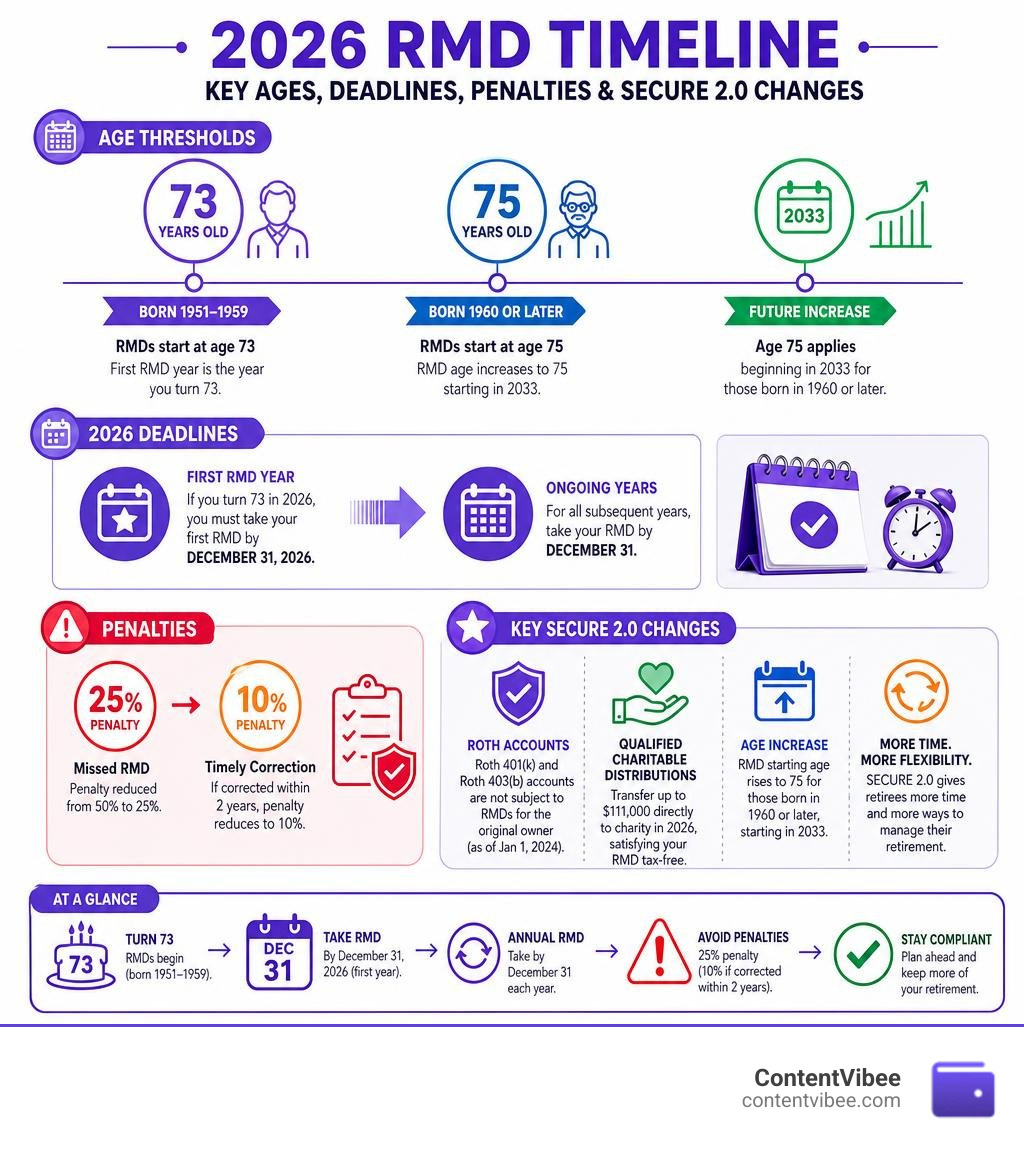
- RMD starting age is now 73 for anyone born between 1951 and 1959
- The first-time 2026 RMD cohort is people born in 1953 who turn 73 this year
- The missed RMD penalty dropped from 50% to 25% — and falls further to 10% if you fix it within two years
- Roth 401(k) and Roth 403(b) accounts are no longer subject to RMDs for the original owner (as of January 1, 2024)
- QCDs let you transfer up to $111,000 directly to charity in 2026, satisfying your RMD without adding to taxable income
- The RMD age will rise again to 75 for those born in 1960 or later, starting in 2033
The core idea is simple: the IRS doesn’t let tax-deferred retirement savings grow forever. At some point, you must start taking withdrawals so that deferred taxes get paid. SECURE 2.0 gave retirees more time and more flexibility — but the rules still have real teeth if you miss a deadline or miscalculate.
If you’re nearing retirement age, or you’ve already crossed into RMD territory, understanding these updates is not optional. The stakes include unnecessary tax bills, IRS penalties, and missed planning opportunities that could cost you tens of thousands of dollars.
This guide breaks down everything clearly — age rules, deadlines, calculation methods, penalty corrections, Roth exemptions, QCD strategies, inherited IRA rules, and business owner planning.
Understanding the Secure Act 2.0 RMD Changes 2026: Age, Deadlines, and Birth Year Rules
Navigating the required minimum distribution (RMD) rules used to be a relatively straightforward milestone. For decades, the magic number was 70½. You hit that age, you looked up your divisor, and you took your money.
However, the SECURE Act of 2019 and the subsequent SECURE 2.0 Act completely rewrote this timeline. In 2026, we are operating under a phased transition that gives many retirees more time to let their tax-deferred nest eggs grow. But this added flexibility also introduces a bit of complexity based on the exact year you were born.
To find your specific starting age and plan your transition smoothly, you can consult The Essential RMD Age Table Guide for Smart Retirees. Having a clear roadmap prevents costly timing mistakes.
Who Must Take a Distribution Under the Secure Act 2.0 RMD Changes 2026?
For the current 2026 calendar year, the spotlight is directly on retirees born in 1953. If you were born in 1953, you will celebrate your 73rd birthday this year, officially inducting you into the 2026 RMD cohort.
The SECURE 2.0 framework established that anyone born between January 1, 1951, and December 31, 1959, has an RMD starting age of 73. If you were born in 1951 or 1952, you have already begun taking your RMDs in prior years and must continue to do so by December 31, 2026. If you are turning 73 this year, you have officially reached your Required Beginning Date (RBD) milestone.
Managing these distributions requires a comprehensive look at your overall cash flow. For a broader perspective on how to coordinate these mandatory withdrawals with your day-to-day budget, check out The Ultimate Guide to Retirement Money Management.
Future Age Increases Scheduled Beyond 2026
If you were born in 1960 or later, you can breathe a temporary sigh of relief. Under the Secure Act 2.0 RMD changes 2026 roadmap, your RMD starting age will eventually rise to 75. This change is scheduled to take effect in 2033.
This multi-year gap provides a valuable planning window. For those in their 60s, this extra time allows for strategic tax planning, such as executing multi-year Roth conversions or coordinating retirement income with other sources. To see how these delayed RMD ages align with your plans for claiming federal retirement benefits, read The Ultimate Guide to Social Security Benefit Optimization.
The Required Beginning Date (RBD) and the First-Year Delay Trap
When you reach your RMD starting age, the IRS grants you a one-time grace period for your very first distribution. You have until April 1 of the year following the calendar year you turn 73 to take your first RMD. For the 1953 cohort turning 73 in 2026, this means your absolute deadline for your first distribution is April 1, 2027.
While delaying your first RMD to April 1 of the following year can offer temporary relief, it comes with a massive tax trap. If you choose to delay your 2026 RMD until April 1, 2027, you must still take your second RMD (the one for the 2027 calendar year) by December 31, 2027.
Taking two large, mandatory distributions in a single tax year can artificially inflate your adjusted gross income (AGI). This sudden income spike can push you into a significantly higher federal tax bracket, trigger state tax issues, and increase your Medicare Part B and Part D premiums via the Income-Related Monthly Adjustment Amount (IRMAA). For most retirees, it is cleaner and more tax-efficient to take the first RMD by December 31 of the year they turn 73, keeping the distributions separated into different tax years.
Calculating Your 2026 RMD, Aggregation Rules, and Missed Penalties
Calculating your RMD is a mathematical process dictated by the IRS. The basic formula is:
RMD Amount = (Prior Year-End Account Balance) / (IRS Life Expectancy Factor)
To find your starting point for your 2026 RMD, you must look at the fair market value of your tax-deferred accounts as of December 31, 2025. Once you have that balance, you divide it by the corresponding life expectancy factor from the appropriate IRS table. To simplify this math and avoid manual errors, you can use our resource to Calculate Your RMD Without the Headache.
How to Use IRS Life Expectancy Tables for 2026 Calculations
For the vast majority of account owners, the IRS Uniform Lifetime Table (Table III) is the correct tool to use. This table assumes you have a beneficiary who is not more than 10 years younger than you.
Under the updated tables, which reflect slightly longer life expectancies and therefore result in marginally smaller mandatory withdrawals than in previous decades, the divisor for a 73-year-old is 26.5.
For example, if your Traditional IRA balance was $500,000 on December 31, 2025, you would divide $500,000 by 26.5. This results in a 2026 RMD of $18,868 (an effective distribution rate of approximately 3.77%). If you turn 74 in 2026, your divisor is 25.5, resulting in an RMD of $19,608 on that same $500,000 balance.
The only common exception to using Table III is if your spouse is your sole primary beneficiary and is more than 10 years younger than you. In this scenario, you are permitted to use the Joint Life and Last Survivor Table (Table II), which yields a larger divisor and a lower mandatory withdrawal. For official lookups and further details, you can review the IRS RMD Guidelines.
Aggregation Rules: IRAs vs. 401(k) Plans
One of the most common mistakes retirees make is assuming that all retirement accounts are treated equally when satisfying RMDs. The rules differ significantly depending on the account type:
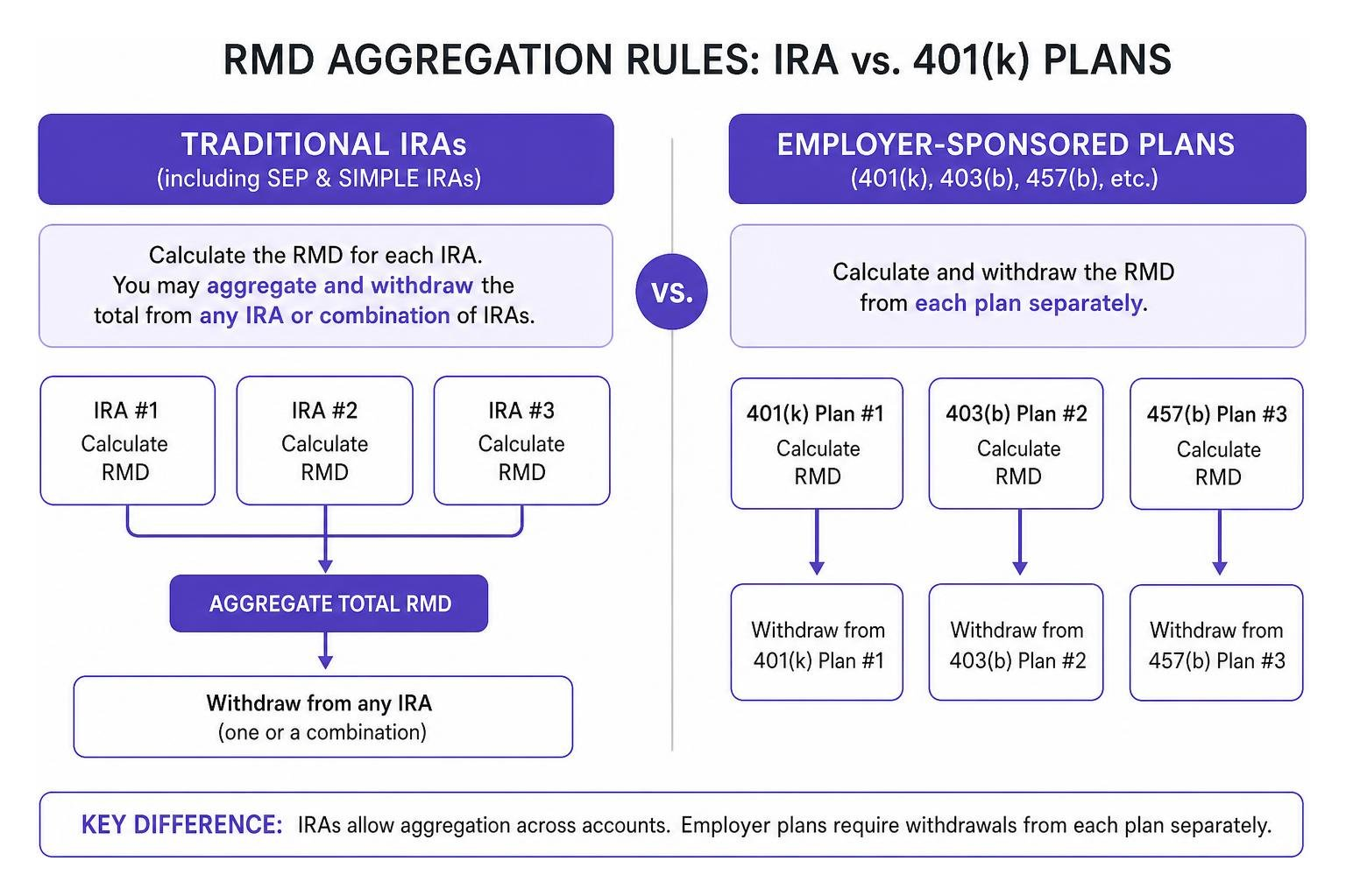
- Traditional IRAs (including SEP and SIMPLE IRAs): You must calculate the RMD for each individual IRA you own. However, you are allowed to aggregate the total RMD amount and withdraw it from any single IRA or combination of IRAs that you choose.
- Employer-Sponsored Plans (such as 401(k), 403(b), and 457(b) plans): You must calculate and withdraw the RMD from each individual employer plan separately. You cannot satisfy a 401(k) RMD by taking extra money out of an IRA or a different 401(k) plan.
Understanding how these account balances interact is key to planning your yearly contributions and eventual withdrawals. To learn more about how to calculate your workplace plan limits, see The Ultimate Guide to Calculating Your 401k Contributions.
How SECURE 2.0 Slashed the Missed RMD Penalty
Historically, the penalty for failing to take an RMD was one of the most punitive in the entire tax code: a whopping 50% excise tax on the undistributed amount.
Fortunately, the SECURE 2.0 Act reduced this base penalty to 25% of the shortfall. Furthermore, if you correct the mistake within the designated “correction window” (generally prior to the IRS assessing the tax or by the end of the second tax year following the year of the mistake), the penalty is reduced to 10%.

To correct a missed RMD and seek a waiver:
- Withdraw the missed RMD amount from your account as soon as you realize the error.
- File IRS Form 5329 with your federal tax return.
- Attach a letter of explanation showing “reasonable cause” (such as a medical emergency, a death in the family, or a serious administrative error by your custodian) and document the steps you have taken to correct the mistake. The IRS has historically been quite lenient in waiving the penalty entirely if you correct the error promptly and submit a reasonable explanation.
Roth Account Exemptions and Catch-Up Contribution Rules
One of the most taxpayer-friendly provisions of the SECURE 2.0 Act relates to how Roth accounts are handled during your lifetime. To make sure you are maximizing these accounts, you can read The Ultimate Guide to Your 2026 Max Roth IRA Contribution.
The Elimination of RMDs for Employer Roth Accounts
Prior to 2024, Roth IRAs were exempt from lifetime RMDs, but Roth accounts within employer-sponsored plans (such as Roth 401(k) or Roth 403(b) accounts) were still subject to RMD rules. This discrepancy forced many retirees to roll their workplace Roth assets into a Roth IRA before reaching RMD age to avoid mandatory distributions.
Effective January 1, 2024, SECURE 2.0 eliminated lifetime RMD requirements for Roth accounts in employer-sponsored retirement plans. This aligns workplace Roth accounts with Roth IRAs, allowing your designated Roth 401(k) balance to grow completely tax-free for the rest of your life. This exemption applies only to the original account owner; inherited Roth accounts are still subject to post-death distribution rules.
Secure Act 2.0 RMD Changes 2026 and Catch-Up Contribution Coordination
For those who are still working and are in their early 60s, SECURE 2.0 introduced enhanced catch-up contributions. Starting in 2025 and continuing into 2026, individuals aged 60 to 63 can make larger catch-up contributions to their workplace plans.
The 2026 limit for this specific age cohort is the greater of $11,250 or 150% of the standard catch-up limit. To see how this fits into the broader retirement savings landscape, you can consult The Ultimate Guide to Retirement Contribution Catch-Up Limits.
However, there is an important tax coordination rule to keep in mind: starting in 2026, if you earn more than $145,000 (indexed for inflation) in FICA wages from your employer in the preceding calendar year, any catch-up contributions you make must be directed to a Roth account. This means you will not receive an immediate tax deduction for these catch-up contributions, but they will grow and distribute completely tax-free in retirement.
Strategic Tax Minimization: QCDs, Roth Conversions, and Entity Planning
Leaving your RMD planning to the last minute can lead to a heavy tax bill. Implementing proactive tax strategies can help you control your tax bracket and preserve your wealth.
| Strategy | Primary Benefit | Age Eligibility | Key 2026 Limit |
|---|---|---|---|
| Qualified Charitable Distribution (QCD) | Excludes up to $111,000 from taxable income directly to charity | Age 70½ or older | $111,000 per individual |
| Roth Conversion | Eliminates future RMDs and allows tax-free growth | Any age | No limit, but taxed upon conversion |
Qualified Charitable Distributions (QCDs) as an RMD Offset
If you are charitably inclined, the Qualified Charitable Distribution (QCD) remains one of the single most powerful tax strategies available. A QCD allows you to transfer funds directly from your Traditional IRA to a qualified 501(c)(3) charity.
For 2026, the individual limit for QCDs has been adjusted for inflation to $111,000 (or up to $222,000 for married couples filing jointly, provided each spouse owns their own IRA).
The beauty of a QCD is twofold:
- The distributed amount counts directly toward satisfying your annual RMD.
- The money is excluded from your adjusted gross income (AGI).
Because it never enters your taxable income, it does not push you into a higher tax bracket or trigger IRMAA surcharges. You can begin making QCDs at age 70½, even though your RMD starting age is now 73.
This strategy is especially useful if you live in a state with unique retirement income tax rules. To see how your state treats various retirement income streams, read The Ultimate Guide to State Pension Tax Breaks and Exemptions.
Roth Conversions and Gap-Year Planning
Another highly effective strategy is executing Roth conversions during your “gap years” — the period between your retirement date and the age when your RMDs and Social Security benefits begin.
During these low-income years, your tax bracket may be lower than it will be once mandatory distributions start. By converting a portion of your Traditional IRA balance to a Roth IRA, you pay taxes on that money now at a lower rate.
Once inside the Roth IRA, those funds are free from lifetime RMD requirements and can grow tax-free. To understand how to coordinate these conversions with your workplace plan limits, see The New 2026 Maximum 401k Contribution Limits Explained.
Entity Planning and Salary Optimization for Business Owners
If you are a business owner, self-employed individual, or real estate investor, you have additional opportunities to manage your taxable income alongside your RMDs.
For example, if you operate as an S Corporation, you can optimize your salary-to-distribution ratio. By keeping your W-2 “reasonable salary” on the lower end, you can manage your overall AGI, leaving room in your tax bracket to absorb your mandatory RMDs without crossing into higher tax brackets.
Additionally, self-employed individuals can utilize a Solo 401(k) or a SEP IRA. To compare these business structures and maximize your pre-RMD savings, read The Ultimate Guide to the 2026 Max SEP Contribution Guide for Savvy Entrepreneurs.
Inherited IRAs and the 10-Year Distribution Rule
So far, we have focused on RMDs for original account owners. However, the Secure Act 2.0 RMD changes 2026 also interact with inherited retirement accounts.

The 2024 IRS Final Regulations on Inherited Accounts
The original SECURE Act of 2019 introduced the 10-year rule, which requires most non-spouse beneficiaries to fully distribute the assets of an inherited IRA within 10 years of the owner’s death.
For years, there was widespread confusion about whether beneficiaries had to take annual distributions during years 1 through 9, or if they could simply wait and empty the account in a single lump sum in year 10.
In July 2024, the IRS released final regulations that clarified this issue:
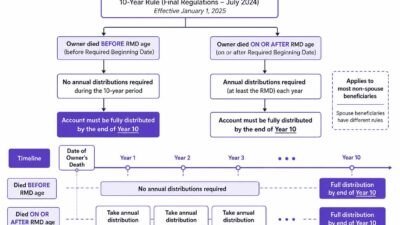
- If the original owner died before reaching their Required Beginning Date (RBD): The beneficiary is not required to take annual distributions during years 1 through 9. They can choose to wait and empty the entire account by December 31 of the 10th year following the owner’s death.
- If the original owner died after reaching their RBD: The beneficiary must take annual RMDs (based on their own life expectancy) during years 1 through 9, and then fully empty the remaining balance by the end of the 10th year.
The IRS had repeatedly waived penalties for missed inherited RMDs during the transition years of 2020 through 2024. However, starting in 2025 and continuing into 2026, these waivers have expired. Beneficiaries must now comply with these annual distribution rules or face the missed RMD penalty.
Eligible Designated Beneficiaries vs. Non-Eligible Beneficiaries
It is important to note that these strict 10-year rules apply primarily to “Non-Eligible Designated Beneficiaries” (such as adult children or grandchildren).
“Eligible Designated Beneficiaries” (EDBs) are exempt from the 10-year limit and can still stretch distributions over their own life expectancies. EDBs include:
- Surviving spouses
- Minor children of the account owner (until they reach the age of majority, at which point the 10-year clock starts)
- Chronically ill or disabled individuals
- Individuals who are not more than 10 years younger than the deceased account owner
Surviving spouses also have the unique option to execute a spousal rollover, moving the inherited assets into their own IRA and delaying distributions until they reach their own RMD starting age.
Frequently Asked Questions about 2026 RMD Rules
Can I withdraw more than my RMD in 2026?
Yes, you are always permitted to withdraw more than the required minimum amount from your retirement accounts. However, any amount you withdraw above your RMD cannot be “carried forward” or applied to satisfy your RMD requirements in future tax years. Every year requires a fresh calculation based on your account balance on December 31 of the preceding year.
Does my Roth IRA require RMDs during my lifetime?
No. Roth IRAs do not require any lifetime minimum distributions for the original account owner. This is one of the primary tax advantages of Roth IRAs compared to Traditional IRAs. However, if you inherit a Roth IRA as a non-spouse beneficiary, you are still subject to the 10-year distribution rule, though the withdrawals you make from the inherited Roth IRA will generally be tax-free.
What if I am still working at age 73?
If you are still actively employed at age 73, you may qualify for the “still-working” exception. This exception allows you to delay taking RMDs from your current employer’s 401(k) or 403(b) plan until April 1 of the year following the year you finally retire.
To qualify for this exception:
- You must be actively employed by the company sponsoring the retirement plan.
- You must not own more than 5% of the business sponsoring the plan.
- Your specific plan documents must explicitly allow for this exception (always verify this with your HR department or plan administrator).
This exception applies only to the retirement plan of your current employer. You must still take annual RMDs from any Traditional IRAs or former employer retirement plans you hold.
Conclusion
The Secure Act 2.0 RMD changes 2026 offer a valuable opportunity to optimize your retirement strategy. With the starting age now set at 73 for the 1953 birth cohort, lower penalties for missed distributions, and lifetime RMD exemptions for workplace Roth accounts, retirees have more flexibility than ever before.
However, capitalizing on these rules requires proactive planning. Waiting until December to calculate your distributions, or failing to coordinate your withdrawals with your overall income, can lead to unnecessary tax liabilities.
At ContentVibee, we are committed to providing clear, actionable financial advice to help you navigate these updates with confidence. To learn more about optimizing your retirement income, managing your tax brackets, and securing your financial future, explore our comprehensive guide and Optimize Your Retirement Strategy Today.