


Why the SECURE Act 2.0 RMD Age Changes in 2026 Matter for Your Retirement
The secure act 2.0 rmd age changes 2026 are one of the most important retirement rule shifts in decades — and if you were born between 1951 and 1959, they affect you right now.
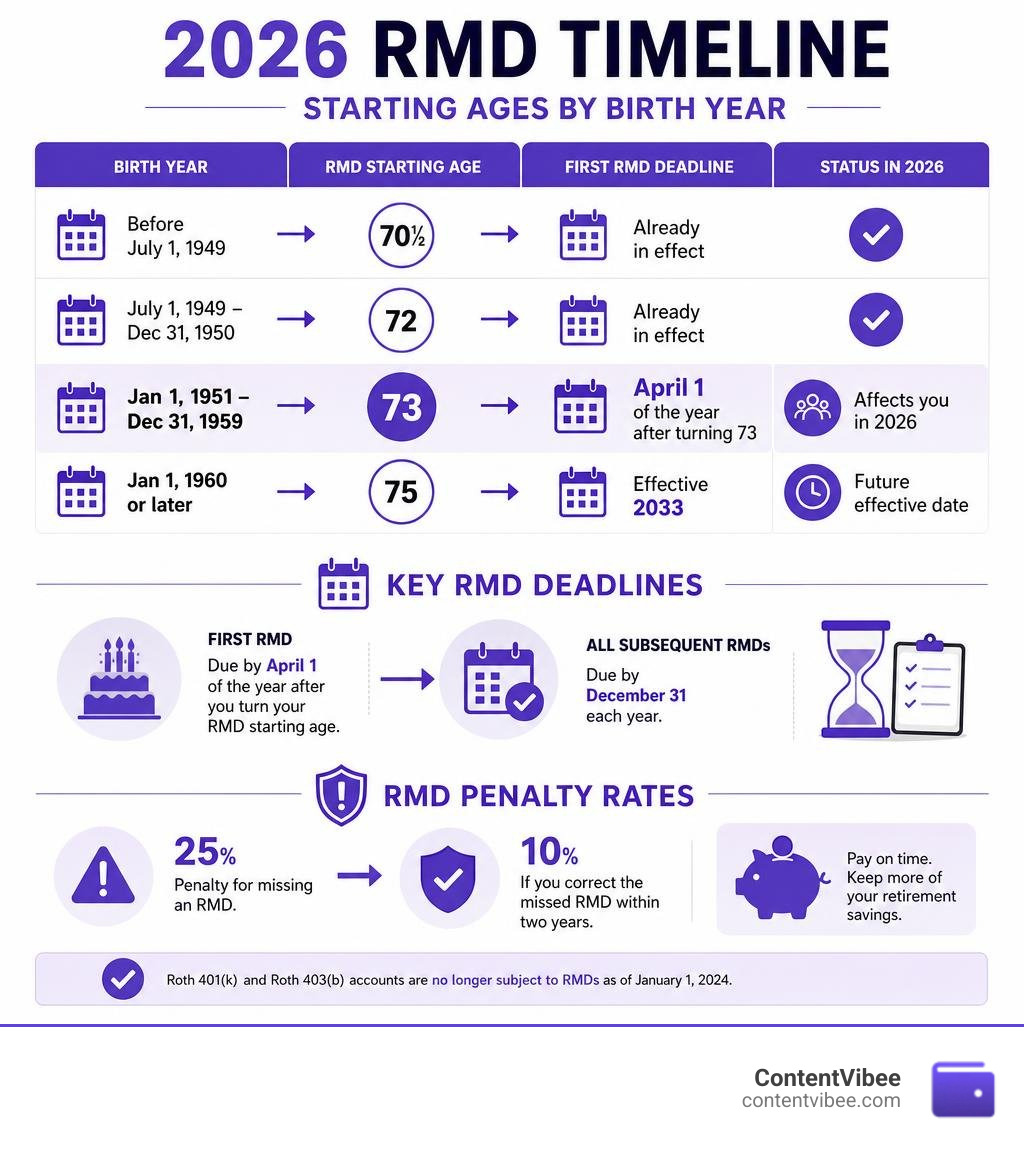
Here is the quick answer:
| Born | RMD Starting Age | First RMD Deadline |
|---|---|---|
| Before July 1, 1949 | 70½ | Already in effect |
| July 1, 1949 – Dec 31, 1950 | 72 | Already in effect |
| Jan 1, 1951 – Dec 31, 1959 | 73 | April 1 of the year after turning 73 |
| Jan 1, 1960 or later | 75 | Effective 2033 |
Key facts for 2026:
- If you turn 73 in 2026 (born in 1953), your first required minimum distribution is due by April 1, 2027
- All subsequent RMDs are due by December 31 each year
- The penalty for missing an RMD dropped from 50% to 25% — and falls to just 10% if you fix the mistake within two years
- Roth 401(k) and Roth 403(b) accounts are no longer subject to RMDs as of January 1, 2024
These changes give retirees more time and more flexibility. But the rules are layered — and getting them wrong can still cost you thousands in unnecessary taxes or penalties.
This guide breaks down exactly what changed, who it affects, how to calculate what you owe, and the smartest strategies to reduce your tax bill in 2026.
Basic secure act 2.0 rmd age changes 2026 glossary:
Navigating the SECURE Act 2.0 RMD Age Changes in 2026

The SECURE 2.0 Act, signed into law in late 2022, represents a massive overhaul of the American retirement system. One of its most talked-about elements is the delay of Required Minimum Distributions (RMDs). For decades, retirees had to begin taking money out of their tax-deferred accounts at age 70½. The original SECURE Act of 2019 pushed that to 72, and SECURE 2.0 has now bumped it to 73, with a future jump to 75.
As we navigate July 2026, these rules are no longer future projections—they are actively shaping the tax strategies of millions of retirees. If you were born in 1953, you are celebrating your 73rd birthday this year, which means 2026 is your first official RMD year.
To help you keep track of these moving targets, we have designed The Essential RMD Age Table Guide for Smart Retirees to simplify the age thresholds and clarify exactly when Uncle Sam expects you to start withdrawing your hard-earned nest egg.
Who is Affected by the SECURE Act 2.0 RMD Age Changes in 2026?
Determining your exact starting age under the secure act 2.0 rmd age changes 2026 framework depends entirely on the year you were born.
The law created a staggered transition:
- Born 1951 through 1959: Your RMD age is 73.
- Born 1960 or later: Your RMD age is 75 (this change will take effect in 2033).
There was initially some confusion in the financial community regarding individuals born in 1959. Due to a drafting error in the original legislative text of SECURE 2.0, those born in 1959 technically fell into two overlapping age categories (both age 73 and age 75). Thankfully, the IRS issued final regulations that took effect on January 1, 2025, clarifying that individuals born in 1959 must begin their RMDs at age 73.
To make sure you know where you stand, here is a breakdown of the RMD starting ages by birth year:
| Birth Year | RMD Starting Age | First Distribution Calendar Year |
|---|---|---|
| 1950 | 72 | 2022 (or by April 1, 2023) |
| 1951 | 73 | 2024 (or by April 1, 2025) |
| 1952 | 73 | 2025 (or by April 1, 2026) |
| 1953 | 73 | 2026 (or by April 1, 2027) |
| 1954 | 73 | 2027 (or by April 1, 2028) |
| 1955 | 73 | 2028 (or by April 1, 2029) |
| 1956 | 73 | 2029 (or by April 1, 2030) |
| 1957 | 73 | 2030 (or by April 1, 2031) |
| 1958 | 73 | 2031 (or by April 1, 2032) |
| 1959 | 73 | 2032 (or by April 1, 2033) |
| 1960 or later | 75 | 2035 (or by April 1, 2036) |
Deadlines and the “April 1 Trap” for 2026 Retirees
If you turn 73 in 2026, your “Required Beginning Date” for your first RMD is April 1, 2027. This grace period is a helpful safety net, but it comes with a major caveat that financial planners refer to as the “April 1 Trap.”
If you choose to delay your first RMD until April 1, 2027, you are still legally required to take your second RMD (the one for the 2027 tax year) by December 31, 2027.
Taking two large, taxable distributions in a single calendar year can artificially inflate your Adjusted Gross Income (AGI). This double-taxation risk can:
- Push you into a higher federal and state income tax bracket.
- Trigger higher taxes on your Social Security benefits. To avoid this, read up on The Ultimate Guide to Social Security Benefit Optimization.
- Push you into a higher bracket for Medicare Part B and Part D premiums via IRMAA (Income-Related Monthly Adjustment Amount) surcharges.
For most retirees, we recommend taking your first RMD by December 31 of the year you turn 73 (in this case, December 31, 2026) rather than delaying it to the following spring. Spacing out your withdrawals keeps your taxable income predictable and stable.
Calculating Your RMD and Understanding Account Differences
Calculating your RMD is a straightforward mathematical equation, but it requires using the correct variables. The formula is:
$$\text{RMD Amount} = \frac{\text{Prior Year Account Balance (as of Dec 31)}}{\text{IRS Life Expectancy Factor}}$$
For your 2026 RMD, you will use your account balance from December 31, 2025. You will then divide that number by the life expectancy factor found in the IRS Uniform Lifetime Table (Table III). The IRS updated these tables to reflect longer average life expectancies, which means your required withdrawals are slightly smaller than they would have been a few years ago.
For example, at age 73, your divisor is 26.5. If your traditional IRA balance was $500,000 on December 31, 2025, your calculation would look like this:
$$\frac{\$500,000}{26.5} = \$18,868$$
If you want to skip the manual math, you can easily Calculate Your RMD Without the Headache using our dedicated tools, or map out your broader retirement timeline with our Beginners Guide to Retirement Calculator.
IRA vs. Employer-Sponsored Plan RMD Rules
Not all retirement accounts are treated equally when it comes to RMDs. There are key differences in how you must calculate and withdraw these funds depending on where they are held.
Traditional IRAs
If you own multiple Traditional IRAs, you must calculate the RMD for each account individually. However, the IRS allows you to aggregate the total RMD amount and withdraw it from just one IRA, or distribute it across several IRAs in any proportion you choose.
Employer-Sponsored Plans (401(k), 403(b), 457(b))
Unlike IRAs, you cannot aggregate RMDs for employer-sponsored defined contribution plans. If you have three different 401(k) accounts from past employers, you must calculate and withdraw the specific RMD from each individual account.
To simplify your life, we often suggest rolling old 401(k) plans into a single Traditional IRA before you reach RMD age.
The “Still-Working” Exception
If you are still employed past your RMD age, you may be able to delay RMDs from your current employer’s 401(k) or 403(b) plan until April 1 of the year after you retire. This exception only applies if:
- You do not own more than 5% of the business sponsoring the retirement plan.
- Your employer’s specific plan document allows for this delay.
This exception does not apply to Traditional IRAs or 401(k) plans from prior employers.
The New Roth 401(k) and Roth 403(b) Exemptions
Before SECURE 2.0, there was an annoying discrepancy in tax law: original owners of Roth IRAs were exempt from RMDs, but owners of designated Roth 401(k) and Roth 403(b) accounts were still required to take RMDs.
Thankfully, Section 325 of the SECURE 2.0 Act corrected this imbalance. Effective January 1, 2024, designated Roth accounts in employer-sponsored plans are completely exempt from pre-death RMD rules. This aligns them fully with Roth IRAs, allowing your Roth workplace assets to grow tax-free for as long as you live.
For a deeper technical breakdown of how these employer plan rules are administered, you can review the detailed analysis on Required minimum distributions after SECURE 2.0 .
Inherited IRAs and the 10-Year Rule Under the 2024 Final Regulations
If you have inherited a retirement account, or plan to leave one to your heirs, the RMD landscape is entirely different. The SECURE Act of 2019 eliminated the beloved “stretch IRA” for most non-spouse beneficiaries, replacing it with a strict 10-year rule that requires the inherited account to be completely emptied by the end of the tenth year following the owner’s death.

For years, there was intense debate over whether beneficiaries had to take annual distributions during that 10-year window, or if they could simply wait and withdraw the entire balance in year 10.
The IRS finally settled this issue in its July 2024 final regulations (which took effect on January 1, 2025). The rule depends on whether the original owner had already reached their Required Beginning Date (RBD) before they passed away:
- If the owner died before reaching their RMD age: The beneficiary is not required to take annual distributions. They can wait until the 10th year to withdraw all the funds.
- If the owner died after reaching their RMD age: The beneficiary must take annual RMDs in years 1 through 9 (calculated using their own life expectancy under Table I), and then fully empty the remaining balance by the end of the 10th year.
These rules apply to “Designated Beneficiaries” (like adult children or grandchildren). However, “Eligible Designated Beneficiaries”—which include surviving spouses, chronically ill or disabled individuals, minor children of the account owner, and individuals not more than 10 years younger than the decedent—still retain the ability to stretch distributions over their single life expectancy.
Penalties, Corrections, and Strategic Tax Planning
Navigating these shifts requires active oversight of your accounts. If you want to keep more of your wealth, incorporating these updates into your ongoing financial plan is essential. To build a robust foundation, check out The Ultimate Guide to Retirement Money Management for clear, actionable steps on structuring your income.
How SECURE 2.0 Slashed the Missed RMD Penalty
Historically, the penalty for failing to take an RMD was one of the most punitive in the entire tax code: a whopping 50% excise tax on the amount you failed to withdraw.
SECURE 2.0 dramatically reduced this burden:
- The base penalty is now 25% of the missed distribution amount.
- The penalty is further reduced to 10% if you correct the mistake within the “correction window” (generally two years from the year the RMD was missed, before the IRS assesses the tax).
To correct a missed RMD and qualify for the 10% rate, you must:
- Withdraw the missed RMD amount as soon as you realize the error.
- File IRS Form 5329 with your federal tax return.
If the mistake was due to a reasonable error (such as a medical emergency, a death in the family, or an administrative mistake by your financial custodian), you can request a full waiver of the penalty. You should take the missed distribution immediately, file Form 5329, and attach a polite letter of explanation to the IRS. Historically, the IRS has been highly accommodating in granting waivers for first-time, self-corrected mistakes.
Strategic Planning Around the SECURE Act 2.0 RMD Age Changes in 2026
The delay in the RMD age to 73 gives you a valuable window of time to implement proactive tax strategies. Here are the most effective ways to manage your tax burden in 2026:
1. Qualified Charitable Distributions (QCDs)
If you are charitably inclined, a QCD is arguably the single best tax-saving tool available to retirees. It allows you to transfer up to $111,000 in 2026 directly from your Traditional IRA to a qualified 501(c)(3) charity.
The beauty of a QCD is twofold:
- The transferred amount counts directly toward satisfying your annual RMD.
- The distribution is completely excluded from your Adjusted Gross Income (AGI), meaning you do not pay income tax on it.
Crucially, QCD eligibility still begins at age 70½, even though your RMD starting age is now 73. This means you do not have to wait until your RMD years to start utilizing this tax-saving strategy.
2. Systematic Roth Conversions
The gap years between your retirement and your first RMD year (age 73) represent a golden opportunity. During these low-income “gap years,” you can convert portions of your Traditional IRA into a Roth IRA.
You will pay ordinary income taxes on the converted amount now, but the funds will grow tax-free and will not be subject to RMDs during your lifetime. This systematically reduces the size of your tax-deferred accounts, lowering your future RMD liabilities and protecting your heirs from heavy tax burdens.
To make sure you are maximizing your annual savings before and during retirement, review The Ultimate Guide to Your 2026 Max Roth IRA Contribution. If you are still earning income or want to catch up on savings, it is also smart to look at The Ultimate Guide to Retirement Contribution Catch-Up Limits and stay up to date on The New 2026 Maximum 401k Contribution Limits Explained.
3. Optimizing Social Security and Claiming Ages
Taking RMDs can push your income into brackets where more of your Social Security benefits become taxable. Coordinating your RMD age with your Social Security strategy is essential.
Learn how to align these timelines by checking out The Complete Guide to Social Security Full Retirement and The Definitive Guide to Social Security Claiming Age.
Frequently Asked Questions About 2026 RMD Rules
What is the RMD starting age for individuals turning 73 in 2026?
If you turn 73 in 2026 (meaning you were born in 1953), your RMD starting age is 73. Your very first RMD is for the 2026 tax year, and you have until April 1, 2027 to withdraw it. However, to avoid the “April 1 Trap” of taking two distributions in 2027, it is often wiser to complete your first withdrawal by December 31, 2026.
Do I have to take an RMD from my Roth 401(k) in 2026?
No. Thanks to Section 325 of the SECURE Act 2.0, designated Roth accounts in employer-sponsored plans (like Roth 401(k) and Roth 403(b) accounts) are completely exempt from lifetime RMD requirements. This change went into effect on January 1, 2024.
How do I correct a missed RMD to reduce my penalty to 10%?
To reduce the penalty from 25% to 10%, you must withdraw the missed distribution amount from your account immediately upon discovery. Next, file IRS Form 5329 with your tax return to report the mistake and calculate the reduced 10% excise tax. If you have a valid reason for the oversight, you can also use this form to request a full waiver of the penalty.
Conclusion
The secure act 2.0 rmd age changes 2026 rules provide retirees with unprecedented flexibility, but they also require careful planning. With RMD ages pushed to 73, lower penalties for mistakes, and the elimination of Roth 401(k) RMDs, you have more control over your retirement distribution strategy than ever before.
At ContentVibee, we believe that clear, actionable financial advice is the key to a stress-free retirement. Don’t let tax season catch you off guard—start planning your distribution schedule today to keep more of your hard-earned money in your pocket.
Ready to master your retirement benefits? Explore the Complete 2026 Retirement Benefits Guide to secure your financial peace of mind.


