

Why Margin of Safety Accounting Is the Financial Metric Every Business Needs
Margin of safety in accounting is one of the most practical risk management tools available — yet many business owners overlook it until things go wrong.
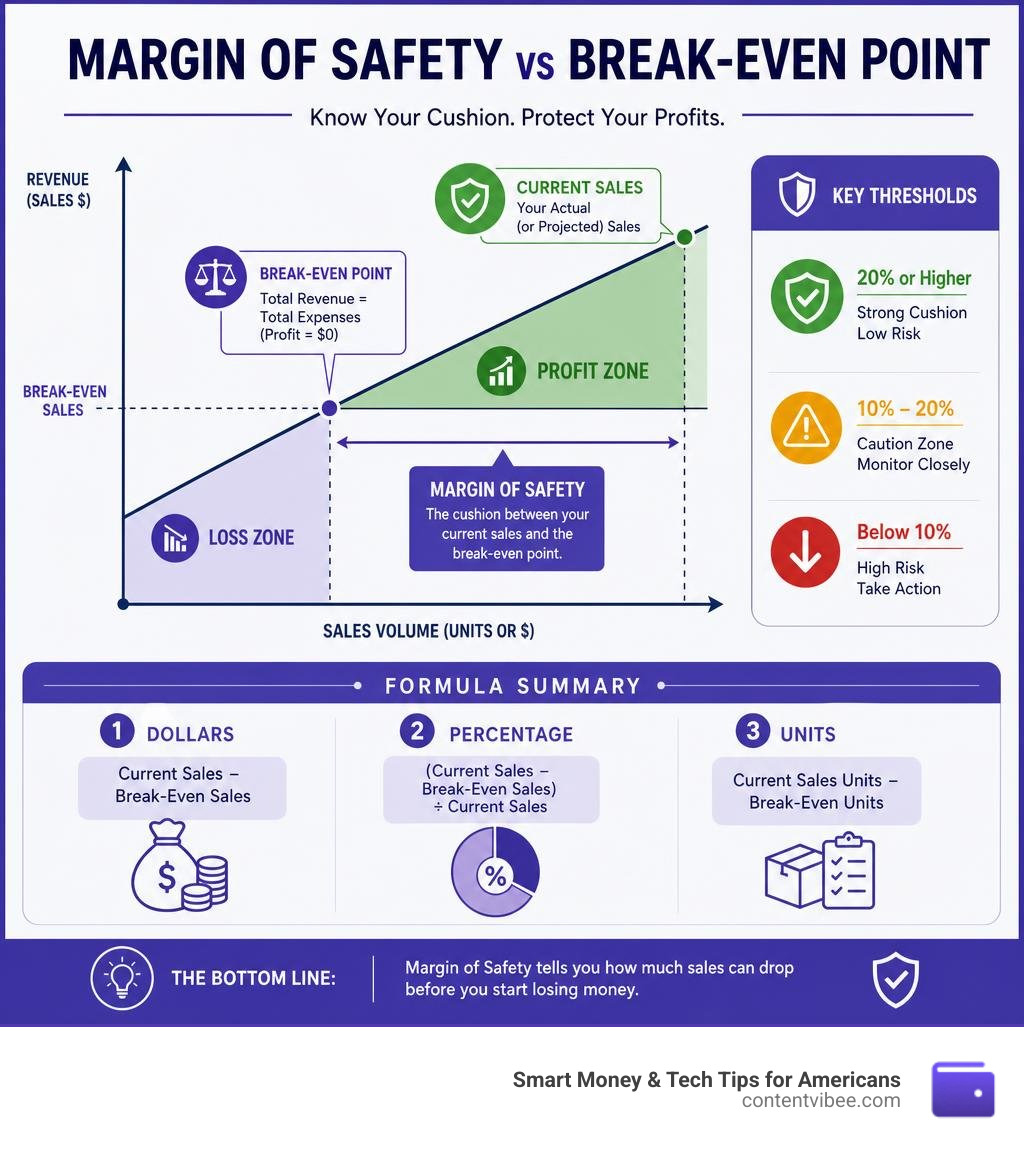
Quick answer: The margin of safety tells you how much your sales can drop before your business starts losing money. Here’s the formula at a glance:
| Format | Formula |
|---|---|
| Dollars | Current Sales − Break-Even Sales |
| Percentage | (Current Sales − Break-Even Sales) ÷ Current Sales |
| Units | Current Sales Units − Break-Even Units |
A result above 20% is generally considered healthy. Below 10% is a warning sign.
Think of it like the weight limit on an elevator. The stated limit might be 250 lbs, but the actual safe capacity is higher — that buffer is your margin of safety. In business, that buffer is the gap between what you’re selling and the bare minimum you need to sell just to break even.
For retirees and pre-retirees managing fixed incomes, understanding how businesses measure financial risk matters — whether you’re evaluating a stock, running a side business, or simply trying to make sense of financial reports.
A low margin of safety doesn’t just mean thin profits. It means the business is one bad quarter away from a loss.
This guide walks you through everything: what the metric means, how to calculate it in three formats, what a good number looks like, and how to use it to make smarter financial decisions.
What is Margin of Safety Accounting?
At its core, margin of safety accounting measures the cushion a business has between its current (or projected) sales performance and its break-even point. The break-even point is the exact level of sales where total revenues equal total expenses, resulting in exactly $0 of net income.
As detailed by AccountingTools, the margin of safety represents the specific volume of sales decline that can occur before a company begins to experience operating losses. It is a vital component of Cost-Volume-Profit (CVP) analysis, which studies how changes in costs and volume affect a company’s operating income.
If we look at a business’s health, we cannot rely on net profit alone. A company might show a healthy-looking net profit of $50,000 this month. But if its break-even point requires $45,000 in sales and it currently generates $50,000, that profit is highly precarious. A minor market downturn, a new competitor, or a slight increase in supplier costs could instantly wipe out that profit and push the business into a deficit.
By analyzing the margin of safety, managers can determine exactly how much breathing room they have. It acts as a financial early-warning system. If the buffer is wide, we can confidently invest in growth, research and development, or marketing. If the buffer is narrow, we must immediately pivot to cost-control measures or pricing adjustments to protect our bottom line.
How to Calculate the Margin of Safety
To calculate your margin of safety, you must first gather three essential pieces of data:
- Actual or Budgeted Sales: The revenue your business is currently making or expects to make during a specific period.
- Fixed Costs: Expenses that do not change regardless of how much you produce or sell (such as rent, insurance, and executive salaries).
- Variable Costs: Expenses that fluctuate in direct proportion to your production or sales volume (such as raw materials, direct labor, and shipping fees).
Once you have these figures, you must calculate your break-even sales revenue. If you are doing this in spreadsheets, you can make the process much easier by setting up templates. You can learn how to build these dynamic sheets in our guide on how to stop eyeballing it with Excel margin formulas.
Let’s break down the calculations step by step across three different formats: dollars, units, and percentages.
Calculating Margin of Safety Accounting in Dollars
The dollar-based calculation is the most straightforward way to visualize your financial cushion. It tells you the exact amount of revenue you can lose before you stop making a profit.
The basic formula is:
$$\text{Margin of Safety (Dollars)} = \text{Current (or Budgeted) Sales} – \text{Break-Even Sales}$$
As explained in the educational resources from OpenStax, the break-even sales point in dollars is calculated by dividing your total fixed costs by your contribution margin ratio.
Let’s look at a practical example. Imagine a manufacturing business, Manteo Machine, which has:
- Current Sales: $225,000
- Break-Even Sales: $153,000
Using our formula:
$$\text{Margin of Safety} = \$225,000 – \$153,000 = \$72,000$$
This means Manteo Machine can afford to lose up to $72,000 in sales revenue before it begins operating at a loss.
Calculating Margin of Safety Accounting in Units and Percentages
While knowing the dollar amount is helpful, expressing your margin of safety in units or as a percentage often provides better operational clarity.
Margin of Safety in Units
For businesses that sell physical products, tracking the margin of safety in units helps production managers align their schedules with sales risks. The formula is:
$$\text{Margin of Safety (Units)} = \text{Current Sales Units} – \text{Break-Even Units}$$
If Manteo Machine sells its parts for $90 each, we can convert our sales figures into units:
- Current Sales Units: 2,500 units ($225,000 / $90)
- Break-Even Units: 1,700 units ($153,000 / $90)
$$\text{Margin of Safety (Units)} = 2,500 – 1,700 = 800 \text{ units}$$
This tells us that the production line can produce 800 fewer units than budgeted before the company starts losing money.
Margin of Safety as a Percentage
To compare different divisions or companies of varying sizes, the percentage format is the gold standard. It normalizes the data, showing the percentage drop in sales the company can withstand.
The formula, as outlined by Xero, is:
$$\text{Margin of Safety (\%)} = \frac{\text{Current Sales} – \text{Break-Even Sales}}{\text{Current Sales}} \times 100$$
Using our Manteo Machine figures:
$$\text{Margin of Safety (\%)} = \frac{\$225,000 – \$153,000}{\$225,000} \times 100 = 32\%$$
A margin of safety of 32% means that sales can decline by nearly one-third before the business enters negative territory. This represents a highly stable operating environment.
Interpreting Your Margin of Safety: What is a “Good” Percentage?
What do these percentages actually mean for your day-to-day operations?
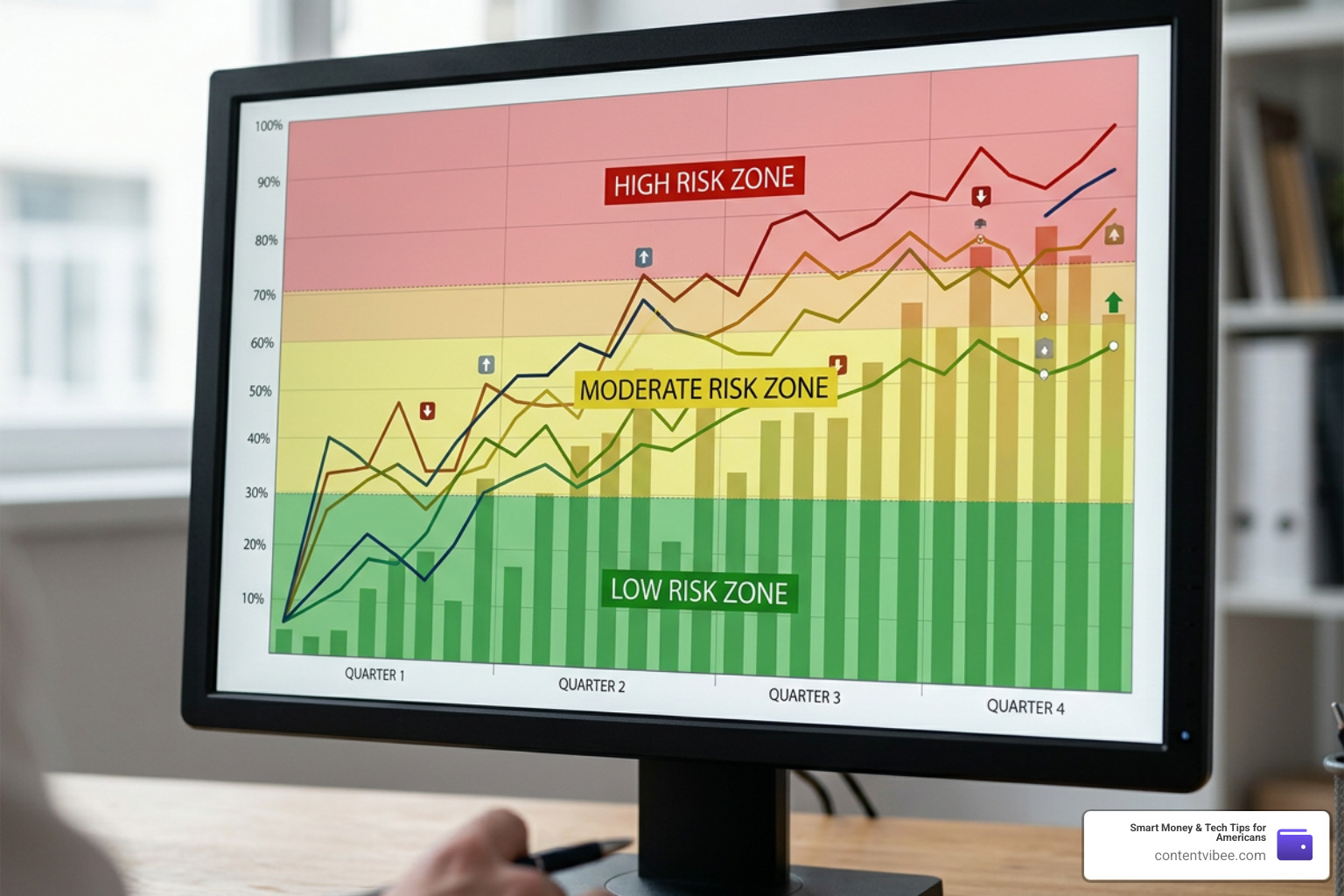
To help you evaluate your business or investments, we categorize margin of safety percentages into three distinct risk tiers:
- Healthy (20% or More): A margin of safety above 20% indicates a strong, resilient business. The company has a comfortable buffer to absorb sudden economic downturns, rising material costs, or aggressive moves by competitors.
- Moderate (10% to 19%): The business is stable but must be managed carefully. A bad quarter or a minor sales dip could quickly erase profits.
- High Risk (Below 10%): A margin of safety below 10% means the business is walking a financial tightrope. There is virtually no room for error. A single lost client, a shipping delay, or an unexpected repair bill could push the company into a net loss.
To understand how quickly a major capital decision can erode this safety buffer, consider a historic case study involving Ford Co.
The company purchased new automated machinery to increase production capacity. While the automation promised higher long-term efficiency, it raised their fixed operating expenses to $1,000,000 per year. Following this heavy investment, Ford Co. achieved $4,200,000 in sales, but their new break-even point climbed to $3,956,400.
Using our percentage formula:
$$\text{Margin of Safety} = \frac{\$4,200,000 – \$3,956,400}{\$4,200,000} \times 100 = 5.8\%$$
By raising its fixed costs so high, Ford Co. was left with a razor-thin 5.8% margin of safety. While the new machinery made them more modern, it also made them highly vulnerable to minor fluctuations in consumer demand. This is why we must always look deeper than top-line revenue. To learn more about how fixed and variable costs impact your overall profitability, read our guide on gross margin cost demystified for small businesses.
The Strategic Role of Margin of Safety in Business Decisions
The margin of safety is not just a backward-looking report card; it is an active decision-making framework. Here is how we can use it to guide our strategic moves:
- Pricing Strategy: If our margin of safety is high, we have the flexibility to run promotional discounts to capture market share. If it is low, we cannot afford price wars and must focus on premium positioning.
- Cost Control: A shrinking margin of safety signals that we must audit our overhead. It tells us exactly when to freeze hiring, renegotiate vendor contracts, or reduce discretionary spending.
- Product Evaluation: When launching new products, we can calculate their individual margins of safety to decide which items deserve more marketing budget and which should be discontinued.
- Performance Targets: Instead of setting arbitrary sales goals, we can back into our targets. If we know our fixed costs require $100,000 in sales to break even, and we want a 25% safety buffer, we know our minimum target sales must be $133,333.
To visualize how these scenarios play out in real life, review the comparison below:
| Scenario Metric | High Margin of Safety (e.g., 35%) | Low Margin of Safety (e.g., 5%) |
|---|---|---|
| Risk Tolerance | High; can experiment with new products. | Extremely low; must focus on core survival. |
| Pricing Flexibility | High; can absorb temporary price cuts. | None; price cuts will trigger immediate losses. |
| Operational Focus | Growth, expansion, and market share. | Cost reduction and cash flow preservation. |
| Vulnerability to Churn | Low; can withstand losing key accounts. | Critical; losing one client could be catastrophic. |
Margin of Safety in the Technology Sector
While traditional manufacturing companies must manage physical inventory, technology companies face an entirely different financial landscape.
Tech firms — especially Software-as-a-Service (SaaS), artificial intelligence (AI), and quantum computing startups — typically deal with massive upfront Research and Development (R&D) costs. These R&D expenditures, alongside high Customer Acquisition Costs (CAC), create massive fixed operating expenses.
Once the software or platform is built, however, the variable cost of delivering it to an additional user is near zero. This creates a business model with incredibly high operating leverage.
For tech companies, monitoring the margin of safety in accounting is critical for three main reasons:
- High Innovation Risk: Tech products can become obsolete overnight. A high safety margin ensures the company has the financial runway to pivot when a competitor releases a superior product.
- Sales Volatility: Young tech startups often experience highly unpredictable sales cycles.
- Customer Churn: SaaS businesses rely on recurring subscription revenue. If the customer churn rate spikes unexpectedly, the subscription revenue can drop rapidly.
If a SaaS platform has $500,000 in fixed overhead, charges $100 per month per subscription, and incurs $20 in variable hosting costs per user, its contribution margin per unit is $80 ($100 – $20).
To break even, it needs:
$$\text{Break-Even Point} = \frac{\$500,000}{\$80} = 6,250 \text{ subscriptions}$$
If they currently have 10,000 active subscribers, their margin of safety in units is 3,750 subscribers. Expressed as a percentage, their margin of safety is 37.5%. This indicates that they can lose over a third of their customer base to churn before they stop breaking even — giving them a comfortable buffer to optimize their product and improve customer retention.
Limitations and Relationship to Other CVP Metrics
While the margin of safety is an invaluable metric, we must acknowledge its limitations. Like all CVP metrics, it relies on several simplifying assumptions:
- Constant Selling Price: It assumes that the price per unit remains constant regardless of sales volume, ignoring volume discounts.
- Linear Cost Behavior: It assumes that fixed costs remain perfectly flat and variable costs change in a perfectly linear fashion, which is rarely true over a long timeline.
- Constant Sales Mix: For companies selling multiple products, it assumes the proportion of each product sold remains constant. If customers suddenly buy more of your low-margin items and fewer of your high-margin items, your overall break-even point will rise, rendering your previous margin of safety calculations inaccurate.
To understand how the margin of safety fits into your broader financial picture, we must look at how it interacts with other key metrics.

As shown in the diagram, the margin of safety works hand-in-hand with:
- Contribution Margin: This is the revenue left over after subtracting variable costs. It is the money available to cover fixed costs and generate profit. The higher your contribution margin, the faster you reach your break-even point, which naturally expands your margin of safety.
- Degree of Operating Leverage (DOL): Operating leverage measures how sensitive your net income is to changes in sales volume.
There is a fascinating, inverse relationship here: companies with high fixed costs (like tech startups or heavy manufacturers) have high operating leverage. This means that once they pass their break-even point, their profits grow exponentially. However, it also means they have a much smaller margin of safety until they reach that point.
Managing this balance is the key to corporate survival. If you are an accountant or advisor helping clients navigate these ratios, check out our margin calculator for accountants to stop undercharging and multiply profits.
Frequently Asked Questions about Margin of Safety Accounting
How often should a company recalculate its margin of safety?
At a minimum, we recommend calculating your margin of safety monthly or quarterly. However, you should instantly recalculate it whenever your business experiences:
- Significant Cost Changes: A sudden rent increase, a minimum wage hike, or a spike in raw material costs.
- Pricing Adjustments: If you raise or lower your prices, your contribution margin changes, which shifts your break-even point.
- Seasonality: Many businesses experience massive seasonal swings. A toy retailer might have a 60% margin of safety in December but a negative margin of safety in March. For these businesses, calculating a rolling 12-month average is essential to avoid false panic.
What actions should be taken if the margin of safety is negative or shrinking?
A negative margin of safety means your current sales are below your break-even point — you are actively losing money. If your margin is shrinking or negative, you must take immediate action:
- Reduce Fixed Expenses: Can you downsize your office space, renegotiate software subscriptions, or automate manual processes to lower your overhead?
- Optimize Variable Costs: Renegotiate with suppliers, buy raw materials in bulk, or find more efficient shipping methods to improve your contribution margin.
- Adjust Pricing: A small, strategic price increase can dramatically lower your break-even point, provided it does not trigger a massive drop in sales volume.
- Improve Product Mix: Focus your marketing efforts on your highest-margin products or services while phasing out low-margin, high-effort offerings.
How does the accounting concept differ from the value investing principle?
While we have focused on managerial accounting, the term “margin of safety” is also legendary in the investing world. As explained by Investopedia, the concept was popularized by Benjamin Graham (the father of value investing) and his most famous student, Warren Buffett.
The differences between the two applications are distinct:
- In Accounting: The margin of safety is an objective, internal operational metric. It measures the gap between actual sales and break-even sales using verifiable financial data.
- In Investing: The margin of safety is a subjective, external valuation tool. It represents the difference between a company’s estimated intrinsic value (what the business is truly worth based on discounted cash flows) and its current stock market price.
Value investors aim to buy stocks only when they trade at a significant discount (often 20% to 50%) to their intrinsic value. This discount protects the investor from analytical errors, unexpected industry downturns, or market volatility.
This philosophy was further immortalized by billionaire investor Seth Klarman, head of the Baupost Group, in his legendary 1991 book, Margin of Safety. Klarman has delivered incredible, Buffett-esque long-term returns by strictly adhering to this principle.
Interestingly, because the book was printed in limited quantities and went out of print, it has become a cult classic. It is famously known as the #1 most-stolen book from university libraries, with physical copies regularly selling for over $900 on secondary markets!
Conclusion
Whether you are running a local small business, managing a fast-growing tech startup, or investing your hard-earned retirement savings, the margin of safety is your ultimate financial shield. It cuts through the noise of top-line revenue and tells you exactly how much economic storm your business can weather before taking on water.
In 2026, you do not need to perform these complex calculations on the back of a napkin. Modern cloud accounting platforms like Xero, combined with automated FP&A tools, can track your fixed and variable costs in real-time, displaying your live margin of safety on an interactive dashboard.
At ContentVibee, we specialize in helping personal finance enthusiasts, business owners, and retirees navigate complex financial landscapes. To easily model different pricing, cost, and break-even scenarios for your business or personal projects, use our free, interactive ContentVibee Margin Calculator. Keep your buffers wide, your fixed costs managed, and your financial future secure!