How Much Is a Social Security Spousal Benefit Worth?
A social security spousal benefit can be worth up to 50% of your spouse’s full retirement benefit — and millions of Americans leave this money on the table simply because they don’t know it exists.
Here’s a quick answer to what most people want to know:
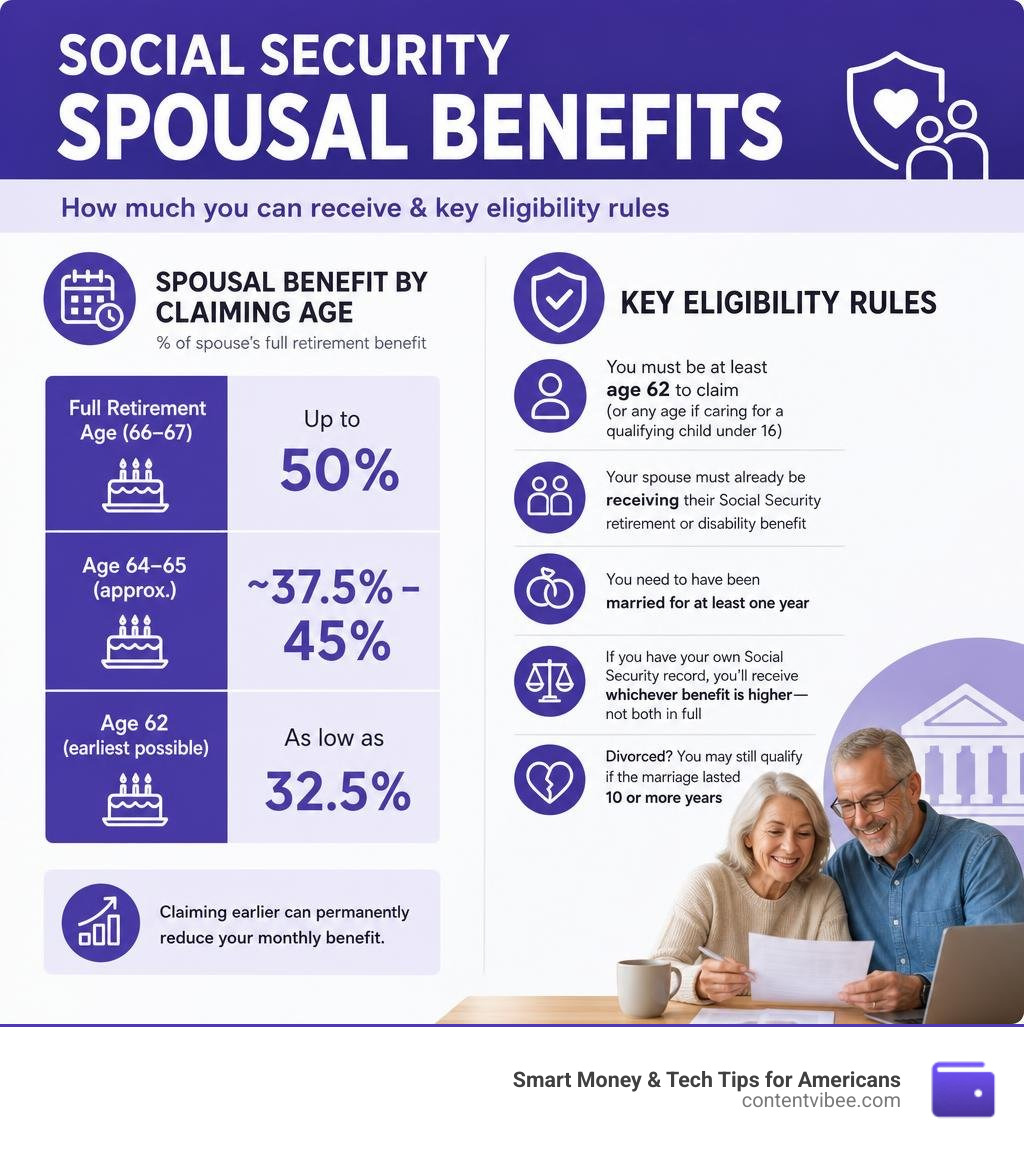
| Claiming Age | Spousal Benefit (% of Spouse’s Full Benefit) |
|---|---|
| Full Retirement Age (66–67) | Up to 50% |
| Age 64–65 (approx.) | ~37.5% – 45% |
| Age 62 (earliest possible) | As low as 32.5% |
Key facts at a glance:
- You must be at least age 62 to claim (or any age if caring for a qualifying child under 16)
- Your spouse must already be receiving their Social Security retirement or disability benefit
- You need to have been married for at least one year
- If you have your own Social Security record, you’ll receive whichever benefit is higher — not both in full
- Divorced? You may still qualify if the marriage lasted 10 or more years
Timing matters a lot here. Claiming at 62 instead of waiting until your full retirement age can permanently reduce your monthly check — sometimes by nearly a third.
The good news: once you understand how the calculation works, you can make a smarter decision about when to file and how much to expect.
What is the Social Security Spousal Benefit and Who Qualifies?

The social security spousal benefit is designed to provide financial security for couples during their retirement years. It ensures that a spouse who had lower lifetime earnings—or who spent years working unpaid inside the home—can still receive a substantial retirement payout based on their partner’s work history.
But how does it work, and who is actually eligible? To get started, you must understand that this benefit does not deplete your partner’s retirement account. Instead, it is an additional payment paid by the Social Security Administration (SSA). To qualify, you must meet specific criteria outlined in the official regulations.
If you are trying to figure out if you meet the baseline criteria, we recommend checking out our comprehensive guide on How to Understand Spousal Benefit Eligibility as a starting point. To help you navigate the fine print, let’s break down the rules for both happily married couples and those who have gone their separate ways.
Basic Eligibility Rules for the Social Security Spousal Benefit
To qualify for a spousal benefit on a living spouse’s record, you must satisfy several strict federal requirements. According to the SSA Handbook § 305, you are generally entitled to these benefits if:
- Your spouse is already entitled to benefits: The primary worker (your husband or wife) must already be receiving their own retirement or disability benefits. If they haven’t filed yet, you cannot collect a spousal benefit on their record.
- You meet the age or parental requirement: You must be at least 62 years old, or you must have a qualifying child in your care. A qualifying child is defined as a child who is under age 16 or who became disabled before age 22. If you are caring for a qualifying child, the age 62 restriction does not apply to you.
- You meet the marriage duration rule: In most cases, you must have been legally married to your spouse for at least one continuous year before applying.
- Your own benefit is lower: You cannot receive a spousal benefit if your own primary retirement benefit is higher than half of your spouse’s full retirement benefit. The SSA will always pay your own retirement benefit first.
For a deeper dive into how these rules apply directly to married households, you can read our detailed breakdown on How Social Security Spousal Benefits Work For Married Couples.
There are also legal distinctions to keep in mind. Under the SSA’s Program Operations Manual System (POMS), specifically SSA – POMS: RS 00202.001, the government recognizes both a “legal spouse” and a “deemed spouse.” A deemed spouse is someone who entered into a marriage ceremony in good faith, even if a legal technicality (like an administrative error in a previous divorce) technically invalidated the marriage. This ensures that honest mistakes don’t strip you of your hard-earned retirement security.
Special Rules for Divorced Spouses
What happens if you are divorced? Many people mistakenly believe that splitting up means losing access to their ex-partner’s Social Security record. Fortunately, the system is highly protective of long-term ex-spouses.
If you are divorced, you can still claim a social security spousal benefit on your ex-spouse’s record if you meet the following conditions:
- The 10-Year Rule: Your marriage must have lasted for at least 10 consecutive years before the divorce was finalized. If you divorced at 9 years and 11 months, you unfortunately do not qualify.
- The Remarriage Rule: You must currently be unmarried. If you remarry, you generally lose the right to claim benefits on your ex-spouse’s record (unless your subsequent marriage ends by death, divorce, or annulment). Your ex-spouse’s marital status does not affect your eligibility; they can remarry five times over, and it won’t impact your claim.
- The 2-Year Divorce Rule: Unlike married couples, you can actually claim benefits on your ex-spouse’s record even if they haven’t filed for Social Security yet. However, this is only allowed if you have been divorced for at least two consecutive years, and your ex is at least 62 years old.
The best part? Your ex-spouse will never be notified by the SSA that you have filed on their record. It does not impact their monthly payment in any way, nor does it affect the benefits of their current spouse. For more details on navigating these complex rules, read Double The Fun Understanding Your Spousal Social Security Benefits.
How to Calculate Your Spousal Benefit Amount

Calculating your potential spousal benefit is relatively straightforward once you understand the basic formula. The absolute maximum spousal benefit you can receive is 50% of your spouse’s Primary Insurance Amount (PIA).
The PIA is the monthly amount your spouse is entitled to receive at their exact Full Retirement Age (FRA). It is important to note that if your spouse decided to claim their retirement benefits early (resulting in a permanently reduced check for them), your spousal benefit is still calculated based on their full FRA amount. You are not penalized for their decision to claim early.
However, if you decide to claim your spousal benefit before reaching your own Full Retirement Age, your monthly check will be permanently reduced. You can explore the SSA’s official calculation resources on Benefits for Spouses to see how these math formulas are applied. To better visualize this process, let’s look at how the timeline of your claim shapes your final numbers.

If you’d like a step-by-step guide to doing these calculations yourself, check out our resource on Determining Your Spousal Social Security Benefit Amount.
The Impact of Claiming Age on Your Social Security Spousal Benefit
Your age at the moment you file for the social security spousal benefit is the single most important factor determining your monthly payout. If you wait until your Full Retirement Age (which is between 66 and 67, depending on your birth year), you will receive the full 50% of your partner’s PIA.
If you file early, the SSA applies a strict reduction formula:
- For the first 36 months before your FRA, your benefit is reduced by 25/36 of 1% for each month.
- For any additional months beyond 36 months, the benefit is further reduced by 5/12 of 1% per month.
This means if you claim at the absolute earliest age of 62, your spousal benefit will be permanently slashed to just 32.5% of your partner’s PIA.
| Months Before Full Retirement Age | Percentage of Spouse’s PIA You Receive |
|---|---|
| 0 Months (Full Retirement Age) | 50.0% |
| 12 Months Early | 45.8% |
| 24 Months Early | 41.7% |
| 36 Months Early | 37.5% |
| 48 Months Early | 35.0% |
| 60 months Early (Age 62, if FRA is 67) | 32.5% |
For example, let’s say your spouse’s PIA is $2,000.
- If you wait until your FRA to claim, your maximum spousal benefit is $1,000 (50%).
- If you claim 36 months early, your benefit is reduced to $750 (37.5%).
- If you claim 60 months early at age 62, your benefit drops to just $650 (32.5%).
Because these reductions are permanent, understanding the calendar is vital. To learn more about how to optimize your filing date, read Social Security Spousal Benefits Timing Is Everything.
How Your Own Retirement Benefits Interact with Spousal Benefits
A common point of confusion is how your own work history interacts with your spousal benefits. Can you double-dip and collect both?
The short answer is no. Under the SSA’s “deemed filing” rules, when you apply for retirement benefits, you are automatically filing for both your own retirement benefit and the spousal benefit. The SSA will calculate both amounts and pay you your own retirement benefit first. If your spousal benefit is higher than your own retirement benefit, you will receive a “spousal top-up” to make up the difference.
Let’s look at the real-world example of Sandy:
- Sandy’s own retirement benefit at her FRA is $1,000.
- Sandy’s husband has a PIA of $2,500. At FRA, Sandy’s maximum spousal benefit is 50% of that, which equals $1,250.
- Because Sandy’s spousal benefit ($1,250) is higher than her own benefit ($1,000), she is eligible for the spousal benefit.
- The SSA will pay Sandy her own $1,000 retirement benefit, plus a $250 spousal top-up. Her total monthly check will be $1,250.
If Sandy’s own retirement benefit had been $1,500, she would simply receive her own $1,500 check, and no spousal benefit would be paid because her own record yields the higher amount. To make sure you aren’t leaving money on the table during this calculation, read our guide on Maximizing Spousal Benefits Without Leaving Money On The Table.
Key Differences: Spousal Benefits vs. Survivor Benefits
It is incredibly common to confuse spousal benefits with survivor benefits, but they are entirely different programs with distinct rules, calculations, and purposes.
The primary difference lies in whether the worker is living or deceased:
- Spousal Benefits: Paid while your spouse is still alive. The maximum benefit is capped at 50% of their Primary Insurance Amount.
- Survivor Benefits: Paid to you after your spouse passes away. The maximum benefit can be up to 100% of the deceased worker’s actual monthly benefit.
If your spouse passes away and you are already receiving a spousal benefit, the SSA will transition you to a survivor benefit. Additionally, while spousal benefits do not earn “delayed retirement credits” (waiting past your FRA to claim a spousal benefit will not increase it beyond the 50% cap), survivor benefits do factor in those credits. If your late spouse delayed claiming their own benefit until age 70 to maximize their check, your survivor benefit will reflect that higher, maximized amount.
To understand how these rules are codified in administrative policy, you can review the definitions under SSA – POMS: RS 00202.001. For a broader look at how couples can coordinate both types of benefits to secure their financial future, check out Double The Fun A Guide To Social Security Spousal Benefits For Couples.
How to Estimate and Apply for Your Spousal Benefits Online
In July 2026, managing your retirement planning is easier than ever thanks to the SSA’s digital tools. You can estimate your future spousal benefits and file your application entirely online.
The absolute best way to start planning is by creating or logging into your personal my Social Security account. Creating an account takes less than 10 minutes and gives you instant access to your personalized earnings record and benefit estimates.
Here is the step-by-step process to estimate your spousal benefits online:
- Go to the official SSA website and sign in to your my Social Security account.
- Scroll down to the Retirement Calculator section of your dashboard.
- Select the option that says Calculate a Benefit as a Spouse or Compare with Benefit as a Spouse.
- Choose the future age or date you plan to start receiving your benefits.
- Enter your spouse’s estimated retirement benefit at their Full Retirement Age (you can find this on their own my Social Security statement).
Once you are ready to apply, you can complete the online application on the SSA website if you are at least 61 years and 9 months old. The system will guide you through entering your marriage history, your spouse’s details, and your direct deposit information.
According to the official payment guidelines in SSA – POMS: RS 00202.020, your monthly payments will be processed and rounded to the nearest dollar, with adjustments made for any early retirement reductions.
If you want a digital tool to run different retirement scenarios and see how your claiming age affects your household income, try out our Tools/Finance Calculator/Social Security Spousal Benefit Calculator.
Frequently Asked Questions About Spousal Benefits
Does claiming a spousal benefit reduce my partner’s monthly payment?
No. This is one of the most common myths about the social security spousal benefit. Claiming a benefit on your partner’s work record does not reduce their monthly check by a single penny. It also does not impact the benefits of any other family members, such as a divorced ex-spouse. The system is designed to pay these benefits out of the general Social Security trust funds, not by deducting money from your spouse’s account. For more on coordinating your claims as a team, read The Smart Couples Guide To Social Security Strategies.
Can I receive a spousal benefit if my ex-spouse hasn’t filed yet?
Yes, but only if you meet the “independently entitled divorced spouse” criteria. To do this, you must have been divorced for at least two consecutive years, your ex-spouse must be at least 62 years old, and your marriage must have lasted for at least 10 years. If you meet these conditions, you can file for benefits on their record even if they are still working and haven’t claimed their own retirement benefits yet. To learn more about timing strategies for both married and divorced couples, read Timing Is Everything How Married Couples Can Claim Social Security Simultaneously.
What is the maximum spousal benefit I can receive?
The absolute maximum spousal benefit is 50% of your spouse’s Primary Insurance Amount (PIA) at their Full Retirement Age. Unlike personal retirement benefits, spousal benefits do not increase if you delay claiming past your own Full Retirement Age. There are no “delayed retirement credits” for spouses. Once you reach your FRA, your spousal benefit is capped, so there is no financial benefit to waiting until age 70 to claim it.
Conclusion
Navigating the rules of the social security spousal benefit can feel overwhelming, but taking the time to understand them is one of the most valuable things you can do for your retirement security. By coordinating your claiming ages, understanding the impact of early filing penalties, and leveraging online tools, you and your partner can maximize your monthly lifetime income.
At ContentVibee, we specialize in breaking down complex financial rules into clear, actionable steps. Whether you are navigating the latest SECURE Act 2.0 changes, managing required minimum distributions (RMDs), or mapping out your Social Security strategy, we are here to help you make informed decisions.
Ready to see exactly how much you stand to receive? Head over to our easy-to-use tool and Calculate Your Spousal Benefits the Easy Way to start optimizing your retirement strategy today!