

The Age That Changes Everything for Your 401(k)
Understanding the 401k withdrawal rules 59 1 2 is one of the most important things you can do before touching your retirement savings. Get it wrong and you could hand the IRS thousands of dollars in penalties — completely unnecessarily.
Here is the quick answer most people need:
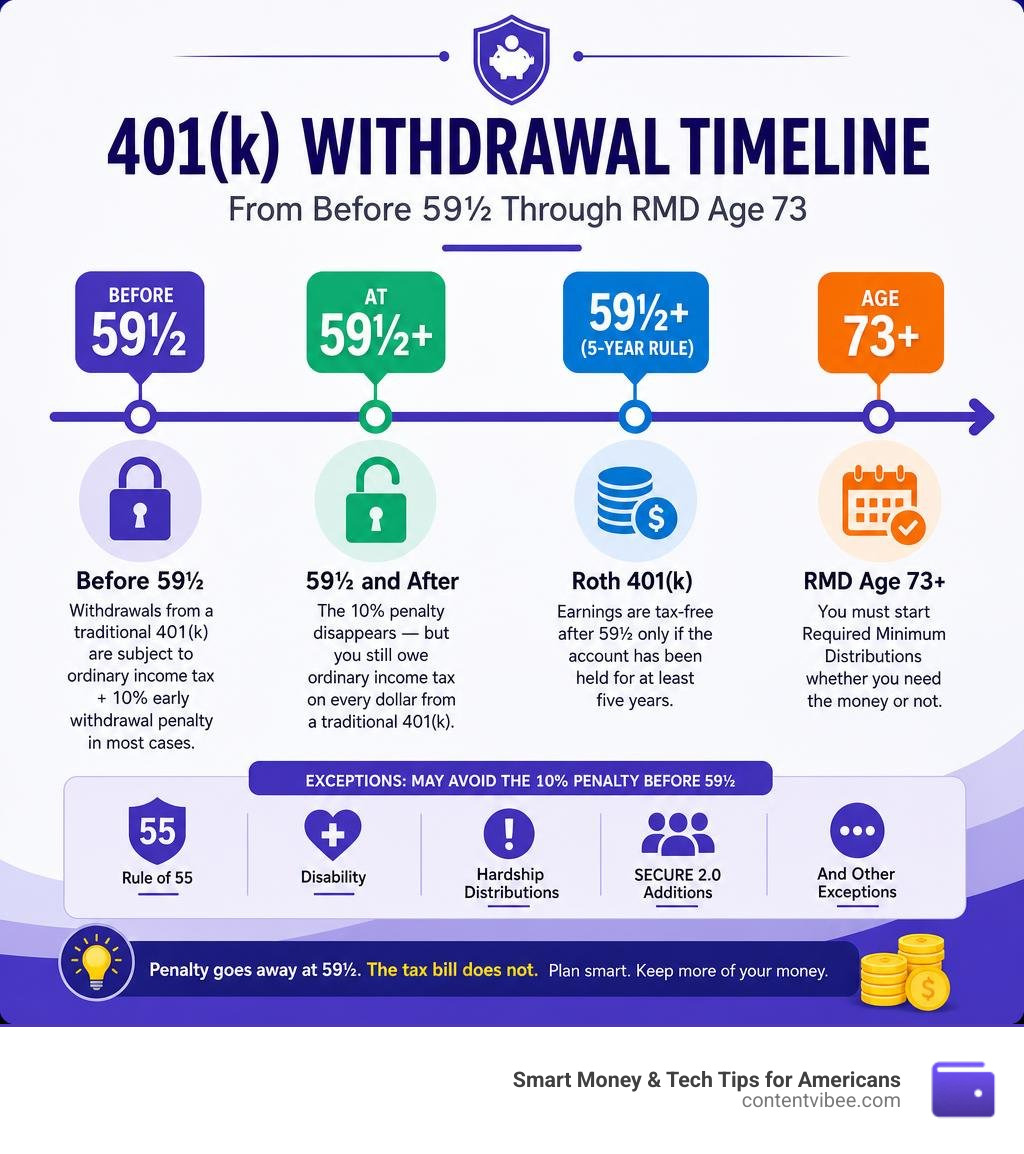
Key 401(k) withdrawal rules at age 59½:
- Before 59½: Withdrawals from a traditional 401(k) are subject to ordinary income tax plus a 10% early withdrawal penalty in most cases
- At 59½ and after: The 10% penalty disappears — but you still owe ordinary income tax on every dollar from a traditional 401(k)
- Roth 401(k): Earnings are tax-free after 59½ only if the account has been held for at least five years
- Required Minimum Distributions (RMDs): You must start withdrawing at age 73 (or 75 if born in 1960 or later) whether you need the money or not
- Exceptions exist: The Rule of 55, hardship distributions, disability, and several SECURE 2.0 additions can let you avoid the 10% penalty before 59½
The penalty goes away at 59½. The tax bill does not. That distinction trips up a lot of people who assume “penalty-free” means “tax-free.” It doesn’t.
This guide walks you through every major rule — from the moment you turn 59½ all the way through RMDs — so you can make smart, confident decisions about your retirement money.
What is the 59½ Rule and Why Does It Exist?
To understand the 401k withdrawal rules 59 1 2, we have to look at why the IRS set this specific threshold in the first place. A 401(k) is designed to be a long-term retirement vehicle, not a high-yield checking account. To encourage you to keep your hands off this money until you actually retire, the government created a tax-advantaged system with a catch: if you take the money out early, you pay a steep price.
The IRS baseline for the earliest age you can withdraw from a qualified retirement plan without penalties is age 59½. This rule acts as a structural guardrail, protecting your portfolio from the temptation of mid-life splurges so that compound interest can do its magic over several decades. According to the IRS guidelines on When can a retirement plan distribute benefits? | Internal Revenue Service , qualified plans are legally bound to restrict distributions until specific events occur—the most common being reaching this exact half-birthday.
The Core 401k withdrawal rules 59 1 2 Explained
Calculating your exact 59½ milestone is straightforward, but it requires precision. If your 59th birthday is on May 5, you will officially reach age 59½ on November 5 of that same year. From that exact date forward, you can request distributions from your tax-deferred accounts without looking over your shoulder for the 10% early withdrawal tax.
However, penalty-free access does not mean tax-free access. When you withdraw funds from a traditional, tax-deferred 401(k), every single dollar is treated as ordinary taxable income. If you plan on taking out a significant chunk of money, it could easily push you into a higher federal and state tax bracket. To learn more about structuring your savings prior to this milestone, check out The Ultimate Guide To Retirement Money Management.
Traditional vs. Roth 401(k) Rules at 59½
The tax treatment at age 59½ diverges dramatically depending on whether your funds are in a traditional pre-tax 401(k) or a Roth 401(k):
- Traditional 401(k): Contributions were made pre-tax, meaning you received a tax break when you put the money in. At age 59½, you can withdraw these funds penalty-free, but the entire distribution (both contributions and earnings) is taxed as ordinary income in the year you receive it.
- Roth 401(k): Contributions were made with after-tax dollars. At 59½, your contributions can always be withdrawn tax-free and penalty-free. However, to withdraw the earnings tax-free, you must meet the five-year rule. This means at least five tax years must have passed since January 1 of the year you made your first contribution to the Roth 401(k) plan.
If you withdraw earnings from a Roth 401(k) before meeting both the age 59½ requirement and the five-year rule, those earnings will be subject to ordinary income taxes and potentially a 10% penalty.
Navigating the 401k withdrawal rules 59 1 2
Reaching age 59½ is more than just a legal milestone; it is the beginning of a highly strategic financial phase. Many retirement planners refer to the period between age 59½ and the start of Required Minimum Distributions (RMDs) as the “golden window” for tax optimization.

The Golden Window of Tax Planning
This golden window can last anywhere from 13½ to 15½ years depending on your birth year. Because you are no longer subject to the 10% early withdrawal penalty, but are not yet legally forced to take mandatory distributions, you have complete control over your taxable income.
During this window, we can utilize several smart tax strategies:
- Bracket Filling: If you retire early and find yourself in a historically low tax bracket before your Social Security benefits or pensions kick in, you can deliberately withdraw funds from your traditional 401(k) up to the top of your current tax bracket. This allows you to pay taxes at a lower rate now, rather than waiting for RMDs to force you into a higher bracket later.
- Roth Conversions: You can systematically roll over portions of your traditional 401(k) into a Roth IRA, paying the ordinary income tax on the converted amount. Once inside the Roth IRA, that money grows entirely tax-free and is exempt from lifetime RMDs.
- Medicare IRMAA Management: Be careful when planning large withdrawals during this window. The federal government looks back at your tax returns from two years prior to determine your Medicare Part B and Part D premiums (known as the Income-Related Monthly Adjustment Amount, or IRMAA). A massive 401(k) withdrawal at age 63 could quietly double your Medicare premiums at age 65.
In-Service Distributions at Age 59½
Can you touch your 401(k) money if you are still working at age 59½? The answer is: it depends entirely on your employer’s plan.
While the IRS legally permits “in-service distributions” (withdrawals while still actively employed) once you reach 59½, employer plans are not required to offer them. Fortunately, about 70% of large employer plans do allow some form of in-service withdrawal at this age.
If your plan allows it, you can execute an in-service rollover, transferring your 401(k) balance directly into a traditional or Roth IRA. This move gives you access to a wider array of investment choices, lower fees, and more robust tax-planning tools without triggering any taxes or penalties, provided it is done via a direct trustee-to-trustee transfer.
Taxes and Penalties: Before vs. After Age 59½
The financial consequences of accessing your 401(k) change instantly the moment you cross the 59½ threshold. To see how these numbers shake out for your specific balance, we highly recommend you review our resource: Before You Cash Out Use This 401K Withdrawal Calculator First.
The True Cost of Early Withdrawals Under 401k withdrawal rules 59 1 2
To illustrate the sheer gravity of taking an early withdrawal, let us look at a real-world scenario. Imagine you are 45 years old, living in California, and decide to withdraw $40,000 from your traditional 401(k) to fund a home renovation.
Before age 59½, the financial damage is severe:
- Federal Income Tax: Assuming you are in the 22% marginal bracket, that is $8,800.
- State Income Tax: California’s state income tax could add another 6% ($2,400).
- Federal Early Penalty: The IRS levies a flat 10% penalty ($4,000).
- State Early Penalty: California adds an extra 2.5% state early withdrawal penalty ($1,000).
In total, you could lose up to 40.5% ($16,200) of your distribution to taxes and penalties, leaving you with just $23,800 in hand. Furthermore, your plan administrator is legally required to execute a mandatory 20% federal tax withholding on any direct early distribution paid to you in cash. This means you will only receive $32,000 upfront, and you will have to reconcile the remaining tax and penalty liabilities when you file your IRS Form 1099-R and Form 5329 the following spring.
Once you reach age 59½, that 12.5% in combined federal and state penalties completely vanishes. You will still owe ordinary income tax on the $40,000, but you will keep significantly more of your hard-earned money.
How to Avoid the 10% Penalty Before Age 59½
If you absolutely must access your 401(k) savings before age 59½, you do not necessarily have to accept the 10% penalty. The IRS has established several specific exceptions to the early distribution tax. When claiming these exceptions, you must report them on IRS Form 5329.
For a comprehensive breakdown of these rules directly from the source, consult the Retirement topics – Exceptions to tax on early distributions – IRS page.
| Exception Type | Maximum Limit / Rule | Applicable Plan Types |
|---|---|---|
| Rule of 55 | No dollar limit; must separate from service at age 55+ | Qualified Workplace Plans Only (401k, 403b) |
| Birth or Adoption | Up to $5,000 per child | 401(k), 403(b), IRAs |
| Disaster Recovery | Up to $22,000 per federally declared disaster | 401(k), 403(b), IRAs |
| Emergency Personal Expenses | Up to $1,000 per calendar year (repayable) | 401(k), 403(b), IRAs |
| Domestic Abuse Victims | Lesser of $10,000 or 50% of account balance | 401(k), 403(b), IRAs |
| Medical Expenses | Unreimbursed expenses exceeding 7.5% of AGI | 401(k), 403(b), IRAs |
The Rule of 55 vs. Age 59½
The Rule of 55 is one of the most powerful, yet frequently misunderstood, exceptions in the tax code. If you separate from service (whether through retirement, layoff, or quitting) in or after the calendar year you turn 55, you can take penalty-free withdrawals from your most recent employer’s 401(k) plan.
For qualified public safety employees (such as police officers, firefighters, and federal law enforcement), this exemption age is lowered to 50, or after 25 years of service with the plan sponsor. To dive deeper into how this works, read our detailed guide on Retirement Topics Exceptions To Tax On Early Distributions At 55.
Crucial Warning: The Rule of 55 applies only to the 401(k) of the employer you just left. It does not apply to IRAs or to 401(k) plans from previous employers. If you immediately roll your workplace 401(k) into an IRA after being laid off at age 56, you will permanently lose your Rule of 55 penalty protection for those funds.
Substantially Equal Periodic Payments (SEPP / 72(t))
If you want to retire early and cannot use the Rule of 55, you can look into IRS Section 72(t). This rule allows you to take penalty-free distributions from an IRA or a 401(k) at any age by setting up Substantially Equal Periodic Payments (SEPP).
Under a SEPP plan, you must calculate your annual distribution using one of three IRS-approved methods (amortization, capitalization, or life expectancy). Once you start, you are locked into a highly rigid payment schedule. You must continue taking these exact payments for at least five years or until you reach age 59½, whichever period is longer.
If you modify, miss, or cancel a single payment before that timeline ends, the IRS will retroactively hit you with the 10% early withdrawal penalty (plus interest) on every single dollar you have withdrawn since day one.
SECURE 2.0 and Hardship Exceptions
The SECURE Act 2.0 introduced several compassionate exceptions to make retirement accounts more flexible during times of crisis:
- Emergency Personal Expenses: You can withdraw up to $1,000 once per calendar year for an immediate personal or family financial emergency. You have the option to repay this distribution within three years to restore your retirement balance.
- Domestic Abuse Victims: Survivors of domestic abuse can withdraw up to $10,000 (indexed for inflation) or 50% of their vested balance within one year of the abuse occurring.
- Terminal Illness: If a certified physician declares you have a terminal illness with a life expectancy of 84 months or less, you can access your funds penalty-free.
In-Service Withdrawals, Hardship Distributions, and Loans
When you are actively employed and need capital, you generally have two main internal paths to access your 401(k) funds: taking a loan or requesting a hardship withdrawal.

Hardship Distributions and Their Limits
A hardship distribution is permitted only if you have an “immediate and heavy financial need.” The IRS provides “safe harbor” guidelines for what qualifies, including:
- Unreimbursed medical expenses for you, your spouse, or dependents.
- Costs directly related to purchasing your principal residence (excluding mortgage payments).
- Tuition and related educational fees for the next 12 months of postsecondary education.
- Payments necessary to prevent eviction from or foreclosure on your principal residence.
- Funeral or burial expenses.
- Certain expenses to repair damage to your principal residence resulting from a casualty.
Hardship withdrawals are non-repayable, meaning you cannot put the money back into your account later. They are fully taxable as ordinary income, and unless you qualify for an exception, they may still be subject to the 10% early withdrawal penalty.
401(k) Loans as an Alternative
If you expect to get back on your feet quickly, borrowing from your 401(k) is almost always a better option than taking a direct withdrawal.
Under standard IRS guidelines:
- You can borrow up to 50% of your vested account balance, up to a maximum of $50,000.
- You must repay the loan within five years (unless the funds are used to purchase a principal residence).
- Payments must be made at least quarterly, usually through automatic payroll deductions.
- The interest rate is typically set at the prime rate plus 1% to 2%, and that interest is paid directly back into your own account.
The biggest risk of a 401(k) loan is job separation. If you leave your employer (voluntarily or involuntarily) with an outstanding loan balance, you must generally repay the entire remaining balance by the tax filing deadline of the following year. If you fail to do so, the remaining balance is classified as a “deemed distribution,” triggering ordinary income taxes and a 10% early withdrawal penalty if you are under 59½. For a broader comparison of early withdrawal options, we recommend reading 401(k) withdrawal rules: How to avoid penalties – Empower and What’s the 59½ rule for early retirement savings withdrawals? .
Required Minimum Distributions (RMDs) and the 59½ Rule
While the 401k withdrawal rules 59 1 2 represent the moment you are allowed to start taking money out, Required Minimum Distributions (RMDs) represent the moment the government forces you to start taking money out.
Under the SECURE Act 2.0, the RMD age has been adjusted:
- If you turned 73, you must begin taking RMDs.
- The RMD starting age will rise to 75 beginning in 2033.
Your annual RMD is calculated by dividing your total traditional 401(k) balance as of December 31 of the prior year by a life expectancy factor provided in the IRS Uniform Lifetime Table. For example, at age 73, the divisor is 26.5. If you have a $500,000 traditional 401(k) balance, your first RMD would be approximately $18,868.
If you fail to take your full RMD by the deadline (generally December 31 each year), you will face a steep 25% excise tax on the amount that was supposed to be withdrawn. This penalty can be reduced to 10% if you correct the mistake and file an updated return within two tax years.
For official regulatory details on calculating your distributions, refer to the 401k Resource Guide Plan Participants General Distribution Rules | Internal Revenue Service .
Frequently Asked Questions About 401(k) Withdrawals
Can I withdraw from my 401(k) at 59½ while still working?
Yes, but only if your employer’s specific plan document allows for “in-service distributions.” While the IRS permits penalty-free withdrawals at age 59½, individual employers have the right to restrict these withdrawals to protect the integrity of the plan. You should consult your plan’s Summary Plan Description (SPD) or contact your HR department to verify your options.
How are Roth 401(k) withdrawals taxed after age 59½?
Your contributions to a Roth 401(k) are always 100% tax-free and penalty-free upon withdrawal because they were made with after-tax dollars. However, the investment earnings are only tax-free if you have reached age 59½ and have satisfied the five-year rule (meaning five tax years have elapsed since your very first contribution to the Roth account).
What happens if I roll over my 401(k) to an IRA at age 59?
If you roll over your 401(k) to an IRA at age 59, you will lose the ability to use the Rule of 55 for those funds. IRAs do not qualify for the Rule of 55. If you need to access that money before age 59½, you will have to wait until you hit the half-year mark or use an alternative exception (like a 72(t) SEPP schedule) to avoid the 10% penalty.
Conclusion
At ContentVibee, we understand that navigating retirement regulations can feel overwhelming. Reaching age 59½ is a major milestone, but it is just the first step in building a sustainable, long-term retirement income strategy.
To ensure you are maximizing your wealth and keeping as much money as possible out of the hands of the tax collector, you must look at your entire financial picture. This includes coordinating your withdrawals with Social Security and utilizing calculators to model your portfolio’s longevity.
Take control of your financial future today by checking out The Ultimate Guide To Social Security Benefit Optimization and exploring our comprehensive breakdown on Demystifying The 4 Percent Retirement Withdrawal Calculator.
Ready to Build Your Withdrawal Strategy?
Don’t guess when it comes to your life savings. Use our interactive tool to calculate your sustainable retirement income today: https://contentvibee.com/demystifying-the-4-percent-retirement-withdrawal-calculator/.