


Why Your Required Minimum Distribution Could Cost You Thousands If You Get It Wrong
A required minimum distribution is the minimum amount the IRS requires you to withdraw from your tax-deferred retirement accounts each year once you reach a certain age. Miss it — or get the math wrong — and you could face a penalty of up to 25% of the amount you failed to withdraw.
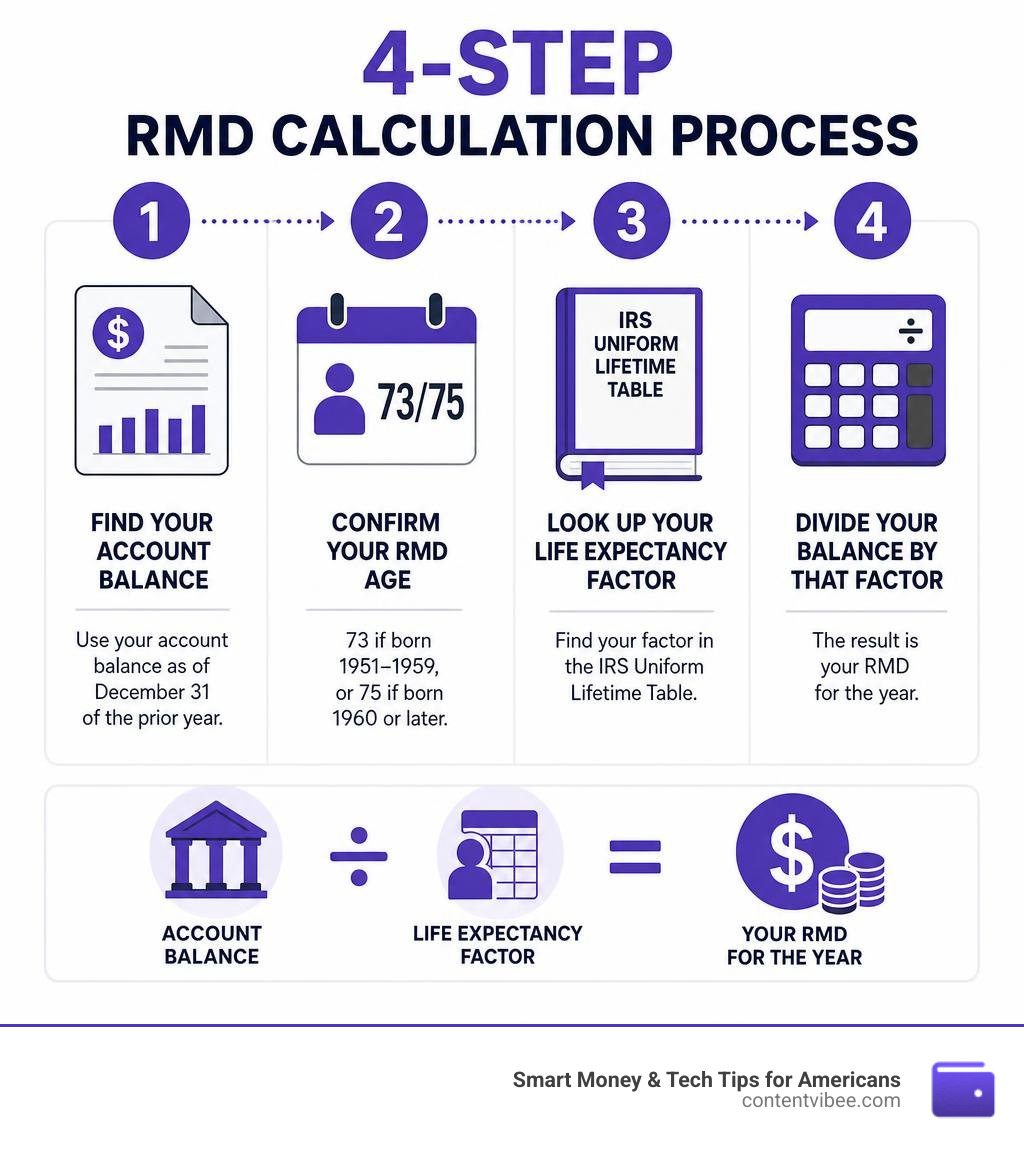
Here’s the quick answer on how to calculate your RMD in 4 steps:
- Find your account balance as of December 31 of the prior year
- Confirm your RMD age — 73 if born 1951–1959, or 75 if born 1960 or later
- Look up your life expectancy factor from the IRS Uniform Lifetime Table
- Divide your balance by that factor — the result is your RMD for the year
Example: A $500,000 IRA balance at age 74 (life expectancy factor: 25.5) = an RMD of $19,607.
Retirement accounts like traditional IRAs and 401(k)s grow tax-deferred for years — sometimes decades. But the IRS doesn’t let that tax break last forever. Once you hit the required age, you must start withdrawing a set amount every year, whether you need the money or not. That withdrawal gets added to your taxable income for the year.
The rules have also shifted recently. The SECURE 2.0 Act raised the starting age and changed how inherited accounts are handled. If you’re still using old assumptions, you may be calculating the wrong amount — or taking money out at the wrong time.
This guide walks you through the exact 4-step process to calculate your RMD correctly in 2026, so you can stay compliant and keep more of your retirement savings.
What is a Required Minimum Distribution and Why Does It Matter?
At its core, a required minimum distribution (RMD) is the government’s way of ensuring that tax-deferred retirement accounts are used to support you during your golden years rather than serving as permanent, tax-free wealth transfer vehicles.
When you contribute to a traditional IRA, 401(k), 403(b), or SEP IRA, you generally receive an upfront tax deduction. Your investments then compound over time without the drag of annual capital gains or dividend taxes. However, this is a tax-deferral arrangement, not a tax exemption. Uncle Sam eventually wants his share of the pie.
According to the Retirement topics – Required minimum distributions (RMDs) | Internal Revenue Service , these mandatory withdrawals are treated as taxable ordinary income. This means they are taxed at your current marginal income tax bracket, which can impact your overall tax liability, potentially push you into a higher tax bracket, and even affect your Medicare premiums or the taxation of your Social Security benefits.
Failing to understand how RMDs work can disrupt your entire financial strategy. To keep your retirement assets secure, it is crucial to integrate these distributions into your broader plan for smart retirement money management.
How to Calculate Your RMD in 4 Easy Steps
Calculating your RMD does not require an advanced degree in mathematics, but it does require precision. If you make a mistake, you risk either paying unnecessary taxes on excess distributions or facing steep penalties for under-withdrawal.

To help you visualize the process, here is the basic operational sequence:
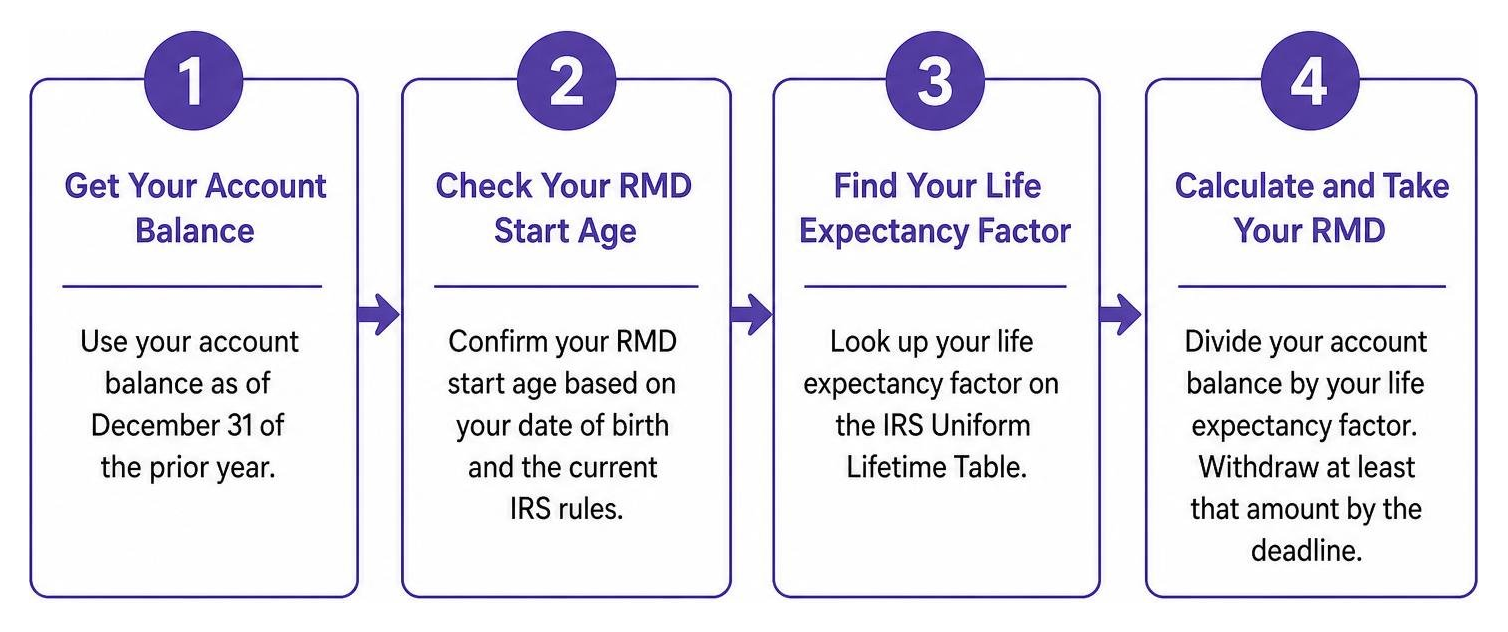
While you can always use an interactive tool like the Required Minimum Distribution Calculator to double-check your numbers, walking through the manual calculation ensures you understand exactly where your money is going. Let’s break down the process step-by-step.
Step 1: Determine Your Account Balance as of December 31 of the Prior Year
The starting point for your 2026 RMD is the fair market value of your retirement account on December 31, 2025.
You can easily find this number on your year-end account statements or by logging into your custodian portal. However, you cannot always take this number at face value. The IRS requires you to make adjustments for specific outstanding transactions that might not have cleared by the stroke of midnight on New Year’s Eve:
- Outstanding Rollovers: If you initiated a rollover from one traditional IRA to another in late December 2025, and the funds were in transit (not credited to either account) on December 31, you must add that “floating” amount back to the receiving account’s balance.
- Recharacterized Conversions: If you had any recharacterized Roth conversions that were in transit or not fully settled in your traditional IRA on December 31, those balances must be appropriately accounted for.
For more details on tracking your initial account values, refer to the How do I calculate my required minimum distribution? resource.
Step 2: Identify Your Applicable RMD Age Under SECURE Act 2.0
One of the most significant updates in recent retirement legislation is the shifting timeline for when RMDs must begin. The SECURE 2.0 Act phased in new age requirements based on your birth year.
To determine when you must begin taking distributions, use this breakdown:
- If you were born between 1951 and 1959: Your applicable RMD age is 73.
- If you were born in 1960 or later: Your applicable RMD age is 75.
Note: For individuals born in 1959, there has been a technical clarification in the law confirming their RMD age is 73, though the transition to age 75 officially applies to those born in 1960 or later.
Keeping track of these shifting timelines is vital. You can read a deep dive on how these legislative adjustments affect your timeline in our guide to Mastering the SECURE Act 2.0 RMD Age Shifts.
Step 3: Divide Your Balance by the Required Minimum Distribution Life Expectancy Factor
Once you have your adjusted December 31, 2025 balance and know your age at the end of 2026, you will look up your “distribution period” (life expectancy factor) using the appropriate IRS life-expectancy tables.
For the vast majority of account owners, you will use Table III (the Uniform Lifetime Table). This table assumes you are either single or married to a spouse who is not more than 10 years younger than you.
| Age at Year-End | Distribution Period (Factor) |
|---|---|
| 73 | 26.5 |
| 74 | 25.5 |
| 75 | 24.6 |
| 76 | 23.7 |
| 77 | 22.9 |
There is a major exception to this rule: If your spouse is your sole beneficiary and is more than 10 years younger than you, you are permitted to use Table II (the Joint Life and Last Survivor Expectancy Table). Because your spouse has a longer life expectancy, Table II provides a larger factor, which results in a smaller mandatory withdrawal and lets you keep more money growing tax-deferred.
To calculate your final amount, use the official IRA required minimum distribution worksheet | Internal Revenue Service and apply this simple formula:
$$\text{RMD Amount} = \frac{\text{Prior Year-End Balance}}{\text{Life Expectancy Factor}}$$
Using our earlier example: If your traditional IRA balance was $500,000 on December 31, 2025, and you turn 74 in 2026, your factor is 25.5.
$$\frac{\$500,000}{25.5} = \$19,607.84$$
Step 4: Withdraw the Funds Before the Deadline
Generally, your annual RMD must be completely withdrawn by December 31 of each calendar year.
However, you get a one-time grace period for your very first RMD. You can delay your first withdrawal until April 1 of the year following the calendar year in which you reach your applicable age. For example, if you reach age 73 in 2026, you have until April 1, 2027, to take your first distribution.
The Double-Taxation Trap: While delaying your first RMD to April 1 of the following year can be tempting, it comes with a massive tax risk. If you delay your 2026 RMD to April 1, 2027, you must still take your second (2027) RMD by December 31, 2027. This means you will be forced to take two distributions in a single tax year, which could easily push you into a much higher federal income tax bracket.
Staying ahead of these deadlines is essential to avoid unnecessary IRS penalties. To make sure you don’t miss a beat, check out our breakdown on how to prepare for these timelines: Don’t Let Uncle Sam Catch You Napping with These 2026 RMD Changes.
Key Differences: IRAs vs. Employer-Sponsored Plans
The calculation formula remains the same across different retirement accounts, but the operational rules vary significantly depending on whether your money is held in an Individual Retirement Account (IRA) or an employer-sponsored plan like a 401(k) or 403(b).
| Feature | Individual Retirement Accounts (IRAs) | Employer-Sponsored Plans (401k, 403b) |
|---|---|---|
| Account Aggregation | Yes. Calculate separately, but you can withdraw the total amount from any one or more of your IRAs. | No. You must calculate and withdraw the RMD separately from each individual plan. |
| Still-Working Exception | No. RMDs must begin at your applicable age regardless of employment status. | Yes. If permitted by the plan, you can delay RMDs until retirement (unless you own 5%+ of the business). |
| Designated Roth Accounts | Exempt from lifetime RMDs. | Exempt from lifetime RMDs starting in 2024 (under SECURE 2.0). |
| Pre-1987 Contributions | N/A | Special rules may apply to 403(b) plans if pre-1987 balances were separately accounted for. |
If you are currently managing multiple workplace accounts, it is helpful to understand the baseline limits for these accounts. Read our updated guides on The New 2026 Maximum 401k Contribution Limits Explained and The Ultimate Guide to the 2026 Max SEP Contribution Guide for Savvy Entrepreneurs to keep your accounts optimized.
Smart Strategies to Reduce the Tax Impact of Your RMD
Because RMDs are taxed as ordinary income, they can create a substantial tax burden. Fortunately, there are several highly effective strategies you can use to minimize this tax drag.
1. Qualified Charitable Distributions (QCDs)
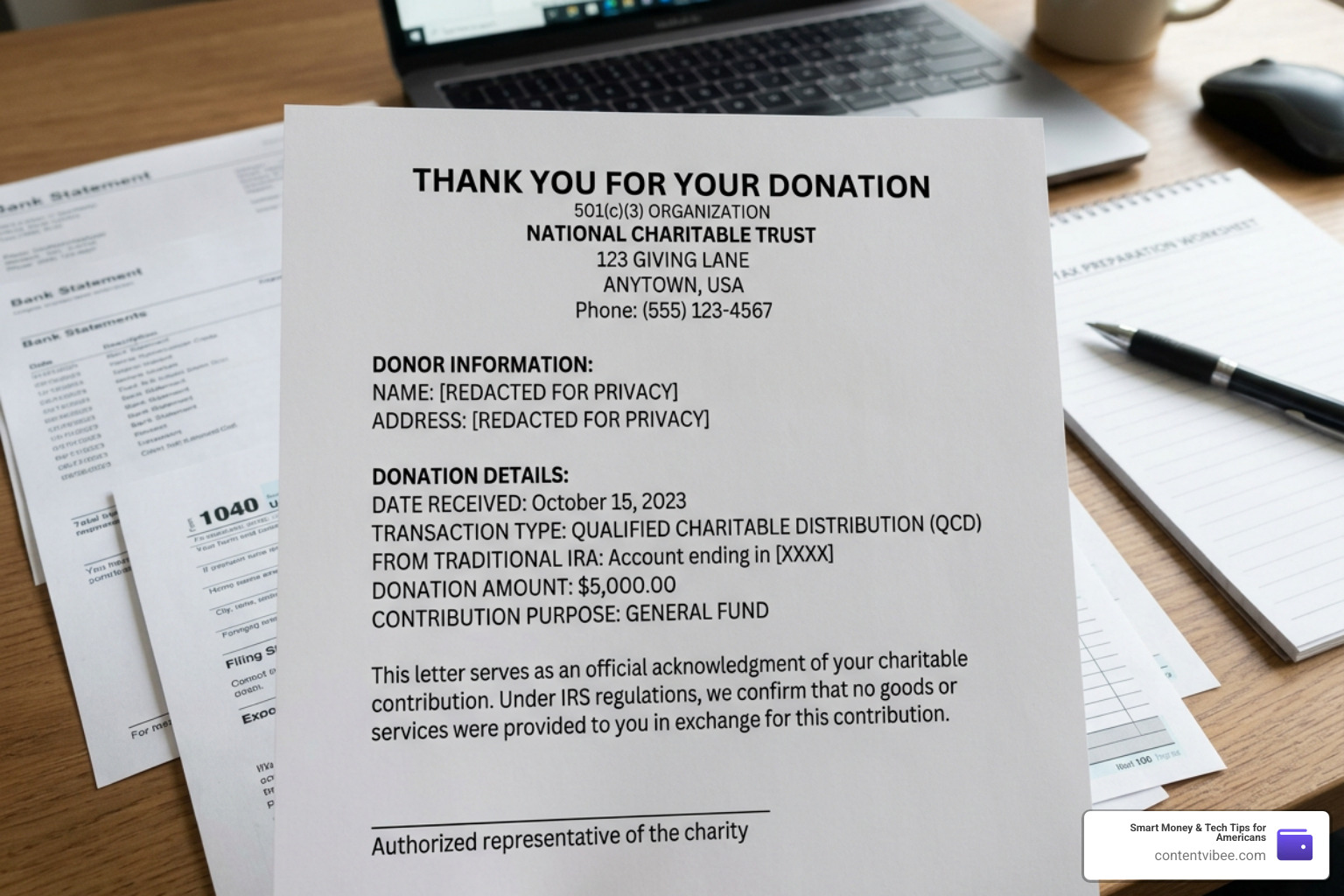
If you are charitably inclined, a QCD is one of the most powerful tax-saving tools available. A QCD allows you to transfer up to $111,000 in 2026 directly from your traditional IRA to an eligible 501(c)(3) charity.
The primary benefit? The transferred amount counts toward satisfying your annual RMD, but it is completely excluded from your adjusted gross income (AGI). Because it never touches your tax return as income, it won’t push you into a higher tax bracket or trigger surcharges on your Medicare premiums. You can begin making QCDs at age 70½, even before your mandatory RMD age.
2. Strategic Roth Conversions
A Roth conversion involves moving funds from a traditional IRA or 401(k) into a Roth account. You must pay ordinary income taxes on the converted amount in the year of the transfer, but once the funds are in the Roth account, they grow tax-free and are exempt from lifetime RMDs.
That you cannot use an annual RMD to fund a Roth conversion. The IRS requires you to satisfy your RMD first, and only additional funds beyond that amount can be converted. To plan this out, review The Ultimate Guide to Your 2026 Max Roth IRA Contribution.
3. Qualifying Longevity Annuity Contracts (QLACs)
A QLAC is a deferred income annuity purchased inside your traditional IRA or employer plan. Under SECURE 2.0, you can invest up to $200,000 (adjusted for inflation) of your retirement balance into a QLAC. The portion of your account allocated to the QLAC is excluded from your overall balance when calculating your annual RMD, allowing you to defer distributions on those assets up to age 85.
4. In-Kind Transfers
If you don’t need the cash from your RMD and want to keep your money invested, you do not have to sell your mutual funds or stocks. You can execute an “in-kind transfer,” moving the shares directly from your traditional IRA into a taxable brokerage account. You will still owe income tax on the value of the shares at the time of the transfer, but your money remains fully invested in the market.
For a broader perspective on how to structure your retirement withdrawals, you may also want to explore our analysis of the Demystifying the 4 Percent Retirement Withdrawal Calculator alongside The Ultimate Guide to Retirement Contribution Catch-Up Limits.
Frequently Asked Questions About RMDs
What are the penalties for missing an RMD?
If you fail to withdraw your full RMD by the required deadline, the IRS imposes a steep excise tax on the shortfall (the difference between what you should have withdrawn and what you actually withdrew).
- Standard Penalty: 25% of the remaining undistributed amount.
- Reduced Penalty: 10% if you correct the error and withdraw the remaining funds within a two-year correction window (and file the correction before the excise tax is formally assessed).
To request a waiver of this penalty due to a reasonable error (such as a medical emergency or a custodian miscalculation), you must file IRS Form 5329 along with a letter of explanation. For more official guidelines on this process, consult the Retirement plan and IRA required minimum distributions … .
Do Roth IRAs have lifetime RMDs?
No. Original owners of Roth IRAs are never required to take minimum distributions during their lifetimes because these accounts are funded with after-tax dollars.
Additionally, thanks to the SECURE 2.0 Act, designated Roth accounts within workplace retirement plans (like Roth 401(k) and Roth 403(b) plans) are also exempt from lifetime RMDs starting in 2024. This aligns the rules for workplace Roth accounts with individual Roth IRAs, giving retirees much greater flexibility over their tax-free assets.
For more information on optimizing your tax-free cash flow alongside other federal benefits, read our guide to The Ultimate Guide to Social Security Benefit Optimization.
How to Calculate Your Required Minimum Distribution for Inherited Accounts
The RMD rules for inherited retirement accounts are highly complex and depend heavily on when the original owner passed away and your relationship to them.
For original owners who passed away after December 31, 2019, the SECURE Act eliminated the ability for most non-spouse beneficiaries to “stretch” distributions over their lifetimes. Instead, they must adhere to the 10-year rule, which requires the inherited account to be completely emptied by the end of the tenth calendar year following the owner’s death.
Under recent IRS clarifications (including Notice 2024-35, Certain Required Minimum Distributions for 2024 and the final regulations published in the 58886 ), if the original owner had already reached their required beginning date before passing away, the beneficiary must continue taking annual RMDs in years 1 through 9, based on their own single life expectancy, before fully emptying the account in year 10.
Eligible Designated Beneficiaries (EDBs): The 10-year rule does not apply to certain protected classes, known as EDBs. These individuals can still calculate RMDs using the Single Life Expectancy Table:
- Surviving Spouses: Can elect to treat the inherited IRA as their own or take lifetime distributions.
- Minor Children of the Account Owner: Can use their life expectancy until they reach the age of majority (21), at which point the 10-year clock begins.
- Disabled or Chronically Ill Individuals: Exempt from the 10-year rule; can use lifetime distributions.
- Individuals Not More Than 10 Years Younger than the Owner: Can use their own single life expectancy.
To learn more about the legal foundation of these rules, you can review the Required Minimum Distribution (RMD) Rules for Original Owners of Retirement Accounts .
Conclusion
Calculating and managing your required minimum distributions is a fundamental part of a successful retirement plan. While the math behind dividing your prior year-end balance by an IRS life expectancy factor is straightforward, navigating the deadlines, account types, and tax mitigation strategies requires proactive planning.
At ContentVibee, we specialize in translating complex federal regulations into clear, actionable steps so you can protect your hard-earned savings. By staying ahead of the SECURE Act 2.0 timeline and leveraging tools like QCDs or Roth conversions, you can keep your tax liabilities low and your retirement secure.
Ready to map out your distribution schedule? Use our comprehensive resource, The Essential RMD Age Table Guide for Smart Retirees, to find your exact factors and plan your withdrawals with confidence.