


Are Robo Advisor Fees Actually Worth It?
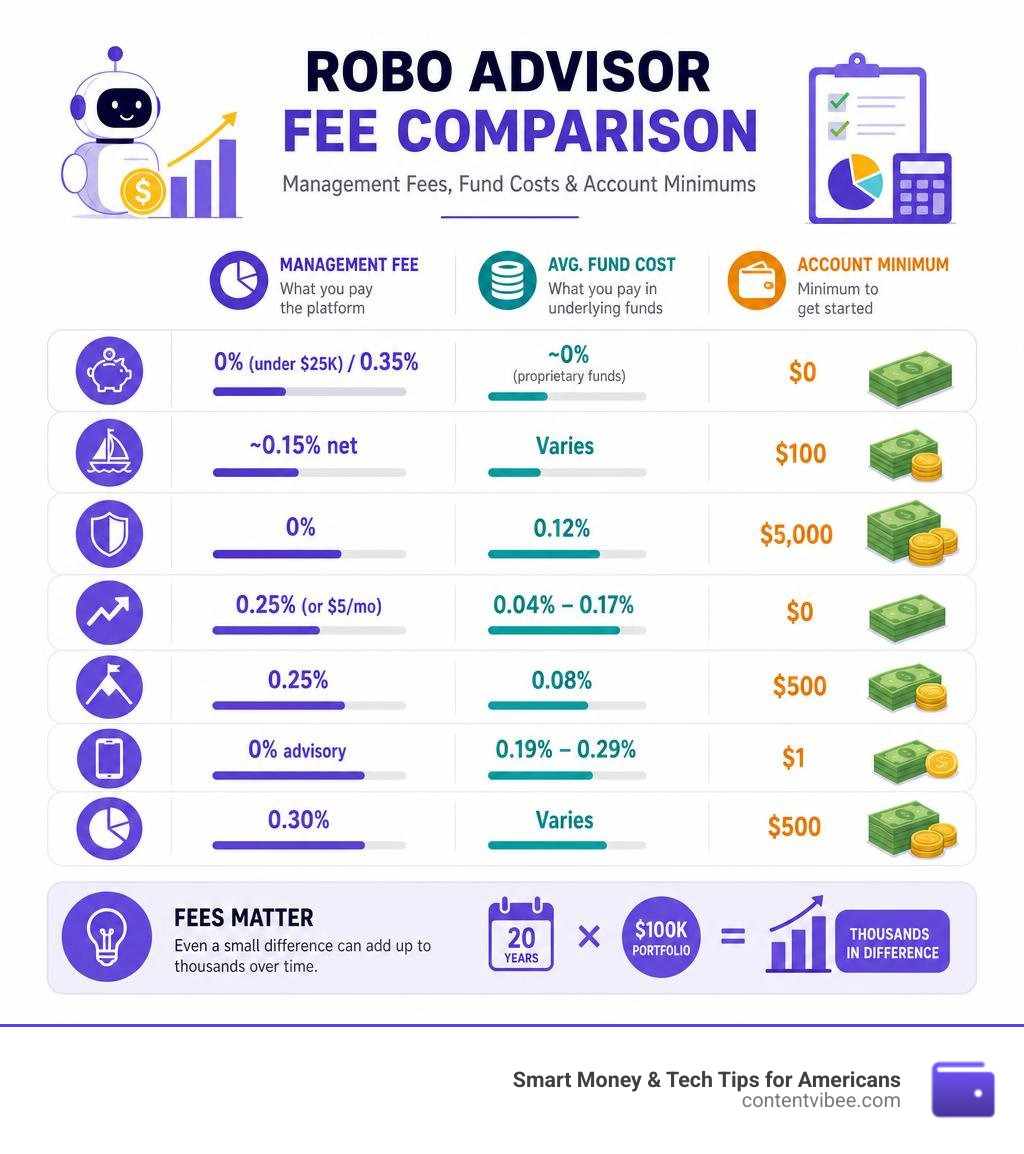
Robo advisor fees typically range from 0% to 0.35% per year in management fees, plus underlying fund costs of 0.04% to 0.29%. Here’s a fast summary of what major platforms charge right now:
| Robo-Advisor | Management Fee | Avg. Fund Expense Ratio | Account Minimum |
|---|---|---|---|
| Fidelity Go | 0% (under $25K) / 0.35% | ~0% (proprietary funds) | $0 |
| Vanguard Digital Advisor | ~0.15% net | Varies | $100 |
| Schwab Intelligent Portfolios | 0% | 0.12% | $5,000 |
| Betterment | 0.25% (or $5/mo) | 0.04%–0.17% | $0 |
| Wealthfront | 0.25% | 0.08% | $500 |
| SoFi Robo Investing | 0% advisory | 0.19%–0.29% | $1 |
| E*TRADE Core Portfolios | 0.30% | Varies | $500 |
If you’re dealing with mounting bills and wondering where to put any money you do have, fees matter a lot. Even a small difference — say 0.25% vs. 1% — adds up to thousands of dollars over time.
Consider this: on a $100,000 portfolio over 20 years, a human advisor charging 1% could cost you more than $120,000 extra compared to a low-cost robo-advisor. That’s real money.
But “low fee” doesn’t always mean “low cost.” Some robo-advisors advertise zero management fees while quietly earning revenue through higher-cost proprietary funds or cash allocations that drag down your returns.
This guide breaks down exactly what you’re paying — and what you’re actually getting — across every major platform in 2026.
Understanding the Structure of Robo Advisor Fees
When we look at automated investing, the pricing menu can seem surprisingly simple at first glance. You see a single percentage point, like 0.25%, and think, “Great, that’s all it costs!” But under the hood, the total cost of ownership is actually built from several distinct layers.
Understanding how these fees interact is crucial. If you do not look at the complete picture, you might choose an option that looks cheap on paper but drains your returns over time. This is exactly Why Robo Advisor Fees Comparison Matters when you are trying to build long-term wealth.
To determine if this style of investing fits your financial journey, you must first ask yourself: Is Automated Portfolio Management Right for You? If you prefer a hands-off approach that keeps costs low compared to traditional wealth managers, then understanding these three core fee components is your first step:
- The Management Fee (Advisory Fee): This is the fee charged directly by the platform to manage your money, rebalance your assets, and keep the algorithms running. It is typically calculated as an annual percentage of your Assets Under Management (AUM) and billed monthly or quarterly.
- The Fund Expense Ratio: This is an indirect fee. It is not billed to you directly; instead, it is charged by the mutual funds or Exchange-Traded Funds (ETFs) that hold your actual investments. This money goes directly to the fund managers (like Vanguard, BlackRock, or Charles Schwab) to cover their operational costs.
- Account Minimums and Service Fees: Some platforms require a certain amount of cash just to open an account, while others charge flat monthly fees if your balance sits below a certain threshold.
Direct Management Fees vs. Indirect Fund Expenses
Let’s look closer at the relationship between direct advisory fees and indirect fund expenses. A robo-advisor might charge a very low direct management fee, but if they fill your portfolio with expensive ETFs, your “all-in” cost could end up higher than a platform with a slightly higher direct fee but incredibly cheap underlying funds.
For instance, some platforms utilize proprietary funds to keep total costs to a minimum. A prime example is Fidelity Go, which utilizes zero-expense-ratio Fidelity Flex mutual funds. If you want to see how this translates to your wallet, you can read The No-Nonsense Guide to Fidelity Robo Advisor Fees to see how they structure their pricing across different balance tiers.
When evaluating any platform, always calculate the all-in cost: $$\text{All-In Cost} = \text{Annual Advisory Fee} + \text{Average Asset Expense Ratio}$$
If a robo-advisor charges a 0.25% advisory fee and uses ETFs with an average expense ratio of 0.08%, your all-in cost is 0.33%. If another platform charges 0% advisory fees but uses funds with an average expense ratio of 0.25%, your all-in cost is 0.25%. While the second option is cheaper, you must evaluate what features you are losing by choosing the “free” management option.
How Account Minimums Affect Your Total Costs
Account minimums act as the first barrier to entry for many investors. While some modern platforms allow you to start with as little as $1, others require thousands of dollars just to get the virtual keys to the dashboard.
But account minimums do more than just limit who can sign up; they can actually impact your total costs through a phenomenon known as cash drag. Some robo-advisors require you to keep a specific percentage of your portfolio in cash. While they do not charge an advisory fee on this cash, that money is sitting on the sidelines earning lower returns than if it were fully invested in the market.
If you are just starting out, finding an option with low or zero minimums allows you to Set and Forget Your Way to Wealth with Automated Investing without having to save up a massive lump sum first.
Comparing Top Robo-Advisors in 2026
The automated investing landscape in 2026 is highly competitive. To help you navigate the noise, we have compiled the exact costs, minimums, and key features of the most popular platforms.
- Fidelity Go: Charges a 0% advisory fee for balances under $25,000. Once your balance hits $25,000 or more, the fee becomes 0.35% per year. The major benefit here is that it uses Fidelity Flex funds, which carry a 0% expense ratio, meaning your advisory fee is essentially your all-in cost.
- Vanguard Digital Advisor: This service has a low entry point of a $100 minimum balance. It charges an annual gross advisory fee of 0.20% for an index portfolio option (or 0.25% for an active portfolio option). However, Vanguard reduces this by a credit of revenue from the underlying investments, bringing the net advisory fee to approximately 0.15% (about $15 per year for every $10,000 invested). You can learn more about their specific pricing structure directly on the Digital Advisor | What it costs | Vanguard page.
- Schwab Intelligent Portfolios: This program has a $5,000 minimum and charges a 0% annual management fee. The underlying ETFs have an average expense ratio of 0.12%. To see how Schwab manages pricing across its retail offerings, you can review the Charles Schwab Pricing Guide.
- Betterment: Charges a standard 0.25% annual fee. However, if your balance is under $24,000, they charge a flat $5 per month unless you set up recurring monthly deposits of at least $250. The underlying portfolio expense ratios range from 0.04% to 0.17%.
- Wealthfront: Charges a flat 0.25% annual management fee with a $500 account minimum. The average portfolio expense ratio is incredibly competitive, sitting around 0.08%.
- SoFi Robo Investing: Advertises a $0 advisory fee with a $1 minimum. However, the catch is that SoFi builds its portfolios using proprietary SoFi ETFs, which carry higher expense ratios of 0.19% to 0.29%—roughly three to five times higher than the funds used by its closest competitors.
- Revolut Robo-Advisor: Charges an annual fee of 0.25%, with a minimum monthly fee of $0.25 for portfolios with a balance of $100 or more.
- E*TRADE Core Portfolios: Charges an annual fee of 0.30% with a minimum investment of $500.
Comparing Robo Advisor Fees to Traditional Advisor Costs
How do these automated fees stack up against traditional human wealth managers? The cost difference is staggering.
A traditional, in-person financial advisor typically charges an annual fee of 1% to 2% of your assets under management. When you include the expense ratios of the mutual funds they select, your all-in cost can easily reach 1.50% to 1.75% per year.
On a $500,000 portfolio, the annual cost gap between a 0.25% robo-advisor and a 1% human advisor is $3,750. Over 10 years, assuming average market growth, that single percentage point difference can translate to a loss of over $75,000 solely to fees.
Of course, human advisors argue that they provide “behavioral coaching”—preventing you from selling during a market panic—which Vanguard research suggests can add up to 0.50% in annual net value. But if you have the discipline to stay the course on your own, automated tools are vastly cheaper. If you are debating between these two paths, take a look at our guides on To Manage or Not to Manage: Taking the Reins of Your Investments and understand the trade-offs of Why Managing Your Portfolio Manually before making your final choice.
Premium Features Included in Higher Fee Tiers
As your account balance grows, many robo-advisors unlock premium tools that can easily justify their management fees.
One of the most powerful features is tax-loss harvesting (TLH). This automated strategy sells losing investments to offset capital gains and up to $3,000 of ordinary income, lowering your tax bill. TLH can generate between 0.10% and 0.50% of annual “tax alpha” (extra return), which completely offsets the cost of a 0.25% management fee in taxable accounts. You can read more about how this works in our article on Tax-Loss Harvesting: The Secret Weapon of Robo Advisors.
Additionally, once you hit higher balance tiers (such as $25,000 with Fidelity Go), platforms often provide access to human financial coaches or CFP® professionals. This hybrid model gives you the best of both worlds: low-cost algorithmic management for daily tasks, and human expertise when life gets complicated.
Evaluating the True Cost of Automated Investing
To truly evaluate robo advisor fees, you have to look beyond the basic pricing tables. You must consider how a platform’s investment philosophy aligns with your personal risk tolerance and goals.
Every robo-advisor starts by asking you to fill out a questionnaire to gauge how much risk you can handle. But can a series of online questions actually understand your financial psychology? We dive deep into this dilemma in our guide: Robo Advisor Asset Allocation: Can Robots Really Gauge Your Risk Tolerance?.
Selecting the right platform is about finding the sweet spot where low fees meet robust, personalized portfolio construction. If you want to understand how asset allocation impacts your long-term returns, check out our analysis on Why Choosing the Right Portfolio Management.
Hidden Costs Beyond Standard Robo Advisor Fees
We always warn our readers to watch out for the “fine print” costs of automated investing. The two biggest culprits are cash drag and proprietary fund markups.
For example, Schwab Intelligent Portfolios charges $0 in direct advisory fees. However, they require a mandatory cash allocation of 6% to 29% in your portfolio. Schwab keeps this cash in its sweep program, earning revenue on the interest spread. During a bull market, having up to nearly a third of your portfolio sitting in cash can severely drag down your overall performance compared to a fully invested portfolio that charges a modest 0.25% fee.
Similarly, SoFi Robo Investing charges $0 in management fees but populates your portfolio with its own brand of ETFs. These ETFs have expense ratios of 0.19% to 0.29%, which is significantly higher than the ultra-low-cost index funds used by other platforms. Always look at the all-in cost before declaring a “free” platform the winner.
Tax Implications and Portfolio Rebalancing Costs
Another area where costs can quietly add up is portfolio rebalancing. As different assets grow at different speeds, your portfolio will naturally drift away from your target allocation. Robo-advisors automatically buy and sell assets to bring you back in line.
In a tax-advantaged account like an IRA or 401(k), these transactions have zero tax consequences. However, in a taxable brokerage account, rebalancing can trigger capital gains taxes. High-quality robo-advisors use “tax-coordinated rebalancing,” which uses incoming dividends or new deposits to rebalance your account rather than selling assets and triggering a tax bill.
Understanding these tax nuances is a vital part of long-term planning. To make sure you do not get hit with an unexpected tax bill, take a look at our guide on Why Choosing the Right Investment Portfolio matters for your taxable accounts.
Frequently Asked Questions about Robo-Advisors
What is the typical fee for a robo-advisor?
The industry standard for a robo-advisor management fee is 0.25% of assets under management per year. This means that for every $10,000 you have invested, you will pay $25 annually. When you add the average underlying ETF expense ratios (usually around 0.08% to 0.15%), the typical all-in cost of automated investing sits between 0.30% and 0.40% per year.
Are there any completely free robo-advisors?
Yes, platforms like Schwab Intelligent Portfolios and SoFi Robo Investing charge $0 in direct management fees. However, they are not completely “free” to run. Schwab makes money by requiring a cash sweep allocation (which can limit your portfolio’s growth), while SoFi utilizes proprietary ETFs with higher expense ratios.
Is a robo-advisor cheaper than a human financial advisor?
Almost always. Traditional human financial advisors typically charge a 1.00% management fee, plus the costs of the mutual funds they select, bringing the total cost closer to 1.50% or more. Robo-advisors operate at a fraction of this cost, typically saving you thousands of dollars a year in fees.
Conclusion
At ContentVibee, we believe that smart investing is all about maximizing your returns while ruthlessly minimizing the costs you can control—and fees are at the very top of that list.
Automated investing has democratized wealth management, making sophisticated portfolio construction accessible to anyone with a smartphone and a few dollars to spare. But as we have seen, not all robo advisor fees are created equal. Whether you choose a low-cost subscription model, a traditional percentage-based fee, or a “free” service that utilizes cash sweep programs, the key is to align the platform’s fee structure with your account balance and financial goals.
Ready to take the next step in optimizing your investment strategy? Read our comprehensive breakdown on Understanding Managed Investment Account Fees to ensure you are keeping as much of your hard-earned money in your market portfolio as possible.