


What You’re Actually Paying When You Hand Over Your Portfolio
Managed investment account fees are the ongoing costs you pay a professional to oversee your investments — and they can quietly take a much bigger bite out of your returns than most people realize.
Here’s a quick breakdown of what to expect:
| Fee Type | Typical Range |
|---|---|
| Advisory / wrap fee | 1.00% – 3.00% of assets per year |
| Managed account advisory fee | 0.25% – 1.00% of assets per year |
| Underlying fund expenses (ETFs/mutual funds) | 0.05% – 1.00%+ per year |
| Platform or manager fees | 0.03% – 0.50% per year |
| 12b-1 / distribution fees | Up to 1.00% per year |
| Hidden costs (transfer fees, minimums, spreads) | Varies |
The total you pay is rarely just one number. It’s a stack of charges — and most investors never see the full picture until they go looking for it.
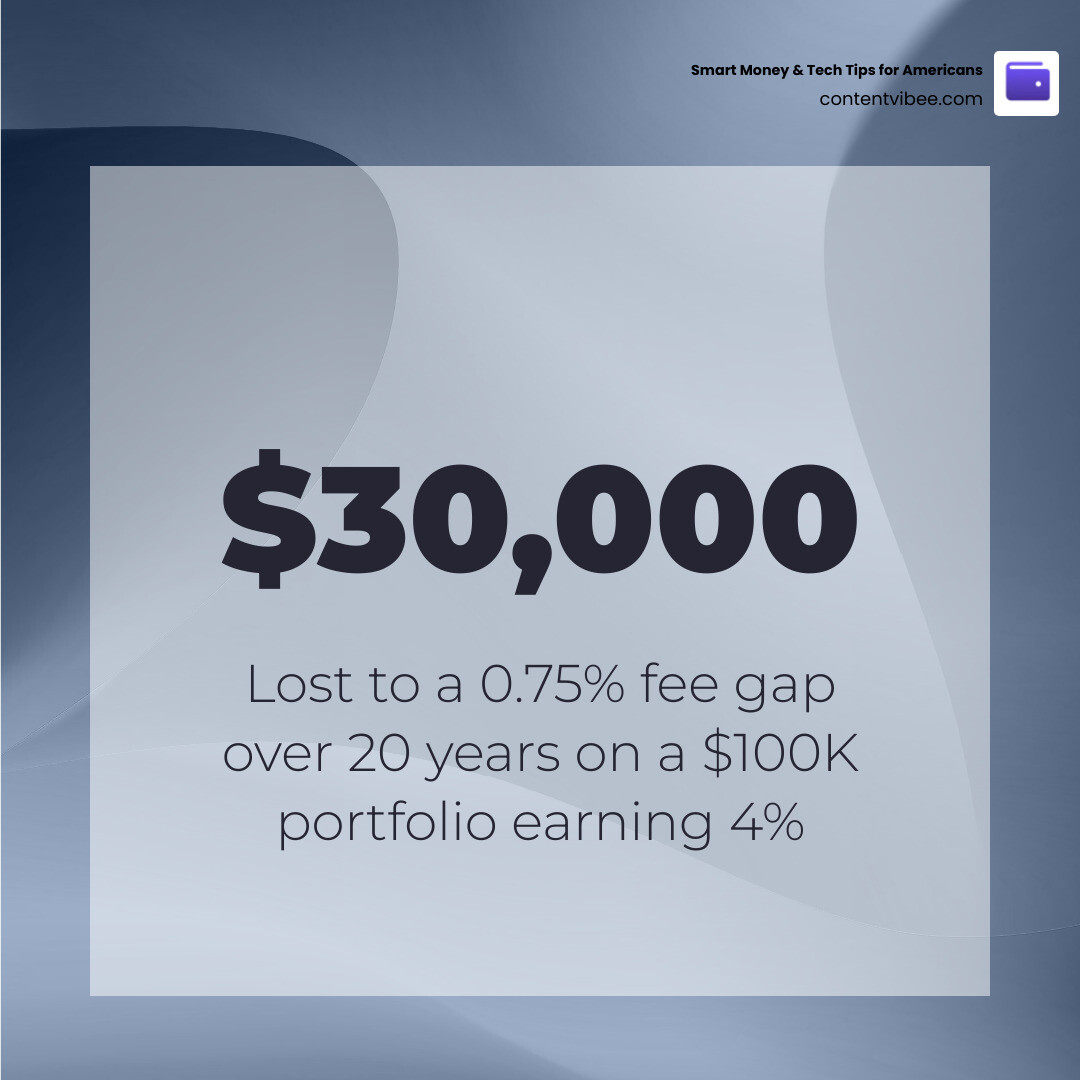
Consider this: on a $100,000 portfolio earning 4% annually, the gap between a 0.25% fee and a 1.00% fee could cost you nearly $30,000 over 20 years. That’s not a rounding error. That’s a real retirement shortfall.
Yet millions of busy professionals sign up for managed accounts without fully understanding what they’re paying — or whether those fees are actually earning their keep.
This guide breaks down every layer of managed account costs, shows you how they compare to alternatives, and helps you decide when professional management is genuinely worth it.
What Managed Accounts Are and Why Managed Investment Account Fees Exist
A managed account is an investment account run with professional oversight. Sometimes the manager has discretionary authority, meaning they can make trades for you without asking every time. Other times the relationship is non-discretionary, which means the advisor recommends moves but you approve them.
Either way, the fee exists because you are paying for more than a place to park investments. You are paying for judgment, ongoing monitoring, administration, and, ideally, advice tailored to your goals.
Managed accounts often come with account minimums, commonly in the $25,000 to $100,000 range, though some programs go lower. They are usually marketed to investors who want personalization, less day-to-day responsibility, or help handling more complex situations.
Managed Accounts vs. Self-Directed Brokerage Accounts
A self-directed brokerage account is the DIY version. You choose the investments, place the trades, and shoulder the consequences of buying high, panic-selling low, or discovering your “diversified portfolio” is 83% tech stocks and vibes.
A managed account is service-heavy. A brokerage account is tool-heavy.
| Feature | Managed Account | Self-Directed Brokerage Account |
|---|---|---|
| Investment decisions | Advisor or manager handles some or all decisions | You make the decisions |
| Fee structure | Asset-based advisory fee, wrap fee, or layered fees | Usually commissions, spreads, fund expenses, and account fees |
| Personalization | Often customized to goals, taxes, and risk tolerance | Depends on your own effort |
| Rebalancing | Usually included | You do it yourself |
| Tax management | Sometimes included | Usually self-managed |
| Advisor role | Ongoing advice and oversight | Optional or limited |
| Best for | Hands-off investors or more complex situations | Confident DIY investors |
If you want a plain-English comparison of advisory and brokerage pricing, Financial Advisor Costs & Fees | Edward Jones and Understanding Our Commissions and Fees | Morgan Stanley show how firms describe the distinction between asset-based advice and transaction-based brokerage.
What You’re Paying For in a Managed Relationship
The visible fee is usually expressed as a percentage of assets. The invisible part is the service stack behind it.
You may be paying for:
- Portfolio construction
- Ongoing monitoring
- Rebalancing
- Tax-aware placement of investments
- Tax-loss harvesting in taxable accounts
- Cash management
- Performance reporting
- Custody and recordkeeping
- Access to planning conversations
- Behavioral coaching during scary markets

That last one matters more than many investors expect. An advisor who keeps you from bailing out at the bottom of a bear market may add more value than one who picks a slightly better fund.
Who Typically Uses Managed Accounts
Managed accounts are often a fit for:
- Busy professionals with limited time
- Retirees drawing income from portfolios
- Households with multiple account types
- Investors with taxable assets who need tax coordination
- People with concentrated stock positions
- Higher-net-worth investors wanting customization
- Anyone who knows they are not going to manage this stuff consistently on their own
The Full Menu of Managed Investment Account Fees
When people hear “the fee is 1%,” they often assume that is the whole story. It usually is not.
A managed account can include several layers of cost:
- Advisory or AUM fee
- Wrap fee
- Platform fee
- Manager fee
- Underlying mutual fund or ETF expense ratios
- Trading costs
- 12b-1 fees
- Cash drag or sweep spread
- Transfer, paper statement, or minimum account fees
Asset-Based Advisory Fees and Wrap Fees
The most common charge is an asset-based fee, also called an AUM fee. It is a percentage of the assets in the account, often billed monthly or quarterly. Typical managed account advisory fees fall around 0.25% to 1.00% annually, though wrap programs can run from 1% to 3%.
A wrap fee bundles services into one asset-based charge. That may include advice, portfolio management, trade execution, custody, and reporting. Sounds tidy, and sometimes it is. But “wrapped” does not always mean “all inclusive.”
Some wrap brochures make clear that certain costs still sit outside the bundled fee. For example, these disclosure examples show how important it is to read the fine print:
You can also compare general advisor pricing context in How Much Does a Financial Advisor Cost in 2026? – NerdWallet .
Platform, Manager, and Underlying Fund Costs
A managed account may use one manager, several managers, model portfolios, separately managed accounts, mutual funds, ETFs, or some mix of all three. Each layer can have its own cost.
Here are the main buckets:
- Platform fee: charged for account administration, technology, and access to the managed program
- Manager fee: charged by the actual portfolio manager or strategist
- Underlying investment costs: expense ratios inside the funds or ETFs you own
This is where investors can get tripped up. You may pay 0.80% for advice and still hold funds that charge another 0.40% or 0.70%. Suddenly your “under 1%” account is not under 1%.
For background on fee layers, see What are Wealth Management Fees and Average Management Fee for Mutual Funds.
As of 2024, the average asset-weighted expense ratio for all mutual funds and ETFs had fallen to 0.34%, less than half what investors paid 20 years earlier. Asset-weighted matters because it reflects where investor dollars actually are, not just the sticker price of every fund on the shelf.
Hidden Fees Investors Often Miss
Some of the most important costs are the least obvious.
Watch for:
- 12b-1 fees inside mutual funds
- Bid-ask spreads on ETF trades
- Bond markups and markdowns
- Ticket charges or broker-assisted trade fees
- Transfer-out fees
- Account minimum fees
- Paper statement fees
- Clean-share surcharges
- Alternative investment custody fees
- Cash sweep spread, where idle cash earns less than you might expect
For example, one disclosed fee schedule shows a $40 minimum annual account fee, a $45 broker-assisted trade fee, and separate fees for certain special holdings and transfers. Those costs may be small alone and annoying together.
Mutual fund investors should also watch for 12b-1 fees, which are distribution and marketing charges and can be as high as 1.00% annually. If you can choose a lower-cost share class without them, that often deserves a hard look.
For more on overlooked trading charges, read Don’t Get Short Changed by Hidden Commission in Stock Market Trades.
Where to Find Fee Disclosures Before You Invest
Before opening a managed account, we should look in at least five places:
- Form ADV brochure
- Wrap fee brochure
- Account fee schedule
- Fund prospectus or summary prospectus
- Trade confirmations and annual statements
In a mutual fund prospectus, the key section is usually “Fees and Expenses” or “Annual Fund Operating Expenses.” In an advisory relationship, the Form ADV and wrap brochure explain how the firm is paid, what is included, and what is not.
A provider fee schedule example: https://www.axos.com/documents/axos-invest-managed-portfolio-fee-schedule
A firm commission and fee disclosure page example: Understanding Our Commissions and Fees | Morgan Stanley
How Managed Account Costs Compare With Brokerage Accounts, Funds, and Robo-Advice
Managed accounts are not the only way to get investing help. The smartest choice often comes down to total cost versus total value.
Typical Fee Ranges by Account Type
Here is a practical comparison:
- Self-directed brokerage account: may have $0 stock commissions, but you still may pay fund expense ratios, spreads, bond markups, and account service fees
- Robo-advisor: often around 0.25% for management, plus underlying ETF costs
- Traditional managed account: commonly 0.25% to 1.00% annually, sometimes higher in wrap programs
- Active mutual funds: often 0.50% to 1.00%, with an asset-weighted average of 0.40% for equity mutual funds
- Index mutual funds: asset-weighted average around 0.05%
- Index ETFs: asset-weighted average around 0.14% for equity ETFs and 0.10% for bond ETFs
- Hedge funds: can run far higher, often using the classic 2% management fee plus 20% of profits
For deeper comparisons, see Why Robo Advisor Fees Comparison Matters and Brokerage Fee Stock Market.
Why Asset-Weighted Averages Matter More Than Sticker Prices
A simple average treats every fund equally. An asset-weighted average gives more influence to the funds where investors have actually put their money.
That matters because ultra-expensive niche funds may skew a simple average upward, while low-cost broad-market funds often hold most investor assets.
From 1996 to 2024:
- Fees on stock mutual funds fell 62%
- Bond fund fees fell 55%
And in 2024:
- Equity mutual funds had an asset-weighted average expense ratio of 0.40%
- Bond mutual funds had an asset-weighted average of 0.38%
- All mutual funds and ETFs combined averaged 0.34% on an asset-weighted basis
This tells us something encouraging: costs have fallen. It also tells us something less cheerful: expensive options still exist, and many investors still end up in them.
When Higher Fees Buy Real Value—and When They Don’t
Higher fees can make sense when they buy something concrete, such as:
- Sophisticated tax management
- Personalized withdrawal planning
- Coordination across retirement, taxable, and trust accounts
- Help with concentrated stock risk
- Behavioral coaching
- Estate or charitable planning support
Higher fees often make less sense when:
- The portfolio is mostly plain index funds
- The service is largely automated
- Your finances are simple
- You are not getting tax or planning support
- The advisor cannot clearly explain the value
In other words, paying more for actual expertise can be rational. Paying more for a fancy wrapper around basic indexing is less exciting.
The Long-Term Impact of Fees on Investment Returns
Fees do not just reduce returns once. They reduce the base that compounds from then on. That is why fee drag is such a big deal.
How Fees Compound Against You Over Decades
Let us return to the $100,000 portfolio example.
If the portfolio earns 4% annually before fees, the difference between paying 0.25% and 1.00% can cost nearly $30,000 over 20 years. That is because the higher fee is deducted year after year, and each deduction shrinks future growth.
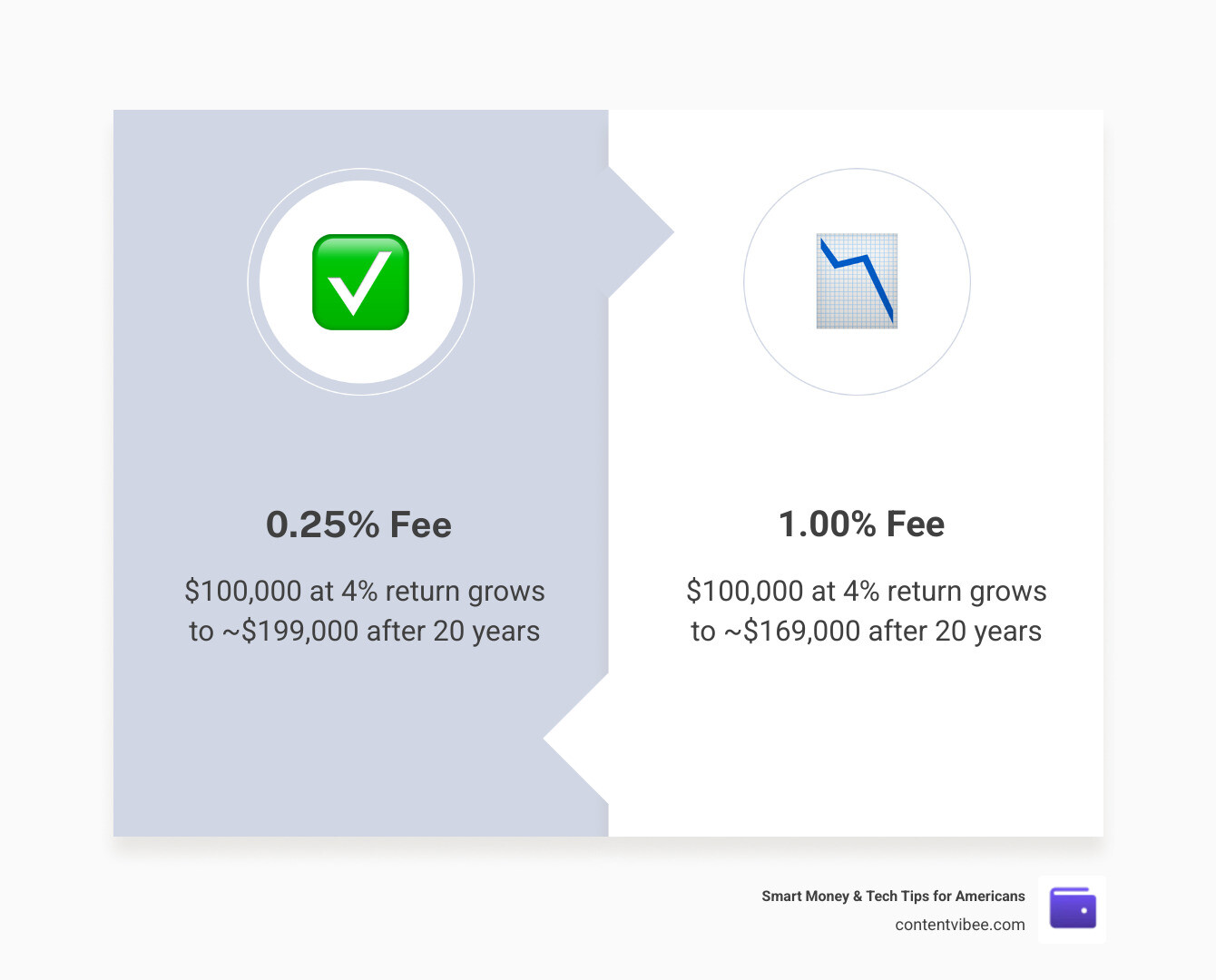
This is why a fee that looks “small” in percentage terms can create a very real retirement gap over time.
If you want to model your own scenario, How to Use an AUM Fee Calculator to Save Your Retirement is a useful next step.
Do Higher Fees Lead to Better Performance?
Usually, no clear evidence says higher fees reliably lead to better net returns.
Research cited in the background for this article shows that 60% of funds underperformed the S&P 500. That does not mean every active manager is bad. It does mean higher cost is not proof of higher skill.
In fact, a manager charging more has to outperform by enough to cover the fee gap before you benefit. That is a steep hurdle, especially in efficient, competitive markets.
Why Active Funds Often Struggle After Fees
Active funds face multiple headwinds:
- Higher expense ratios
- More trading turnover
- Potential tax inefficiency in taxable accounts
- Benchmark lag after costs
- Difficulty repeating past outperformance
- Survivorship bias, where failed funds disappear and make the survivors look better
Some research summarized in the source material notes that active managers may need more than 2% excess return to overcome average fees and beat the market by 1% after costs. That is a huge ask.
This does not mean active management never works. It means we should demand a specific reason for paying extra.
For related reading, see Why Asset Management vs Investment Management.
How to Judge Whether Managed Investment Account Fees Are Fair
Fair does not mean cheap. Fair means the cost is understandable, transparent, and proportionate to the value you receive.
Questions to Ask Before You Say Yes
Before signing anything, ask:
- What is the all-in annual cost?
- What exactly is included in the advisory fee?
- Are fund expense ratios included or separate?
- Is this a wrap fee program?
- What costs are not covered by the wrap fee?
- What share classes will be used?
- Are there 12b-1 fees?
- How is the advisor compensated?
- Will I pay transaction charges, markups, or transfer fees?
- How much cash is typically held in the account?
- Is tax-loss harvesting included?
- Are fees tiered down at higher balances?
- Can household accounts qualify for lower pricing?
- How often are fees billed and from which balance?
- Can you show me the disclosure documents?
That last one is especially important. If someone gets weirdly evasive when you ask about cost, our eyebrows should begin exercising.
Red Flags That Suggest Fees May Be Too High
Watch for these warning signs:
- Vague or incomplete fee disclosures
- Several layers of charges with no simple summary
- High-cost mutual fund share classes when cheaper ones exist
- Frequent trading with unclear benefit
- Large idle cash balances in a fee-based account
- Claims about performance without context or benchmarks
- Pressure to focus on “service” while dodging exact numbers
- Product conflicts that encourage pricier investments
Some wrap fee brochures also note that negotiated pricing is possible in certain cases. If one client can pay less for a similar service, that is a clue to ask questions.
Tools and Resources to Compare Costs Across Providers and Funds
Good fee analysis is not glamorous, but it works.
Use:
- Mutual fund and ETF screeners
- Fund prospectus fee tables
- Form ADV brochures
- Wrap fee brochures
- Account statements
- Trade confirmations
- Fee calculators
- Share class comparison tools
These internal guides can help us go deeper:
When Paying for Professional Management Makes Sense
Professional management can be worth it. The key is matching the service to the complexity of your life, not just the size of the sales pitch.
Situations Where a Managed Account Can Earn Its Keep
Paying for management may make sense if you need:
- Withdrawal planning in retirement
- Tax coordination across account types
- Household-level asset allocation
- Help managing a business-owner financial life
- Charitable giving strategies
- Ongoing risk management
- Legacy or estate coordination
- Someone to stop you from making emotional investing decisions
In these cases, the value may come less from stock picking and more from planning, discipline, and tax awareness.
When Lower-Cost Alternatives May Be the Better Choice
A lower-cost option may be better if:
- You have a simple portfolio
- You are comfortable using index funds or ETFs
- Your account balance is still small
- You are highly fee-sensitive
- Your financial life is straightforward
- You mostly want automation, not deep planning
That could mean a self-directed brokerage account, a low-cost robo-advisor, or a simple portfolio of index funds.
Related reading:
Frequently Asked Questions About Managed Investment Account Fees
What is included in a typical managed account fee?
Usually, the fee covers some combination of investment management, portfolio monitoring, rebalancing, reporting, custody, and access to advice. It may or may not include underlying fund expenses, external manager costs, certain trading charges, or special account service fees. Always verify what is excluded.
Are wrap fees always cheaper than paying separately?
No. A wrap fee can be cost-effective for accounts with frequent trading or bundled services. But for low-turnover portfolios, paying one bundled fee may cost more than paying separately. Also, some wrap accounts still have costs outside the wrap fee, so “one fee” is not always literally one fee.
Can you negotiate managed account fees?
Sometimes, yes. Larger balances, householded accounts, and reduced service levels may qualify for lower pricing. Some disclosures specifically mention that fees can vary. It never hurts to ask politely and directly.
Conclusion
The real lesson with managed investment account fees is simple: focus on total cost, not just the headline number.
A managed account can be worth every basis point if it delivers meaningful planning, tax help, discipline, and peace of mind. It can also be an expensive way to own the same basic funds you could buy far more cheaply elsewhere.
At Smart Money & Tech Tips for Americans, we think the right question is not “Is this fee high?” It is “What am I getting for it, and is that improving my net return or financial life enough to justify the cost?”
Before you sign, compare the all-in fee, read the disclosures, inspect the underlying investments, and model the long-term impact. Future you may never send a thank-you card, but future you should at least get to keep more of the portfolio.
For a broader perspective on service models and costs, read Why Asset Management vs Investment Management.


