


Why Automated 529 College Savings Could Be the Smartest Move You Make for Your Family
Automated 529 college savings plans let you set up regular, hands-off contributions to a tax-advantaged education account — so your money grows in the background while you focus on everything else.
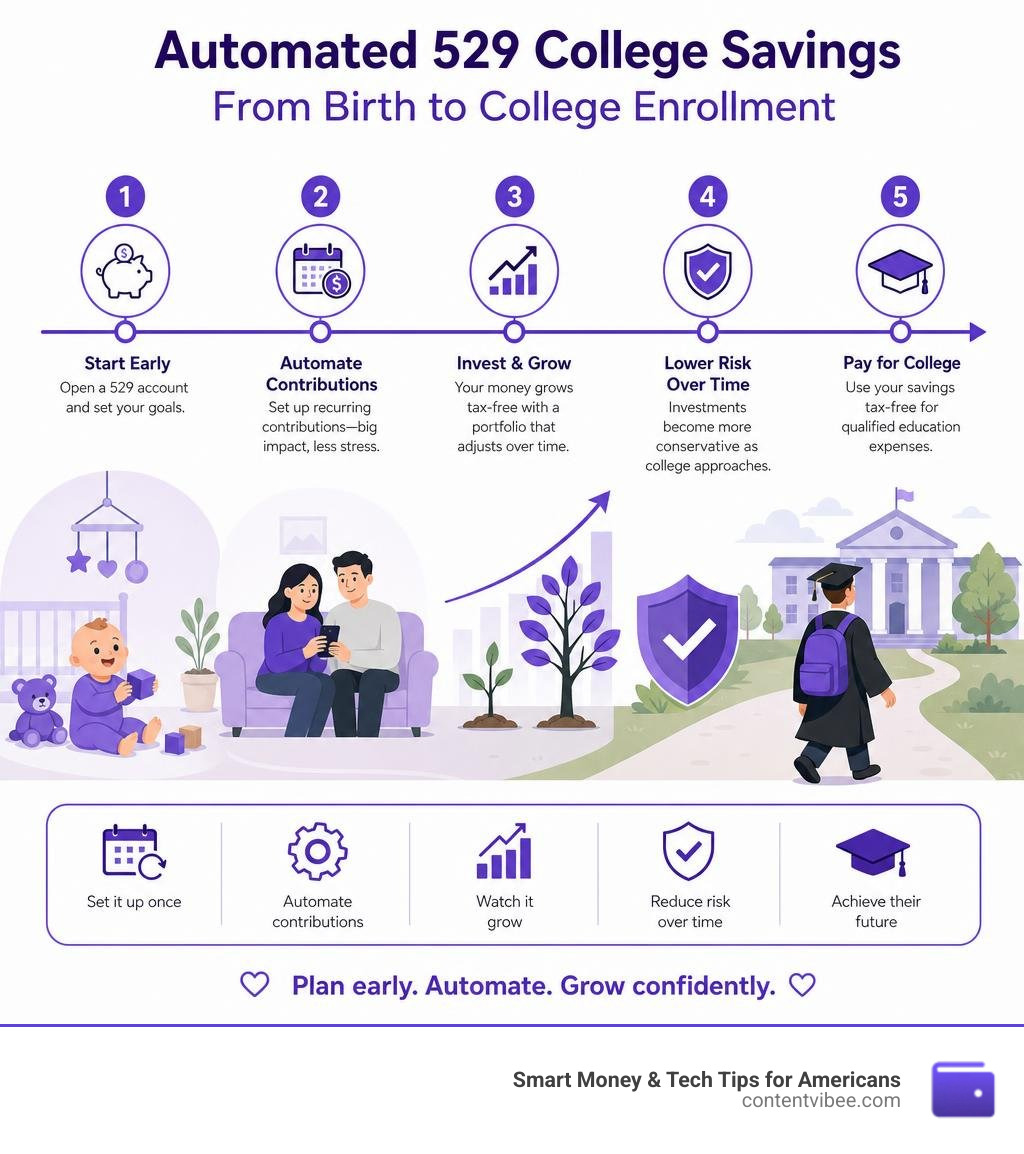
Here’s a quick snapshot of how it works:
- Open a 529 account with a provider like Wealthfront, Ohio CollegeAdvantage, or a Fidelity-managed state plan
- Set a recurring contribution — as little as $25/month — from your bank account or paycheck
- Choose an enrollment-year portfolio that automatically shifts from higher-risk to lower-risk investments as college approaches
- Watch your balance grow tax-free, with withdrawals for qualified education expenses completely untaxed
College costs are rising every year. The average family feels the pressure — but many put off saving because it feels complicated or overwhelming. The truth? It doesn’t have to be.
Modern 529 plans have made automation the default. Providers now handle the hard parts for you: rebalancing your portfolio, reducing risk as your child gets older, and keeping fees low. You don’t need a finance degree to get started.
Whether you’re saving for a grandchild, a newborn, or a teenager a few years from college, automating your 529 is one of the simplest ways to build real education savings — without stress.
Understanding Automated 529 College Savings and How It Works
At its core, a 529 plan is a state-sponsored investment account designed to help families save for future education costs. But let’s be honest: manually managing an investment portfolio while raising kids is a recipe for forgotten contributions and unnecessary stress. That is where automated 529 college savings strategies come to the rescue.
When you automate your 529 savings, you are utilizing technology to handle two critical components of wealth-building: consistent saving and smart investing.
First, the system automatically pulls a designated amount of money from your bank account or payroll check at regular intervals. This feeds your account consistently, allowing you to benefit from compound interest. Over a decade or more, even modest monthly contributions can grow into a substantial college fund.
Second, the investment side is automated using “Enrollment-Year Portfolios.” If you are looking for a hands-off approach, this is the simple, all-in-one investment portfolio based on the date you determine you will need the money to pay for education expenses.
These portfolios use what financial professionals call a “glidepath.” When your child is a toddler, the automated system invests aggressively in equities (stocks) to maximize growth. As the high school graduation date approaches, the system automatically and gradually shifts those assets into more stable investments (bonds and cash preservation funds) to protect your accumulated savings from sudden stock market drops.
The Key Benefits of Automating Your Education Savings
If you’ve ever tried to manually transfer money into a savings account every month, you know that life has a habit of getting in the way. Automating your 529 plan completely removes human error from the equation.
Here are the primary advantages of going hands-off:
- True Hands-Off Management: You set it up once, and the technology does the heavy lifting. You don’t have to remember passwords, log in, or execute trades.
- The Power of Dollar-Cost Averaging: By investing a fixed dollar amount on a regular schedule, you naturally buy more investment shares when prices are low and fewer when prices are high. This removes the emotional temptation to “time the market.”
- Automatic Risk Reduction: You don’t have to remember to log in on your child’s 14th birthday to sell stocks and buy bonds. The system handles this transition smoothly behind the scenes.

How Automated 529 College Savings Manage Risk Over Time
Managing risk manually can be terrifying. If the stock market drops right before your child’s freshman year, it could wipe out years of hard work.
Automated age-based and enrollment-year portfolios solve this by executing a structured asset allocation strategy. These portfolios typically rebalance on a quarterly or semi-annual basis.
For example, a portfolio targeted for a child entering college in 2042 might start with roughly 90% equity exposure to capture early market growth. By the time that enrollment year arrives, the portfolio automatically transitions to a capital preservation stance—often holding up to 60% in stable capital preservation instruments and 30% in fixed income, leaving only 10% in equities. This systematic, automated transition ensures that you aren’t exposed to excessive volatility when you actually need to start paying tuition bills.
Setting Up Recurring Contributions for Automated 529 College Savings
Setting up the funding side of your automated account is incredibly straightforward. Most modern platforms give you two primary ways to automate your deposits:
- Automatic Bank Transfers (ACH): You link your checking or savings account and schedule a recurring transfer (e.g., $50 every payday or the 1st of every month).
- Payroll Deductions: Some employers allow you to send a portion of your paycheck directly to your 529 plan, meaning the money is saved before it ever hits your bank account.
To figure out how much you should be automating each month to hit your goals, we highly recommend utilizing interactive finance calculator tools to map out your budget and project your future college savings.
Comparing Automated 529 Plans vs. Traditional 529 Plans
While traditional 529 plans often require you to manually select individual mutual funds and perform your own rebalancing, automated plans handle the asset management for you. However, this convenience can come with different fee structures.
When choosing between a direct-sold state plan and an automated robo-advisor platform, it is essential to look at the total cost of ownership. This includes the management fee, administrative fees, and the underlying fund expense ratios.
For instance, a leading automated option like the Wealthfront 529 plan has helped over 1.4 million funded clients manage more than $95 billion in total assets. They charge a flat 0.25% annual management fee, with an all-in expense target (including underlying fund fees) of just 0.39% to 0.45%.
On the other hand, traditional state-managed plans, such as those managed by Fidelity, often feature no annual account fees or minimums to open an account, allowing you to build a custom portfolio using low-cost index funds if you prefer a do-it-yourself approach.
| Feature | Automated Robo-Advisor 529s | Traditional State-Managed 529s |
|---|---|---|
| Portfolio Management | Fully automated glidepath and rebalancing | Manual selection or static pre-built portfolios |
| Minimum to Open | Varies (often $0 to $500) | Often $0 (e.g., Fidelity-managed plans) |
| Typical Fees | Flat advisory fee (approx. 0.25%) + fund expenses | No advisory fee; only underlying fund expenses |
| Ease of Use | High (set-and-forget) | Moderate (requires initial selection and manual monitoring) |
Tax Advantages, State Benefits, and Eligible Expenses
One of the biggest reasons to choose a 529 plan over a standard taxable brokerage account is the unmatched tax treatment.
First, your investments grow entirely tax-deferred. Second, when you withdraw the funds to pay for qualified education expenses, those distributions are 100% tax-free at the federal level.
Additionally, many states offer generous state income tax deductions or credits for residents who contribute to their home state’s plan. For example, the Ohio 529 Mutual Fund Based Plans | Ohio 529 allow families to start saving with automatic investment plans for as little as $25, while offering Ohio residents a state income tax deduction of up to $4,000 per year, per beneficiary. Crucially, these accounts have a generous maximum lifetime limit of $555,000 per beneficiary across all accounts.
To explore your options across different states, you can also look into 529 Plans – College Savings Plans – Fidelity Investments to compare state-specific tax perks. Some states even offer special grants to encourage early savings. For instance, Maine’s NextGen 529 provides a $500 Alfond Grant for babies born as Maine residents, alongside a 30% NextStep Matching Grant of up to $300 per year for residents who set up automated funding.
Furthermore, prestigious plans like The Hartford SMART529 received the coveted “Top of the Class” designation for 2025 from Saving for College, highlighting the strength of their investment options and program structure.
Best of all, 529 funds are highly flexible. They aren’t just for traditional four-year universities. You can use your tax-free withdrawals for:
- Trade and vocational schools
- Registered apprenticeship programs
- Associate degrees and community colleges
- Up to $10,000 per year for K-12 private school tuition
- Required books, fees, computers, and room and board
What Happens to Leftover Funds in an Automated 529?
A common worry for parents is: “What if my child gets a full scholarship, or decides not to go to college at all?”
Fortunately, the money is never truly lost. You have several highly flexible options to redirect those funds without paying taxes or penalties:
- Change the Beneficiary: You can easily change the account beneficiary to another eligible family member—such as a sibling, cousin, or even yourself—for their own qualified education expenses.
- Rollover to a Roth IRA: Thanks to recent federal tax updates, you can roll over up to a lifetime limit of $35,000 from a 529 plan into a Roth IRA in the beneficiary’s name. This is an incredible way to give your child a head start on retirement saving, provided the 529 account has been open for at least 15 years.
- Take a Non-Qualified Withdrawal: If you absolutely must cash out the money for non-educational purposes, you can. You will only pay income tax and a 10% federal penalty on the earnings portion of the account, not the principal amount you originally contributed.
If you are trying to balance saving for your child’s education with building your own nest egg, we recommend using a Retirement Calculator Estimate Savings Needed to ensure you are funding your personal retirement goals alongside your college savings.
Frequently Asked Questions about Automated College Savings
What is the maximum contribution limit for a 529 plan?
There are no annual contribution limits for 529 plans, but contributions are subject to federal gift tax exclusion rules. For individuals, you can contribute up to the annual limit ($18,000 to $19,000 depending on the tax year) per beneficiary without filing a gift tax return.
You can also “super-fund” an account by contributing a lump sum of up to five years’ worth of gifts at once (up to $95,000) and averaging it over five years. The maximum lifetime account limit varies by state, with many states (like Ohio) capping total account sizes at $555,000 per beneficiary.
Can I use an automated 529 plan for K-12 tuition?
Yes! You can use your automated 529 plan to pay for up to $10,000 per year, per beneficiary in tuition expenses for public, private, or religious elementary and secondary schools.
How do automated 529 plans integrate with overall family financial planning?
Automating your college savings is just one piece of the puzzle. A truly comprehensive financial plan balances education goals with retirement security.
To see how your college savings fit into your broader retirement roadmap, check out our retirement calculators and learn how to manage your future spending using the 4 percent withdrawal rules to protect your wealth over the long haul.
Conclusion
Automating your 529 college savings plan is one of the most effective, stress-free ways to secure your child’s educational future. By taking advantage of automated recurring contributions and enrollment-year portfolios, you ensure your money is working hard in the background while you focus on enjoying your family today.
At ContentVibee, we are dedicated to helping you make smart money decisions that build lasting financial freedom. If you want to learn more about how automated investing and financial algorithms can simplify your wealth-building journey, read our comprehensive guide on What is a Robo-Advisor to find the best digital tools for your family’s future.


