


Indexed Universal Life Insurance Investment Risks and Returns is one of the most searched topics among self-directed investors trying to figure out if IUL policies are worth the complexity — and the cost.
Here is a quick summary before we dive deep:
| Key Factor | What to Expect |
|---|---|
| Growth potential | Linked to indexes like the S&P 500, but capped (typically 8%–12%) |
| Downside protection | A 0% floor means no credited loss during market drops |
| Main risks | Fees, rising cost of insurance, non-guaranteed caps, lapse risk |
| Tax advantages | Tax-deferred growth, tax-free loans, tax-free death benefit |
| Best suited for | High earners who have maxed out 401(k)s and IRAs |
| Worst suited for | Those needing low-cost coverage or simple market exposure |
IUL sits in an interesting middle ground. It is not a direct market investment. Your money does not go into stocks. Instead, the insurer uses your premium to credit interest based on how an index performs — with a ceiling on gains and a floor that stops losses.
That sounds appealing. But the reality is more nuanced.
Fees, caps, and rising mortality charges can quietly erode returns — even in years when the market does well. And unlike a 401(k) or a simple index fund, IUL policies come with layers of complexity that most investors underestimate.
This guide breaks it all down clearly: how returns are actually calculated, what risks are real versus overstated, and who this product genuinely makes sense for in 2026.
The Mechanics of Market-Linked Growth: Caps, Floors, and Participation
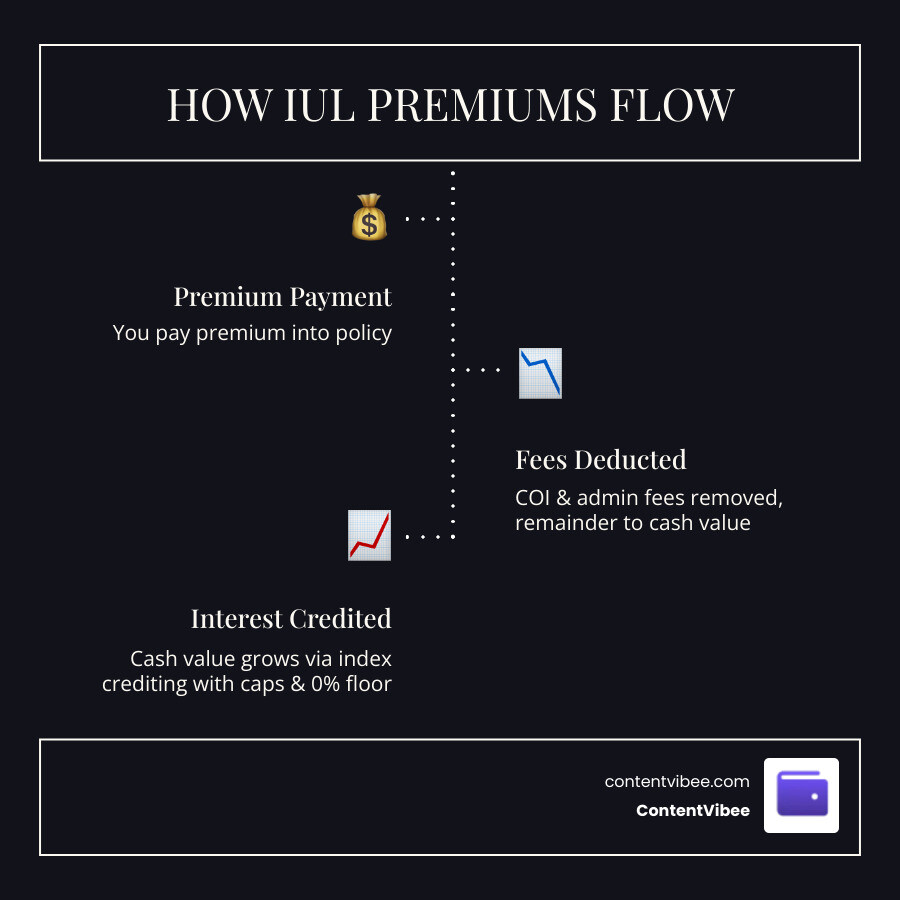
To understand Indexed Universal Life Insurance Investment Risks and Returns, we first have to pull back the curtain on how the insurance company actually calculates your “earnings.” When you pay your premium, a portion goes toward the cost of insurance (COI) and administrative fees. The remainder enters the cash value account.
Unlike Variable Universal Life (VUL), where your money is directly invested in mutual-fund-like subaccounts, IUL cash value remains in the insurer’s general account. The insurer then uses call options and hedging strategies to “track” an index like the S&P 500.

The Three Pillars of IUL Returns
There are three main “levers” the insurance company uses to determine how much interest is credited to your account:
- The Floor (Typically 0%): This is the famous “zero is your hero” feature. If the S&P 500 drops 20%, your account is credited 0%. You don’t lose principal due to market performance.
- The Cap (Typically 8%–12%): This is the trade-off for the floor. If the market skyrockets 25%, but your cap is 10%, you are only credited 10%.
- The Participation Rate: This determines what percentage of the index’s gain you actually receive. If the index grows 10% and your participation rate is 70%, your return is 7% (before fees).
Most policies use an annual point-to-point calculation. This means the insurer looks at the index value on day one of your policy year and compares it to the value 365 days later. They don’t care about the volatility in between; they only care about those two specific data points.
Comparing the “Big Three” of Permanent Life Insurance
| Feature | Whole Life | Indexed Universal Life (IUL) | Variable Universal Life (VUL) |
|---|---|---|---|
| Investment Risk | Low (Guaranteed by insurer) | Medium (Linked to index) | High (Direct market exposure) |
| Growth Potential | Steady/Dividends | Market-linked (Capped) | High (Uncapped) |
| Downside Protection | Guaranteed minimum | 0% Floor | None (Can lose principal) |
| Premiums | Fixed | Flexible | Flexible |
Analyzing Indexed Universal Life Insurance Investment Risks and Returns
When we look at Indexed Universal Life Insurance Investment Risks and Returns in 2026, we have to acknowledge that the “protection” comes at a price. The biggest risk isn’t necessarily the market going down—it’s the internal costs of the policy going up while the market stays flat.
The Realistic Return Expectation
Many sales illustrations show a consistent 6% or 7% return every single year. In the real world, returns are lumpy. You might have three years of 10% (hitting the cap), followed by two years of 0% (hitting the floor).
According to A Closer Look at the Risks and Rewards of IUL Insurance | Indexed Universal Life, the non-guaranteed nature of these rates is the primary risk. The insurance company has the right to change the caps and participation rates after you buy the policy. If the insurer’s costs for hedging go up, they might drop your 11% cap to 8%, significantly limiting your long-term wealth accumulation.
Historical Performance: Indexed Universal Life Insurance Investment Risks and Returns in Volatile Markets
Let’s look at how IUL performed during the volatile start of the 2020s. In 2022, the S&P 500 dropped by roughly 18.1%. A direct investor in an index fund saw their balance crater. However, an IUL holder with a 0% floor saw their cash value stay flat (excluding fees).
In 2023, the market roared back with a 24.2% gain. While the direct investor recovered, the IUL holder was likely capped at 10% or 11%. Over that two-year period, the IUL provided a smoother ride, but often a lower total net return than a simple Whole Life Insurance policy might have provided when you factor in the rising costs of the IUL’s internal insurance.
Mitigating Policy Lapse: Managing Your Investment
The ultimate risk of an IUL is a policy lapse. This happens when the internal fees (which increase as you get older) become higher than the interest being credited. If your cash value hits zero, the policy terminates, and you could face a massive tax bill on any outstanding loans.
To mitigate this, we recommend:
- Overfunding: Paying more than the minimum premium to build a “cushion” of cash value.
- Annual Reviews: Checking your policy every year to ensure the current caps and fees still align with your original plan.
- Switching Strategies: Many 2026 policies allow you to move money between different indexes or a fixed-interest account if you expect high market volatility.
The Hidden Costs: How Fees and COI Impact Net Returns
One of the most important things to realize about Indexed Universal Life Insurance Investment Risks and Returns is that a 0% market return is actually a negative net return. Why? Because the insurance company still deducts its fees every month.

The “Fee Stack” in an IUL
- Premium Loads: A percentage (often 5%–10%) taken off the top of every dollar you pay before it even hits your cash value.
- Administrative Fees: Monthly flat charges for maintaining the policy.
- Cost of Insurance (COI): This is the price of the actual death benefit. Because you are getting older every year, the “mortality charge” per thousand dollars of coverage increases. If your cash value doesn’t grow fast enough to keep up with these rising costs, the policy can eat itself alive.
- Surrender Charges: If you decide the policy isn’t for you in the first 10 to 15 years, the insurer will keep a significant portion of your cash value as a “breakup fee.”
As noted in the Pros and Cons of Indexed Universal Life Insurance (IUL): A Comprehensive Guide, these expenses are often front-loaded. It is common for an IUL policy to have a negative return for the first 5 to 10 years because the fees outweigh the interest credits.
Strategic Suitability: Is IUL the Right Financial Protection Tool?
We often see IUL marketed as a “magic” bucket for retirement, but it is a specialized tool that only works for specific people. It is generally best suited for high-net-worth individuals who have already maxed out their 401(k)s and IRAs and are looking for a tax-advantaged place to put extra cash.
The 7-Pay Test and MEC Risks
The IRS has strict rules about how much money you can put into a life insurance policy. If you fund it too quickly (violating the “7-Pay Test”), the policy becomes a Modified Endowment Contract (MEC). Once it’s a MEC, you lose the ability to take tax-free loans, which is one of the main reasons people buy IUL in the first place.
Is it better than a 401(k)?
For the average worker, the answer is usually no. A 401(k) offers an immediate tax deduction and often a company match—which is essentially a 100% return on your money. IUL does not provide a tax deduction for premiums. However, IUL does not have Required Minimum Distributions (RMDs), and the loans you take from the policy don’t count as income for Social Security taxing purposes.
You might consider IUL if:
- You need permanent life insurance for estate planning.
- You are in a high tax bracket and want tax-deferred growth.
- You want “downside protection” and are willing to sacrifice the market’s biggest “up” years to get it.
- You are interested in the “Infinite Banking” concept—using your policy as a personal bank.
Frequently Asked Questions about IUL Risks and Returns
Can you lose money in an IUL policy during a market crash?
Technically, your cash value won’t drop because the market went down (thanks to the 0% floor). However, your balance can decrease because the insurer still takes out the cost of insurance and administrative fees. If the market is at 0% and your fees are 2%, your account value drops by 2%.
How do participation rates affect my total interest credited?
The participation rate is a multiplier. If the index gains 10% and your rate is 140% (common in some “volatility-controlled” indexes), you get 14%. If your rate is 80%, you get 8%. Always check if your participation rate is guaranteed or if the insurer can lower it later.
Is an IUL better than a 401(k) for long-term wealth accumulation?
For most people, a 401(k) or a Roth IRA is a more efficient wealth-building tool due to lower fees and simpler structures. IUL is generally used as a supplemental strategy for those who have already exhausted traditional retirement accounts.
Conclusion
Navigating Indexed Universal Life Insurance Investment Risks and Returns requires a balanced perspective. It is a powerful tool for tax-efficient wealth transfer and downside protection, but it is not a “set it and forget it” investment. Between the caps on your gains and the rising cost of insurance, the internal “gravity” of the policy can be heavy.
At ContentVibee, we believe that financial security comes from understanding the fine print before you sign. If you are looking for a way to balance market participation with a safety net, IUL might have a place in your portfolio—provided you manage it actively and fund it properly.
Ready to dive deeper into your financial future? Explore more financial protection strategies to find the right fit for your goals in 2026.


