


Charles Schwab Investment Account Fees and Advisory Cost Structure can mean the difference between keeping more of your returns — or quietly giving them away.
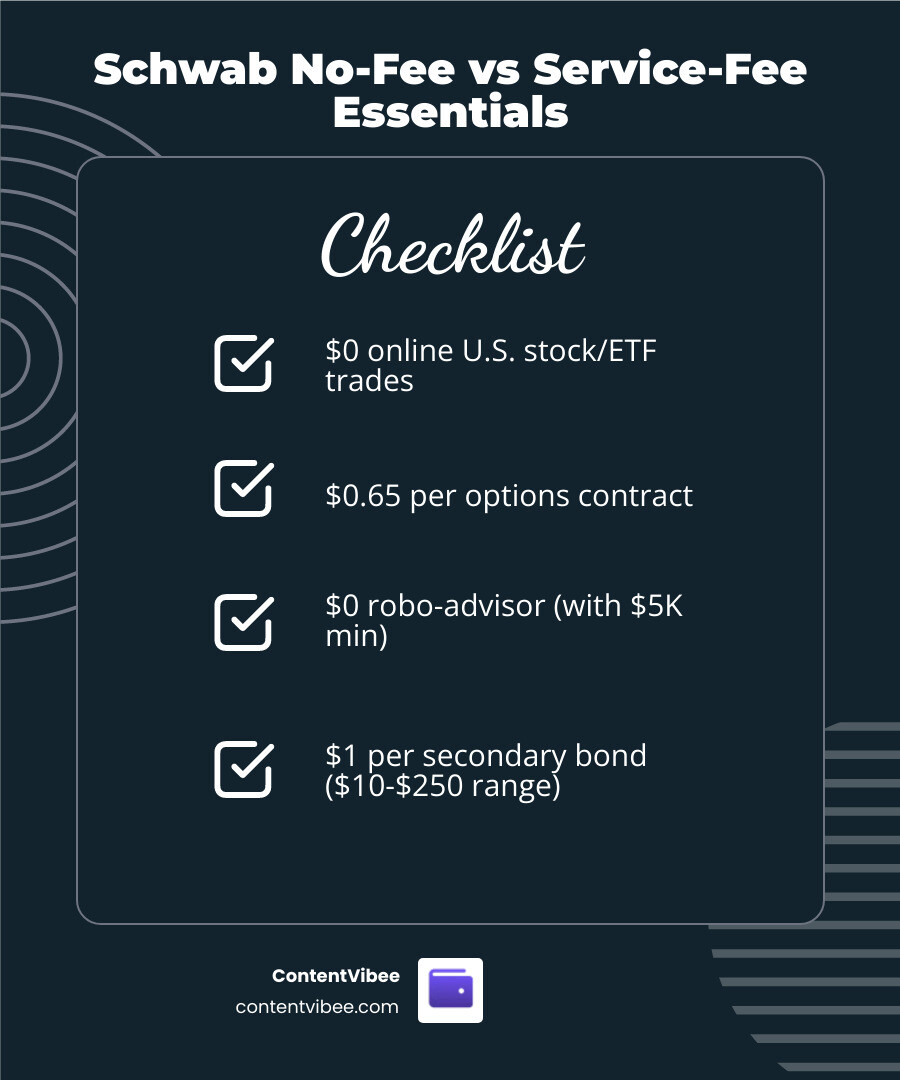
Here’s a quick snapshot of what Schwab charges across its most common services:
| Service | Fee |
|---|---|
| Online U.S. stock/ETF trades | $0 |
| Options (per contract) | $0.65 |
| Broker-assisted trades | +$25 per trade |
| Schwab Intelligent Portfolios (robo-advisor) | $0 advisory fee ($5,000 minimum) |
| Schwab Wealth Advisory | From 0.80% annually ($500,000 minimum) |
| No-transaction-fee mutual funds | $0 (3,000+ funds) |
| Transaction-fee mutual funds | Up to $74.95 per purchase |
| Secondary market bonds | $1/bond ($10 min, $250 max) |
| Outgoing wire transfer | $25 (waived for $100K+ households) |
| Foreign currency conversion | Up to 3% markup |
Schwab has built a reputation as a low-cost broker — and for many everyday trades, that reputation holds. But the full picture is more layered than “$0 commissions” suggests.
Depending on what you trade, which services you use, and how your accounts are structured, your actual costs can vary significantly.
This guide breaks it all down clearly so you know exactly what you’re paying — and what you’re getting.
Breaking Down the Charles Schwab Investment Account Fees and Advisory Cost Structure
As we move through April 2026, the brokerage landscape remains highly competitive, and Schwab continues to lead with its “zero-dollar” headline pricing. For the vast majority of individual investors in the USA, the cost to enter the market has never been lower. Whether you are opening a standard brokerage account, a Traditional IRA, or a Roth IRA, you will find that there are $0 account minimums and $0 opening or maintenance fees.
The core of the Charles Schwab Investment Account Fees and Advisory Cost Structure is the $0 commission for online trades. If you are trading U.S. exchange-listed stocks or ETFs, you won’t pay a dime in base commissions when using the website or mobile app. This democratization of trading allows even small-scale investors to build diversified portfolios without the “drag” of transaction costs eating into their principal.
However, “online” is the keyword here. If you prefer a more “human” touch or need help over the phone, the costs change. According to the Pricing Guide for Individual Investors | Charles Schwab, choosing a broker-assisted trade adds a significant surcharge.
| Trade Method | Commission for U.S. Stocks/ETFs |
|---|---|
| Online/Mobile App | $0 |
| Automated Phone | $5 |
| Broker-Assisted | $25 |
It is also worth noting that while Schwab doesn’t charge you a commission, there are “Industry Fees” that are passed through to the investor. These include the SEC Section 31 Fee and the FINRA Trading Activity Fee. These are typically fractions of a penny, but they are part of the regulatory landscape of the U.S. financial system.
Trading Costs for Options, Futures, and Fixed Income
If you are looking to move beyond simple buy-and-hold stock strategies, the Charles Schwab Investment Account Fees and Advisory Cost Structure introduces per-contract or per-trade pricing. Options trading is a popular choice for many of our readers, and Schwab keeps this relatively affordable. While the base commission is $0, there is a $0.65 per-contract fee.
Interestingly, Schwab offers a small break for active traders: if you “buy to close” an options position that is trading at $0.05 or less, the per-contract fee is waived. If you need a broker to help you execute an options trade, be prepared for the $25 service charge on top of the contract fees.
For those venturing into the derivatives market, futures trades carry a $2.25 commission per contract, per side. This is a flat rate regardless of whether you trade online or via phone.
When it comes to “safe haven” investments like fixed income, Schwab’s pricing is quite transparent.
- Treasuries (Notes, Bonds, Bills): $0 online for secondary market trades.
- Corporate and Municipal Bonds: $1 per bond for online secondary market trades, with a $10 minimum and a $250 maximum.
- New Issues: Usually $0, as the fee is typically built into the offering price by the issuer.
Detailed breakdowns of these specific asset classes can be found on the Pricing | Account Fees | Charles Schwab page.
Mutual Fund Fees and Short-Term Redemption Rules
Mutual funds can be one of the most confusing parts of any fee schedule. Schwab attempts to simplify this through its Mutual Fund OneSource program, which offers over 3,000 no-load, no-transaction-fee (NTF) funds. When you buy an NTF fund, you pay $0 in commissions.
However, not all funds are in this program. For “Transaction-Fee” funds, you could pay up to $74.95 per purchase. This fee is capped at 8.5% of the principal, so it won’t swallow a very small investment entirely, but it is still a hefty price compared to $0.
We also need to talk about the “Short-Term Redemption Fee.” Schwab discourages market timing in mutual funds. If you sell a no-transaction-fee fund that you’ve held for 90 days or less, Schwab may charge a $49.95 redemption fee. This is separate from any fees the mutual fund company itself might charge (which would be disclosed in the fund’s prospectus).
To avoid these costs, we recommend checking the “Fund Facts & Fees” section on the Schwab website before you click “buy.” You can also compare these costs to other industry standards by looking at Why 401k Investment Companies Fees and Retirement to see how Schwab stacks up against the broader market.”
Managed Services and the Advisory Cost Structure
For investors who don’t want to pick their own stocks, Schwab offers a variety of managed solutions. This is where the Charles Schwab Investment Account Fees and Advisory Cost Structure shifts from “per trade” to “percentage of assets” or “subscription-based.”

Schwab Intelligent Portfolios® (The Robo-Advisor)
The entry-level managed service is Schwab Intelligent Portfolios. This service has $0 advisory fees. Instead of charging you to manage the money, Schwab earns revenue from the underlying ETF expense ratios and the interest on the cash portion of the portfolio (which is held in a Schwab Bank account).
- Minimum Investment: $5,000.
- Cost: $0 advisory fee, though you still pay the internal expenses of the ETFs used in the portfolio.
Schwab Wealth Advisory™
For those with more significant assets who want a dedicated financial advisor, Schwab Wealth Advisory is the flagship service.
- Minimum Investment: $500,000.
- Fee Structure: Starts at 0.80% of assets under management (AUM).
- Tiered Pricing: As your balance grows, the percentage fee decreases. For example, assets over $5 million or $10 million often see significantly lower rates.
This service covers financial planning, portfolio management, and regular meetings with a professional. Understanding these costs is essential for any investor looking to maximize their net returns while receiving professional guidance.
Charles Schwab Investment Account Fees and Advisory Cost Structure for Independent Advisor Clients
Some investors work with an independent Registered Investment Advisor (RIA) who uses Schwab as a “custodian” to hold the assets. In these cases, the pricing can be different. Schwab offers “Alternative Pricing” and “Advisor Billing” for these clients.
Under the Pricing Guide for Advisor Services | Charles Schwab, independent advisors can negotiate pricing based on the total volume of business they bring to Schwab. This might result in lower transaction fees for the client, but the client will also be paying a separate fee directly to their independent advisor.
If you’re in this boat, we suggest using Schwab Alliance, the dedicated portal for clients of independent advisors, which often provides a streamlined (and sometimes cheaper) electronic trading experience. You can learn more about how software impacts these costs in our guide on Why Investment Manager Software Fees matter.
Minimizing Charles Schwab Investment Account Fees and Advisory Cost Structure via Householding
One of the best ways to lower your costs at Schwab is through Householding. Schwab allows you to link the accounts of family members living at the same address (and sometimes even extended family) to create a “Household Balance.”
Why does this matter? Because many fee waivers are triggered by your total household assets.
- $100,000+ Household Balance: You qualify for 3 free online domestic wire transfers per quarter (usually $15 each).
- $1,000,000+ Household Balance: You can get fees waived for physical stock certificates and overnight check delivery.
By aggregating your IRA, your spouse’s brokerage account, and perhaps a child’s custodial account, you can reach these tiers faster. It’s a “strength in numbers” approach to banking and investing. For more on how brokerage firms handle these structures, see Why Brokerage Firm Investment Fees and Account structures vary.”
Account Maintenance, Activity Fees, and Global Trading
While trading is often free, “activity” is where incidental costs can creep in. Schwab doesn’t have an “inactivity fee,” which is a huge plus for long-term investors. However, there are specific service fees you should be aware of to avoid surprises on your monthly statement.
Common Service Fees
- Full Account Transfer-Out (ACAT): If you decide to leave Schwab and move your entire account to another broker, there is a $50 fee. (Partial transfers are often free).
- Wire Transfers: Online domestic wires cost $15. If you call in to have a broker do it, it’s $25.
- Late Settlement Fee: If you sell a security but don’t have the funds or the shares ready to settle on time, you could be hit with a $25 fee.
- Non-Sufficient Funds (NSF): If a check or electronic transfer bounces, expect a $25 charge.
- Custody for Non-Publicly Traded Securities: If you hold “alternative” investments like private equity or non-traded REITs, Schwab charges $250 per position annually (capped at $500 per account).
Global Trading and Currency
For the adventurous investor looking at international markets, the Charles Schwab Investment Account Fees and Advisory Cost Structure gets a bit more complex.
- Schwab Global Account: This allows you to trade on foreign exchanges in local currencies. Commissions vary by country (e.g., 2000 JPY for Japan, 32 AUD for Australia).
- Foreign Currency Conversion: Schwab charges a markup of up to 3% (300 basis points) of the principal when converting USD to a foreign currency.
- American Depositary Receipts (ADRs): Many foreign stocks trade in the U.S. as ADRs. Custodian banks for these ADRs often charge “pass-through fees” of $0.01 to $0.05 per share, which Schwab automatically deducts from your account.
If you are dealing with high-risk international transactions, it is also vital to understand protection. We’ve seen an uptick in unauthorized bank transaction how to dispute and recover money USA 2026 queries. Schwab’s “Satisfaction Guarantee” is a strong safety net, promising to refund eligible fees if you aren’t happy, but being proactive about security is always better.
Frequently Asked Questions about Schwab Fees
Does Schwab charge a fee for inactive brokerage accounts?
No. Unlike some older brokerage models or certain international firms, Charles Schwab does not charge an inactivity fee. You can leave your account sitting with a $0 balance or a stagnant portfolio without being penalized. This makes it an excellent choice for “set it and forget it” investors.
What is the cost for trading foreign stocks on local exchanges?
If you aren’t using the Schwab Global Account and instead ask a broker to execute a trade on a foreign exchange, the cost is the greater of $100 or 0.75% of the principal. This is quite expensive, so we highly recommend using the Global Account or sticking to ADRs that trade on U.S. exchanges for $0.
Are there any hidden fees for Schwab’s robo-advisory service?
While there is no “advisory fee” for Schwab Intelligent Portfolios, it isn’t strictly “free.” The “cost” is twofold:
- ETF Expense Ratios: You pay the internal management fees of the ETFs in the portfolio (though Schwab chooses low-cost options).
- Cash Sweep: A portion of your portfolio (often 6-10%) is held in cash. Schwab earns a spread on this cash. While it provides stability, that cash may earn less than it would in a high-yield money market fund.
Conclusion
Navigating the Charles Schwab Investment Account Fees and Advisory Cost Structure in 2026 requires a balance of utilizing free tools while avoiding service-heavy surcharges. For the self-directed investor, Schwab offers one of the most cost-effective platforms in the USA. By sticking to online trades, utilizing the Mutual Fund OneSource list, and leveraging householding for fee waivers, you can keep your investment costs near zero.
At ContentVibee, we believe that cost-transparency is the first step toward financial freedom. Much like the Zacks Rank system helps investors find value by predicting stock performance, understanding your broker’s fee schedule helps you find value in your financial partnership. Whether you are recovering from a financial setback or building a legacy, every dollar saved on fees is a dollar that can compound for your future.
If you’ve encountered issues with unauthorized fees or need to know more about protecting your assets from fraud, explore our other resources. From identity theft credit report fraud how to fix and protect your score USA to deep dives into other major custodians, we have the insights you need.
Explore more investment insights and recovery strategies
Note: All pricing is based on Schwab’s official April 2026 fee schedules. Fees are subject to change, and we recommend visiting schwab.com/pricingguide for the most current updates before making significant investment decisions.
Related Reading:
- Why Credit Union Investment Services Fees
- Why Brokerage Firm Investment Fees and Account
- Why Investment Manager Software Fees“