


TCGplayer investment value cards are trading cards bought and sold on the TCGplayer marketplace that show strong potential for price growth — driven by tournament results, rarity, card condition, and collector demand.
Top TCGplayer investment value cards right now (April 2026):
| Card | Game | Recent Price | Price Change |
|---|---|---|---|
| Latias & Latios GX (Alt Full Art) | Pokémon | $1,738.85 | +$119.37 |
| Sylveon ex (156/131) | Pokémon | $543.24 | +$66.06 |
| Team Aqua’s Kyogre EX | Pokémon | $348.89 | +$87.67 |
| Blue-Eyes White Dragon (Secret Rare) | Yu-Gi-Oh! | $301.04 | +$29.97 |
| Crimson Dragon (QCSR) | Yu-Gi-Oh! | $188.68 | +$44.24 |
The trading card market has quietly grown into a serious alternative asset class. A single tournament win can spike a card’s price overnight. A market buyout can send a low-supply card soaring in hours. And vintage Pokémon cards from 1999–2003 have shown 15–25% annual appreciation over the long term.
But not every spike is a signal worth chasing. Some price jumps fade as fast as they appear. Knowing the difference between hype and real value is what separates smart TCG investors from buyers who get left holding the bag.
This guide breaks down 10 clear ways to spot cards with real investment potential on TCGplayer — whether you’re a collector looking to grow your holdings, or a seller trying to time your listings right.
Analyzing Market Trends and TCGPlayer Investment Value Cards
To find tcgplayer investment value cards, we first have to understand the powerhouse behind the data. TCGplayer is the heartbeat of the secondary market. Since raising $45M over four funding rounds and its subsequent acquisition by eBay on August 22, 2022, the platform has become the gold standard for pricing.
When we look for value, we don’t just look at “Listed Median” prices—we look at the Market Price, which reflects the actual price cards are selling for. By monitoring “Sold Listings,” we can see if a price spike is backed by real buyers or if it’s just a seller’s wishful thinking.
For those of us treating this like a serious portfolio, tools like the TCG Alpha Estimator: Pro Rare Card Investment Calculator | Calcix are essential. They help us calculate our “Alpha”—the return we get above a standard market index like the S&P 500.
Short-Term Spikes vs. Long-Term Holds
| Investment Type | Driver | Typical Timeline | Example |
|---|---|---|---|
| Short-Term Spec | Tournament Meta / New Set Hype | 1–4 Weeks | Chaos Hunter (QCSR) |
| Mid-Term Hold | Out-of-Print Sets / Format Staple | 6–18 Months | Crimson Dragon (QCSR) |
| Long-Term Asset | Vintage Scarcity / Iconic Art | 3–10 Years | Latias & Latios GX (Alt Art) |
Spotting TCGPlayer Investment Value Cards in Yu-Gi-Oh!
Yu-Gi-Oh! is a market where tournament results dictate prices almost instantly. Take Chaos Hunter (Quarter Century Secret Rare). After a big win at YCS Birmingham on February 9, 2025, where it was used effectively against the Maliss archetype, the price jumped from $9.86 to over $18.50 in days.
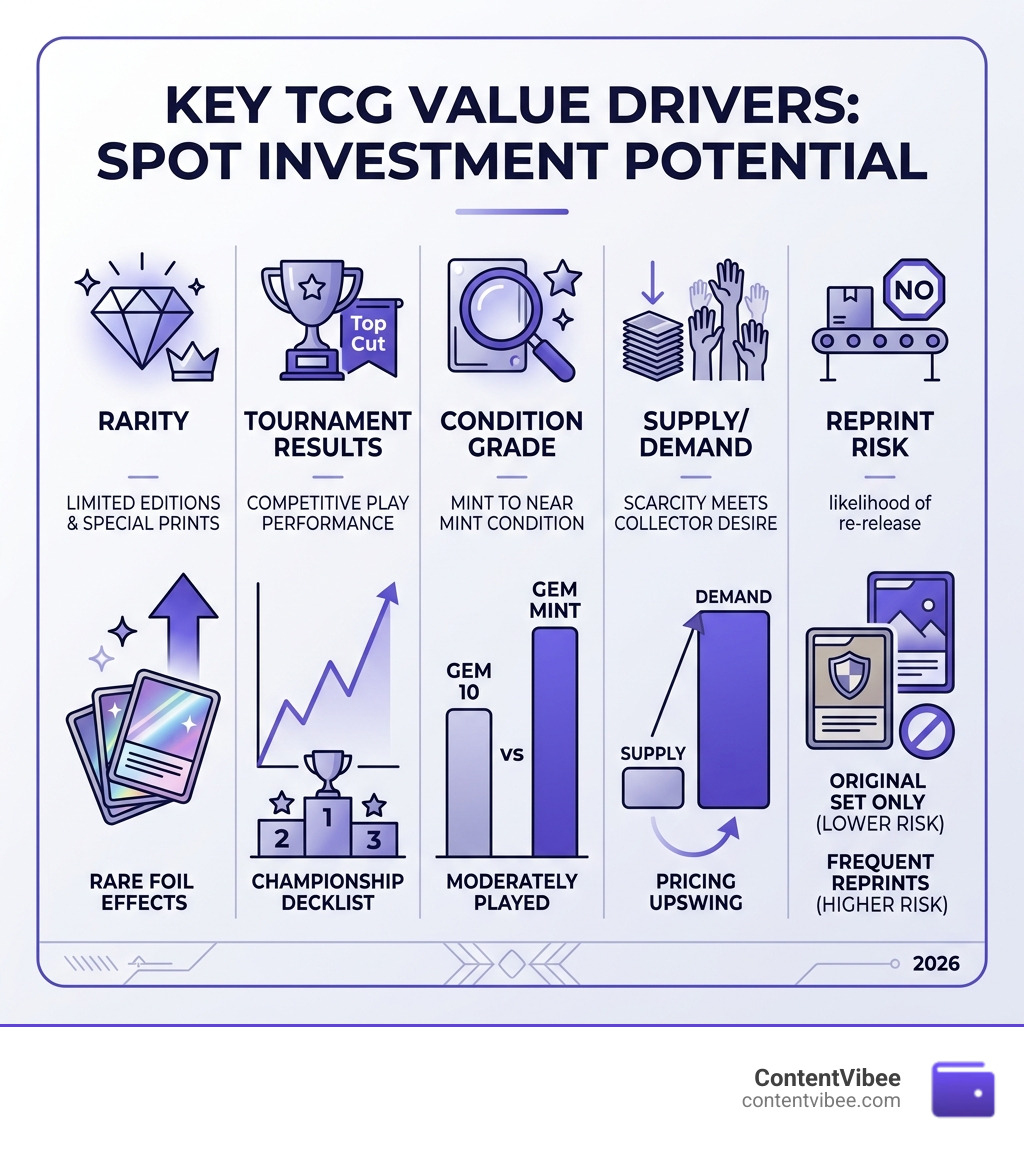
Why was this a smart move? Because of the rarity. Konami’s current policy suggests they won’t reprint a card in Quarter Century Secret Rare (QCSR) if it already has a version in that rarity. This makes QCSRs a “reprint-proof” safe haven for investors.
We also see huge movement around nostalgic releases. The Blue-Eyes White Destiny Structure Deck release sent cards like Blue-Eyes Spirit Dragon climbing by over $12.00 as players scrambled to “bling out” their new decks. To avoid getting caught in a “pump and dump,” we always recommend reading TCG Valuation 101: How to Spot Long-Term Card Investments (And Avoid Flops) to learn how to stack signals like supply and cultural relevance.
Evaluating TCGPlayer Investment Value Cards in Pokémon
In the Pokémon world, “Waifu” cards and “Alternate Arts” are king. The Latias & Latios GX (Alternate Full Art) from Team Up is a prime example of a pre-pandemic set card reaching legendary status. It increased by a staggering $119.37 recently, hitting a market price of $1,738.85.
Sometimes, value comes from sudden market activity. On April 10, 2025, a massive buyout of Sylveon ex (156/131) from Prismatic Evolutions caused the price to jump $66.06. When supply is low, even a small group of investors can shift the market floor. If you want to dive deeper into these dynamics, the Pokemon Card Game Value: Complete TCG Investment & Analysis Guide provides a great framework for balancing competitive play with collectible appeal.
Identifying High-Growth Assets: Rarity and Competitive Play

What actually makes a card worth money? It’s a mix of math and emotion. According to the experts at Understanding Card Values: What Makes a Trading Card Worth Money? | TCGrader | TCGrader Blog, rarity tiers are just the beginning.
- Rarity and Short Prints: It’s not just about being a “Secret Rare.” Sometimes, “short prints” or error cards within a set create artificial scarcity that collectors crave.
- Competitive Playability (The “Meta”): If a card is a 3-of in a championship-winning deck, demand will explode. However, these are often “Standard” legal, meaning they might lose 40-60% of their value once they rotate out of tournament play.
- Condition is Everything: A PSA 10 (Gem Mint) card can be worth 2x to 10x more than a PSA 9. For vintage cards, even lower grades like a PSA 5 Base Set Charizard can be worth hundreds because there simply aren’t enough high-grade copies to go around.
Just like in real estate, we need to think about more info about asset allocation when building a TCG portfolio. We suggest a “Barbell Strategy”: keep 40% in stable vintage assets, 30% in competitive staples you can flip, and the rest in high-upside speculative cards.
Financial Security: Protecting Your TCG Assets from Fraud and Theft
As tcgplayer investment value cards reach prices comparable to stocks or small plots of land, financial security becomes a major concern. We aren’t just talking about keeping your cards in a cool, dry place — we’re talking about your digital and bank security.
If you are a high-volume seller or buyer, you are a target for fraud. We have seen cases of unauthorized bank transaction how to dispute and recover money USA 2026 where hackers gain access to marketplace accounts to drain funds. Always use two-factor authentication (2FA) and monitor your accounts weekly.
If you fall victim to identity theft credit report fraud how to fix and protect your score USA, it can freeze your ability to use platforms like TCGplayer or eBay. Furthermore, be wary of “too good to be true” private deals that require wire transfers. A wire transfer fraud victim what to do and recovery options USA 2026 often has very little recourse once the money leaves the bank.
every investor faces risk, whether it’s a market crash or a security breach. You might even ask, is automated portfolio management right for you? to help track your assets without exposing your primary bank accounts to unnecessary risk.
Maximizing Returns: Grading, Liquidity, and Tax Strategies
To truly maximize the value of your tcgplayer investment value cards, you need an exit strategy. Buying a card is easy; selling it for a profit after fees and taxes is the hard part.
The Power of Grading
Grading cards through services like PSA, BGS, or CGC provides:
- Authentication: Proves the card isn’t a high-quality counterfeit.
- Condition Preservation: The sonically sealed slab protects against humidity and physical damage.
- Value Multiplier: A PSA 10 is the “Gold Standard” that serious investors demand.
- Liquidity: Graded cards often sell faster because the buyer doesn’t have to guess the condition from blurry photos.
The 2026 Tax Reality
In 2026, the IRS continues to treat trading cards as “collectibles.” This means they are subject to a maximum capital gains tax rate of 28% in the USA.
When you sell a high-value card like a Latias & Latios GX, you should calculate your “cost basis.” This includes the original purchase price, shipping, marketplace fees, and even the cost of grading. As we discuss in TCG as Investment: A Gamer’s Guide to Collectible Card Valuation and Long-Term Strategy, keeping a detailed ledger is the only way to ensure you aren’t overpaying the taxman.
Why choosing the right investment portfolio matters here—if you are flipping modern cards, your tax burden and fees (usually 10-15% on TCGplayer) might eat all your profits. Long-term holds often provide better net returns after all is said and done.
Frequently Asked Questions about TCG Investing
How do tournament results impact card prices?
Tournament results are the primary driver for short-term price spikes. When a deck wins a major event like a YCS or a Regional Championship, the “tech cards” used in that deck often see a 30-50% price increase within 48 hours. Investors who watch “Limitless TCG” or live streams often buy these cards during the tournament to catch the wave before the general public.
What is the difference between Market Price and Mid Price on TCGplayer?
Market Price is calculated using the most recent completed sales on the platform. It is the most accurate reflection of what people are actually paying. Mid Price is the middle point of all currently listed copies. Mid price can be easily manipulated by sellers listing cards at absurdly high prices, so always rely on Market Price and Sold Listings for your valuation.
Are vintage cards safer than modern competitive staples?
Generally, yes. Vintage cards (1999–2003) have a fixed supply. They won’t be reprinted with the original 1st Edition stamps. Modern staples are at constant risk of being reprinted in “Mega Tins” or “Selection Sets,” which can crash their value by 80% overnight. However, modern “Special Art” cards are becoming a middle ground—highly collectible but still used in play.
Conclusion
At ContentVibee, we believe that whether you are investing in real estate or tcgplayer investment value cards, the fundamentals remain the same: research, diversify, and protect your gains. The TCG market in 2026 is more than a hobby—it’s a sophisticated financial landscape.
By balancing the thrill of the “meta” with the stability of vintage assets, and utilizing smart capital gains strategies, you can turn a collection of cardboard into a resilient financial portfolio. If you’re wondering what is the safest investment?, the answer is usually a diversified one.
Ready to level up your financial game? Explore our investment categories to learn more about maximizing your returns in every asset class.


