Why the Difference Between Brokerage Fee and Commission Costs You More Than You Think
Understanding the difference between brokerage fee and commission is one of the most overlooked money moves you can make — especially when every dollar counts during a major life change like a divorce.
Here’s the short answer:
| Brokerage Fee | Commission | |
|---|---|---|
| What it is | A flat or recurring charge for account services | A percentage-based payment for executing a transaction |
| Who pays it | The client, directly to the broker | The client, or sometimes a third party (like an insurer or fund company) |
| When it’s charged | Regularly (annual, monthly) or per service | At the time of a trade, sale, or policy purchase |
| Examples | Account maintenance fee, inactivity fee, platform fee | Real estate agent cut, mutual fund sales load, stock trade commission |
| Tied to performance? | No | Sometimes (tied to deal size or premium) |
In plain terms: brokerage fees are what you pay just to have an account or use services, while commissions are what you pay when a transaction actually happens.
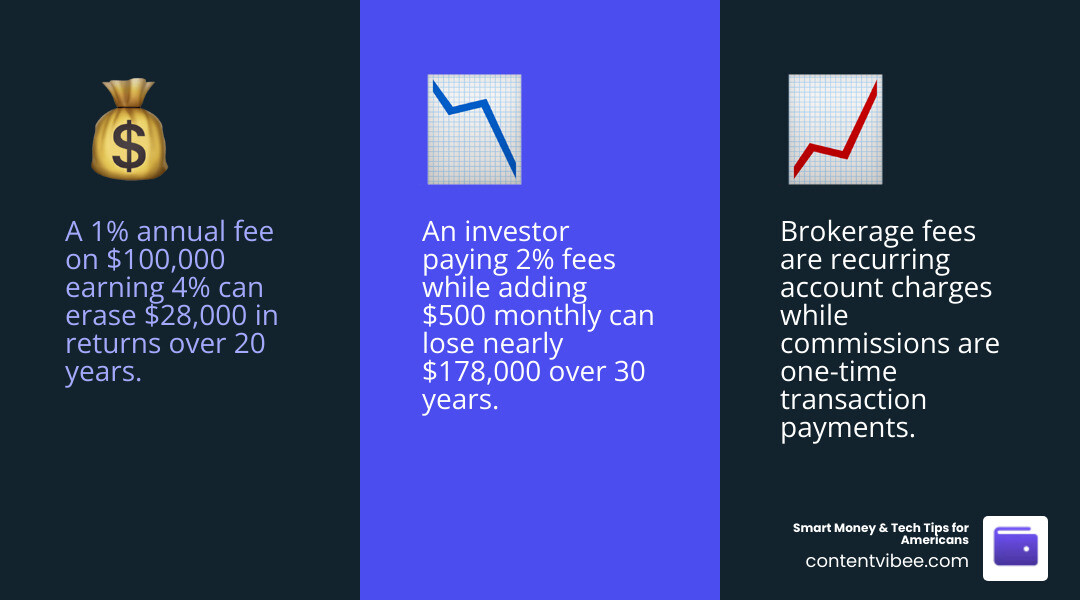
Both can quietly drain your wealth over time. A seemingly small 1% annual fee on a $100,000 investment earning 4% can wipe out $28,000 in returns over just 20 years. And an investor paying 2% annually while contributing $500 a month could lose nearly $178,000 to fees over 30 years — roughly equal to every dollar they ever deposited.
That’s not a rounding error. That’s your retirement.
This guide breaks down exactly how each charge works, where they show up (investing, real estate, insurance, and more), and how to keep more of your money where it belongs — with you.
Understanding the Difference Between Brokerage Fee and Commission
When we dive into financial intermediaries, the terminology can get a bit murky. However, the difference between brokerage fee and commission essentially boils down to why you are being charged.
A brokerage fee is a service charge. Think of it like a subscription to a gym; you pay the fee to have access to the equipment and the space. On the other hand, a commission is more like a tip or a success fee; it is paid when a specific action—like buying a stock or selling a house—is completed.
For a deeper dive into these definitions, check out this guide on Commission in Finance: Definition, Examples, and Key Differences From Fees.
| Feature | Flat Fee (Brokerage Fee) | Percentage Commission |
|---|---|---|
| Predictability | High; you know exactly what’s coming. | Low; varies with the size of the deal. |
| Incentive | To provide ongoing service/maintenance. | To close the deal or increase trade volume. |
| Best For | Long-term holders and passive investors. | One-time transactions or specialized advice. |
Defining the Brokerage Fee in Modern Finance
In May 2026, the “brokerage fee” has evolved. While many platforms now offer “zero-commission” trading, they still need to keep the lights on. We often see these costs manifest as:
- Account Maintenance Fees: Annual charges (often $50–$75) just to keep your account open.
- Inactivity Charges: Penalties for not trading enough (ranging from $50 to $200 per year).
- Platform Subscriptions: Monthly fees for “Pro” tools, advanced data, or research.
Understanding Why Brokerage Firm Investment Fees and Account structures exist helps you see the “hidden” costs of “free” platforms.
How Commissions Function as Transactional Incentives
Commissions are the engine of the sales world. In the stock market, a commission is a direct payment to the broker for executing your trade. While stock commissions have plummeted toward zero for retail investors, they still exist for options (often $0.50 to $0.65 per contract) and mutual funds.
Mutual funds often use “sales loads.” A front-end load might take 3% to 8.5% of your money before it’s even invested! For more on how these costs are structured, read about Brokerage Commissions Explained: Unlocking Trading Costs.
How Compensation Structures Work Across Industries
The difference between brokerage fee and commission isn’t just a Wall Street problem. It affects how we buy homes, secure loans, and protect our families with insurance.

Industry Standards for Real Estate and Mortgages
In the California real estate market, commissions are king. Typically, a seller pays a commission of 5% to 6% of the home’s sale price. This is then split between the buyer’s agent and the seller’s agent.
Mortgage brokers operate similarly but on a smaller scale. Their fees generally range from 1% to 2% of the total loan amount. While this might seem small, on a $750,000 California mortgage, a 2% fee is a staggering $15,000. This is why understanding Why Credit Union Investment Services Fees can be a smarter path for some, as they often offer lower-cost alternatives to traditional brokers.
The Difference Between Brokerage Fee and Commission in Insurance
In insurance, the broker represents you, the client, while an agent represents the insurance company.
- Commission: Most insurance brokers earn a percentage of the annual premium paid by the carrier. This aligns their incentive with keeping you as a happy, renewing client.
- Fees: Some high-end brokers charge a flat fee for specialized risk management or consulting services, which can eliminate the bias toward more expensive policies.
For those in California, legal precedents often dictate When is a Broker Entitled to his Commission Fee, particularly regarding the “procuring cause” of a sale.
The Long-Term Impact of Fees on Your Wealth
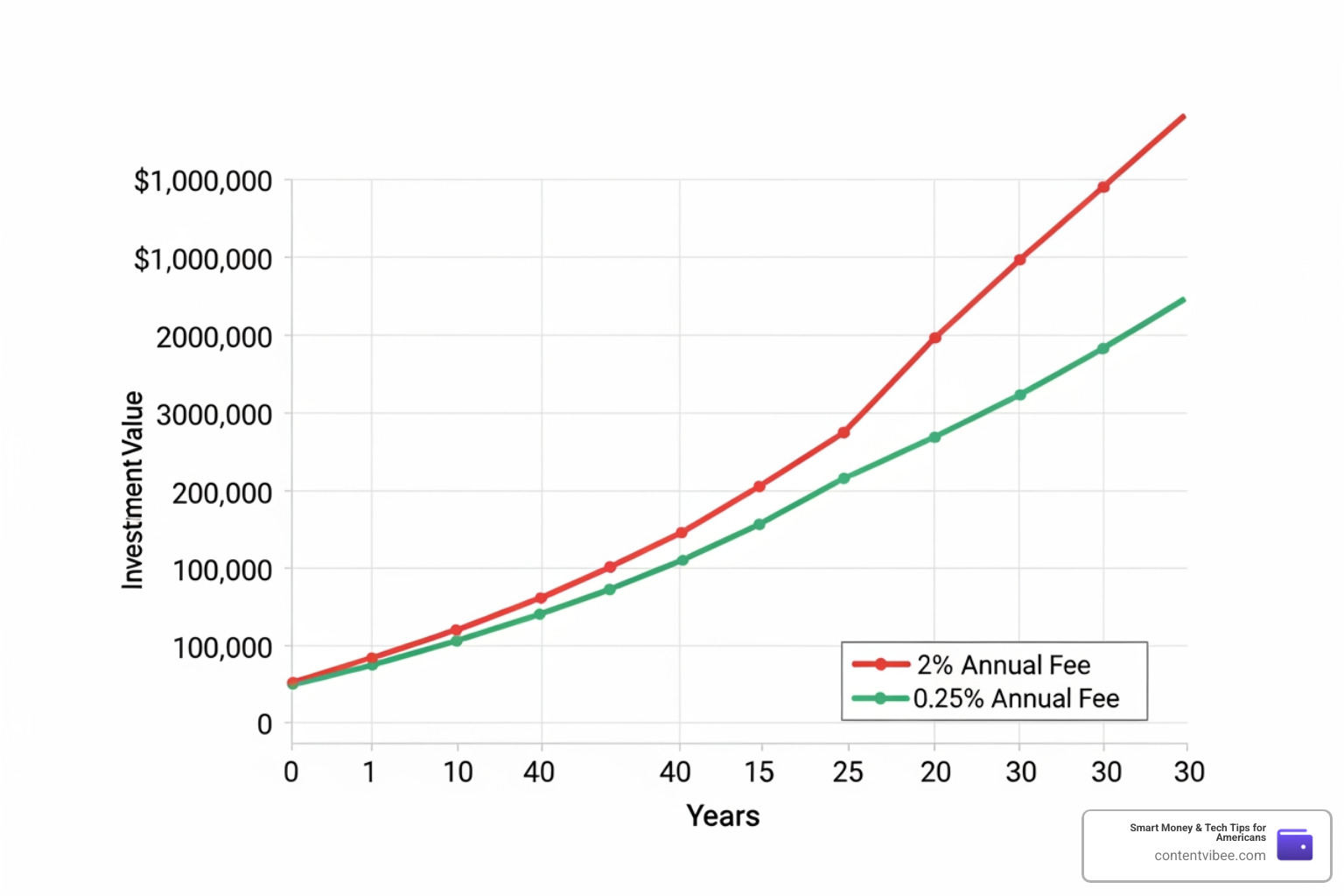
We cannot stress this enough: fees are the “silent killer” of wealth. Because they are often deducted automatically, they feel invisible. But thanks to the power of compounding, a small fee today is a massive loss tomorrow.
How Expense Ratios and Sales Loads Erode Returns
If you hold mutual funds or ETFs, you are paying an “expense ratio.” This is a brokerage fee “baked into” the fund.
- Actively Managed Funds: Often charge 1% or more.
- Index Funds: Often charge less than 0.25%.
If your fund also has a “12B-1 fee” (a marketing fee), you’re paying an extra 0.25% to 1% annually just so the fund can advertise to other people. It’s vital to know What You’re Actually Paying for Full-Service Brokerage or other full-service firms to ensure the advice is worth the cost. You can also learn more about How Fees and Expenses Affect Your Investment Portfolio from federal resources.
Comparing Full-Service vs. Robo-Advisor Costs
Full-service brokers typically charge an Assets Under Management (AUM) fee of 1% to 2%. For a $500,000 portfolio, that’s $5,000 to $10,000 every single year.
Robo-advisors, which use algorithms to manage your money, have disrupted this model. They average annual fees between 0.20% and 0.30%. This is Why Robo-Advisor Fees Comparison Matters; over a 30-year career, switching from a 1% human advisor to a 0.25% robo-advisor could save you enough to buy a vacation home.
How to Minimize Costs and Maximize Returns
You don’t have to be a victim of high fees. In 2026, the consumer has more power than ever to negotiate and choose lower-cost paths.
Strategies to Reduce the Difference Between Brokerage Fee and Commission Costs
- Go Digital: Opt for electronic statements. Many brokers charge $2–$5 per month just to mail you a piece of paper.
- Use No-Load Funds: Never pay a sales commission to buy a mutual fund. There are thousands of “no-load” options that perform just as well.
- Audit Your “PFOF”: Some “free” brokers make money through “Payment for Order Flow,” which might mean you get a slightly worse price on your stock. For high-volume traders, a small flat fee might actually be cheaper than a “free” trade with poor execution.
- Consolidate Accounts: Many firms waive annual maintenance fees if your total balance exceeds a certain threshold (like $25,000 or $50,000).
For a detailed breakdown of what to look for, see Understanding Leading Robo-Advisor Investment Fees as a benchmark for low-cost digital management.
Evaluating the Fiduciary vs. Suitability Standard
This is perhaps the most important “tech tip” for your money: Ask if your advisor is a Fiduciary.
- Suitability Standard: The broker only has to suggest products that are “suitable” for you. They can suggest a high-commission product even if a cheaper, better one exists.
- Fiduciary Standard: The advisor must act in your best interest.
Understanding What Are Wealth Management Fees and the standards behind them ensures you aren’t being steered into high-commission products that benefit the broker more than your bank account. You can also check FINRA.org to verify the background of your professional.
Frequently Asked Questions about Brokerage Costs
Are brokerage fees and commissions tax-deductible in 2026?
Unfortunately, no. For individual investors, the Tax Cuts and Jobs Act of 2018 suspended miscellaneous itemized deductions, including investment fees. This remains the case in 2026. However, commissions are typically added to the “cost basis” of your investment, which can reduce your capital gains tax when you sell.
What is the typical commission for an options trade?
While stock trades are often $0, options usually carry a per-contract fee. The industry standard in 2026 is roughly $0.65 per contract, though some platforms drop this to $0.50 if you trade more than 30 times a month.
Do zero-commission brokers have hidden costs?
Yes. They often make money through “Payment for Order Flow” (PFOF), interest on your uninvested cash (cash sweep), and margin lending interest. Always check the “Form CRS” (Relationship Summary) which brokers are legally required to provide.
Conclusion
At Smart Money & Tech Tips for Americans, we believe that transparency is the first step to financial freedom. Whether you are navigating a complex divorce settlement in California or just trying to optimize your 401(k), the difference between brokerage fee and commission is a distinction that can save you hundreds of thousands of dollars over your lifetime.
Don’t let your hard-earned gains be eaten away by “zombie fees.” Take the time to audit your statements, ask your advisor the hard questions, and lean into technology like robo-advisors to keep your costs low.
Ready to see how your current provider stacks up? Why Investment Fees Comparison Matters is a great place to start your research.
Take control of your portfolio costs today and ensure your money is working for you—not your broker.