


Can a Widow Get Her Husband’s Social Security? The Short Answer
Can a widow get her husband’s Social Security? Yes. A surviving wife may qualify for monthly Social Security survivor benefits based on her late husband’s work record, as long as he earned enough work credits and she meets the age, marriage, and other eligibility rules.
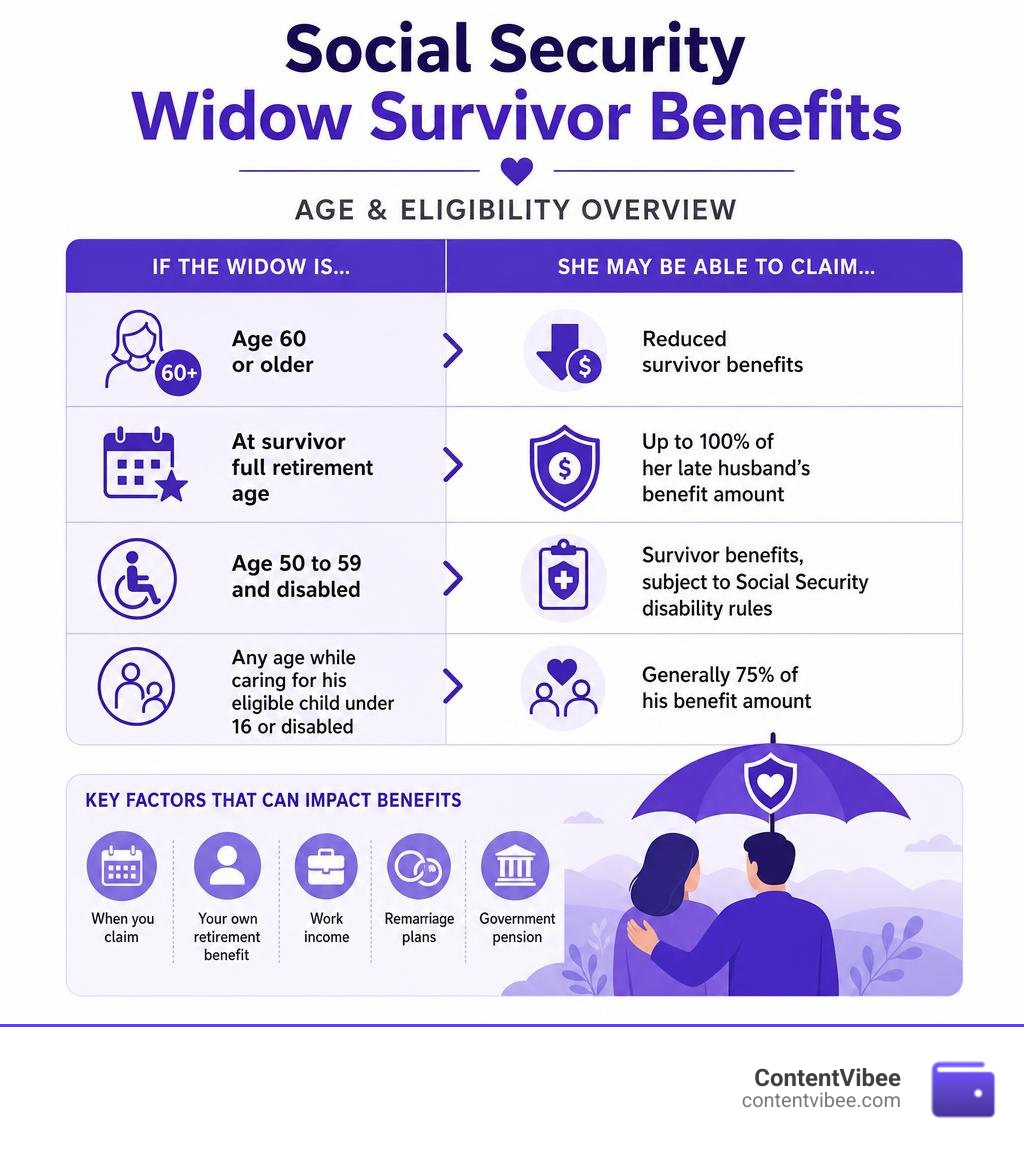
| If the widow is… | She may be able to claim… |
|---|---|
| Age 60 or older | Reduced survivor benefits |
| At survivor full retirement age | Up to 100% of her late husband’s benefit amount |
| Age 50 to 59 and disabled | Survivor benefits, subject to Social Security disability rules |
| Any age while caring for his eligible child under 16 or disabled | Generally 75% of his benefit amount |
The timing can make a major difference. Claiming at age 60 can mean a permanently lower monthly payment, while waiting until survivor full retirement age can provide the largest survivor amount. Her own retirement benefit, remarriage plans, work income, and any government pension can also affect the best path forward.
More than 3.8 million widows and widowers, including some surviving divorced spouses, received survivor benefits as of September 2025. The rules can feel dense during an already difficult time, but the core question is straightforward: which benefit can you receive, and when should you claim it?
Can a Widow Get Her Husband’s Social Security? Age Requirements and Eligibility
When we lose a spouse, navigating the financial road ahead can feel overwhelming. Fortunately, Social Security survivor benefits were designed specifically to offer a safety net for surviving partners. However, before payments begin, the Social Security Administration (SSA) evaluates a few core eligibility criteria.
First, your deceased spouse must have earned sufficient work credits during his career. Under standard rules, no worker needs more than 10 years (or 40 credits) to make family members eligible for survivor benefits. Under a special rule, if he worked and earned at least 6 credits (about 1.5 years of work) within the 3 years immediately preceding his death, certain benefits can still be paid to a surviving spouse caring for young children.
Second, the duration of your marriage matters. Under general guidelines, you must have been legally married to your husband for at least 9 continuous months immediately prior to his death. There are important statutory exceptions to this 9-month requirement, as detailed in Code of Federal Regulations § 404.335. For example, the 9-month rule is waived if:
- The death was accidental (defined legally as bodily injury caused by external, violent, and accidental means, where death occurs within 3 months of the injury).
- The death occurred in the line of duty while serving on active military duty.
- You and your husband had a biological or adopted child together.
- You were previously entitled to or eligible for auxiliary benefits (such as spousal or child disability benefits) in the month before your marriage.
Understanding whether can a widow get her husband’s social security starts with verifying these work credits and marriage timelines.
How Age Affects When Can a Widow Get Her Husband’s Social Security Benefits
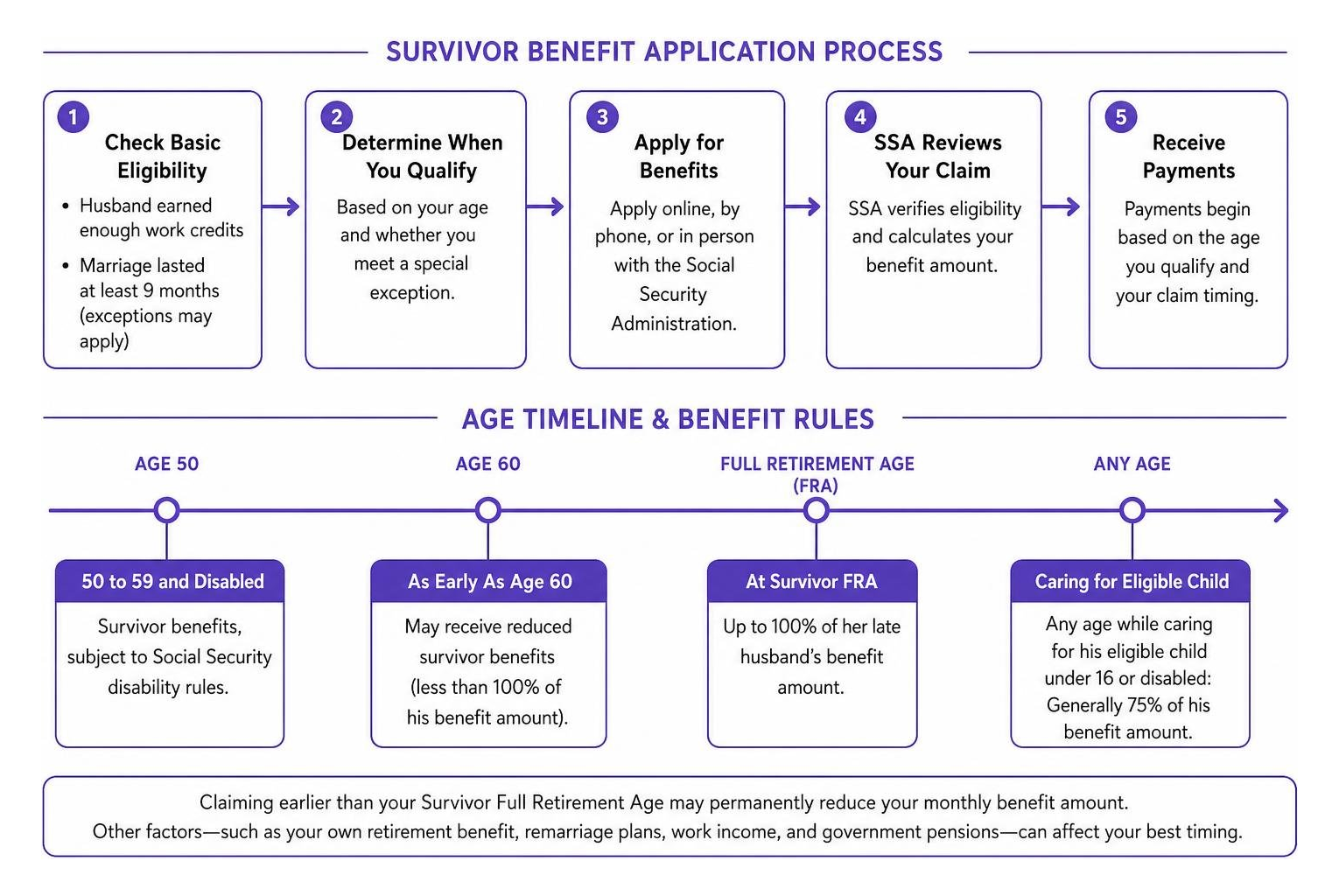
Age is the primary factor determining when you can start receiving monthly payments and how much you will get each month. Under standard retirement rules, the absolute minimum age to claim standard widow survivor benefits is age 60.
If you choose to claim benefits right at age 60, your payment will be permanently reduced because you are claiming early before reaching your survivor Full Retirement Age (FRA). Claiming early yields a lifetime reduction in monthly income, which is why timing your claim requires careful thought. To explore more about how age thresholds function, review our comprehensive guide on Survivor Benefits 101: Can a Widow Get Her Husband’s Social Security.
Special Rules for Widows Under Age 60: Disability and Child-in-Care
Many widows ask us: Can a widow who is only 55 years old apply for survivor benefits now, or must she wait until age 60? Generally, a 55-year-old widow cannot claim standard survivor benefits unless she meets one of two major statutory exceptions:
- The Disability Exception (Ages 50 to 59): If you are disabled, you can begin receiving survivor benefits as early as age 50. To qualify, your disability must meet SSA standards and must have begun either before your spouse’s death or within 7 years (84 months) following his passing (or within 7 years of when mother’s/father’s benefits ended). Disabled widows between ages 50 and 59 receive a fixed rate equal to 71.5 percent of the deceased spouse’s benefit, subject to a 5-month waiting period after disability onset.
- The Child-in-Care Exception (Any Age): If you are caring for your late husband’s biological or adopted child who is under age 16 (or disabled before age 22), you can receive survivor benefits at any age—even if you are well under 60. In this scenario, you receive 75 percent of his primary insurance amount. Once the youngest child turns 16, your parent survivor benefits stop (a period often called the Social Security “blackout period”) until you reach age 60 (or age 50 if disabled), at which point you can reapply for aged widow benefits.
How Much Survivor Benefits Will a Widow Receive?
The exact amount a surviving spouse receives depends heavily on her age at the time of claiming and whether her deceased husband claimed his own retirement benefits early or delayed them.
If you wait until your survivor Full Retirement Age, you will receive 100 percent of your late husband’s primary insurance amount (PIA), plus any delayed retirement credits he earned. However, if he claimed early retirement benefits before his own FRA, your maximum benefit as a widow will be capped at the amount he was receiving (or 82.5 percent of his primary insurance amount, whichever is higher).
The table below breaks down how claiming age alters the percentage of your late husband’s basic benefit amount:
| Claiming Age / Status | Percentage of Deceased Husband’s Benefit |
|---|---|
| Survivor Full Retirement Age (FRA) | 100% |
| Age 62 | ~82.5% |
| Age 60 (Standard Minimum Age) | 71.5% |
| Disabled Widow (Ages 50 – 59) | 71.5% |
| Caring for Child Under 16 (Any Age) | 75.0% |
These reductions are fixed permanent adjustments. Official guidance in SSA – POMS: NL 00711.040 – Widow’s Benefits Paragraphs establishes these precise reduction percentages across all age brackets. That total payments across all family members claiming on a single worker’s record are subject to the Social Security Family Maximum Limit, which typically ranges from 150 percent to 180 percent of the deceased worker’s basic benefit amount.
Understanding Survivor Full Retirement Age vs. Standard Retirement Age
A critical nuance many people miss is that Full Retirement Age for survivor benefits is calculated differently than Full Retirement Age for regular retirement or spousal benefits.
For regular retirement, anyone born in 1960 or later has an FRA of 67. But for survivor benefits, the phase-in schedule is slightly different:
- For survivors born between 1945 and 1956, survivor FRA is age 66.
- For survivors born between 1957 and 1961, survivor FRA gradually increases in two-month increments per year.
- For survivors born in 1962 or later, survivor FRA reaches age 67.
Knowing your exact survivor FRA ensures you do not claim too early if your goal is to lock in a 100 percent payout. Unlike standard personal retirement benefits, survivor benefits do not earn delayed retirement credits past your survivor FRA. Therefore, there is no financial advantage to delaying a survivor claim past your survivor FRA.
The $255 Lump-Sum Death Payment
In addition to monthly survivor benefits, the Social Security Administration pays a one-time lump-sum death payment of $255.
To receive this payment, you must be a surviving spouse who was living in the same household with the worker at the time of his death. If you were living apart, you may still qualify if you were already receiving or eligible for auxiliary benefits on his record. If there is no eligible surviving spouse, the $255 payment can be paid to a child who qualifies for benefits on the worker’s record. You must apply for this payment within 2 years of the worker’s date of death.
Dual Entitlement: Can a Widow Receive Her Own Retirement and Survivor Benefits?

A frequent point of confusion is dual entitlement: If I earned my own Social Security retirement benefit, can I draw both my own benefit and my deceased husband’s benefit at the same time?
The short answer is no; Social Security does not combine both checks to pay you a double benefit. Instead, the SSA applies dual entitlement rules: you will receive your own earned retirement benefit first. If your late husband’s survivor benefit is higher than your own benefit, Social Security pays you an additional amount so that your total combined check equals the higher survivor benefit amount.
This rule opens up powerful claiming strategies. Because personal retirement benefits and survivor benefits are legally separate, you can choose to claim one benefit early while allowing the other to grow.
For instance, a widow at age 60 could file a “restricted application” to claim only her reduced survivor benefit. Meanwhile, she lets her own personal retirement benefit grow unreduced until age 70, earning 8 percent delayed retirement credits each year after her regular FRA. At age 70, if her own retirement benefit has grown larger than her survivor benefit, she can switch to her own higher benefit.
Detailed administrative policies regarding dual entitlement and switching benefits are outlined in SSA – POMS: RS 00207.002 – Widow(er)’s Benefits – Payment and Termination. For a step-by-step walkthrough on structuring these choices, read A Compassionate Guide to Survivor Benefit Rules.
Impact of Government Pensions and the Social Security Fairness Act
Historically, widows who worked in state, local, or federal government jobs that did not pay into Social Security (such as public school teachers, police officers, or civil service employees) faced severe benefit reductions under the Government Pension Offset (GPO) and Windfall Elimination Provision (WEP). In many cases, the GPO reduced a widow’s survivor benefit by two-thirds of her government pension, often eliminating her survivor check entirely.
However, major legislative changes altered this landscape. The Social Security Fairness Act eliminated these reductions under WEP and GPO for benefits payable starting January 2024 onward. As a result, widows receiving government pensions based on non-covered employment are now able to claim full survivor benefits without the severe offsets that previously wiped out their payments.
Remarriage and Divorced Widow Rules
What happens if you fall in love and decide to remarry after your husband passes away? Does remarrying strip away your right to survivor benefits? The answer depends entirely on your age on the day you tie the knot:
- Remarrying Before Age 60 (or Age 50 if Disabled): If you remarry prior to age 60, you generally forfeit your eligibility to receive survivor benefits on your deceased husband’s record for as long as your new marriage lasts. However, if that subsequent marriage ends due to divorce, annulment, or death, your eligibility to claim on your first husband’s record is restored starting the month the remarriage ends.
- Remarrying At or After Age 60 (or Age 50 if Disabled): If you wait until after reaching age 60 (or age 50 if disabled) to remarry, your remarriage is legally disregarded for survivor benefit entitlement. You will continue to collect your survivor benefit on your late husband’s record unchanged.
What about surviving divorced spouses? If you were previously married to a worker who passed away, you can claim surviving divorced spouse benefits if you meet these conditions:
- Your marriage to the deceased worker lasted at least 10 continuous years prior to final divorce.
- You are at least 60 years old (or 50 if disabled), or caring for his child under 16.
- You are currently unmarried (or remarried after age 60).
Surviving divorced spouse benefits do not reduce the benefit amounts paid to a late worker’s current widow or other family members, as divorced benefits do not count against the family maximum cap. Learn more about these scenarios in our article on How Survivor Benefits Work When a Spouse Passes Away.
How to Apply for Deceased Spouse Social Security Benefits
Unlike standard retirement benefits, you generally cannot apply for Social Security survivor benefits completely online. The SSA requires an interview—either by phone or in person at a local field office—to verify original documents and process survivor claims.
If you were already receiving spousal benefits on your husband’s record prior to his death, the transition is usually simpler: once the funeral home or family reports his death to Social Security, the SSA will automatically update your spousal benefit to a survivor benefit. However, if you are claiming on his record for the first time or switching from your own retirement record, you must actively file an application. To prepare for this process, review Claim Deceased Spouse Benefits.
Steps on How Can a Widow Get Her Husband’s Social Security Approved
To ensure your application is processed smoothly without delays, gather these necessary documents before your appointment:
- Proof of Death: Official death certificate or funeral home notice (unless already reported by the funeral director).
- Proof of Age: Your original birth certificate.
- Proof of Marriage: Official marriage certificate establishing a duration of at least 9 months (or 10 years if a surviving divorced spouse).
- Divorce Papers: Final divorce decree if applying as a surviving divorced spouse.
- Tax Records: Most recent W-2 forms or self-employment tax returns (Schedule C) to verify recent earnings.
- Social Security Numbers: Your SSN and your deceased husband’s SSN.
- Direct Deposit Information: Bank account routing and account numbers for direct deposit setup.
Tip: Do not delay filing your claim just because you are missing a specific document! Social Security representatives can often assist you in obtaining official agency record certified copies.
Frequently Asked Questions About Widow Social Security Benefits
Can a 55-year-old widow draw her late husband’s Social Security?
Generally, a 55-year-old widow cannot draw standard survivor benefits because the minimum age for aged widow benefits is 60. However, she can draw benefits at age 55 if she qualifies under one of two exceptions: she has a qualifying disability that began within 7 years of her husband’s death (eligible from age 50-59 at a 71.5 percent rate), or she is caring for her late husband’s child who is under age 16 or disabled (eligible at a 75 percent rate regardless of her age). If neither exception applies, she must wait until age 60 to file.
Does remarrying at age 62 reduce a widow’s survivor benefit?
No. Because age 62 is after the age 60 threshold, remarrying at age 62 has no negative impact on your survivor benefits. The SSA allows widows who remarry at or after age 60 (or age 50 if disabled) to keep receiving their full survivor benefit on their deceased husband’s work record.
Can a surviving divorced spouse claim survivor benefits if the ex-husband remarried?
Yes. As long as your marriage to the deceased ex-husband lasted for at least 10 continuous years and you meet the age requirements (age 60+, or 50+ if disabled), you can claim surviving divorced spouse benefits. His remarriage to another person does not prevent you from claiming, nor does your claim reduce the survivor benefits paid to his current widow.
Conclusion: Securing Your Financial Future as a Surviving Spouse
Understanding can a widow get her husband’s social security is key to establishing stability after experiencing a profound loss. Whether you qualify right now at age 60, qualify early due to a disability or child-in-care rule, or elect to coordinate survivor benefits alongside your own personal retirement check, these monthly payments represent benefits earned over a lifetime of hard work.
Take the time to evaluate your full financial picture, compare claiming options, and schedule an appointment with the Social Security Administration. For more guidance on optimizing auxiliary payments, check out The Complete Guide to Social Security Spousal Benefit Eligibility. At ContentVibee, we are committed to providing step-by-step financial clarity so you can claim what is rightfully yours with confidence.


