


What Every Widow Should Know About Getting Her Husband’s Social Security
Can a widow get her husband’s Social Security? Yes — and more than 3.8 million surviving spouses were already receiving these benefits as of September 2025.
Here’s the short answer:
- Yes, a widow can receive her late husband’s Social Security as survivor benefits
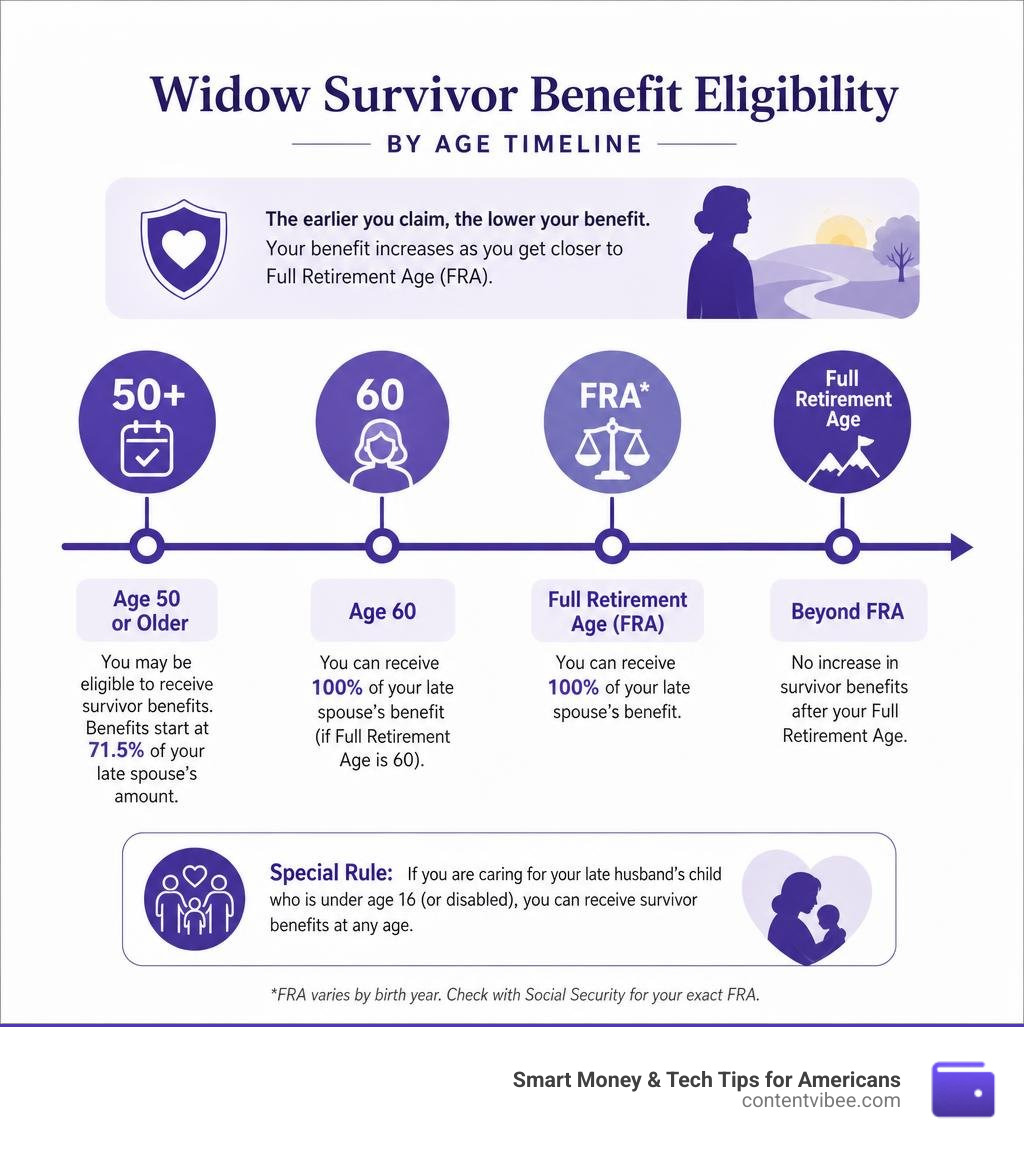
- You must generally be age 60 or older (or 50+ if disabled)
- The marriage must have lasted at least 9 months before his death
- You can receive 71.5% to 100% of his benefit, depending on your age when you claim
- If you’re caring for his child under age 16, you can collect at any age
Losing a spouse is hard enough. Figuring out your finances on top of that grief can feel overwhelming.
The good news: Social Security survivor benefits exist specifically to help widows replace lost income. The benefit can be significant — in some cases worth more than a typical life insurance policy over a lifetime.
But the rules around eligibility, timing, and how much you get are easy to misunderstand. Many widows assume they don’t qualify — and leave real money on the table.
This guide breaks it all down in plain English, so you know exactly where you stand.
Can a Widow Get Her Husband’s Social Security? Eligibility Rules Explained
When we look at how the Social Security Administration (SSA) handles a spouse’s passing, the fundamental question of can a widow get her husband’s social security comes down to two main things: your late husband’s work history and your relationship status.
To pay out survivor benefits, the deceased worker must have been “fully insured.” In the Social Security system, workers earn “credits” by paying Social Security taxes. Most people need 40 credits (roughly 10 years of work) to be fully insured. However, if a worker dies young, a special rule allows younger families to qualify if the deceased worked for just one and a half years (6 credits) within the three years prior to their death.
To understand if you are eligible as a survivor, you can check the official SSA resources on Who can get Survivor benefits. We also highly recommend reviewing our comprehensive guide on How Survivor Benefits Work When A Spouse Passes Away to understand how these benefits are established right after a loss.
Standard Marriage Duration and Exceptions
Under standard federal rules, a surviving spouse must have been legally married to the deceased worker for at least 9 months immediately before his death. This rule is designed to prevent “deathbed marriages” solely for financial gain.
However, life doesn’t always go according to plan. The law provides several critical exceptions to this 9-month requirement. You may still qualify for benefits on a shorter marriage if:
- The death was accidental (e.g., a car crash or sudden workplace accident).
- The death occurred in the line of duty while serving on active military service.
- You and your late husband had a child together (either biologically or through adoption).
- You were already receiving or eligible for certain other Social Security spousal or survivor benefits before this marriage.
These legal nuances are outlined in the Code of Federal Regulations § 404.335. If you find yourself in a situation where your marriage was cut short unexpectedly, we explain these unique scenarios in detail in our article on What You Need To Know About Spousal Survivor Benefits.
Age Requirements for Claiming Survivor Benefits
The standard age at which a widow can begin claiming survivor benefits is 60. However, claiming at age 60 means accepting a permanently reduced monthly benefit.
If you wait until your Full Retirement Age (FRA) as a survivor, you will receive 100% of your late husband’s benefit. It is important to note that the FRA for survivor benefits is slightly different from the FRA for standard retirement benefits. For survivors born in 1959, the FRA is 66 and 6 months, and it gradually rises to 67 for those born in 1960 or later.
There are two major exceptions to the age 60 rule:
- Disability: If you are disabled and your disability started before your husband’s death or within 7 years of his passing, you can claim survivor benefits as early as age 50.
- Caring for Children: If you are caring for your late husband’s child who is under age 16 or disabled, you can collect benefits at any age.
For a deeper dive into these regulatory definitions, you can consult the official SSA – POMS: RS 00207.001 – Widow(er)’s Benefits Definitions and Requirements – 05/02/2023.

How Much of Her Husband’s Social Security Can a Widow Get?
The amount of money a widow receives is directly tied to her late husband’s “Primary Insurance Amount” (PIA) — which is the amount he was receiving, or was entitled to receive, at his full retirement age.
When a spouse dies, the SSA does not simply combine both of your checks. Instead, you are entitled to the higher of the two individual benefits. For example, if you were receiving $1,200 a month on your own record and your husband was receiving $2,000, your individual check stops, and you begin receiving his $2,000 benefit instead.
To get an accurate estimate of what your combined household income will look like, you can read the AARP’s breakdown on How does Social Security work when a spouse dies?. To run your own numbers, use our specialized guide to Calculate Survivor Retirement Benefits.
Calculating the Survivor Benefit Percentage by Age
The percentage of your husband’s benefit that you receive is determined by the exact month you decide to file. The reduction is calculated on a sliding scale between age 60 and your Full Retirement Age.
The official policy language for these calculations is detailed in SSA – POMS: NL 00711.040 – Widow’s Benefits Paragraphs – 12/22/2003.
Here is a quick-reference table showing how claiming age affects the percentage of the deceased worker’s benefit a widow receives:
| Claiming Age | Percentage of Late Husband’s Benefit |
|---|---|
| Full Retirement Age (FRA) | 100% |
| Age 65 | Approx. 92.9% |
| Age 62 | Approx. 82.5% |
| Age 60 | 71.5% |
| Age 50–59 (Disabled) | 71.5% |
| Any Age (with qualifying child) | 75% |
As you can see, filing at age 60 permanently reduces your monthly check by 28.5%. Over a decade, that reduction can add up to tens of thousands of dollars.
How Can a Widow Get Her Husband’s Social Security While Caring for Children?
If you are a widow caring for your late husband’s child, the standard age requirements are waived. This is often referred to as a “mother’s benefit.”
To qualify, the child must be under the age of 16 or have a disability that began before age 22. In this scenario, you can collect 75% of your late husband’s benefit, regardless of your age. The child is also typically eligible to receive an additional 75% of the parent’s benefit on their own record.
However, be aware of the “family maximum benefit” limit. The total amount a single family can receive on one worker’s record is capped — usually between 150% and 188% of the worker’s basic benefit. If the total of all eligible family members’ benefits exceeds this limit, each person’s check (except the worker’s) is reduced proportionally.
You can learn more about how to navigate these family benefits directly on the official Survivor benefits portal.
Remarriage, Working, and Dual Entitlement Rules
Life gets complicated, and so do Social Security rules. If you decide to remarry, continue working, or try to claim multiple benefits at once, the SSA has strict guidelines on what you can and cannot do.
The underlying regulations for these complex scenarios are found in SSA – POMS: RS 00207.002 – Widow(er)’s Benefits – Payment and Termination – 02/06/2018.
How Remarriage Affects Survivor Benefits
One of the most common myths is that remarrying will automatically strip a widow of her late husband’s survivor benefits. The truth depends entirely on your age when you remarry:
- Remarriage BEFORE Age 60 (or 50 if disabled): If you remarry before this milestone, you lose your eligibility to receive survivor benefits on your late husband’s record. However, if that subsequent marriage later ends (due to divorce or death), your eligibility to claim on your first husband’s record is restored.
- Remarriage AT OR AFTER Age 60 (or 50 if disabled): If you wait until age 60 to remarry, your survivor benefits on your deceased husband’s record are completely unaffected. The SSA deems this subsequent marriage not to have occurred for entitlement purposes.
This means a widow in her mid-60s who remarries can choose to keep her late husband’s survivor benefit if it is higher than her new spouse’s spousal benefit.
Can a Widow Get Her Husband’s Social Security and Her Own Retirement Benefit?
The short answer is no, you cannot receive both benefits in full at the same time. The SSA does not “double stack” benefits. Instead, they apply the dual entitlement rule, which pays you the higher of the two amounts.
However, this rule opens up a highly effective financial planning strategy known as the switching strategy.
Because survivor benefits and retirement benefits are two separate programs, you can claim one first while letting the other grow. For example, a widow at age 60 could choose to claim a reduced survivor benefit. Meanwhile, she leaves her own retirement benefit untouched. Her own benefit will continue to earn delayed retirement credits of 8% per year until she reaches age 70. At age 70, she can switch to her own maximized retirement benefit if it has grown larger than the survivor benefit.
To see how to coordinate these two programs to maximize your lifetime payout, read our in-depth workbook: Claiming Whats Yours A Guide To Deceased Spouse Social Security.
Working While Receiving Survivor Benefits and Earnings Limits
If you choose to claim survivor benefits early (before your survivor Full Retirement Age) and continue to work, your benefits may be temporarily reduced if your earnings exceed the annual limit.
For 2026, the earnings limit is subject to annual adjustments (the limit was $23,400 in 2025). If you earn more than the limit, the SSA will withhold $1 in benefits for every $2 you earn above the threshold. In the year you reach your Full Retirement Age, a higher limit applies, and the SSA only withholds $1 for every $3 earned.
Once you reach your survivor Full Retirement Age, the earnings test disappears completely. You can earn as much money as you want, and your monthly survivor check will be paid in full. Furthermore, any benefits withheld in earlier years are recalculated and added back to your monthly check to make up for the early reductions.
How to Apply for Social Security Survivor Benefits
Unlike standard retirement benefits, you cannot apply for survivor benefits online. You must apply by phone or in person at a local SSA office.
To start the process, we recommend reading our step-by-step checklist on how to Claim Deceased Spouse Benefits.
Required Documents and Proofs
To process your claim, the SSA will require original documents or certified copies. They will not accept photocopies.
The official list of required evidence is maintained in the SSA – POMS: RS 00207.004 – Widow(er)’s Benefits – Table of Proofs and Development – Policy – 08/08/2011.
When you schedule your appointment, make sure you have the following documents ready:
- Proof of Death: Usually a certified death certificate (often, the funeral home will report the death directly, but you should verify this).
- Proof of Marriage: Your marriage certificate to show you met the duration requirements.
- Proof of Age: Your birth certificate.
- Tax Records: Your late husband’s most recent W-2 forms or self-employment tax returns to verify his earnings record.
- Direct Deposit Info: Your bank routing and account numbers so the SSA can deposit your checks directly.
The $255 Lump-Sum Death Payment
In addition to monthly survivor benefits, a surviving spouse who was living in the same household as the deceased at the time of death is eligible for a one-time lump-sum death payment of $255.
If the spouse was living separately, they may still qualify if they were already receiving benefits on the worker’s record. If there is no surviving spouse, the payment can be made to an eligible child.
You must apply for this lump-sum payment within two years of your husband’s death, or you will forfeit the money.
Frequently Asked Questions About Survivor Benefits
We hear many of the same questions from our community members navigating these complex rules. Here are clear, straightforward answers to the most common queries.
Can a divorced widow get her deceased ex-husband’s Social Security?
Yes. If you are divorced, you can still collect survivor benefits on your deceased ex-husband’s record. To qualify, your marriage must have lasted at least 10 years before the divorce became final.
Additionally, you must be unmarried (unless you remarried after age 60). The benefits paid to a surviving divorced spouse do not affect the benefit amount that a current widow or other family members receive on the same worker’s record.
What happens to survivor benefits if the deceased spouse claimed early?
If your late husband claimed his retirement benefits early (before his own FRA), his benefit was permanently reduced. Unfortunately, this reduction carries over to you. Under a complex rule known as the “RIB-LIM” (Retirement Insurance Benefit Limitation), your survivor benefit is capped.
Generally, you cannot receive more than the larger of:
- The reduced benefit your husband was receiving at the time of his death.
- 82.5% of his unreduced Primary Insurance Amount.
Are disabled widows eligible for survivor benefits earlier?
Yes. If you are a disabled widow, you can claim survivor benefits starting at age 50.
To qualify, your disability must meet the strict definition of disability used for Social Security Disability Insurance (SSDI), and the disability must have started before your husband’s death or within 7 years of his passing (the “prescribed period”).
Conclusion
Understanding how and when can a widow get her husband’s social security is a vital part of securing your financial future after a loss. By knowing the marriage duration rules, age requirements, and dual entitlement options, you can protect your household income and avoid leaving thousands of dollars on the table.
At Smart Money & Tech Tips for Americans, we specialize in making complex financial rules simple. Our partners at ContentVibee help retirees navigate everything from survivor benefits to the latest SECURE Act 2.0 RMD changes with clear, actionable guidance.
Don’t guess when it comes to your financial security. Use our free tool to Calculate Your Spousal Benefits and make sure you are claiming every dollar you deserve.


