

What Losing a Spouse Means for Your Social Security Income
To claim deceased spouse benefits, follow these steps:
- Call the SSA at 1-800-772-1213 to schedule an appointment — you cannot apply online.
- Gather documents: death certificate, marriage certificate, your birth certificate, and W-2 forms.
- Check your eligibility: you generally must be age 60 or older (50 if disabled) and married for at least 9 months.
- Know your amount: you can receive between 71.5% and 100% of your late spouse’s benefit, depending on your age at the time you claim.
- Apply promptly: benefits start the month the SSA receives your claim, not the month you call.
Losing a spouse is one of the hardest things a person can go through — emotionally and financially. For millions of Americans, it also raises an urgent question: what happens to the Social Security income we were counting on?
The good news is that Social Security survivor benefits exist precisely for this moment. As of September 2025, more than 3.8 million widows and widowers were receiving monthly survivor payments based on a late spouse’s work record. These benefits can replace a significant portion of lost household income — up to 100% of your deceased spouse’s benefit if you claim at the right time.
But the rules around eligibility, timing, and benefit amounts are not simple. Getting the details wrong — like claiming too early or not knowing about the one-time $255 death payment — can cost you real money.
This guide walks you through everything you need to know, step by step.
Who is Eligible to Claim Deceased Spouse Benefits?
When a spouse passes away, navigating the federal rules to determine if you qualify for their benefits can feel like learning a new language. The Social Security Administration (SSA) has specific definitions for who qualifies as a widow, widower, or surviving divorced spouse.
At Smart Money & Tech Tips for Americans, we want to make this as simple as possible. To start, survivor benefits are designed to provide financial security to the surviving family members of workers who paid into the system through payroll taxes. You can learn more about general eligibility guidelines on the official Survivor benefits | SSA page, but we will break down the essential rules below.
To explore how these rules compare to standard retirement options, you can also check out The Ultimate Guide To Spousal Social Security Eligibility.
Standard Spousal Eligibility Requirements
To qualify for standard widow or widower benefits, you must meet several core criteria established under the Code of Federal Regulations § 404.335:
- The Nine-Month Rule: In most cases, you must have been legally married to your spouse for at least nine months immediately preceding the day they died.
- Exceptions to the Nine-Month Rule: The SSA waives this duration requirement if your spouse’s death was accidental (defined as an unexpected event resulting in death within three months of the injury) or occurred while they were on active duty in the military.
- Fully Insured Status: Your deceased spouse must have worked long enough to be “fully insured.” Generally, this requires earning 40 work credits (roughly 10 years of work), though younger workers may qualify with fewer credits.
- Age Requirement: You must be at least 60 years old to claim standard benefits. If you are disabled, the age requirement drops to 50.
Understanding these foundational rules is the first step toward securing your household income during a difficult time. For a deeper look at navigating these rules, read Claiming Whats Yours A Guide To Deceased Spouse Social Security.
Exceptions for Divorced Spouses, Disability, and Childcare
The SSA recognizes that modern families have diverse structures, which is why there are specific exceptions that expand eligibility beyond current legal spouses.
- Divorced Spouses: If you are divorced, you can still claim deceased spouse benefits on your ex-spouse’s record. According to the SSA – POMS: RS 00207.001 – Widow(er)’s Benefits Definitions and Requirements – 05/02/2023 , you must have been married to your ex-spouse for at least 10 years before the divorce became final. Additionally, you must be unmarried (unless you remarried after age 60) to claim.
- Disabled Widow(er)s: If you have a disability that meets the SSA’s strict definition, you can claim benefits as early as age 50. However, your disability must have started before or within seven years of your spouse’s death (or within seven years of when your mother’s/father’s benefits ended).
- Child-in-Care Provision: If you are caring for your deceased spouse’s child who is under age 16 or disabled, you can claim survivor benefits at any age. You do not have to wait until age 60, and the nine-month marriage rule does not apply.
These exceptions ensure that vulnerable family members, including young children and disabled survivors, are not left without support.
How Much Can You Receive in Monthly Survivor Benefits?
The amount you receive in monthly survivor benefits is directly tied to your late spouse’s lifetime earnings and the age at which you choose to claim. The SSA calculates survivor benefits using the deceased worker’s Primary Insurance Amount (PIA) — the benefit they would receive (or were receiving) at their full retirement age.
It is important to note that there is a limit to how much a family can receive on a single worker’s record. This is known as the family maximum benefit, which typically ranges from 150% to 188% of the deceased worker’s primary benefit. If the total benefits payable to all eligible family members exceed this limit, each person’s benefit (except the deceased’s) will be reduced proportionately.
Calculating Your Benefit Percentage Based on Age
The age at which you apply for survivor benefits is the most critical factor in determining your monthly payment.
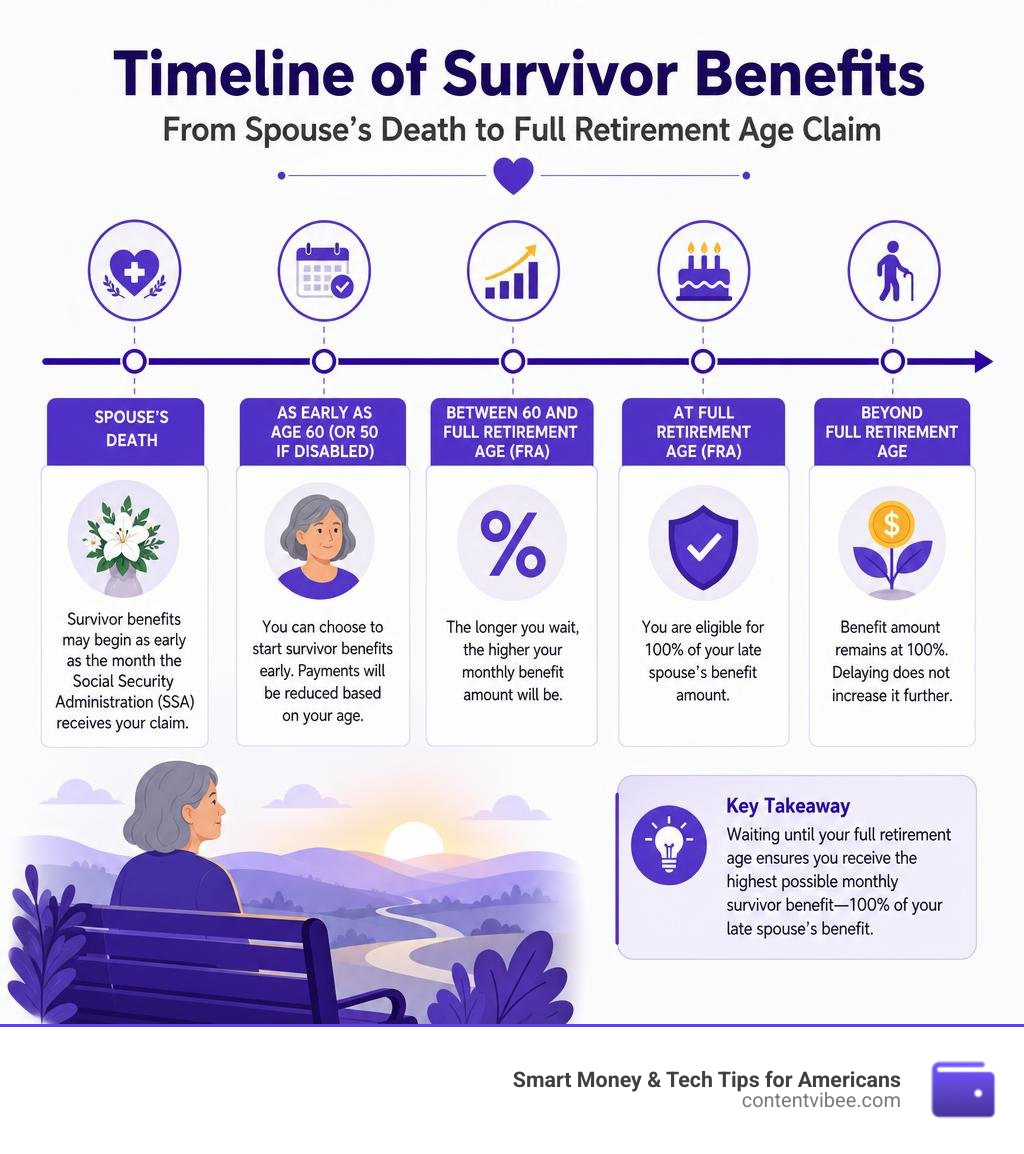
- Full Retirement Age (FRA): If you wait until your own full retirement age as a survivor (which is 67 for anyone born in 1962 or later), you will receive 100 percent of the deceased spouse’s benefit.
- Early Claiming: If you claim survivor benefits early — between age 60 and your full retirement age — your monthly benefit will be permanently reduced. You will receive a scaled amount between 71.5 percent and 99 percent of the deceased’s benefit, depending on how many months you are from your FRA.
- Disability Claiming: If you claim early due to a disability between the ages of 50 and 59, you receive a flat rate of 71.5 percent.
To figure out the exact age milestones for your birth year, refer to our guide: At What Age Can I Claim My Spouses Social Security.
The Impact of the Deceased Spouse’s Earnings History
Your survivor benefit is built on the foundation of your spouse’s work history. Every year they worked and paid payroll taxes, they earned credits toward their future retirement and survivor benefits. If your spouse delayed claiming their own retirement benefit past their full retirement age, they accumulated Delayed Retirement Credits (DRCs). These DRCs pass on to you, meaning your survivor benefit could be even higher than their standard retirement benefit.
Here is a quick look at how your age and situation impact the percentage of the deceased spouse’s benefit you can claim:
| Survivor’s Situation / Age | Percentage of Deceased Spouse’s Benefit |
|---|---|
| Full Retirement Age (FRA) or older | 100% |
| Age 60 to FRA | 71.5% to 99% |
| Disabled (Age 50 to 59) | 71.5% |
| Caring for a child under age 16 | 75% |
| Eligible Child (under 18, or 19 if in high school) | 75% |
Strategic Timing: When to Claim Deceased Spouse Benefits
Deciding when to claim deceased spouse benefits is a highly strategic financial decision. Because the SSA allows you to navigate survivor benefits and your own retirement benefits independently, proper coordination can dramatically increase your lifetime income.
For a comprehensive look at maximizing these options, we highly recommend reading How to maximize Social Security survivor benefits for couples .
How Timing Affects Your Decision to Claim Deceased Spouse Benefits
If you claim survivor benefits early at age 60, you accept a permanent reduction to 71.5% of your spouse’s benefit. However, if you are currently working or have other income sources, it may make sense to delay claiming to let the monthly benefit grow.
That survivor benefit FRA is slightly different from standard retirement FRA. For survivors, the FRA is 66 and 6 months for those born in 1959, gradually rising to 67 for those born in 1962 or later. Delaying past your survivor FRA does not increase your survivor benefit any further; there are no delayed retirement credits for survivor benefits past FRA. Therefore, you should never delay claiming a survivor benefit past your survivor FRA if you are not planning to claim your own retirement benefit instead.
Coordinating Survivor Benefits with Your Own Retirement Benefit
One of the most powerful rules of Social Security is that a surviving spouse can “switch” benefits. Under the dual entitlement policy, you cannot collect both your full retirement benefit and a full survivor benefit simultaneously. Instead, the SSA will pay you an amount equal to the higher of the two benefits.
However, you can strategically coordinate them:
- Strategy A: Claim your reduced survivor benefit at age 60, letting your own retirement benefit grow. At age 70, you can switch to your own retirement benefit if it has grown larger than the survivor benefit due to delayed retirement credits.
- Strategy B: If your own retirement benefit is relatively small, you might claim your own reduced retirement benefit at age 62, and then switch to your unreduced survivor benefit at your full retirement age to secure the maximum possible 100% payout.
Additionally, if you make a mistake, the SSA’s “reset rule” allows you to withdraw an early retirement application within 12 months of filing (provided you repay the benefits received), allowing you to restart your strategy. You can also utilize voluntary suspension at your full retirement age to pause your own retirement benefits and let them grow by 8% per year until age 70 while potentially living on other income.
Step-by-Step Guide: How to Apply for Survivor Benefits
Applying for survivor benefits requires direct interaction with the SSA. Unlike standard retirement benefits, you cannot complete a survivor benefit application online. You must apply either by phone or in person.

Gathering the Required Documents to Claim Deceased Spouse Benefits
To ensure your application is processed without delay, you should gather all necessary original documents beforehand. According to the official SSA – POMS: RS 00207.004 – Widow(er)’s Benefits – Table of Proofs and Development – Policy – 08/08/2011 , the SSA requires specific proofs to establish your relationship and eligibility.
Make sure you have the following ready:
- Proof of Death: A death certificate or a statement from a funeral home.
- Marriage Certificate: To prove your legal marriage to the deceased worker.
- Divorce Decree: If you are applying as a surviving divorced spouse.
- Birth Certificates: Your birth certificate and those of any eligible children.
- Tax Documents: Your deceased spouse’s most recent W-2 forms or self-employment tax returns to verify earnings.
- Bank Account Info: Direct deposit information (routing and account numbers) so the SSA can send your payments securely.
If you are missing a document, do not delay your application! The SSA will help you obtain certified copies or alternative records. For an organized checklist to help you prepare, see The Ultimate Checklist For Your Application For Spousal Benefits.
Submitting Your Application to the Social Security Administration
Once your documents are in order, follow these steps to submit your claim:
- Schedule an Appointment: Call the SSA national toll-free line at 1-800-772-1213 (TTY 1-800-325-0778) between 8:00 AM and 7:00 PM, Monday through Friday, or contact your local California SSA office.
- The Interview: An SSA representative will guide you through the application. They will ask about your marriage history, employment status, and children.
- Automatic Conversion: If you are already receiving spousal retirement benefits on your partner’s record when they pass away, the SSA will automatically convert your payments to survivor benefits once the death is reported. However, you should still contact them to apply for the lump-sum death payment.
- Processing Time: It typically takes several weeks for the SSA to process your application and begin direct deposit payments. Survivor benefits are paid in the month following the month they are due.
Additional Factors: Earnings Limits, Taxes, and Special Benefits
Before you finalize your claiming strategy, it is critical to understand how outside factors like working, taxes, and secondary benefits can impact your monthly payments.
The One-Time Lump-Sum Death Payment
In addition to monthly survivor benefits, the SSA offers a one-time lump-sum death payment of $255.
- Who Qualifies: This payment is available to a surviving spouse who was living in the same household as the deceased worker at the time of death. If they were living apart, the spouse may still qualify if they were already receiving benefits on the worker’s record.
- Time Limit: You must apply for this lump-sum payment within two years of your spouse’s death.
- Children’s Eligibility: If there is no surviving spouse, an eligible child who qualifies for benefits on the deceased’s record may receive the payment.
How Working, Taxes, and Medicare Impact Your Payments
If you plan to continue working while receiving survivor benefits, you must keep the SSA’s earnings limits in mind.
- The Retirement Earnings Test: If you are under your full retirement age and earn more than the annual limit, the SSA will temporarily withhold a portion of your benefits. For example, if you are under FRA for the entire year, the SSA deducts $1 from your benefits for every $2 you earn above the limit. Once you reach FRA, these limits disappear, and your monthly benefit is recalculated upward to make up for the withheld amounts. For a comprehensive look at how this works, see Working In Retirement Are Spousal Benefits Reduced By Working.
- Income Taxes: Depending on your combined income (your adjusted gross income plus nontaxable interest and half of your Social Security benefits), you may have to pay federal income taxes on up to 85% of your survivor benefits.
- Medicare Premiums: If your income is above a certain threshold, your Medicare Part B and Part D premiums may be subject to the Income-Related Monthly Adjustment Amount (IRMAA), which increases your premium costs.
Frequently Asked Questions About Survivor Benefits
Navigating the rules of survivor benefits can lead to many questions. Here are clear answers to some of the most common inquiries we receive.
Can I receive both my own retirement benefit and a survivor benefit at the same time?
No, the SSA does not allow you to combine or “double dip” on both benefits. Under simultaneous entitlement rules, you will receive the higher of the two benefit amounts. If your own retirement benefit is higher, your survivor benefit is suspended. However, you can strategically claim one benefit early while letting the other grow. For more details on collecting rules, read Do Both Spouses Collect Social Security.
How does remarriage affect my eligibility for survivor benefits?
Remarriage can impact your benefits depending on your age when you remarry:
- Remarriage Before Age 60: If you remarry before age 60 (or age 50 if disabled), you lose your eligibility to receive survivor benefits on your deceased spouse’s record. However, if that subsequent marriage ends due to divorce or death, your eligibility to claim on your first spouse’s record is restored.
- Remarriage After Age 60: Remarrying after age 60 (or age 50 if disabled) has no effect on your eligibility. You can continue to receive your deceased spouse’s survivor benefit. For complete details on termination and payment exceptions, refer to SSA – POMS: RS 00207.002 – Widow(er)’s Benefits – Payment and Termination – 02/06/2018 .
What is the Social Security Fairness Act and how does it affect my claim?
The Social Security Fairness Act addresses two provisions that historical rules used to reduce benefits for public employees: the Windfall Elimination Provision (WEP) and the Government Pension Offset (GPO).
If you receive a pension from a government job (like teaching or civil service in California) where you did not pay Social Security payroll taxes, the GPO historically reduced your surviving spouse benefits by two-thirds of your government pension amount. The passage of the Social Security Fairness Act in January 2025 removed these restrictive GPO and WEP rules, allowing many public service survivors to receive their full, unreduced survivor benefits.
Conclusion
Losing a partner is an emotional journey, but securing your financial future shouldn’t have to be a source of stress. By understanding how to claim deceased spouse benefits and coordinating them with your own retirement options, you can maximize your monthly income and preserve your household’s financial health.
At Smart Money & Tech Tips for Americans, we are committed to helping you make sense of complex financial systems so you can make informed decisions. For a complete look at the golden rules of spousal benefits, visit our pillar guide: The Golden Rules Can A Spouse Collect Ss Spousal Benefits.


