


What You Need to Know About Survivor Benefit Rules (Without the Confusion)
Understanding survivor benefit rules can feel overwhelming — especially when you’re already dealing with loss. Here’s a quick summary of who qualifies and what they can expect:
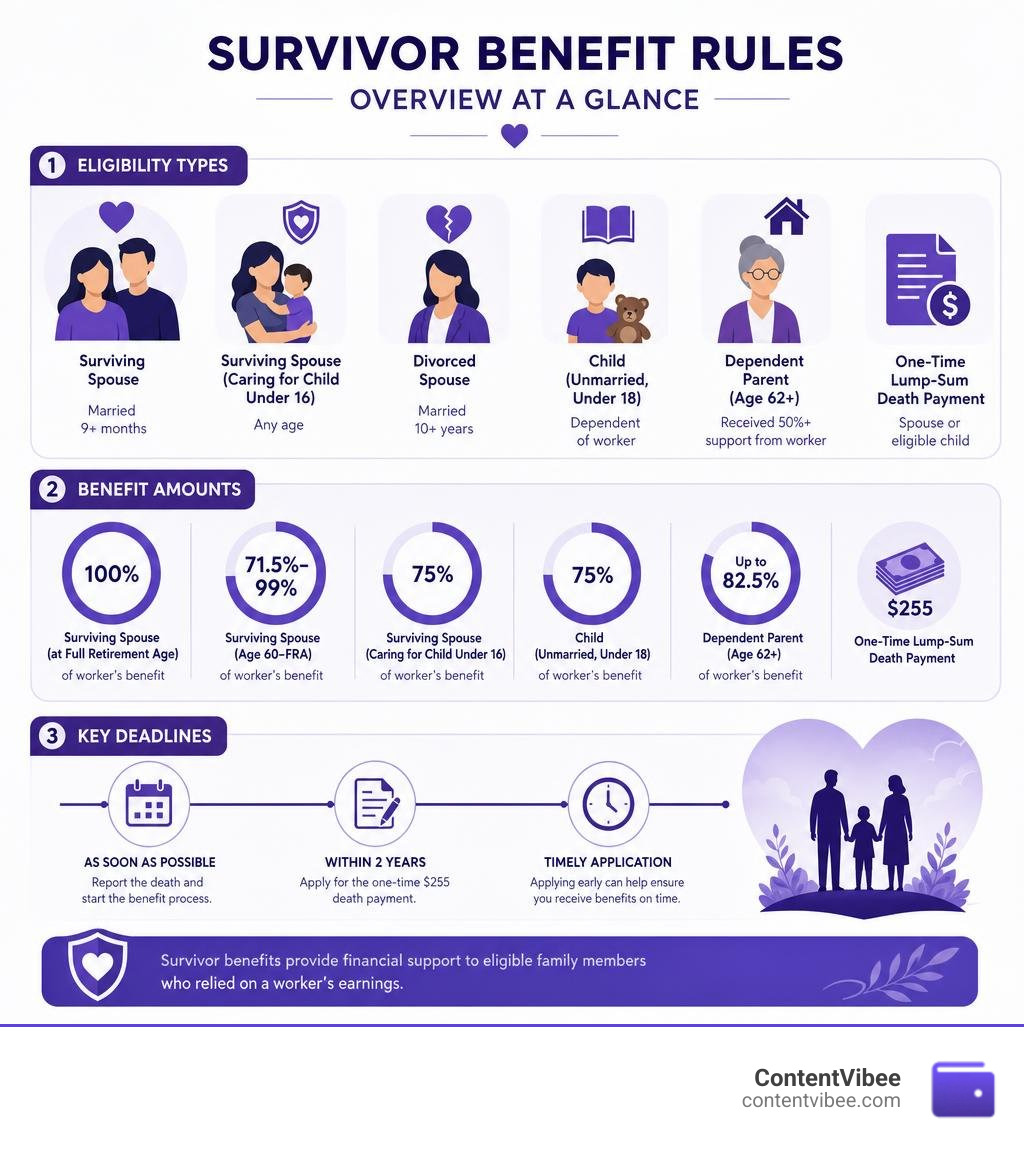
Quick Answer: Key Survivor Benefit Rules at a Glance
| Who | Minimum Requirement | Benefit Amount |
|---|---|---|
| Surviving spouse (at FRA) | Married 9+ months | 100% of worker’s benefit |
| Surviving spouse (age 60–FRA) | Married 9+ months | 71.5%–99% of worker’s benefit |
| Surviving spouse (caring for child under 16) | Any age | 75% of worker’s benefit |
| Divorced spouse | Married 10+ years | Same as surviving spouse |
| Child (unmarried, under 18) | Dependent of worker | 75% of worker’s benefit |
| Dependent parent (age 62+) | Received 50%+ support from worker | Up to 82.5% of worker’s benefit |
| One-time lump-sum death payment | Spouse or eligible child | $255 (apply within 2 years) |
When a family loses its primary earner, the financial impact can hit just as hard as the emotional one. Social Security survivor benefits exist to soften that blow — providing monthly income to eligible spouses, children, and even dependent parents of workers who paid into the system.
As of September 2025, more than 3.8 million widows and widowers were receiving these benefits. Yet many people don’t fully understand the rules until they urgently need them.
This guide breaks down every major survivor benefit rule — from Social Security eligibility and benefit calculations to private pensions, military plans, and federal civil service programs — so you can plan ahead or act quickly when it matters most.
Who Qualifies Under Social Security Survivor Benefit Rules?
How do you qualify for survivor benefits in the first place? It all starts with the deceased worker’s employment history. As a worker pays Social Security taxes, they earn “credits.”
No one needs more than 40 credits (roughly 10 years of work) to ensure their family is eligible for survivor benefits. However, a special rule provides a shortcut for younger workers: if a parent dies early, their children and surviving spouse can receive benefits even if the worker only had 1.5 years of work in the 3 years directly preceding their death.

The Social Security Administration (SSA) has very specific rules regarding exactly who in the family can claim these monthly payments. If you want to know more about the fundamental mechanics of these claims, take a look at our guide on how survivor benefits work when a spouse passes away.
Spousal and Divorced Spousal Survivor Benefit Rules
The most common recipient of a survivor benefit is a surviving spouse. To qualify, you must meet certain marriage duration and age milestones:
- The 9-Month Marriage Rule: Generally, you must have been married to your deceased spouse for at least 9 months prior to their death. There are exceptions to this rule if the death was accidental or occurred in the line of military duty.
- The Age 60 Rule: You can claim standard survivor benefits as early as age 60. However, claiming early will reduce your monthly payout.
- The Disability Exception: If you are disabled and your disability started before or within 7 years of your spouse’s death, you can begin receiving benefits as early as age 50.
- The Childcare Exception: If you are caring for the deceased worker’s child who is under age 16 or disabled, you can receive survivor benefits at any age, without any reduction.
If you are divorced, you might be surprised to learn that you can still qualify for benefits on your ex-spouse’s record. Under the 10-year marriage rule, if your marriage lasted at least 10 years before the divorce was finalized, you are eligible for the exact same survivor benefits as a current spouse. Best of all, claiming as a divorced spouse has absolutely no impact on the benefits of the surviving widow or widower. If you are ready to make a claim, we have a step-by-step breakdown on how to claim deceased spouse benefits to make the process as seamless as possible.
Rules for Children and Dependent Parents
Spouses aren’t the only ones protected by Social Security. The system is designed to safeguard the entire immediate family, including children and aging parents:
- Unmarried Children: Children of the deceased worker can receive monthly benefits if they are unmarried and under the age of 18 (or up to age 19 if they are still full-time students in high school).
- Disabled Adult Children: If a child became severely disabled before reaching age 22, they can receive survivor benefits indefinitely, provided they remain unmarried.
- Dependent Parents: If the deceased worker was supporting their parents, those parents can receive benefits starting at age 62. To qualify, the parent must have received at least 50% of their financial support from the deceased worker.
Navigating these family-wide dynamics can be tricky, but our resource on claiming what’s yours: a guide to deceased spouse Social Security can help you identify every dollar your family is entitled to.
How Survivor Benefits Are Calculated and Paid
The amount your family receives depends entirely on the earnings history of the deceased worker. The SSA calculates a baseline figure called the Primary Insurance Amount (PIA), which is the monthly benefit the worker would have received at their Full Retirement Age (FRA).
From there, the benefit amount is determined by the survivor’s relationship to the deceased and the age at which they claim. To get a clear estimate of what your family’s specific numbers might look like, you can calculate survivor retirement benefits using our specialized tools.
The Impact of Claiming Age on Your Monthly Payment
Just like standard retirement benefits, timing is everything. When you decide to claim your survivor benefit will directly dictate your monthly check:
- At Full Retirement Age (FRA): If you wait until your survivor FRA (which ranges from age 66 to 67 depending on your birth year), you will receive 100% of the deceased worker’s PIA.
- Before Full Retirement Age: If you claim as early as age 60, your benefit will be reduced. The payout scales up gradually for each month you wait, ranging from 71.5% to 99% of the worker’s benefit.
- Caring for a Child: If you qualify under the childcare exception (caring for a child under 16), you automatically receive 75% of the worker’s benefit, regardless of your age.
- Eligible Children: Each eligible child receives 75% of the deceased parent’s benefit.
Because survivor FRAs are slightly different from standard retirement FRAs, it is vital to know your exact milestones. For a complete deep dive into this topic, refer to the definitive guide to Social Security claiming age.
The One-Time Lump-Sum Death Payment
In addition to monthly benefits, the SSA offers a small, one-time payment of $255 to help ease immediate funeral or burial costs.
This payment can only be made to a surviving spouse who was living in the same household as the worker, or an eligible child who qualifies for monthly benefits on the deceased’s record. You must apply for this lump sum within two years of the worker’s death. For more details on this specific payment, read our article on what you need to know about spousal survivor benefits.
Key Rules for Remarriage, Working, and Government Pensions
Many survivors worry that finding love again, returning to work, or receiving a pension will wipe out their hard-earned benefits. While there are rules that can affect your payments, understanding how they operate can prevent costly surprises. For an exhaustive look at general benefit structures, check out the complete guide to benefit rules.
How Remarriage Affects Your Eligibility
If you are a surviving spouse or divorced spouse, remarrying can impact your benefits depending on your age:
- Remarrying Before Age 60 (or 50 if disabled): If you tie the knot before this age milestone, you lose your eligibility to receive survivor benefits on your deceased ex-spouse’s record. However, if that new marriage ends due to divorce or death, your eligibility to claim on your first spouse’s record is fully restored.
- Remarrying At or After Age 60 (or 50 if disabled): If you wait until this age milestone to remarry, your survivor benefits will not be affected. You can continue to receive your monthly check uninterrupted.
This is a critical strategy for couples planning their later years. To learn how to navigate these decisions, explore the smart couples guide to Social Security strategies.
Government Pensions and the Social Security Fairness Act
If you receive a pension from a government job where you did not pay Social Security taxes (such as certain municipal, state, or federal positions), your survivor benefits have historically been subject to reductions under the Government Pension Offset (GPO).
However, legislative updates under the Social Security Fairness Act have aimed to eliminate or severely reduce these offsets, ensuring that public servants and their spouses receive their full, hard-earned benefits. To see how these pension offsets work and how to maximize your total retirement income, refer to the ultimate guide to Social Security benefit optimization.
Comparing Federal and Private Survivor Benefits
Survivor benefits vary significantly depending on whether they originate from Social Security, a private employer, the military, or the federal civil service.
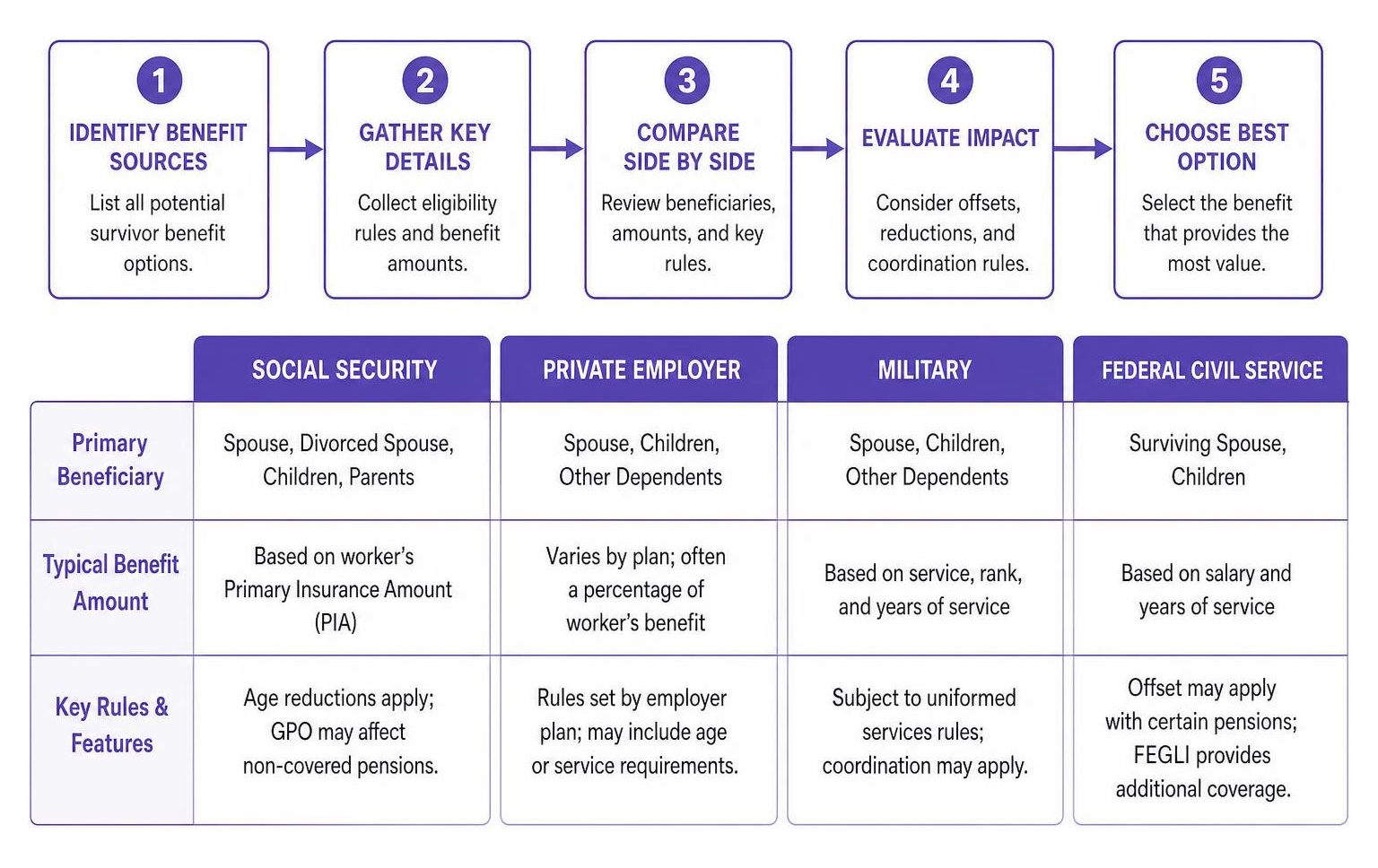
The table below outlines the primary differences across these systems:
| Benefit Source | Primary Beneficiary | Typical Benefit Amount | Key Rules & Features |
|---|---|---|---|
| Social Security | Spouse, Divorced Spouse, Children, Parents | 71.5% to 100% of worker’s PIA | Age reductions apply; GPO may affect non-covered pensions. |
| Private Plans (401k/Pension) | Spouse (unless waived) | 50% to 100% of account or annuity | Spousal consent required to name alternate beneficiaries. |
| Military (SBP) | Spouse, Children, Former Spouse | 55% of selected base amount | Premiums deducted from retired pay; DIC offset has been phased out. |
| Federal Civil Service (FERS/CSRS) | Spouse, Former Spouse, Children | Up to 50% (FERS) or 55% (CSRS) | Basic Employee Death Benefit (BEDB) may also apply. |
For detailed federal guidelines, you can read the official CSRS/FERS Handbook Chapter 52 or review the VA Survivor Benefits and Services Guide.
Private Pension and 401(k) Survivor Benefit Rules
Private retirement plans are governed by federal laws that heavily protect surviving spouses.
- Defined Contribution Plans (like 401ks): If you are married, your spouse is automatically the sole beneficiary of your 401(k) or 403(b) account upon your death. If you want to name someone else — such as a child or a trust — your spouse must sign a written waiver that is notarized or witnessed by a plan representative.
- Defined Benefit Plans (Pensions): By law, traditional pensions must offer a “Joint and Survivor Annuity.” This means that when the retiree dies, the surviving spouse will continue to receive a monthly check (typically 50% or 100% of the retiree’s benefit) for the rest of their life. Again, this survivor option can only be waived with notarized spousal consent.
- Divorce & QDROs: In the event of a divorce, a court order called a Qualified Domestic Relations Order (QDRO) can secure survivor rights for a former spouse, preventing a subsequent spouse from automatically claiming the entire benefit.
Military and Federal Civil Service Survivor Benefits
Military and federal civil service employees have access to robust, specialized survivor programs:
- Military Survivor Benefit Plan (SBP): The SBP allows retired military members to pass on up to 55% of their retired pay to an eligible spouse or child. The premiums are paid via automatic deductions from retired pay. For further reading, check out the Army Survivor Benefit Plan for Soldiers?serv=120) or see the regulatory breakdown in DoD Financial Management Regulation Volume 7B Chapter 44.
- Federal Civil Service (FERS and CSRS): Federal employees are covered under either the Federal Employees Retirement System (FERS) or the Civil Service Retirement System (CSRS). Under FERS, a surviving spouse may receive a Basic Employee Death Benefit (BEDB) — which includes a lump-sum payment of over $37,000 plus 50% of the employee’s final salary — in addition to a monthly survivor annuity.
Frequently Asked Questions About Survivor Benefits
How do I apply for Social Security survivor benefits?
Unlike retirement benefits, you cannot apply for survivor benefits online. You must contact the SSA directly by calling 1-800-772-1213 or by visiting your local Social Security office in person.
To ensure a smooth application process, you should gather the following documents ahead of time:
- Proof of death (death certificate or funeral home notice)
- Social Security numbers for yourself, the deceased worker, and any dependent children
- Birth certificates for any children claiming benefits
- Your marriage certificate (and divorce decrees, if claiming as a divorced spouse)
- Recent W-2 forms or self-employment tax returns for the deceased worker
To see how these applications fit into a broader retirement strategy, read the complete guide to Social Security full retirement.
Can I receive both my own retirement benefit and a survivor benefit?
No, the SSA does not allow “double-dipping.” You cannot combine both payments into one massive check. Instead, you will receive whichever amount is higher.
However, there is a highly effective strategy known as “benefit switching.” You can choose to claim a reduced survivor benefit early at age 60, allowing your own retirement benefit to grow via delayed retirement credits. Then, at age 70, you can switch to your own maximized retirement benefit.
What is the maximum family benefit limit for survivors?
There is a limit to how much money a single family can draw from one worker’s record. This is known as the Maximum Family Benefit. The limit typically ranges between 150% and 180% of the deceased worker’s basic benefit amount. If the total benefits of all qualifying family members exceed this limit, the individual benefits of the children and spouse will be reduced proportionally, but the surviving spouse’s primary share remains protected.
Conclusion
Losing a loved one is one of life’s greatest challenges, but understanding the survivor benefit rules ensures your family is financially protected. Whether you are navigating Social Security, a private 401(k), or military benefits, knowing your rights allows you to make confident, informed decisions.
At ContentVibee, we are dedicated to simplifying complex financial rules so you can focus on what truly matters. Take control of your retirement planning and calculate your spouse retirement benefits today to build a secure foundation for your family’s future.


