

What You Need to Know Before You Apply for Deceased Spouse Social Security
If you need to apply for deceased spouse Social Security benefits, here is the short answer:
How to apply for survivor benefits (quick steps):
- Call SSA at 1-800-772-1213 to schedule a phone or in-person appointment — you cannot apply online.
- Gather your documents — death certificate, your birth certificate, marriage certificate, Social Security numbers, and W-2 forms.
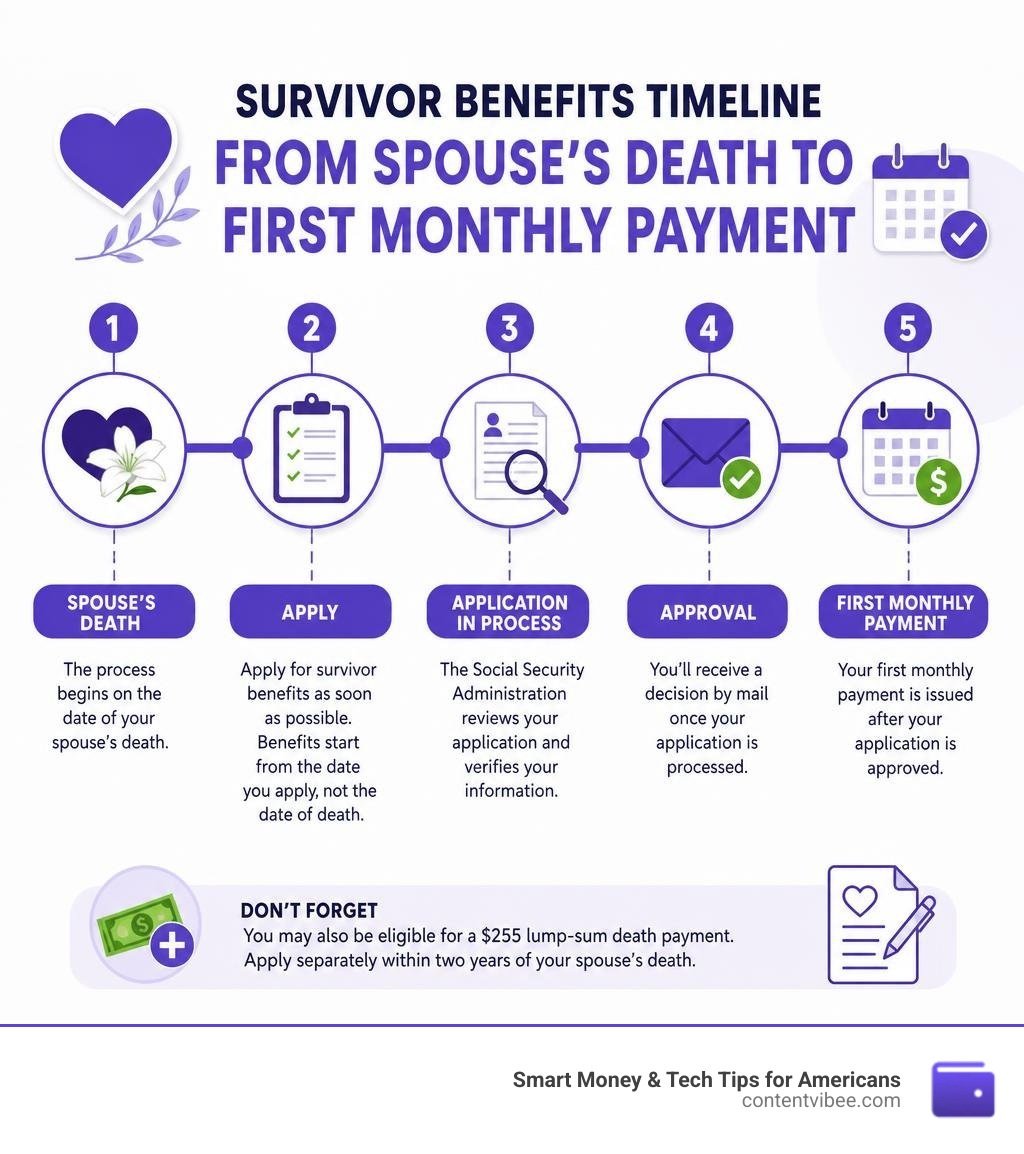
- Apply as soon as possible — benefits start from the date you apply, not the date your spouse died.
- Ask about the $255 lump-sum death payment — you must apply for it separately within two years of death.
Losing a spouse is one of the hardest things a person can go through — emotionally and financially. The bills don’t stop, and figuring out government paperwork while grieving is genuinely overwhelming.
Here is the good news: you may be entitled to monthly Social Security payments based on your late spouse’s work record. More than 5.8 million people received these survivor benefits as of September 2025, and about two-thirds of them are widows and widowers.
This guide walks you through exactly what to do, step by step.
Who is Eligible to Apply for Deceased Spouse Social Security?

When a worker who has paid into Social Security passes away, their family members may be eligible to receive survivor benefits. However, the Social Security Administration (SSA) has strict definitions and requirements regarding who is legally considered a surviving spouse.
According to the official policy outlined in SSA – POMS: RS 00207.001 – Widow(er)’s Benefits Definitions and Requirements – 05/02/2023 , you must establish that you were legally, putatively, or deemed married to the deceased worker under applicable state laws at the time of their death.
Age and Marriage Requirements for Widows and Widowers
To apply for deceased spouse Social Security as a surviving widow or widower, you generally must meet the following criteria:
- The Nine-Month Rule: You must have been married to your deceased spouse for at least nine months immediately preceding the day they died. There are a few exceptions to this rule, such as if the death was accidental or occurred in the line of military duty.
- Age Requirements: You can begin receiving reduced survivor benefits as early as age 60. If you choose to wait until your Full Retirement Age (FRA)—which is age 67 for anyone born in 1962 or later—you will receive 100% of your deceased spouse’s primary benefit amount.
If you are trying to understand how these timeline rules differ from regular spousal benefits, you can explore our guide on How To Check Your Eligibility For Spousal Social Security Benefits.
Rules for Surviving Divorced Spouses
Can you collect survivor benefits on a deceased ex-spouse’s work record? Yes, you can! The SSA treats surviving divorced spouses with the same basic age structures as widows and widowers, but with a few additional caveats:
- The Ten-Year Rule: Your marriage to your ex-spouse must have lasted for at least 10 consecutive years before the divorce was finalized.
- Marital Status: You must currently be unmarried. If you remarry before age 60, you lose eligibility for survivor benefits on your ex-spouse’s record (unless that subsequent marriage ends). However, if you remarry after reaching age 60 (or age 50 if you are disabled), your eligibility remains completely unaffected.
- No Impact on Others: Any benefits paid to you as a surviving divorced spouse will not reduce the benefit amounts paid to the deceased’s current widow, widower, or other dependents.
Special Provisions for Disabled Survivors and Caregiving Spouses
The SSA provides vital exceptions to the standard age rules for those facing physical or caregiving challenges:
- Disabled Widow(er)s: If you are disabled and your disability started before or within seven years of your spouse’s death, you can apply for deceased spouse Social Security starting at age 50.
- Caregiving Spouses (“Child-in-Care” Benefits): You can receive survivor benefits at any age if you are caring for your deceased spouse’s child. The child must be under the age of 16 or have a disability that began before age 22. These benefits will continue until the child turns 16, after which you must wait until age 60 to claim regular survivor benefits (unless you qualify under another exception).
How Survivor Benefits Are Calculated and Coordinated
The amount of money you receive depends on how much your late spouse earned during their lifetime and how old you are when you file your claim.
Estimating Your Monthly Payment and the Family Maximum
The SSA calculates survivor benefits as a percentage of the deceased worker’s primary insurance amount (PIA). Below is a breakdown of what you can expect to receive based on your age and situation:
| Relationship to Deceased | Claimant’s Age / Situation | Percentage of Deceased’s Benefit |
|---|---|---|
| Surviving Spouse | Full Retirement Age (67 for those born 1962+) | 100% |
| Surviving Spouse | Age 60 to Full Retirement Age | 71.5% to 99% |
| Disabled Surviving Spouse | Age 50 to 59 | 71.5% |
| Caregiving Spouse | Caring for a child under 16 or disabled | 75% |
| Surviving Child | Under age 18 (or 19 if in high school) | 75% |
| Dependent Parents | Age 62 or older (one parent / two parents) | 82.5% / 75% each |
To estimate how these percentages translate to actual dollars, you can use our Tools/Finance Calculator/Social Security Spousal Benefit Calculator. For more details on survivor statistics and structures, review the official Survivor benefits | SSA page.
That there is a Family Maximum Benefit. The total amount a family can receive on a single worker’s record is capped, typically ranging between 150% and 180% of the deceased’s primary benefit. If the total of all survivors’ benefits exceeds this cap, individual payments (except for those of divorced spouses) will be reduced proportionally.
Coordinating Your Own Retirement Benefit with Survivor Benefits
One of the most powerful financial strategies available to surviving spouses is the ability to coordinate survivor benefits with their own retirement benefits. Under the SSA’s “dual entitlement” rules, you cannot receive both your full retirement benefit and your full survivor benefit simultaneously. Instead, the SSA will pay you the higher of the two amounts.
However, you can choose to claim one benefit first and let the other grow. For example:
- You can apply for deceased spouse Social Security at age 60 to receive a reduced survivor benefit.
- Meanwhile, you can leave your own retirement benefit untouched. Your retirement benefit will earn delayed retirement credits, growing by 8% each year until you reach age 70.
- At age 70, you can switch to your own maximized retirement benefit if it is larger than the survivor benefit.
To understand how these systems interact, you can read our detailed explanation on Do Both Spouses Collect Social Security. For additional context, check out our articles on Can A Married Couple Both Collect Social Security and Both Spouses Collect Social Security.
How Working and Government Pensions Affect Your Payments
Before you make your final decision, you should be aware of two factors that can reduce your monthly payments:
- The Earnings Test: If you choose to work while receiving survivor benefits before your Full Retirement Age, your benefits may be temporarily reduced. In 2026, if your earnings exceed the annual limit, the SSA will withhold $1 for every $2 you earn above the threshold. To see how working impacts your payments, read Working In Retirement Are Spousal Benefits Reduced By Working.
- Government Pension Offset (GPO): If you receive a pension from a federal, state, or local government job where you did not pay Social Security taxes, your survivor benefits may be reduced by two-thirds of the amount of your government pension.
Step-by-Step: How to Apply for Deceased Spouse Social Security
Now that you understand the rules of eligibility and benefit calculations, let’s walk through the actual application process. It is important to know that you cannot apply for survivor benefits online. You must speak with an SSA representative directly to initiate your claim.
To prepare for this conversation, we highly recommend reading What You Should Know About Social Security if Your Spouse Passes Away | Social Security Matters | SSA .
Gathering Your Required Documents and Information
Before you contact the SSA, you should gather all your paperwork. Do not delay your application if you are missing a document; the SSA is often able to help you obtain the necessary proofs.
According to the checklist on Form SSA-10 | Information You Need to Apply for Widow’s, Widower’s or Surviving Divorced Spouse’s Benefits | SSA and our own The Ultimate Checklist For Your Application For Spousal Benefits, you should prepare the following:
- Proof of Death: Either a death certificate or a notification from a funeral home.
- Social Security Numbers: Both your SSN and your deceased spouse’s SSN.
- Your Birth Certificate: Original or certified copy to prove your age.
- Marriage Certificate: Original copy to prove your marriage duration.
- Divorce Decree: If you are applying as a surviving divorced spouse.
- Tax Documents: Your deceased spouse’s most recent W-2 forms or self-employment tax returns.
- Bank Details: Your account number and routing number to set up direct deposit.
For a deeper dive into the specific evidentiary rules used by SSA claims examiners, you can refer to the official policy manual at SSA – POMS: RS 00207.004 – Widow(er)’s Benefits – Table of Proofs and Development – Policy – 08/08/2011 .
Initiating Your Application by Phone or In Person
Once your documents are organized, here is how to file:
- Call 1-800-772-1213 (TTY 1-800-325-0778) between 8:00 AM and 7:00 PM, Monday through Friday.
- Schedule an Appointment: The representative will schedule a time for a detailed phone interview or an in-person meeting at your local Social Security field office.
- Complete the Interview: During the interview, the agent will verify your relationship status, review your financial details, and process your claim. For a look at the exact procedural steps the field office takes, you can review SSA – POMS: RS 00207.006 – Widow(er)’s Benefits – Entitlement Development – 04/14/2009 .
Claiming the One-Time $255 Lump-Sum Death Benefit
In addition to your monthly payments, you may be eligible for a one-time lump-sum death payment of $255. This payment is only available to a surviving spouse who was living in the same household as the deceased at the time of death. If no such spouse exists, the payment can go to a child eligible for benefits on the deceased’s record.
You must apply for this payment within two years of your spouse’s death. If your spouse was receiving Supplemental Security Income (SSI) at the time of their passing, there may also be outstanding underpayments due to you. You can read about the guidelines for these situations in SSA – POMS: SI 02101.006 – SSI Underpayment Due – Individual Deceased – Surviving Spouse Not Member of an Eligible Couple – 09/22/2023 .
Strategic Timing: When to Apply for Deceased Spouse Social Security
Deciding when to apply for deceased spouse Social Security is just as important as knowing how to apply. Timing your claim correctly can make a massive difference in your long-term financial security.
The Impact of Claiming Age on Your Monthly Benefit
If you choose to claim survivor benefits before your Full Retirement Age, your monthly benefit will be permanently reduced. For example, claiming at age 60 results in a benefit that is only 71.5% of your late spouse’s full amount.
Waiting until your Full Retirement Age ensures you receive 100% of their benefit. To evaluate how these age requirements apply to your personal situation, review our guide on The Ultimate Guide To Spousal Social Security Eligibility.
Navigating Remarriage and Eligibility Changes
Remarriage can complicate your benefits. Here are the rules you need to know:
- Remarrying Before Age 60: If you remarry before age 60 (or age 50 if disabled), you cannot receive survivor benefits on your deceased spouse’s record.
- Remarrying After Age 60: If you remarry after age 60, your eligibility for survivor benefits remains unchanged. You can choose to receive survivor benefits on your deceased spouse’s record, or you can claim spousal benefits on your new spouse’s record if those are higher.
To learn more about these rules, read The Golden Rules Can A Spouse Collect Ss Spousal Benefits.
What to Do If You Are Already Receiving Benefits
If you are already receiving spousal benefits when your partner passes away, the SSA will automatically convert your spousal benefits to survivor benefits once the death is reported.
However, you must still contact the SSA to apply for the $255 lump-sum death payment and to ensure that your monthly benefit has been adjusted to the higher survivor rate.
Frequently Asked Questions about Survivor Benefits
Can I apply for survivor benefits online?
No. The SSA does not allow you to apply for deceased spouse Social Security online. You must call 1-800-772-1213 or visit your local Social Security office to submit your application. You can, however, use your online “my Social Security” account to view estimates of your benefits.
How does the family maximum benefit limit total payments?
The family maximum benefit limits the total monthly amount that can be paid to all survivors on a single worker’s record. If the sum of all individual benefits exceeds this cap (which is usually 150% to 180% of the worker’s primary benefit), the SSA will reduce each person’s benefit proportionally until the total fits under the cap.
What happens if my deceased spouse had non-covered earnings?
If your deceased spouse worked in a job where they did not pay Social Security taxes—such as some government or civil service positions—their benefit record may be affected by the Windfall Elimination Provision (WEP). This can reduce the primary benefit amount upon which your survivor benefits are calculated.
Conclusion
Taking the step to apply for deceased spouse Social Security is an important part of securing your financial future after a loss. By understanding the rules of eligibility, gathering your paperwork ahead of time, and choosing your claiming age strategically, you can maximize the benefits available to you.
For more information on how Social Security supports families, check out our guide on What Is A Social Security Spousal Benefit.
For official government publications and forms, you can download the Survivors Benefits – Social Security Administration PDF. Let us help you navigate these financial decisions with confidence.