


What You Can Actually Expect From a Medical Malpractice Settlement
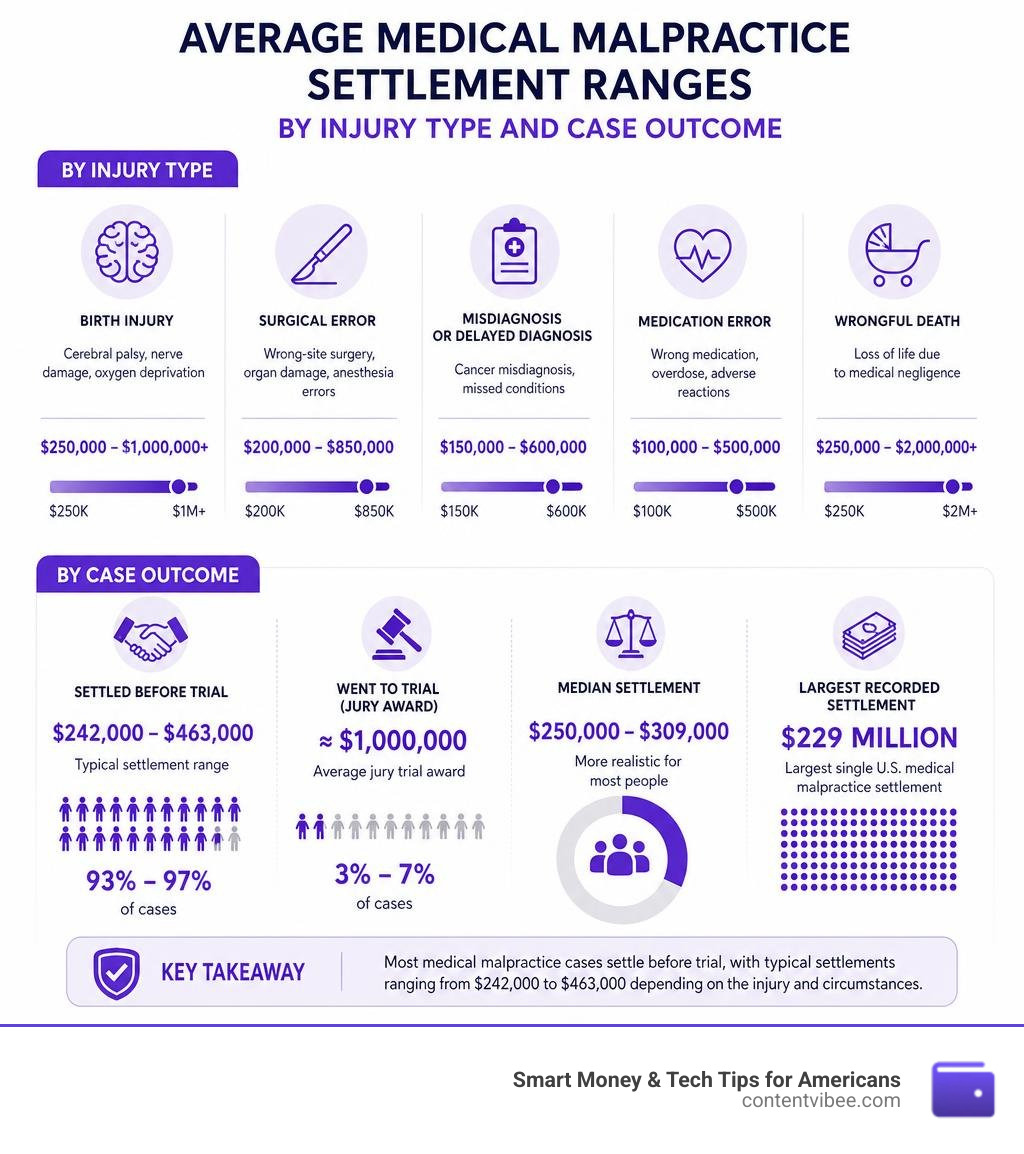
The average medical malpractice settlement in the United States typically falls somewhere between $242,000 and $463,000 — but the number you see depends heavily on the source, the year, and whether you’re looking at the mean or the median.
Here’s a quick snapshot of the key figures:
| Metric | Amount |
|---|---|
| Average settlement (2025, NPDB) | ~$455,000–$463,000 |
| Median settlement | ~$250,000–$309,000 |
| Average jury trial award | ~$1,000,000 |
| Average wrongful death payout | ~$380,300 |
| Cases that settle before trial | ~93–97% |
A few things to understand right away:
- The mean is pulled up by massive outlier cases. The largest single U.S. malpractice settlement was $229 million.
- The median is more realistic for most people. It sits around $250,000–$309,000.
- Going to trial usually means bigger awards — but only about 3–7% of cases ever get there.
- State damage caps can significantly limit what you receive, especially for pain and suffering.
If you’re dealing with medical bills, lost wages, and uncertainty about what your case is worth, those numbers matter. A lot.
Medical errors cause more than 250,000 deaths in the U.S. every year — making it one of the leading causes of preventable death. Yet most people injured by negligence have no idea what fair compensation actually looks like, or how settlements are calculated.
This guide breaks it all down in plain language: what drives settlement values, how damages are calculated, and what you might realistically expect based on your situation.
What is the Average Medical Malpractice Settlement in the United States?

When we look at the big picture, medical malpractice payouts can feel like a game of statistical tug-of-war. If you ask a room of legal experts what the “average” payout is, you will get wildly different answers depending on which dataset they use.
To understand why, we have to look at the National Practitioner Data Bank (NPDB) Data Analysis. The NPDB tracks every single malpractice payment made by licensed healthcare practitioners in the United States. When we analyze this massive database, a clear distinction emerges between the mean (the mathematical average) and the median (the middle point where half of the cases pay more and half pay less).
Because a tiny fraction of cases result in “nuclear” verdicts or massive multi-million dollar settlements, the mathematical average is heavily skewed upward. For instance, while the national average medical malpractice payout in 2025 climbed to $455,724, the median payout sits closer to $250,000 to $309,000. In fact, looking at historical data, only about 2.7% of all medical malpractice cases result in payments exceeding $1 million. The most common payment range is actually between $10,000 and $50,000, which often covers minor mistakes, pharmacy errors, or quick out-of-court resolutions.
To get a clearer picture of how these numbers have shifted over time, we can look at the average and median payouts over the last few years, along with projections for 2026:
| Year | Average National Payout | Median National Payout |
|---|---|---|
| 2022 | $329,565 | $200,000 |
| 2023 | $348,000 | $215,000 |
| 2025 | $455,724 | $250,000 |
| 2026 (Projected) | $457,362 | $309,000 |
As you can see, the average payout has risen steadily—increasing by over 114% since 2000. This is largely driven by “social inflation” (the tendency for juries to award larger sums for emotional distress) and the rising cost of healthcare.
If you are trying to figure out where your specific situation falls on this spectrum, using an interactive tool like our Malpractice Settlement Calculator can help you estimate your potential recovery based on your specific medical bills and state laws.
Key Factors That Influence Malpractice Payouts

No two medical malpractice cases are identical. A surgeon leaving a sponge inside a patient’s abdomen will be treated very differently than a doctor who fails to diagnose a rare condition that has no known cure. When insurance adjusters and defense attorneys evaluate a claim, they look at several core elements to determine what they are willing to pay.
First and foremost is liability and the standard of care. To win a malpractice claim, we must prove that the healthcare provider violated the accepted “standard of care”—meaning they failed to act as a reasonably prudent professional would have under similar circumstances. If the negligence is obvious (such as operating on the wrong limb), liability is clear, and the settlement value increases.
Second, the quality of evidence and expert testimony is paramount. Medical malpractice cases are battlegrounds of expert witnesses. If we have highly credible, board-certified medical experts who can clearly explain to a jury exactly how the doctor’s mistake caused the injury, the insurance company is much more likely to offer a high settlement to avoid going to trial.
Finally, the medical specialty of the practitioner plays a massive role. Some specialties are simply riskier, resulting in higher insurance policies and larger average payouts:
- Obstetricians/Gynecologists (OB/GYNs): Average settlement of $2.22 million, with a median of $1 million.
- Emergency Physicians: Average settlement of $3.26 million, with a median of $2.1 million (often due to high-stakes, diagnostic errors).
- General Surgeons: Average settlement of $1.56 million, with a median of $755,000.
- Non-Physician Medical Personnel: Average settlement of $409,056, with a median of $157,500.
How Injury Severity Impacts the Average Medical Malpractice Settlement
The single most influential factor in determining your settlement size is the severity of the injury. Minor injuries that resolve with a few weeks of physical therapy will result in modest payouts. Catastrophic, life-altering injuries are a completely different story.
When negligence results in permanent brain damage, paralysis, or severe birth injuries, the lifetime cost of care skyrockets. For example, a baby who suffers brain damage during birth due to a delayed C-section may require 24-hour nursing care, specialized housing, and ongoing physical therapy for the rest of their life. These lifetime care costs can easily exceed $10 million.
Because birth injuries represent some of the most devastating and costly medical errors, we have designed a specialized Birth Injury Settlement Calculator to help families estimate the immense long-term economic impact of these tragic situations.
The Role of State Laws and Damage Caps
You could have the exact same medical error occur to two different people, but if one lives in New York and the other lives in Texas, their final payouts will look entirely different. This is because there are no federal laws regulating medical malpractice payouts; instead, the legal landscape is a patchwork of state-specific statutes.
The most restrictive of these laws are damage caps, which place a statutory limit on how much money a plaintiff can recover. These caps usually target non-economic damages (pain and suffering), though some states cap the total recovery.
- Texas: Caps non-economic damages at $250,000 per healthcare provider and $500,000 overall.
- Indiana: Caps total damages (both economic and non-economic) at $1.8 million. The doctor is only personally liable for the first $500,000, with the rest paid out by the state’s Patient Compensation Fund.
- California: Historically capped non-economic damages at $250,000 under MICRA, though recent legislation is gradually raising this cap to $750,000 by 2033 to account for decades of inflation.
- States with No Caps: States like New York, Pennsylvania, and Illinois have no statutory caps on non-economic damages. Unsurprisingly, these states routinely rank among the highest in total annual medical malpractice payouts. In 2025, New York led the nation with a staggering $729.58 million in total payouts.
For a detailed breakdown of how your state’s specific laws might impact your potential recovery, you can consult this comprehensive Medical Malpractice Payouts by State guide.
Additionally, if the injury occurred at a public or county hospital, sovereign immunity laws may apply. In states like Florida, public entities have strict liability caps (often $200,000 per person and $300,000 per incident), meaning you would have to petition the state legislature through a complex “claims bill” to recover anything above those limits.
How Medical Malpractice Damages Are Calculated
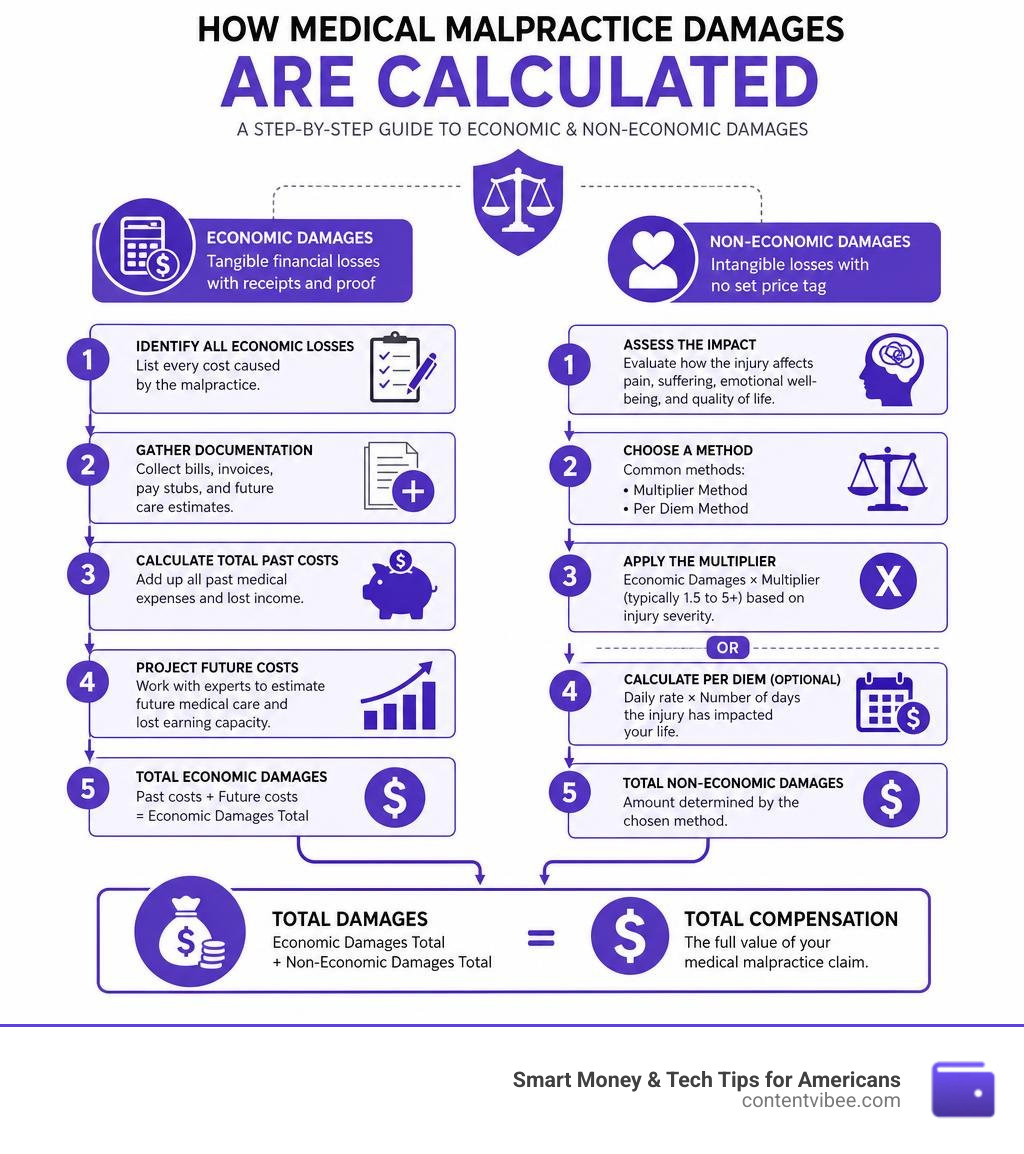
Calculating the value of a medical malpractice claim isn’t about pulling a number out of thin air. It is a highly structured, mathematical process. Insurance companies, defense lawyers, and plaintiff attorneys use specific formulas to translate physical and emotional pain into a dollar amount.
To get a baseline estimate of how these calculations work in real-time, you can play around with our Realistic Settlement Calculator. However, to truly understand the math behind the curtain, we must look at how damages are split into two distinct categories: economic and non-economic.
Economic vs. Non-Economic Damages
When we talk about “damages” in a Personal Injury Claim, we are talking about the financial compensation you are legally entitled to receive to make you “whole” again.
Economic damages are the objective, quantifiable financial losses you have suffered because of the malpractice. These are relatively easy to calculate because they come with receipts, bills, and paystubs. They include:
- Past and present medical bills (surgeries, hospital stays, medications).
- Lost wages from time missed at work.
- Rehabilitation, physical therapy, and medical equipment (wheelchairs, home modifications).
Non-Economic damages are subjective, non-monetary losses. These represent the human cost of the injury—the things money can’t buy back, but must somehow compensate for. They include:
- Physical pain and suffering.
- Mental anguish, anxiety, and PTSD.
- Permanent disfigurement or scarring.
- Loss of enjoyment of life (e.g., no longer being able to hold your children or play your favorite instrument).
To calculate non-economic damages, attorneys often use the multiplier method. They take the total economic damages and multiply them by a “seriousness factor” (typically between 2 and 5) depending on how severe and permanent the injury is. For a highly detailed explanation of this process, you can read more about Calculating Medical Malpractice Settlement Damages.
Calculating Future Expenses and the Average Medical Malpractice Settlement
In severe malpractice cases, the medical bills don’t stop when you sign the settlement agreement. If you require lifelong care, your attorney will hire forensic economists and life care planners to project your future financial needs.
A life care plan is a comprehensive document that outlines every single medical expense you will incur for the rest of your expected lifespan. This includes future surgeries, regular doctor visits, physical therapy, medication, and the cost of in-home nursing care.
The forensic economist will then take these projected costs, factor in inflation, and calculate the “present value” of those future expenses. They will also calculate your future lost earnings—what you would have earned over your lifetime if the injury hadn’t prevented you from working, including lost promotions, retirement contributions, and health benefits.
Because receiving a massive lump-sum settlement can create tax and management challenges, many families opt for a structured settlement. This distributes the money over time through an annuity. You can use our Structured Settlement Calculator to see how monthly or annual payouts can secure your financial future.
Settlement vs. Trial: Why Most Cases Settle Out of Court
If you watch legal dramas on television, you might think every medical malpractice case ends with a dramatic courtroom speech and a tearful jury verdict. In reality, the courtroom is the last place either side wants to end up.
Between 93% and 96.9% of all medical malpractice cases settle out of court before reaching a jury trial. Why? Because trials are incredibly risky, wildly expensive, and emotionally draining for everyone involved.
During pre-trial negotiations and mediation, both sides have a clear view of the evidence. Mediation allows a neutral third-party mediator to help both sides reach a compromise.
For the patient, settling out of court offers guaranteed compensation and closure. For the doctor and their insurance company, it avoids the risk of a “nuclear verdict”—a runaway jury award that exceeds the doctor’s insurance policy limits and results in devastating financial ruin.
The Financial Reality of Going to Trial
While jury trials are rare, they do yield much higher numbers on paper. The average medical malpractice jury award in court cases commonly reaches closer to $1 million, compared to the average out-of-court settlement of around $242,000 to $455,000.
But those higher trial numbers come with a major catch: the cost of litigation.
Taking a medical malpractice case all the way through a jury trial can easily cost $50,000 to over $100,000 in upfront expenses. These costs go toward expert witness fees (doctors often charge $500 to $1,000+ per hour to review records and testify), court reporters, medical illustrations, and trial exhibits.
Furthermore, medical malpractice lawyers work on a contingency fee basis. This means they do not charge you anything upfront; instead, they take a percentage of the final settlement or verdict. While a standard personal injury case might have a 33% fee, medical malpractice cases are so complex that attorneys typically take between 33% and 40% of the recovery, plus litigation expenses.
To understand how these fees are structured and how they impact your final take-home amount, we recommend reading The Truth About Lawyer Fees And What Percentage They Actually Take.
Frequently Asked Questions about Medical Malpractice Payouts
What is the average payout for medical negligence resulting in death?
The average medical malpractice payout for cases resulting in death is approximately $380,300, though this number varies dramatically depending on the state where the negligence occurred.
When a medical error results in death, the family cannot file a standard personal injury claim. Instead, they must file a wrongful death lawsuit or a survival action.
- Wrongful Death: Compensates the surviving family members for their financial and emotional losses, such as lost financial support, funeral expenses, and loss of companionship.
- Survival Action: Compensates the deceased person’s estate for the pain and suffering they experienced between the time of the negligent act and their actual death.
In many states, wrongful death claims must be filed by the personal representative (executor) of the deceased’s estate, rather than the family members directly. Furthermore, many states apply strict statutory limits on non-economic damages in wrongful death cases. For example, Maryland caps non-economic damages for wrongful death with multiple survivors at $1,112,500, while other states have much tighter limits that can severely restrict the family’s financial recovery.
How long do you have to file a medical malpractice lawsuit?
The time limit to file a lawsuit is known as the statute of limitations. If you miss this deadline, you lose your right to sue forever.
In most states, the statute of limitations for medical malpractice is two to three years from the date the negligence occurred. However, there are two crucial exceptions to this rule:
- The Discovery Rule: If the injury could not have reasonably been discovered right away (for example, a surgical sponge left inside your body that doesn’t cause symptoms for three years), the clock may not start ticking until the date you discovered, or should have discovered, the injury.
- The Statute of Repose: This is an absolute hard deadline. Regardless of when you discovered the injury, the statute of repose places an ultimate limit (often 4 to 10 years) after which no lawsuit can be filed.
Because these rules are incredibly complex and vary wildly by state, it is vital to act quickly. You can read our detailed breakdown on How Long Do You Have To Sue Personal Injury Statute Of Limitations Explained to make sure you don’t miss your window of opportunity.
How much do medical malpractice lawyers charge?
As mentioned earlier, medical malpractice attorneys operate on a contingency fee arrangement. This means:
- You pay $0 upfront.
- The lawyer covers all litigation expenses (expert witnesses, medical records, filing fees) out of their own pocket while the case is active.
- If you win or settle, the lawyer takes a pre-agreed percentage (usually 33.3% to 40%) of the total payout, plus reimbursement for the litigation expenses they advanced.
- If you lose, you owe the attorney nothing for their time, though in some rare contracts, you might still be responsible for basic court costs.
Because medical malpractice cases require massive financial investment and specialized medical knowledge, you should always look for an attorney who specializes specifically in medical negligence rather than a general practice lawyer. To learn more about what to expect financially when hiring representation, read our guide on How Much Does A Personal Injury Lawyer Cost.
Conclusion
Navigating the aftermath of medical negligence is one of the most stressful experiences a person can go through. You are dealing with physical pain, mounting medical bills, and the emotional betrayal of trusting a medical professional who ultimately caused you harm.
While the average medical malpractice settlement sits around $242,000 to $463,000, your case’s actual value will depend entirely on your unique medical expenses, future care needs, and the laws of your state.
Because insurance companies will do everything in their power to minimize your payout, securing experienced legal representation is the most critical step you can take. A skilled attorney will gather your medical records, consult with top-tier medical experts, and build a case that forces the insurance company to take you seriously.
If you are currently in the middle of negotiations or considering taking legal action, understanding your options is critical. At ContentVibee, we are here to help you make sense of the financial and legal decisions that shape your life. Take your time, gather your documentation, and consult with a professional to get the compensation you truly deserve.


