


Why Charges for Selling Shares Can Cost You More Than You Think
Understanding the charges for selling shares is one of the most overlooked parts of investing — and it can quietly eat into your returns more than you’d expect.
Here’s a quick overview of the main costs you may face when selling shares:
| Fee Type | Typical Cost |
|---|---|
| Online brokerage commission | $0 (most major US brokers) |
| Rep-assisted trade fee | Up to $32.95 per trade (e.g., Fidelity) |
| SEC regulatory fee | ~$0.01–$0.03 per $1,000 sold |
| FINRA Trading Activity Fee | $0.000195 per share sold |
| Options contract fee | $0.65 per contract (most brokers) |
| Short-term mutual fund fee | Up to $49.95 (if held under 60 days) |
| Foreign transaction/currency fee | Varies by country and broker |
| Capital gains tax | 0%–37% depending on holding period and income |
Many investors focus only on whether their broker charges a trading commission. But even on a “free” platform, regulatory fees, tax obligations, and hidden costs still apply every time you sell.
Here’s why this matters: according to FINRA, a seemingly small 1% annual fee on a $100,000 investment earning 4% annually can reduce your total returns by $28,000 over 20 years. That’s not a rounding error — that’s a real chunk of wealth quietly disappearing.
And if you’re selling stock after receiving a settlement or managing a sudden financial need, knowing exactly what you’ll actually pocket after fees and taxes is critical.
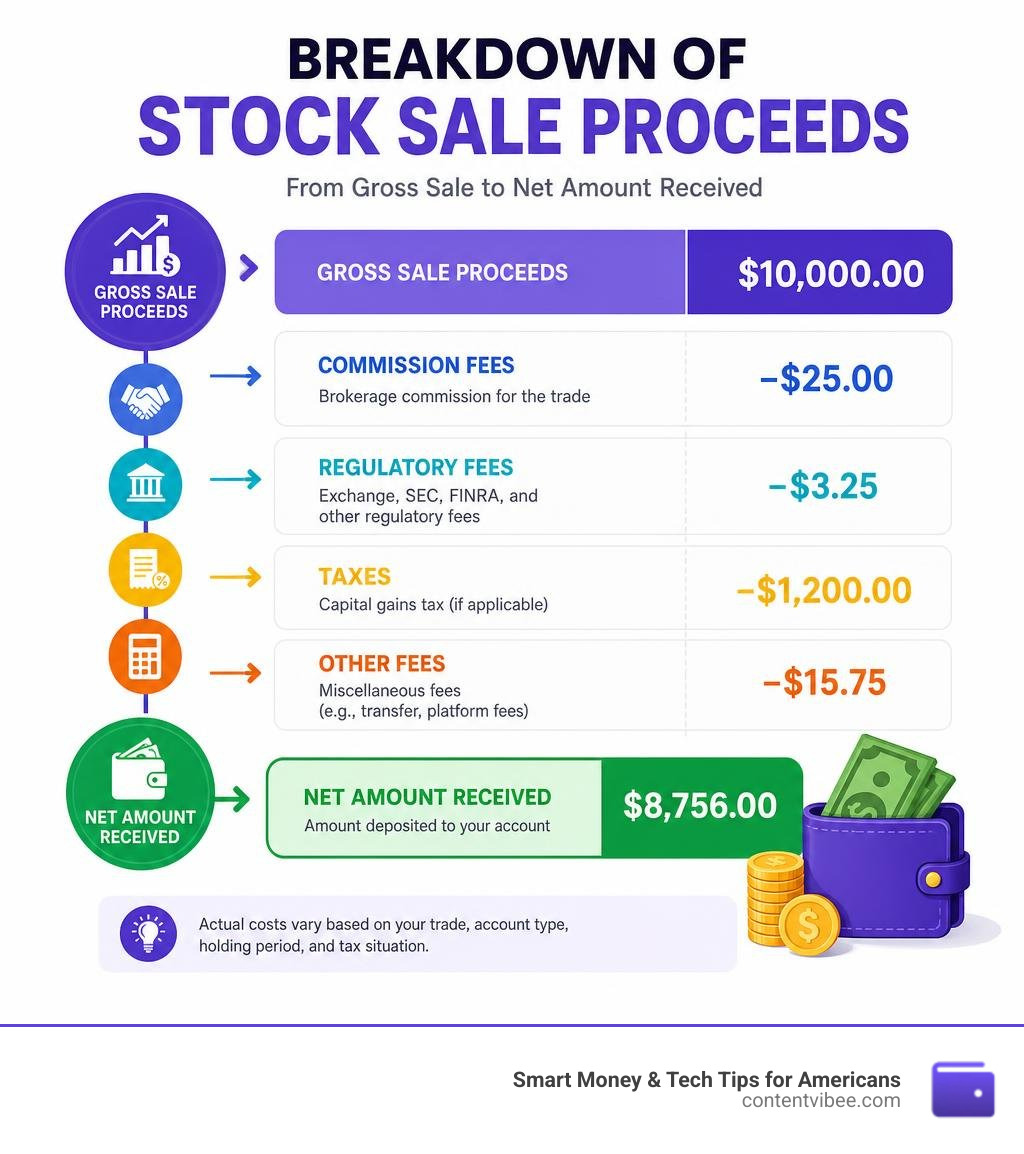
Understanding the Primary Charges for Selling Shares
When we decide to liquidate our investments, we often assume that our account balance is exactly what will hit our bank account. Unfortunately, the mechanics of the financial markets mean that several parties take a small bite out of your transaction before you see a single dime.
Understanding these costs is essential to avoid being short-changed by the market. If you want a deeper look into how these costs slip under the radar, check out our guide on how to Don’t Get Short Changed by Hidden Commission in Stock Market Trades.
Let’s break down the primary costs you will encounter when executing a sell order.
Brokerage Commissions vs. Transaction Fees
The terms “brokerage commission” and “transaction fee” are often used interchangeably, but they refer to different parts of the selling process:
- Brokerage Commissions: This is the fee charged directly by your broker to execute your trade. Historically, this was a flat fee (such as $4.95 or $6.95 per trade) or a percentage of the trade’s total value. Today, most major U.S. consumer brokerages have reduced online stock and ETF commissions to $0. However, commissions still exist for specialized assets like options, mutual funds, or physical certificates.
- Transaction Fees: These are structural costs associated with the clearing, settlement, and processing of your trade. Even if your broker’s commission is $0, transaction fees might still apply, particularly if you are trading mutual funds or using specialized platforms.
To protect your portfolio, it is always a good idea to review the Fees and Commissions | FINRA.org guide to understand how these charges are structured across the industry. For a broader perspective on how these costs impact your overall strategy, read our detailed article on the Brokerage Fee Stock Market.
Online Trading vs. Representative-Assisted Trades
The way you place your sell order has a massive impact on the charges for selling shares. In the modern digital era, self-directed online trading is highly subsidized, while involving a human or using legacy telephone systems comes with a steep premium.
Let’s look at how these costs differ using Fidelity’s current fee structure as an example:
- Online Trades: Selling U.S. equities or ETFs via an online portal or mobile app costs $0.00 in commissions.
- FAST (Fidelity Automated Service Telephone): If you use the automated touch-tone phone system to place your sell order, you will be charged a flat fee of $12.95 per trade.
- Representative-Assisted Trades: If you need to speak to a live broker on the phone to execute your sale, the price jumps to $32.95 per trade.
For options, while the base online commission is $0, you will pay a per-contract fee of $0.65 across major platforms like Fidelity, Charles Schwab, and Merrill Edge. If you are selling mutual funds, watch out for short-term redemption fees. For example, selling a FundsNetwork no-transaction-fee (NTF) fund held for less than 60 days can trigger a flat $49.95 short-term trading fee.
For a complete breakdown of these specific costs, you can view the official Fidelity Brokerage and Commission Fee Schedule | Trading information .
Hidden Costs and Regulatory Fees When Liquidating Stock
Even when your broker proudly advertises “zero-commission trading,” selling shares is never entirely free. Regulatory bodies and market clearinghouses impose micro-fees on every sell transaction. Brokers are legally permitted to—and almost always do—pass these costs directly down to you.
To gain a comprehensive view of how these minor expenses accumulate, you can consult the Costs of Investing Breakdown – Charles Schwab International .
Regulatory Pass-Through Charges for Selling Shares
Whenever you sell a stock, ETF, or option, several regulatory bodies assess fees to cover the cost of market oversight and government supervision. These fees are calculated as a tiny fraction of your total transaction value or on a per-share basis:
- SEC Section 31 Fee: The Securities and Exchange Commission (SEC) charges this fee to offset the government’s cost of supervising the securities markets. It applies only to sell orders. The rate is recalculated periodically (at least once per year) and is currently set at $0.0000206 per dollar of aggregate sales. For example, if you sell $10,000 worth of stock, the SEC fee will be roughly $0.21.
- FINRA Trading Activity Fee (TAF): The Financial Industry Regulatory Authority (FINRA) recovers its regulatory costs by charging a fee of $0.000195 per share on all equity sales, with a maximum cap of $10.00 per trade. If you sell 1,000 shares of a penny stock or a blue-chip stock, the TAF will be approximately $0.20.
- Options Regulatory Fee (ORF): If you are selling options contracts, exchanges pass down an ORF that typically ranges from $0.02 to $0.04 per contract to offset market surveillance costs.
These micro-charges are deducted automatically from your gross sale proceeds. You can see how these fees are calculated in real-time by reviewing the Commissions Stocks | Interactive Brokers LLC schedule.
Foreign Transaction Taxes and Currency Conversion
If you are selling international shares, foreign ordinary shares, or American Depositary Receipts (ADRs), your transactions are subject to a completely different set of fees:
- ADR Pass-Through Fees: ADRs allow Americans to invest in foreign companies easily. However, the depositary banks charge custody fees (typically $0.01 to $0.05 per share) that are deducted when you sell or when dividends are paid.
- Foreign Currency Conversion (FX Markup): If you sell a stock denominated in British Pounds (GBP) or Euros (EUR), your broker must convert those proceeds back into U.S. Dollars (USD). Brokers rarely give you the raw interbank exchange rate; instead, they add an FX markup (often between 0.50% and 1.50% of the transaction value), which acts as a hidden commission.
- International Stamp Duties and Taxes: Some countries impose transactional taxes regardless of where the investor is located. For example, France, Italy, and Spain charge foreign transaction taxes on certain stock sales, and the UK charges a stamp duty reserve tax on stock purchases (which can affect liquidity and pricing when you sell).
For those holding UK assets or trading across foreign exchanges, understanding these international mechanics is vital. You can read more about international trading parameters in the guide on Investing in Shares – How to buy and sell shares online | Fidelity .
How Account Types and Broker Models Impact Your Costs
The total cost of liquidating your investments depends heavily on the type of broker you use and the tax status of your account. The financial industry is divided into different service tiers, each with its own fee philosophy.
| Broker Type | Typical Annual Management Fee | Online Trading Commission | Best Suited For |
|---|---|---|---|
| Full-Service Broker | 1.00% – 2.00% of assets | Varies (often $0 online, but high rep-assisted fees) | Complex wealth management, estate planning, and hands-on guidance |
| Robo-Advisor | 0.20% – 0.30% of assets | $0 (automated rebalancing) | Set-it-and-forget-it investors seeking automated indexing |
| Discount / Online Broker | $0.00 | $0 (self-directed) | Active traders and self-reliant investors who want to minimize fees |
To explore more investment styles and how they fit your financial goals, browse through our Category: Investments archives.
Taxable Brokerage Accounts vs. Tax-Advantaged Accounts
The account type you use to sell shares dictates whether Uncle Sam will take a cut of your proceeds:
- Taxable Brokerage Accounts: Every time you sell a share of stock for a profit in a standard taxable brokerage account, you trigger a taxable event. You will owe Capital Gains Tax (CGT) on the difference between your sale price and your cost basis.
- Tax-Advantaged Accounts (IRAs, 401ks): Selling shares within a Traditional or Roth IRA does not trigger an immediate capital gains tax. You can buy and sell assets freely inside the account without worrying about tax drag. Taxes are only paid upon withdrawal (for Traditional accounts) or not at all (for qualified Roth withdrawals).
For international context, tax-sheltered accounts like ISAs (Individual Savings Accounts) and SIPPs (Self-Invested Personal Pensions) in the UK serve a similar purpose by shielding investors from local capital gains taxes. You can review how UK tax authorities handle these calculations by looking at the official HS284 Shares and Capital Gains Tax (2026) – GOV.UK .
Full-Service Brokers vs. Discount Platforms and Robo-Advisors
How much help do you need when managing your portfolio? Your answer determines your baseline costs:
- Full-Service Brokers: Traditional wealth managers provide comprehensive financial planning, estate coordination, and direct investment advice. In exchange, they typically charge an annual Assets Under Management (AUM) fee of 1.00% to 2.00%. On a $500,000 portfolio, this translates to $5,000 to $10,000 per year, regardless of how many shares you sell.
- Robo-Advisors: Digital advisory platforms use algorithms to build and automatically rebalance your portfolio. They charge a much lower management fee, typically averaging 0.20% to 0.30% annually.
- Discount/Online Brokers: Self-directed platforms offer the cheapest route. You pay $0 in commissions for online stock sales, but you receive no personalized investment advice.
If you want to dive deeper into how to structure your portfolio to avoid excessive management fees, take a look at our article on Selling Your Shares Without Losing Your Shirt to Fees.
Strategies to Minimize Your Charges for Selling Shares
Now that we have mapped out all the potential fees, let’s focus on the actionable steps you can take to keep as much of your money as possible. With a little planning, you can easily reduce your transaction costs and tax liability to near zero.
Tax-Loss Harvesting and Cost Basis Considerations
Your “cost basis” is the original value of an asset for tax purposes (usually the purchase price plus any commissions or transaction costs). When you sell shares, how you calculate your cost basis determines your tax bill.
To understand the fundamentals of cost basis, you can read the educational guide What is cost basis for taxes? | Vanguard .
When you sell only a portion of your holdings in a company, you can choose which shares to sell:
- FIFO (First-In, First-Out): The oldest shares are sold first. If the stock has grown steadily, this often triggers the largest taxable gain.
- Specific Identification (SpecID): You choose exactly which tax lots to sell. This allows you to sell shares with the highest cost basis first, minimizing your current capital gains.
- Tax-Loss Harvesting: If you have positions that have lost value, you can sell them to realize a capital loss. These losses can offset capital gains from your winning positions, up to a limit of $3,000 of ordinary income per year.
For an international comparison of how capital gains and cost bases are calculated, you can refer to the Australian Taxation Office’s Legal database – View: Personal investors guide to capital gains tax 2025: Part B: Sale of shares or units , which details cost-base adjustments and capital gains discounts.
Avoiding Exit Fees and Transfer Penalties
If you decide to switch brokerages, you must be careful about how you move your shares. If you simply sell all your shares to transfer cash, you will trigger massive capital gains taxes in a taxable account.
Instead, you should use an ACATS (Automated Customer Account Transfer Service) transfer to move your shares directly to the new broker without liquidating them. However, watch out for exit fees:
- ACATS Transfer Fees: Your current broker will likely charge an outgoing account transfer fee, which typically ranges from $50 to $100.
- Reimbursement Promotions: Many competitive discount brokers will reimburse your exit fees (up to $500 or more) if you transfer an account above a certain balance threshold (usually $10,000 to $50,000). Always ask your new broker if they will cover these costs before initiating the transfer.
Frequently Asked Questions About Stock Selling Fees
Do zero-commission brokers really charge nothing to sell shares?
No. While they do not charge a visible upfront commission, zero-commission brokers still make money off your trades. They generate revenue through Payment for Order Flow (PFOF), where they send your orders to market makers who pay them a fraction of a cent per share in exchange for the right to execute the trade. This can sometimes result in slightly worse execution prices for you. Additionally, these brokers make money on the interest earned from your uninvested cash, margin lending fees, and options contract charges.
How does capital gains tax affect my net proceeds when selling stock?
Capital gains tax is determined by how long you held the stock before selling:
- Short-Term Capital Gains: If you hold the stock for one year or less, your profits are taxed at your ordinary federal income tax rate (ranging from 10% to 37% in 2026).
- Long-Term Capital Gains: If you hold the stock for more than one year, you qualify for preferential tax rates (0%, 15%, or 20%), depending on your taxable income. Holding your shares for just one extra day can save you thousands of dollars in taxes.
What are the typical wire or transfer fees when closing an account?
When you fully close an account and move your money, brokers may charge an outgoing wire fee (typically $20 to $25) or a full account closure fee (usually $50 to $95). To avoid wire fees, you can often request a standard ACH transfer (electronic bank transfer) to your linked bank account, which is almost always free.
Conclusion
Navigating the charges for selling shares doesn’t have to be a painful experience. By understanding the difference between visible commissions, regulatory pass-through fees, and tax implications, we can make smarter decisions about when and how to liquidate our assets.
At ContentVibee, we believe that smart investing isn’t just about picking the right stocks—it’s about keeping as much of your hard-earned money as possible. Take the time to compare platforms, choose your tax lots wisely, and utilize tax-advantaged accounts whenever possible.
Ready to take full control of your portfolio without giving up your profits to Wall Street fees? Read our complete, step-by-step masterclass on How to Buy and Sell Stocks Without Losing Your Shirt to Fees to optimize your financial strategy today!


