


How Much Does Autopilot Investing Cost?
#
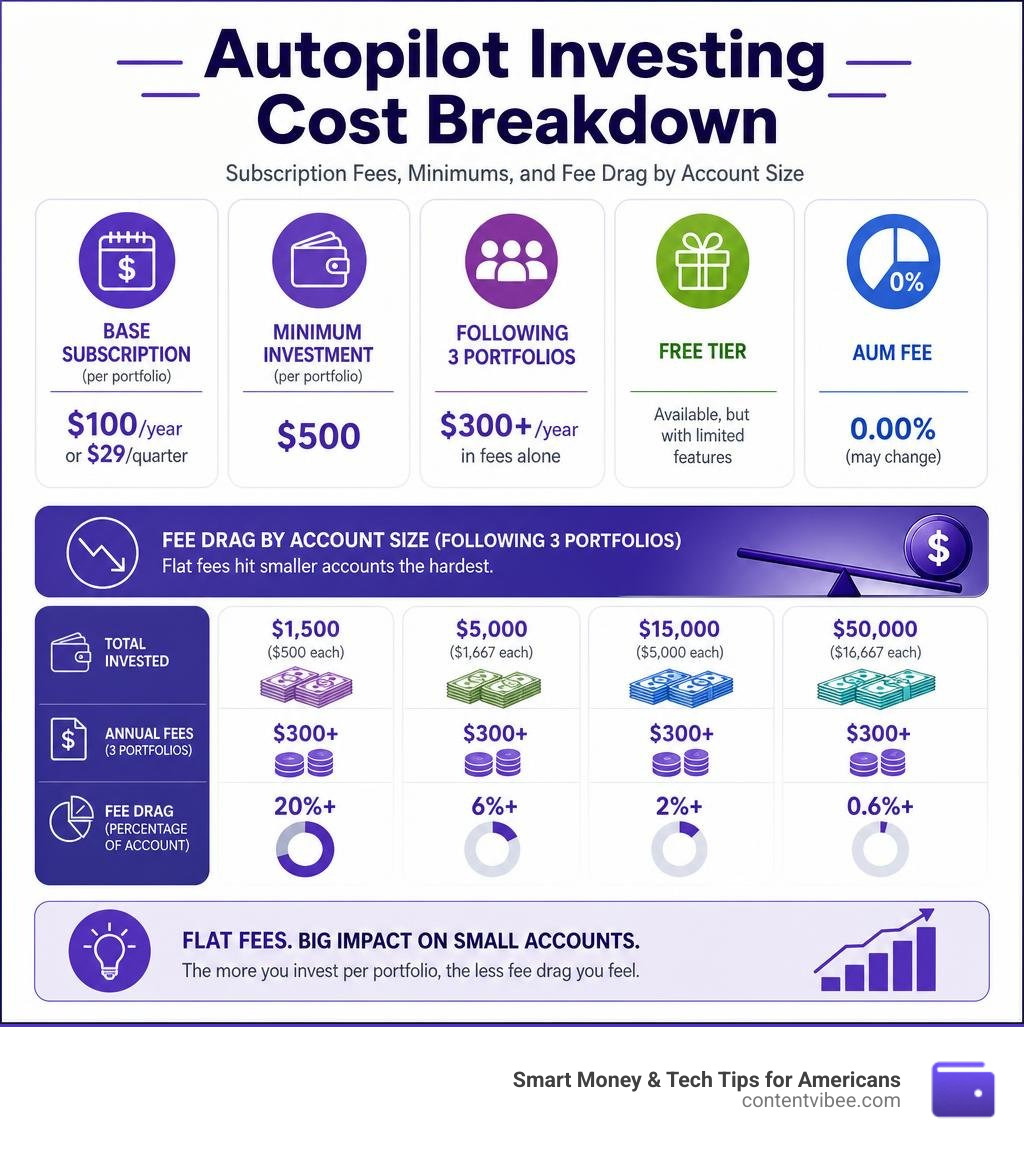
How much does autopilot investing cost is one of the most important questions to answer before you hand over access to your brokerage account. The short answer:
| Cost Type | Amount |
|---|---|
| Base subscription (per portfolio) | $100/year or $29/quarter |
| Minimum investment (per portfolio) | $500 |
| Following 3 portfolios | $300+/year in fees alone |
| Free tier | Available, but with limited features |
| AUM fee | Currently 0.00% (may change) |
So if you follow three portfolios with $500 in each, you’re paying $300 a year in subscription fees on just $1,500 invested. That’s a 20% fee drag before you’ve earned a single dollar.
For retirees or anyone on a fixed income, that math matters a lot.
Autopilot is a copy trading app that automatically mirrors the moves of politicians, hedge fund managers, and other “pilot” investors inside your own brokerage account. It’s grown fast — the platform had over $750 million in assets under management as of mid-2025 and millions of downloads. But popularity doesn’t mean it’s cheap.
The fee structure is flat and per-portfolio, which is very different from the percentage-based fees most robo-advisors charge. That can work in your favor if you have a large account — or seriously eat into your returns if you’re starting small.
Before you automate anything, you need to understand the full picture: base fees, hidden costs, tax implications, and where the real break-even point is.
To understand how Autopilot bills its users, we have to look past the marketing and dive into the actual legal disclosures. According to the official Autopilot Form CRS, the platform operates under a two-tiered system: a Basic Tier and a Premium Tier.
The Basic Tier vs. The Premium Tier
On paper, the Basic Tier has a $0 advisory fee. However, using the free tier in 2026 comes with massive roadblocks. Historically, free users could manually sync their trades, but the platform has heavily restricted manual syncing. If you want the core benefit of the platform—which is real-time, hands-free automated portfolio management—you must upgrade to the Premium Tier.
The Premium Tier pricing starts with a base subscription fee:
- Quarterly Plan: $29 per quarter (approximately $116 per year) per portfolio.
- Annual Plan: $100 per year per portfolio.
However, the Autopilot Form CRS reveals that the Base Advisory & Licensing Fee can actually scale from $29.99 to $199.99 quarterly, or $99.99 to $699.99 annually. Why such a wide range? Because of “creator fees.”
Creator Fees and Premium Portfolios
Autopilot allows third-party traders, financial analysts, and developers to launch their own custom portfolios on the platform. While standard trackers like the Pelosi Tracker (which copies Congresswoman Nancy Pelosi’s stock trades) or the Burry Tracker (which mirrors Michael Burry) generally fall under the standard $100/year pricing, other specialized or actively managed portfolios carry higher creator fees. These creator fees are bundled into your subscription, meaning some premium strategies can cost up to $299 per year or more just to follow.
The Future AUM Fee
Currently, Autopilot’s Asset Under Management (AUM) fee is 0.00%. However, their regulatory filings state that they reserve the right to implement an AUM-based fee in the future, calculated on your average daily balance. If this is implemented, users will have to pay both a flat subscription fee and a percentage of their total portfolio value.
The Hidden Costs of Automated Copy Trading
When you evaluate how much does autopilot investing cost, looking only at the subscription fee is a trap. Copying real-time traders and politicians automatically introduces several structural inefficiencies that quietly drain your portfolio’s value.
1. Trade Delays and Disclosure Lag
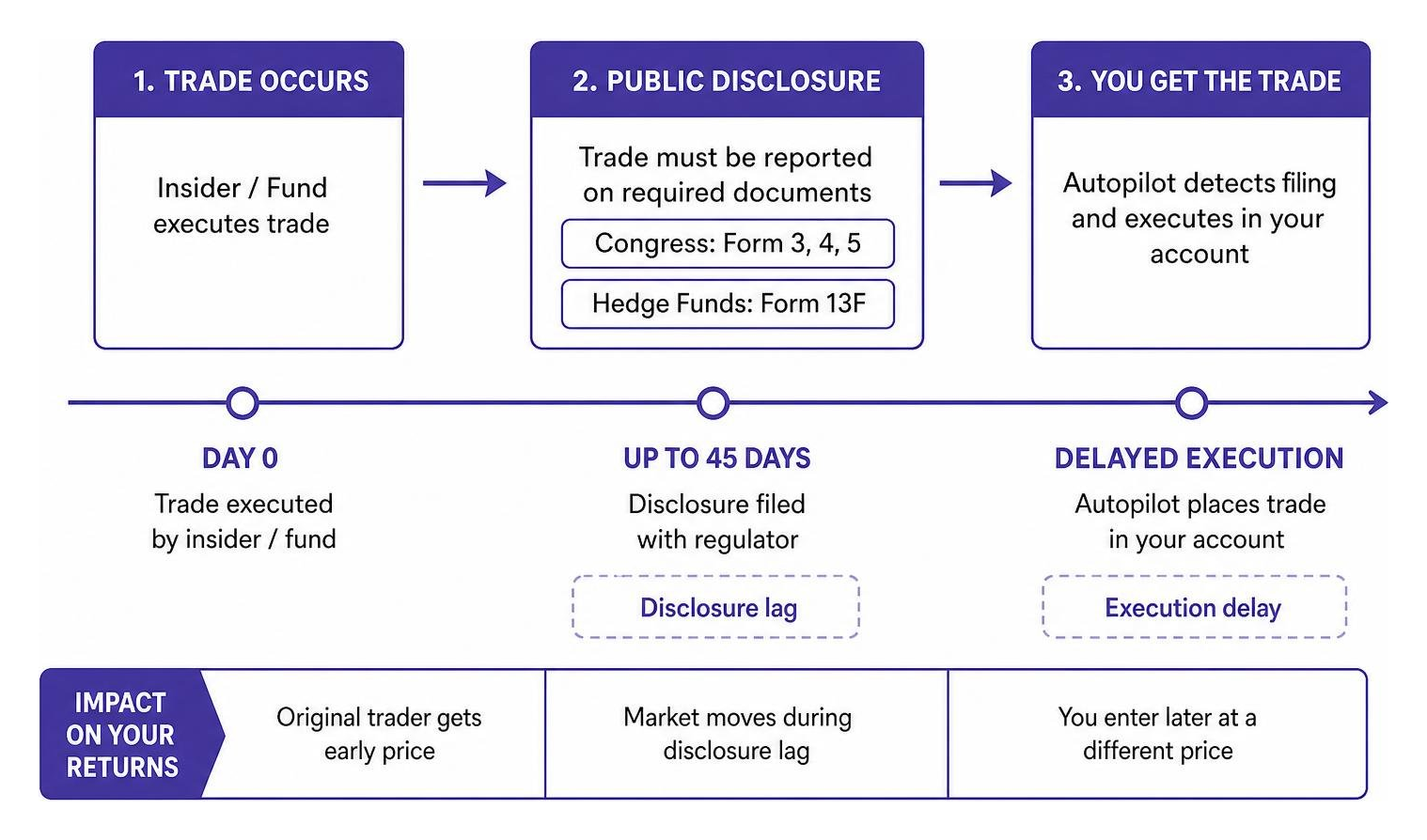
Autopilot does not have a direct, real-time feed into Nancy Pelosi’s brain or Warren Buffett’s trading terminal. Instead, it relies on public disclosures:
- Congressional Trades: Under the STOCK Act, members of Congress have up to 45 days to disclose their trades.
- Hedge Funds: Institutional investment managers must file Form 13F within 45 days of the end of each calendar quarter.
This means when Autopilot mirrors a trade, you are often buying or selling weeks after the “pilot” did. If a stock surged immediately after a politician bought it, you might buy in at the absolute peak. This discrepancy is known as tracking error, and it can cost you far more than the $100 annual subscription fee.
2. High Portfolio Turnover and Capital Gains Taxes
Many Autopilot strategies are highly active. For example, the popular AI World War III Portfolio or the Inverse Cramer Tracker (which short-sells whatever TV personality Jim Cramer recommends) trade frequently.
Every time a portfolio rebalances, Autopilot automatically sends buy and sell orders to your connected brokerage account (such as Robinhood, Webull, or Public.com) via Plaid. Because these trades occur in a standard taxable brokerage account, each sale is a taxable event.
If you hold an asset for less than a year before Autopilot sells it to mirror a new trade, you will owe short-term capital gains tax on the profits, which is taxed at your ordinary income rate. This high turnover can create a massive tax bill at the end of the year, severely hurting your compounding interest.
3. ETF Expense Ratios and Transaction Costs
While most modern brokerages offer commission-free stock trading, some of the portfolios you copy may invest in specialized Exchange Traded Funds (ETFs). These ETFs carry their own internal management fees, known as expense ratios, which are deducted automatically from the fund’s performance. If your chosen pilot frequently rotates into high-fee thematic ETFs, you are paying those fees on top of your Autopilot subscription.
Is Autopilot Cost-Effective? Break-Even Analysis for Small vs. Large Accounts
Because Autopilot charges a flat annual subscription fee rather than a percentage of your assets, the size of your investment account completely dictates whether the app is a smart financial move or a wealth-destroying mistake.
To illustrate this, let’s look at the math across different account sizes assuming you are following one standard portfolio ($100/year fee) and achieving an 8% market return before fees.
| Account Size | Minimum Fee | Annual Subscription Fee | Return on Investment (8% Gross) | Net Return After Fees | Effective Fee Drag (%) |
|---|---|---|---|---|---|
| $500 (Minimum) | Yes | $100 | $40 | -$60 (Loss) | 20.0% |
| $1,000 | Yes | $100 | $80 | -$20 (Loss) | 10.0% |
| $2,000 | Yes | $100 | $160 | +$60 (Profit) | 5.0% |
| $5,000 | Yes | $100 | $400 | +$300 (Profit) | 2.0% |
| $10,000 | Yes | $100 | $800 | +$700 (Profit) | 1.0% |
| $50,000 | Yes | $100 | $4,000 | +$3,900 (Profit) | 0.2% |
The $2,000 Critical Threshold
As the table shows, if you only invest the $500 minimum per portfolio, you are facing a massive 20% fee drag. To simply break even on a $1,000 account, your chosen pilot would need to generate a 10% annual return just to cover the $100 subscription.
For this reason, financial experts generally agree that Autopilot is not cost-effective for accounts under $2,000. Once your balance crosses $2,000, the effective fee drag drops to 5% or lower. If you have a $10,000 account, the $100 flat fee represents a 1% annual charge, which is highly competitive. For a $50,000 account, the fee drops to a minuscule 0.2%, making it cheaper than almost any advisory service on the market.
Autopilot Fees vs. Traditional Robo-Advisors
How does Autopilot’s flat-fee copy trading model compare to the broader automated investing landscape?
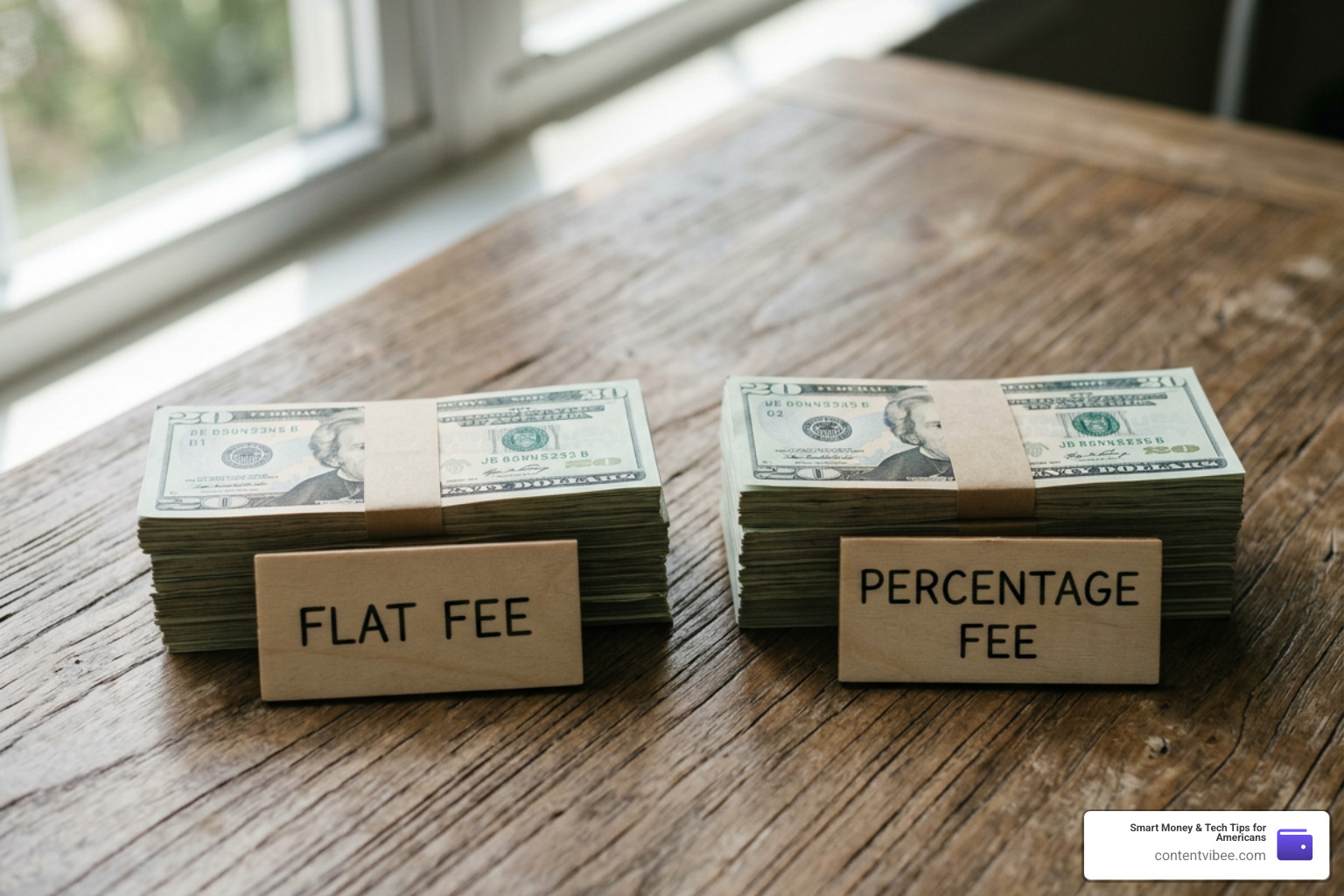
Traditional robo-advisors build diversified portfolios of low-cost ETFs and charge a fee based on a percentage of your Assets Under Management (AUM). The industry standard for a robo-advisor is 0.25% AUM annually.
Let’s look at how the fees stack up when comparing Autopilot to traditional options.
- Traditional Robo-Advisors: If you invest $10,000 with a standard robo-advisor charging 0.25%, you pay $25 per year. On Autopilot, you pay $100 per year for one portfolio. In this scenario, the traditional robo-advisor is significantly cheaper. You can learn more about these structures in our guide to robo advisor fees.
- Large Portfolios: If you have $100,000 to invest, a 0.25% AUM fee equals $250 per year. On Autopilot, you still pay $100 per year (assuming you follow one portfolio). Here, Autopilot becomes the cheaper option.
- Free Alternatives: If you want automated investing without any management fees, there are platforms that offer basic automated rebalancing for free. Check out our list of free robo advisors to see how they compare.
Autopilot is a niche product. While traditional robo-advisors focus on long-term diversification and tax-loss harvesting, Autopilot is built for speculative copy trading.
Frequently Asked Questions About Autopilot Costs
How much does autopilot investing cost for beginners?
For beginners, the absolute minimum cost to start is $500 in capital (the minimum investment required per portfolio) plus the $100 annual subscription fee (or $29 paid quarterly).
Because of the high fee drag on small accounts, we do not recommend beginners start with only the $500 minimum. It is much safer to wait until you have at least $2,000 to allocate so that the subscription fee does not wipe out your gains. Beginners should also stick to highly popular, established trackers like the Pelosi Tracker—which has over $514.6 million currently invested—rather than experimental, high-turnover portfolios that carry extra creator fees.
How much does autopilot investing cost when following multiple portfolios?
If you want to diversify by following multiple traders (known as multi-pilot blending), the costs scale rapidly. Because Autopilot charges per portfolio, following three strategies will cost you $300 per year in base subscription fees. If any of those strategies carry premium creator fees (ranging from $99 to $299/year), your annual bill could easily exceed $500.
Furthermore, you must maintain the $500 minimum investment for each portfolio. To follow three portfolios, you need at least $1,500 in investment capital, which would subject you to a heavy 20% annual fee drag unless you fund the accounts with significantly more cash.
Does Autopilot have a free tier or any discounts?
Yes, Autopilot offers a basic tier, but it is highly limited. Free users do not get automated trade execution; instead, they must manually approve and execute every trade. In practice, because trade notifications can be delayed and manual syncing is often blocked or throttled, the free version is highly impractical for active portfolios.
However, Autopilot does offer promotional partnerships. Their most notable collaboration is with the brokerage Public.com. Under this partnership, Public.com serves as a preferred brokerage partner, and users who link their Public accounts can receive three months of free premium access to Autopilot’s managed portfolios.
Conclusion
Putting your investments on autopilot can save you hundreds of hours of research, but it should never be done blindly. The flat-fee, per-portfolio pricing model of the Autopilot app means it is a premium tool designed for larger accounts. If you have less than $2,000 to invest, the subscription fees will likely eat up your returns, making traditional options or commission-free manual investing a better choice.
At ContentVibee, we specialize in helping Americans navigate the intersection of personal finance, retirement planning, and emerging technology. Whether you are trying to understand complex SECURE Act 2.0 regulations or figuring out if automated trading fits into your retirement strategy, our goal is to provide clear, actionable, and transparent advice.
If you are ready to explore your options, read our guide on the best autopilot investing strategies to find a setup that protects your hard-earned savings while helping your wealth grow.