


Are Fidelity’s Stock Trading Fees Really Zero? Here’s the Quick Answer
Fidelity stock trading fees for standard online U.S. stock and ETF trades are $0. But “free” doesn’t mean no fees exist. There are important exceptions that could cost you — especially if you trade options, certain ETFs, or mutual funds.
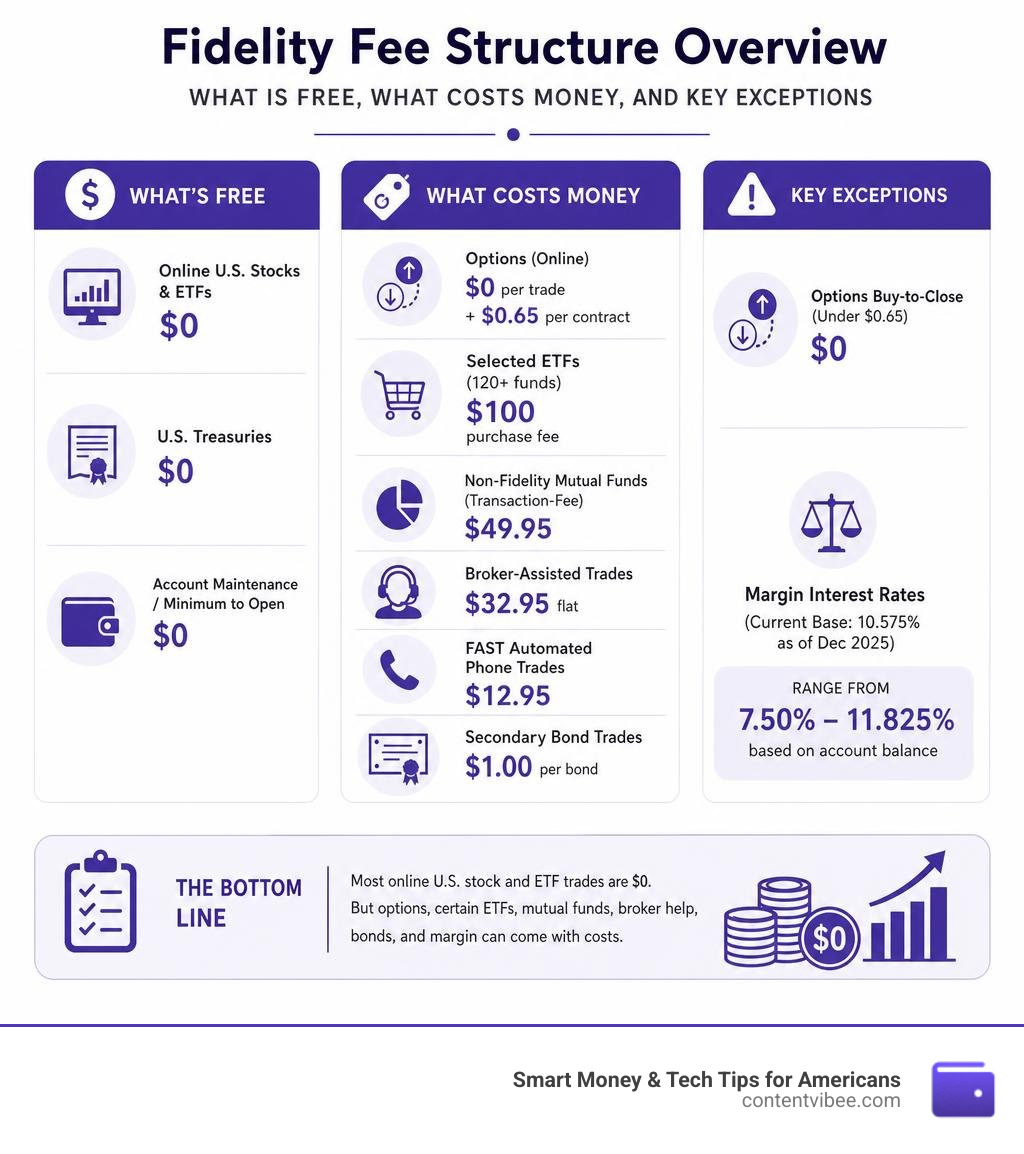
Here is a fast breakdown of what you actually pay at Fidelity in July 2026:
| Trade Type | Cost |
|---|---|
| Online U.S. stocks & ETFs | $0 |
| Options (online) | $0 per trade + $0.65 per contract |
| Options buy-to-close (under $0.65) | $0 |
| Broker-assisted trades | $32.95 flat |
| FAST automated phone trades | $12.95 |
| Selected ETFs (120+ funds) | $100 purchase fee |
| Non-Fidelity mutual funds (transaction-fee) | $49.95 |
| Secondary bond trades | $1.00 per bond |
| U.S. Treasuries (online) | $0 |
| Account maintenance / minimum to open | $0 |
The headline “$0 commissions” is real for most everyday stock and ETF trades. But starting June 1, 2025, Fidelity added a $100 purchase fee on more than 120 ETFs — including popular funds like the Roundhill Magnificent Seven ETF (MAGS), which holds $4.4 billion in assets. That changes the math for some investors significantly.
And if you use margin, rates range from 7.50% (for balances over $1 million) up to 11.825% (for balances under $25,000), based on Fidelity’s current base margin rate of 10.575% set in December 2025.
The bottom line: for buy-and-hold investors trading common stocks and ETFs online, Fidelity is genuinely very low cost. But the full picture is more nuanced.
Demystifying Fidelity Stock Trading Fees: What Is Actually Free?

When we hear the word “free” in the financial world, our inner skeptic immediately starts looking for the catch. It is a healthy habit! For the most part, however, we are happy to report that the core online trading experience at Fidelity is remarkably cost-effective.
By eliminating standard online commissions for retail investors, Fidelity has made it incredibly easy for everyday Americans to build wealth without losing a chunk of their hard-earned cash to transaction costs. But to truly understand how these fidelity stock trading fees function, we have to look at the specific channels you use to place your trades.
To get a complete view of how these policies are structured, you can review the official Trading Commissions and Margin Rates | Fidelity page. Let us break down exactly what you can expect when trading standard assets online.
Standard Fidelity Stock Trading Fees for Online Orders
If you are sitting at your computer or using your smartphone to manage your portfolio, the vast majority of your standard equity transactions will cost you exactly zero dollars.
Specifically, online trades for U.S. stocks and exchange-traded funds (ETFs) carry a $0.00 commission. It does not matter if you are buying one share or ten thousand shares; the base commission remains completely free. This zero-commission model has democratized retail investing, allowing you to execute fractional strategies or dollar-cost average into your favorite companies without worrying about fee friction.
However, we must emphasize that this $0 rate is strictly tied to online self-directed trading. If you step away from your screen and place a trade through other channels, the pricing structure changes dramatically:
- FAST Automated Phone System: If you use Fidelity’s automated touch-tone phone system to place a stock or ETF trade, you will be charged a flat fee of $12.95.
- Broker-Assisted Trades: If you prefer to speak with a living, breathing human representative to execute your trade, you will incur a steep $32.95 fee per transaction.
As you can see, the easiest way to keep your trading costs at zero is to stick entirely to the digital platforms. For a deeper look into how these standard online rates compare to the rest of the industry, check out our guide on Are Fidelity Trades Really Free? Demystifying the Fees.
The Fine Print on Options and Fractional Shares
If you want to venture beyond standard buy-and-hold stock strategies, you need to understand how options and fractional shares are priced.
For options traders, online trades are technically “$0 commission,” but they come with a contract fee. You will pay $0.65 per contract for both buy and sell orders. For example, if you buy 10 options contracts, your fee will be $6.50.
There is, however, a very investor-friendly exception here: buy-to-close orders for low-priced options valued between $0.00 and $0.65 are completely free. This means if you are trying to close out a short options position that has lost most of its value, Fidelity lets you do so without charging that extra contract fee.
What about fractional shares? Fidelity offers a popular feature called “Stocks by the Slice,” which allows you to buy portions of stocks and ETFs for as little as $1.00. This is fantastic for building a diversified portfolio on a budget. The great news is that buying these fractional slices carries $0 in extra fees.
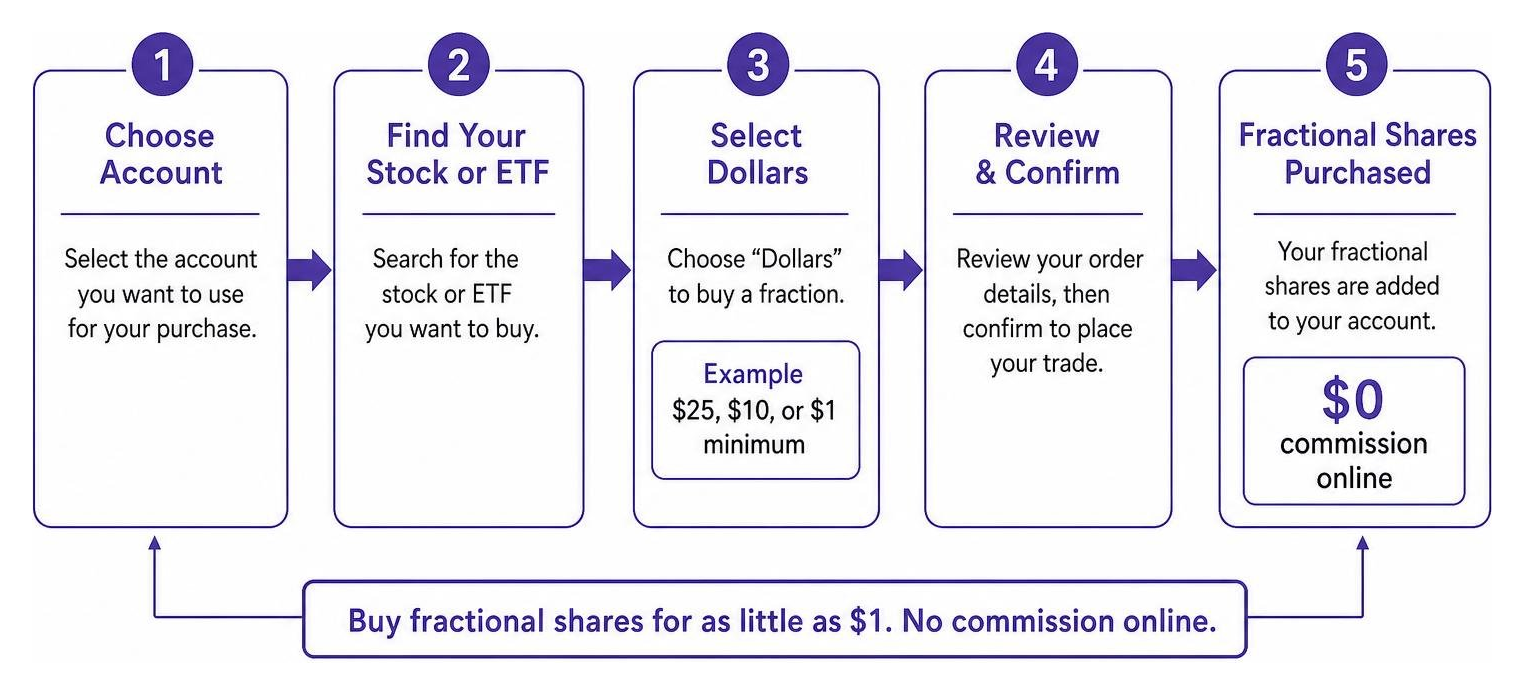
Whether you buy a whole share of a tech giant or just $5 worth of it, you will pay nothing in commissions online. For a more detailed breakdown of how this works, read our analysis on Does Buying Stock Slices Cost Extra? Fidelity Fractional Fees Explained.
The Catch: Recent Fee Changes and ETF Service Charges
While the general rule of thumb is that online stock and ETF trades are free, the landscape shifted recently. Brokerages are constantly balancing their relationships with fund issuers, and sometimes those corporate negotiations impact your wallet.
To stay fully updated on these shifts, it is always a smart idea to consult the official Fidelity Brokerage and Commission Fee Schedule | Trading information document. Let us discuss the most significant recent change that has caught many retail investors off guard.
The New $100 ETF Purchase Fee
Historically, online ETF trades were universally free at Fidelity. However, a major policy change went into effect where Fidelity began charging a $100 purchase service fee on more than 120 specific ETFs.
Why did this happen? Behind the scenes, many ETF issuers pay brokerage platforms asset-based administrative fees to keep their funds available for free trading. When certain ETF issuers declined to pay these platform fees, Fidelity decided to shift the trading costs directly to the retail investor.
This $100 fee applies only to purchase transactions (selling these ETFs remains commission-free online). However, a $100 flat fee on a purchase can be absolutely devastating for smaller accounts. For example, if you wanted to buy a single share of the popular Roundhill Magnificent Seven ETF (MAGS) — which has over $4.4 billion in assets under management — the $100 transaction fee would easily exceed the cost of the share itself!
Other impacted funds include popular thematic products like the Roundhill Generative AI & Technology ETF and the Dan Ives Wedbush AI Revolution ETF. If you plan to trade these specific funds, you may want to look at alternative platforms that do not impose this surcharge, or stick to alternative ETFs that remain completely free. You can find more details on how to navigate these specific transaction charges in our guide on the Fidelity Fee Per Trade.
Mutual Fund Transaction Fees and Short-Term Redemptions
Mutual funds are another area where “free” is highly conditional. Fidelity provides access to more than 10,000 mutual funds, including over 3,700 funds with No Transaction Fees (NTF).
However, if you purchase a mutual fund that is not on their NTF list, you will face a hefty $49.95 transaction fee per purchase. Furthermore, even if you buy a “free” NTF mutual fund, you must be aware of the short-term trading fee.
To discourage rapid trading of mutual funds (which disrupts fund management), Fidelity charges an early redemption fee of $49.95 if you sell shares of an NTF fund that you have held for less than 60 days. If you are planning to trade mutual funds frequently, we highly recommend switching to standard ETFs instead, or ensuring you hold your funds for at least two months to avoid this penalty. For a deeper look at these specific mechanics, check out our article on the Fidelity Mutual Fund Trade Fee: When Is Free Not Actually Free?.
Margin Rates and Account Maintenance Costs
For those who want to use leverage to amplify their trading power, understanding margin rates is absolutely critical. Margin interest is an ongoing cost that can quickly eat into your investment returns if you aren’t careful.
To see the most up-to-date rates directly from the source, you can check the Trading Commissions and Margin Rates – Fidelity Investments page. Below, we have outlined how these tiered interest rates are structured based on your outstanding debit balance.
| Debit Balance Tier | Interest Rate (Effective July 2026) |
|---|---|
| $0 to $24,999 | 11.825% |
| $25,000 to $49,999 | 11.325% |
| $50,000 to $99,999 | 10.375% |
| $100,000 to $249,999 | 10.325% |
| $250,000 to $499,999 | 10.075% |
| $500,000 to $999,999 | 7.750% |
| $1,000,000+ | 7.500% |
Understanding the Tiered Margin Rate Structure
Fidelity uses a tiered margin rate structure that is tied directly to a base rate. As of December 12, 2025, Fidelity’s base margin rate was set at 10.575%, and it remains the benchmark for these calculations in 2026.
As you can see from the table above, the more money you borrow, the lower your interest rate will be. If you are borrowing small amounts (under $25,000), you will face a relatively high rate of 11.825%. On the other hand, institutional-grade traders borrowing over $1 million enjoy a highly competitive rate of 7.50%.
Because margin rates on smaller balances are quite high, we generally advise everyday retail investors to avoid carrying long-term margin balances. The interest charges can easily outpace the average annual return of the stock market. For a comprehensive review of these margin fees and general account costs, check out our Fidelity Brokerage Account Fees Review: What You Need to Know.
How to Avoid Hidden Fidelity Stock Trading Fees
Aside from standard commissions and margin interest, there are a few situational fees that can catch you off guard if you aren’t paying attention.
One such fee is the Additional Assessment fee (often called a regulatory transaction fee). This is a tiny charge ranging from $0.01 to $0.03 per $1,000 of principal that is automatically applied to all stock and ETF sell orders. This fee does not go to Fidelity; rather, it is collected to offset regulatory costs imposed by the SEC and individual Self-Regulatory Organizations (SROs). While it is usually just a few pennies, it is technically a fee you will encounter whenever you liquidate a position.
Other charges to watch out for include:
- Margin Liquidation Fee: If your account falls below the required maintenance margin and Fidelity has to step in to automatically liquidate your positions, you will be hit with a $32.95 fee.
- Foreign Exchange Wire Fees: If you are wire-transferring foreign currencies or trading foreign ordinary stocks that are not DTC-eligible, you could face foreign exchange fees of up to 3% of the transaction value.
To make sure you don’t get hit by unexpected costs when selling assets, take a look at our practical guide, Don’t Get Caught Off Guard by Stock Selling Fees.
Frequently Asked Questions About Fidelity Fees
Is there a fee to open or maintain a Fidelity brokerage account?
No, we are happy to report that there are $0 account service fees and $0 annual maintenance fees for standard retail brokerage accounts. This includes traditional IRAs, Roth IRAs, rollover IRAs, and individual taxable accounts.
Additionally, there is $0 minimum initial investment required to open an account, meaning you can open your portfolio with literally $1 and start buying fractional shares right away. There is also $0 IRA closeout fee, so you won’t be penalized if you ever need to shutter a retirement account.
Does Fidelity charge a fee for transferring an account out?
Unlike many of its major competitors who charge anywhere from $50 to $75 to transfer your assets to another firm, Fidelity charges $0 for outgoing ACAT transfers. This means you can transfer your cash and securities to another brokerage platform completely free of charge, giving you ultimate flexibility and control over where you keep your money.
What is the fee for trading penny stocks on Fidelity?
For investors interested in over-the-counter (OTC) trading and micro-cap equities, Fidelity is actually one of the most affordable options available.
Fidelity charges $0 online commissions for trading OTC penny stocks. However, you must ensure that you place these trades online, as broker-assisted penny stock trades will still trigger the standard $32.95 fee. Also, keep in mind that penny stock trading carries extreme volatility and liquidity risks. For a complete strategy guide on how to safely navigate these micro-cap markets, check out Fidelity Penny Stocks Fees: The Ultimate Guide to OTC Trading.
Conclusion
At Smart Money & Tech Tips for Americans, we believe that minimizing fee friction is one of the most reliable ways to boost your long-term investment returns. Our parent company, ContentVibee, is deeply committed to delivering clear, actionable personal finance guidance — especially when it comes to navigating complex retirement planning topics like the SECURE Act 2.0 and managing your IRA fees.
When we look closely at fidelity stock trading fees, the verdict is clear: for the vast majority of online retail investors, trading stocks and ETFs at Fidelity is indeed completely free. If you stick to online platforms, avoid margin leverage, and double-check your mutual funds and ETFs for specialized transaction surcharges, you can easily run a highly sophisticated portfolio with practically zero fee leakage.
To learn more about how to optimize your retirement accounts and keep your investment costs as low as possible, explore The Ultimate Guide to Fidelity Trading Fees and Savings.