


Why Social Security COLA California Adjustments Matter More Than You Think
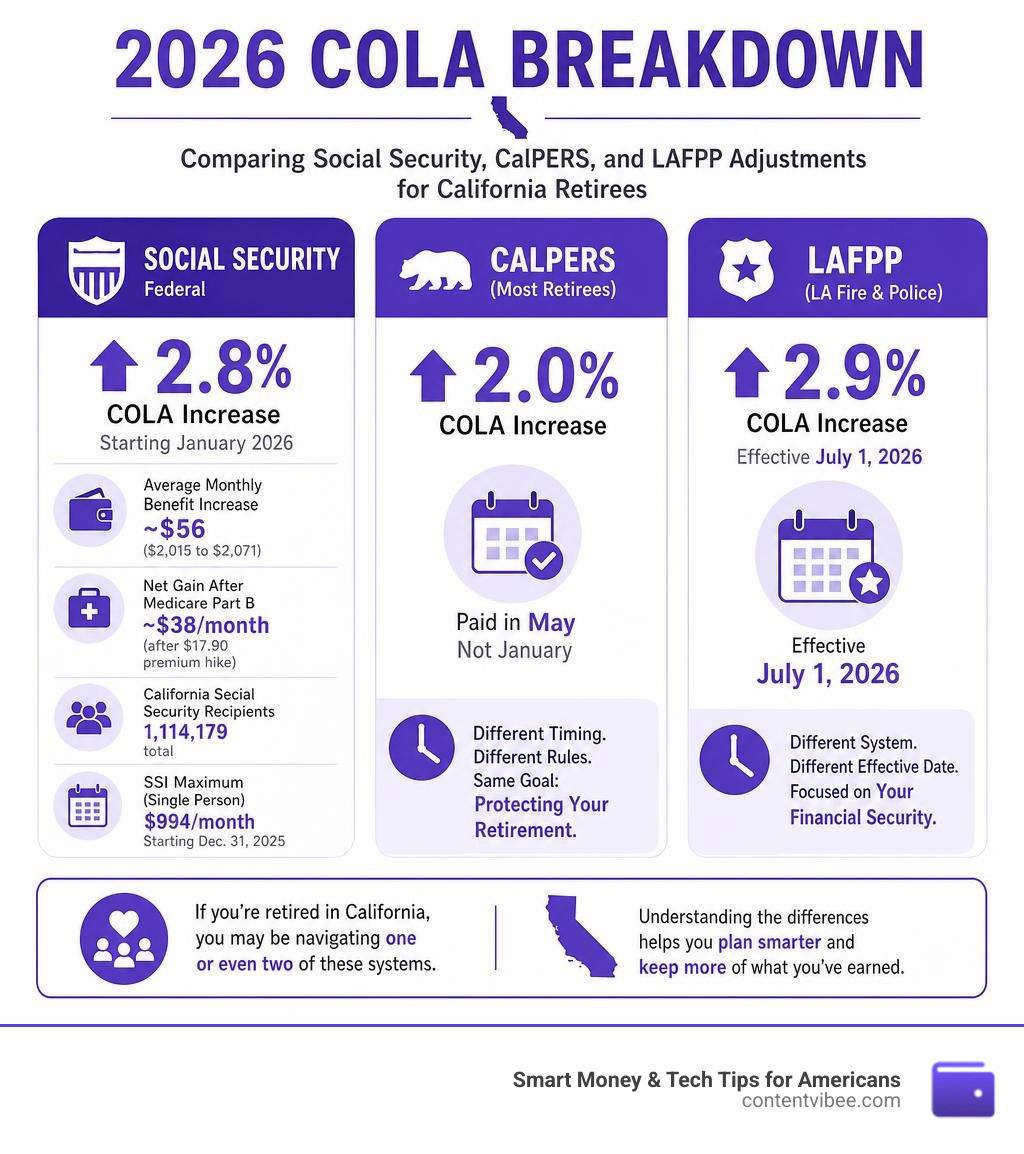
Social Security COLA California adjustments in 2026 bring a 2.8% increase to benefits — but how that plays out depends on which retirement system you’re in. Here’s a quick breakdown:
| Key Factor | 2026 Detail |
|---|---|
| Federal Social Security COLA | 2.8% increase starting January 2026 |
| Average monthly benefit increase | ~$56 (from $2,015 to $2,071) |
| Net gain after Medicare Part B | ~$38/month (after $17.90 premium hike) |
| CalPERS COLA (most retirees) | 2% — paid in May, not January |
| LAFPP COLA (LA Fire & Police) | 2.9% — effective July 1 |
| SSI maximum (single person) | $994/month starting December 31, 2025 |
| California Social Security recipients | 1,114,179 total |
If you’re retired in California, you’re likely navigating at least one of these systems — and possibly two at once.
The 2.8% federal COLA sounds simple. But once you factor in Medicare premiums, CalPERS timing rules, and California’s own pension structures, the picture gets more complex fast.
Nearly one-third of the average COLA increase is eaten up by rising Medicare Part B premiums alone. That $56 monthly bump? It’s closer to $38 in your pocket after premiums.
And if you’re a public employee retired through CalPERS or LAFPP, your COLA follows completely different rules — different timing, different calculations, different caps.
This guide breaks it all down so you know exactly what to expect and how to plan.
Understanding the 2026 Social Security COLA California Adjustments
The federal government announced a 2.8% Cost-of-Living Adjustment (COLA) for 2026, which affects approximately 75 million Americans. Because California is home to one of the largest retiree populations in the nation, these federal adjustments have massive localized ripple effects.
In California alone, there are 1,114,179 Social Security recipients. This group includes 589,962 retirees over the age of 65, 766,642 individuals who are blind or disabled, and 468,593 beneficiaries who receive Supplemental Security Income (SSI). To put the scale of this program in perspective, back in 2024, California Social Security recipients were paid a staggering $9,445,070 in benefits, which included support for 84,072 recipients under the age of 18.
The annual COLA is calculated by the Social Security Administration (SSA) using the Consumer Price Index for Urban Wage Earners and Clerical Workers (CPI-W). The SSA compares the average CPI-W from the third quarter (July, August, and September) of the prior year to the same period of the current year. If there is an increase, that percentage is rounded to the nearest tenth and applied to benefits. To see the official parameters of this year’s adjustment, you can review the 2026 Cost-of-Living Adjustment (COLA) Fact Sheet.
The 2.8% Federal COLA vs. Historical Inflation Trends
The 2026 COLA of 2.8% is a slight step down from recent years, reflecting a gradual cooling of post-pandemic inflation. To give you some historical context, the COLA was:
- 2025: 2.5%
- 2024: 3.2%
- 2023: 8.7% (a historic spike due to rapid inflation)
- 2022: 5.9%
Interestingly, 2026 marks the fifth consecutive year with a COLA at or above 2.5%. This is the longest such streak of consistent, mid-to-high adjustments we have seen since the period of 1988 to 1997. While some analysts point out that trade policies and import tariffs have kept input costs high—creating what some call a “Trump Bump” in the inflation index—the reality for retirees is that everyday expenses like groceries, housing, and utilities in California continue to stretch household budgets.
For a complete history of how these adjustments have shifted over the decades, you can explore the SSA’s official Cost-of-Living Adjustment (COLA) Information page.
How the 2026 COLA Affects Average Monthly Benefits for California Retirees
For the average California retiree, the 2.8% adjustment translates to a monthly increase of approximately $56. This raises the typical monthly retirement check from roughly $2,015 to $2,071 in 2026.
Of course, your actual increase depends entirely on your current benefit level. Here is how the 2.8% increase scales across different monthly benefit amounts:
- $1,500 monthly benefit becomes $1,542 (an extra $42/month or $504/year)
- $1,800 monthly benefit becomes $1,850.40 (an extra $50.40/month or $604.80/year)
- $2,500 monthly benefit becomes $2,570 (an extra $70/month or $840/year)
- $3,000 monthly benefit becomes $3,084 (an extra $84/month or $1,008/year)
While these nominal increases are welcome, we always remind our readers to look at their net income rather than gross numbers. To understand how your baseline benefit is calculated in the first place, check out A Comprehensive Guide to Social Security Benefits.
Comparing California Retirement Systems: CalPERS, LAFPP, and Social Security

Many retired Californians do not rely on Social Security alone. Hundreds of thousands of former public servants, teachers, police officers, and firefighters receive pensions through state and municipal systems. These systems calculate their cost-of-living adjustments using different indexes, schedules, and caps.
| Feature | Social Security | CalPERS | LAFPP (LA Fire & Police) |
|---|---|---|---|
| Effective Month | January | May | July |
| Index Used | CPI-W (National) | CPI-U (National, 1967 base) | CPI (LA-Long Beach-Anaheim) |
| Adjustment Cap | Uncapped (based on inflation) | Typically 2% (some agencies 3-5%) | Tiers 1-2: Uncapped; Tiers 3-6: 3% |
| 2026 Rate | 2.8% | 2.0% (for most) | 2.9% |
| COLA Bank? | No | No | Yes (Tiers 5 and 6 only) |
Key Differences in Social Security COLA California Adjustments and CalPERS Rules
For over 800,000 retired California government workers and school employees, May is the most important month of the year because that is when the California Public Employees’ Retirement System (CalPERS) cost-of-living adjustments are paid out.
Unlike Social Security, which implements its COLA in January, CalPERS adjustments begin the second calendar year after your retirement date and are always reflected in your May 1st check. Furthermore, CalPERS calculates its inflation rate using the Consumer Price Index for All Urban Consumers (CPI-U), utilizing a 1967 baseline.
The biggest distinction lies in the employer-contracted caps:
- The 2% Provision: Approximately 96% of CalPERS retirees are under a contracted 2% annual COLA cap. Even if inflation is much higher, their annual increase is limited to 2%.
- The Lesser of Two Rule: CalPERS applies the lesser of the actual rate of inflation or the contracted percentage. For example, if inflation is 1.8%, you get 1.8%. If inflation is 2.63% (as it was in a recent cycle), you get your capped 2%.
Because these adjustments are compounded and based on your original retirement allowance, older retirees may sometimes see slightly higher adjustments to catch up with historical inflation, but recent retirees will almost always see a flat 2% bump. For more details on how your specific pension tier calculates inflation, you can reference the Cost-of-Living Adjustment (COLA) – CalPERS portal.
How the LAFPP COLA Compares for Los Angeles Pensioners
For retired Los Angeles police officers and firefighters, the Los Angeles Fire and Police Pensions (LAFPP) system operates on yet another schedule. The LAFPP COLA takes effect on July 1st each year and is reflected in the July 31st pension payment.
For 2026, the LAFPP COLA is set at 2.9%. This rate is calculated using the local Consumer Price Index for the Los Angeles-Long Beach-Anaheim area, measured from March through February.
LAFPP applies different rules depending on your pension tier:
- Tiers 1 and 2: These tiers enjoy an uncapped COLA, meaning they receive the full 2.9% adjustment.
- Tiers 3 and 4: These tiers have a strict 3% cap.
- Tiers 5 and 6: These tiers also have a 3% cap, but they feature a “COLA Bank.” If regional inflation exceeds 3% in a given year, the excess percentage is “banked.” In years when inflation falls below 3%, the banked percentage can be drawn out to bring the retiree’s adjustment up to the 3% maximum.
Importantly, LAFPP protects its members against “negative COLA” (deflation). If local prices drop, your pension benefit cannot be reduced below the original amount you received at retirement.
Medicare Part B Premiums and the Net Impact on California Beneficiaries
When federal officials announce a 2.8% COLA, it is easy to assume your monthly take-home income will rise by that full amount. However, for most retirees, Medicare Part B premiums are deducted directly from their Social Security checks.
For 2026, the standard Medicare Part B premium rose by $17.90, bringing the monthly premium to $202.90. Because of this premium hike, the average retiree’s $56 monthly COLA is reduced to a net increase of about $38 per month. This means nearly one-third of your raise is spoken for before it ever hits your bank account.
When planning your retirement timeline, it is critical to account for these healthcare premium deductions. To understand how timing your benefit claim affects your overall lifetime payout, see our guide on the Best Age to Collect SS.
The Hold Harmless Rule and Medicare Premium Offsets
What happens if your individual Social Security COLA increase is smaller than the Medicare Part B premium hike? This is where the federal “Hold Harmless” rule comes into play.
By law, the Medicare Part B premium increase cannot reduce your net monthly Social Security check below what you received in the previous year. If your personal 2.8% COLA only amounts to a $12 monthly increase, Medicare cannot charge you the full $17.90 premium increase. Instead, your premium increase will be capped at $12, ensuring your net benefit check remains exactly the same and does not decrease.
This rule only applies to beneficiaries who have their Medicare premiums deducted directly from their Social Security checks. If you pay your premiums bills manually, or if you are subject to the Income-Related Monthly Adjustment Amount (IRMAA) due to high income, you will not be protected by the hold harmless provision.
Working in Retirement: 2026 Earnings Limits and Taxable Maximums

Many Californians choose to continue working part-time during retirement to supplement their income. If you do, the 2026 COLA adjustments bring changes to both the amount of earnings subject to Social Security taxes and the limits on what you can earn before your benefits are temporarily withheld.
First, the maximum amount of earnings subject to the Social Security payroll tax (the taxable maximum) increases to $184,500 in 2026. Any earned income above this threshold is exempt from the 6.2% Social Security tax.
If you are working while receiving benefits, your earnings may be subject to the Retirement Earnings Test (RET). To learn how working affects other household benefits, read our breakdown: Working in Retirement: Are Spousal Benefits Reduced by Working?.
Navigating Earnings Limits Under Full Retirement Age
If you claim Social Security benefits before reaching your Full Retirement Age (FRA), the SSA imposes strict limits on your earned income:
- Under Full Retirement Age All Year: In 2026, the earnings limit is $24,480. If you earn more than this amount, the SSA will withhold $1 in benefits for every $2 you earn over the limit.
- Reaching Full Retirement Age in 2026: In the year you reach your FRA, the earnings limit rises to $65,160. The SSA will withhold $1 in benefits for every $3 you earn over this limit, but they only count earnings up to the month you actually reach your FRA.
- At Full Retirement Age and Beyond: Once you reach your FRA, there is no earnings limit. You can earn as much as you want without any benefit withholding.
It is vital to report your estimated earnings to the SSA if you are working under FRA. If you fail to do so, you could face an overpayment notice requiring you to pay back withheld benefits. For spouses who are both navigating these rules, check out our guide on whether Do Both Spouses Collect Social Security?.
SSI and Social Security COLA California Adjustments for Low-Income Residents
For low-income seniors and individuals with disabilities, the 2026 COLA also adjusts Supplemental Security Income (SSI) benefits. The maximum federal SSI payment for a single person increases to $994 per month in 2026.
In California, the state adds its own State Supplementary Payment (SSP) on top of the federal maximum. These adjustments are managed administratively through the California Statewide Automated Welfare System (CalSAWS). To implement the 2026 COLA, California run a massive system batch update (which occurred on December 13, 2025) to update benefit amounts for programs like CalWORKs, CalFresh, and SSI.
Because SSI and state supplements are highly sensitive to income, any change in your federal Social Security benefit can trigger a recalculation of your state-level assistance. If you are trying to estimate your combined household benefits, you can use our How Much Social Security Will I Get Calculator.
Frequently Asked Questions about California COLA Adjustments
When do the 2026 COLA payments begin for California retirees?
For SSI recipients in California, the adjusted 2026 payments actually begin on December 31, 2025, because January 1st is a federal holiday. For regular Social Security beneficiaries, the 2.8% increase begins with January 2026 payments, which are distributed on Wednesdays depending on your birth date:
- Born 1st–10th: Paid on January 14, 2026
- Born 11th–20th: Paid on January 21, 2026
- Born 21st–31st: Paid on January 28, 2026
What is the maximum Social Security benefit in 2026?
The maximum monthly Social Security benefit for a worker retiring at Full Retirement Age in 2026 is highly dependent on lifetime earnings, but for those who delay claiming until age 70, the maximum benefit rises to $5,108 per month in 2026. This is significantly higher than the average retiree’s monthly benefit of $2,071.
How do I access my 2026 COLA notice online?
Your personalized COLA notice, which details your exact new monthly benefit and any Medicare premium deductions, was made available in your online my Social Security account starting in late November 2025. Choosing online delivery is highly recommended by the SSA to prevent mail fraud and identity theft.
Conclusion
Navigating Social Security COLA California adjustments requires looking at the entire financial puzzle. Whether you are receiving federal Social Security, a CalPERS pension, or regional benefits like the LAFPP, understanding how these cost-of-living adjustments interact with Medicare premiums and California’s tax structures is crucial for protecting your purchasing power.
At Smart Money & Tech Tips for Americans, we believe that staying proactive about your retirement benefits is the best way to secure your financial future. As we move through 2026, make sure to review your budget, check your online accounts, and adjust your savings strategies accordingly.
For a deeper dive into maximizing your retirement strategy, read A Comprehensive Guide to Social Security Benefits.


