


Why Social Security Strategies for Married Couples Can Make or Break Your Retirement
Social security strategies for married couples are fundamentally different from planning as a single person — and getting them wrong can cost you $150,000 or more in lifetime benefits.
Here’s a quick answer to what most couples need to know:
Top Social Security strategies for married couples:
- 62/70 Split — Lower earner claims at 62, higher earner delays to 70. Best for couples with unequal earnings and good health.
- Both delay to 70 — Maximizes monthly income if both spouses have similar earnings and long life expectancies.
- Higher earner delays, lower earner claims at FRA — Balances current income with long-term survivor protection.
- Both claim early at 62 — Only makes sense when both spouses have serious health issues or shorter life expectancies.
Key rules to know:
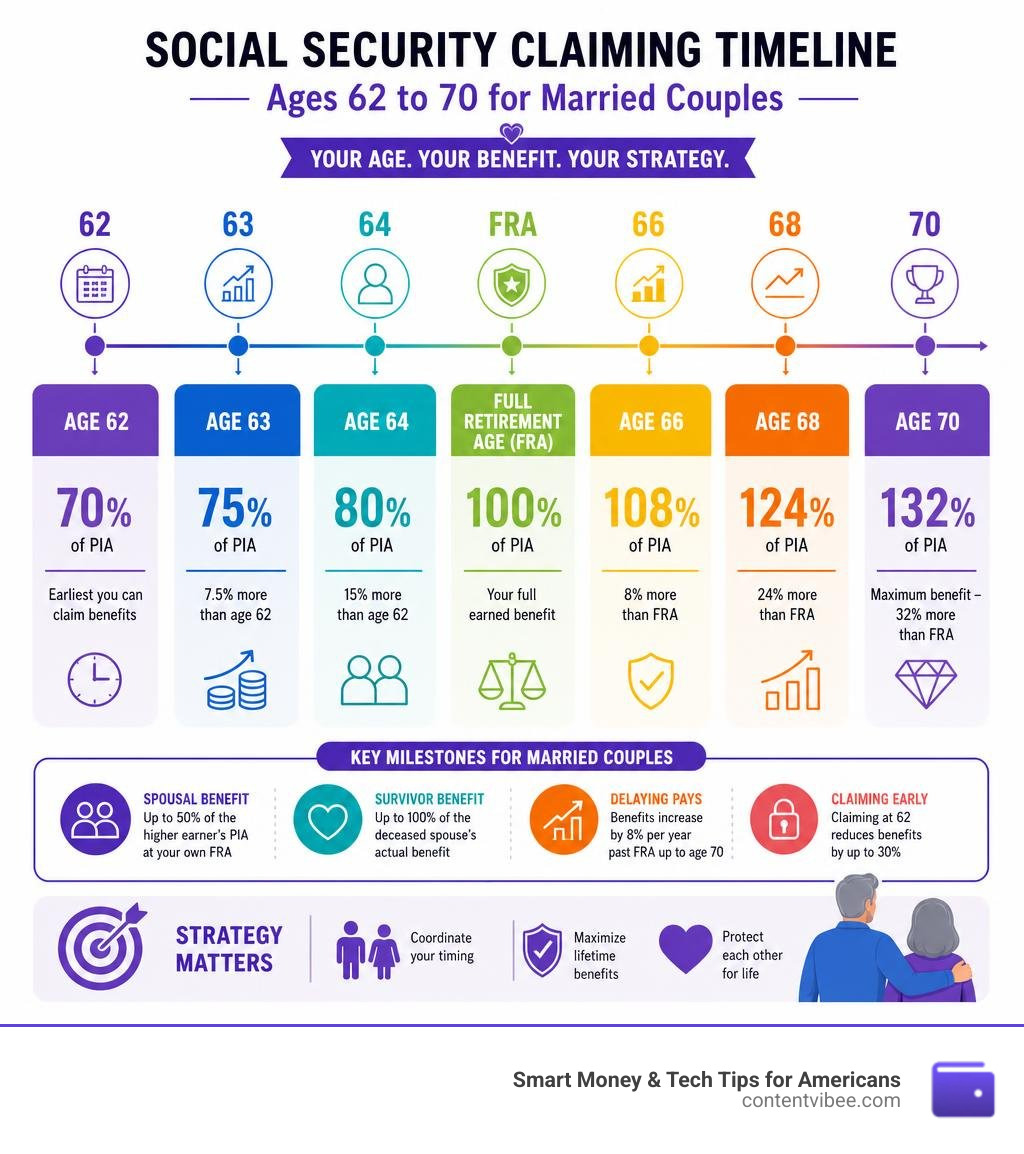
- Spousal benefit = up to 50% of the higher earner’s PIA (Primary Insurance Amount), claimed at your own full retirement age
- Survivor benefit = up to 100% of the deceased spouse’s actual benefit, including any delayed retirement credits
- Delaying past full retirement age increases benefits by 8% per year up to age 70
- Claiming at 62 permanently reduces your benefit by up to 30%
Most couples treat Social Security as two separate decisions. That’s the core mistake.
Because marriage unlocks two powerful benefits singles don’t have — spousal benefits while both partners are alive, and survivor benefits after one passes — the timing choices are deeply intertwined.
The numbers make this clear. A man turning 65 today will live to 87 on average. A woman, to 89. For a couple at 65, at least one spouse will survive to age 93 on average. That’s a long retirement to fund.
And the stakes are high. For the lower-earning spouse, the difference between the highest and lowest possible monthly benefit can exceed 45 to 70 percent, depending on when each spouse claims. Couples can face more than 9,000 possible claiming-age combinations — which sounds overwhelming, but it means there’s real opportunity to optimize.
This guide walks you through every major strategy, rule, and tradeoff so you can make a confident, coordinated decision as a household.
Understanding the Core Social Security Strategies for Married Couples
When we look at retirement planning for couples, we aren’t just looking at two individual timelines. We are looking at a coordinated household income plan. Deciding how to combine your individual earnings histories requires a clear understanding of how the Social Security Administration (SSA) treats married partners.

To build a solid foundation, we must first address a common point of confusion: Can A Married Couple Both Collect Social Security at the same time? The answer is a resounding yes. Both of you can receive monthly checks simultaneously, but how those checks are calculated depends heavily on whether you claim based on your own work record or your spouse’s.
To map out your path, we recommend reviewing the core Social Security Strategies for Married Couples – Vanguard guidelines, which emphasize coordinating your filing dates to build a reliable safety net.
Spousal Benefits: The 50% Rule and Eligibility
The spousal benefit is designed to protect a spouse with lower lifetime earnings (or no formal work history). Under this rule, a husband or wife can receive a benefit worth up to 50% of the higher-earning spouse’s Primary Insurance Amount (PIA).
Your PIA is the monthly amount you are entitled to receive if you claim at exactly your Full Retirement Age (FRA). In 2026, the FRA is 67 for anyone born in 1960 or later.
To understand how this works, let’s look at the basic rules of What Is A Social Security Spousal Benefit:
- The Coordination Rule: The lower-earning spouse cannot claim a spousal benefit until the higher-earning spouse has officially filed for their own retirement benefits.
- The Reduction Rule: If you claim your spousal benefit before reaching your own FRA, the amount is permanently reduced. For example, claiming at age 62 can reduce the spousal benefit to as little as 32.5% of the higher earner’s PIA.
- The Cap Rule: Unlike your own worker benefit, spousal benefits do not earn delayed retirement credits. They do not increase if you wait past your FRA. Therefore, there is zero financial incentive to delay claiming a spousal benefit past age 67.
If you are wondering about the exact timing for your situation, you can read more about At What Age Can I Claim My Spouses Social Security to avoid permanent reduction penalties.
Survivor Benefits: Protecting the Longer-Living Partner
While spousal benefits provide income while both of you are alive, survivor benefits are designed to protect the household after one of you passes away. This is arguably the most critical component of social security strategies for married couples, yet it is often the most overlooked.
When a spouse dies, the surviving partner is entitled to receive up to 100% of the deceased spouse’s actual monthly benefit. At that point, the survivor’s smaller individual benefit disappears, and they transition to the single, larger benefit.
This transition highlights why the higher earner’s claiming age is so vital. If the higher earner delays claiming until age 70, they maximize their own monthly check by earning delayed retirement credits. When they pass away, that maximized monthly benefit is inherited entirely by the surviving spouse.
If you need to calculate these potential amounts, we recommend using resources that help you Calculate Survivor Retirement Benefits to see the long-term impact of your choices. For a deeper look at the administrative steps required during a difficult time, you can also consult our resource, Claiming Whats Yours A Guide To Deceased Spouse Social Security.
Key Factors Influencing Your Joint Claiming Decisions
Before choosing a specific strategy, we need to look at the unique variables that define your household: your health, your age gap, and the mathematical combinations available to you.

For a highly technical analysis of how these variables interact, we can look to the academic research published in The Social Security Claiming Decision for Married Couples | Financial Planning Association. This study highlights that the optimal claiming ages for a couple are highly dependent on the ratio of their respective PIAs and their age differences.
How Age Gaps and Life Expectancy Shape Your Timeline
Many couples make the mistake of planning around the higher earner’s life expectancy alone. In reality, we must plan for the joint life expectancy of the couple.
As mentioned, there is a high probability that at least one member of a 65-year-old couple will live to age 93. If there is a significant age difference—for example, if the higher earner is five to ten years older than the lower earner—the younger spouse is highly likely to spend a decade or more in widowhood.
In these scenarios, maximizing the survivor benefit by having the older, higher-earning spouse delay their claim until age 70 acts as an incredibly efficient longevity insurance policy. It guarantees that the younger spouse will have the largest possible inflation-protected monthly income for the remainder of their life.
To explore how the SSA handles dual-earning households over these long horizons, you can read our guide on how Do Both Spouses Collect Social Security benefits.
Navigating the 9,000+ Claiming-Age Combinations
Because both spouses can choose to claim their benefits at any month between age 62 and 70, the number of potential combinations is staggering:
- For couples where the lower earner is entitled to a spousal benefit only (meaning they have little to no work history), there are 5,917 possible month-of-age claiming combinations.
- For couples where the lower earner is entitled to their own record benefit or is dually entitled (eligible for both their own and a spousal top-up), there are 9,409 possible monthly combinations.
This vast range of options is why a generic “claim at 65” approach rarely works. To narrow down these options, we can use a tool to Calculate Spouse Retirement Benefits to model your exact ages and projected PIAs.
Coordinated Claiming Strategies to Maximize Lifetime Income
To simplify these thousands of options, we can categorize the most effective approaches into four coordinated strategies.
For many households, coordinating these benefits is the single most effective way to boost retirement security. As outlined in Spousal Benefits: An Often Overlooked Key to Maximizing Social …, understanding how to bridge the gap between your retirement date and your claiming date is key to maximizing these payouts.
| Strategy Name | Lower Earner Claiming Age | Higher Earner Claiming Age | Primary Benefit | Best Suited For |
|---|---|---|---|---|
| 62/70 Split Strategy | Age 62 | Age 70 | Provides early household cash flow while maximizing the long-term survivor benefit. | Couples with a large earnings gap and average-to-good health. |
| Both Delay to 70 | Age 70 | Age 70 | Yields the absolute highest monthly household check and maximum lifetime income. | Couples with similar lifetime earnings and excellent health/longevity. |
| Staggered FRA & 70 | Full Retirement Age (67) | Age 70 | Avoids early claiming reductions for the lower earner; fully maximizes survivor benefit. | Couples with a moderate earnings gap wanting to balance income. |
| Both Claim Early | Age 62 | Age 62 | Starts cash flow immediately; avoids waiting periods if funds are urgently needed. | Couples facing serious health challenges or shorter life expectancies. |
Implementing the 62/70 Split: Social Security Strategies for Married Couples with Unequal Earnings
The 62/70 Split is a highly popular strategy for couples with a significant earnings gap.
In this scenario, the lower-earning spouse files for their own retirement benefits early, typically at age 62. This brings immediate income into the household. Meanwhile, the higher-earning spouse delays filing until age 70.
By waiting, the higher earner’s benefit grows by 8% per year past their FRA due to delayed retirement credits. Once the higher earner files at 70, the lower-earning spouse can then transition to a spousal benefit if 50% of the higher earner’s PIA is larger than their own current benefit.
If you are ready to put this strategy into action, you can review the steps for Applying For Spousal Benefits and learn how to officially Claim Spousal Benefits through the SSA.
When Both Spouses Delay to Age 70
If both of you have strong, relatively equal work histories and are in good health, the math changes. The optimal strategy is often for both partners to delay claiming until age 70.
By delaying from age 67 to 70, both of your individual benefits will grow by 24%. In 2026, the maximum monthly benefit for a single person claiming at age 70 is $5,430. For a high-earning couple who both maximize their records, this can result in a combined household benefit of up to $10,860 per month ($130,320 annually).
To see what your individual and combined benefits might look like based on different claiming ages, you can run your numbers through our How Much Social Security Will I Get Calculator.
The Impact of the 2015 Bipartisan Budget Act on Deemed Filing
We must address a major legislative change that eliminated a popular “loophole” couples used to exploit. Before the Bipartisan Budget Act of 2015, a spouse could file a “restricted application” at their FRA to collect only a spousal benefit while letting their own retirement benefit grow delayed until age 70.
Today, this is no longer possible for anyone reaching retirement age. Under the current Filing Rules for Retirement and Spouses Benefits | SSA guidelines, deemed filing applies. This means when you file for either your own retirement benefit or a spousal benefit, you are automatically deemed to be filing for both. The SSA will calculate both amounts and pay you the higher of the two. You cannot strategically choose to receive one while delaying the other.
Special Rules, Entitlement Classes, and the 2026 Landscape
Navigating the Social Security system in 2026 requires keeping up with the latest rules and adjustments. For instance, the Cost-of-Living Adjustment (COLA) for 2026 is set at 2.8%, which helps preserve your purchasing power against inflation.
To stay fully updated on how these yearly changes impact your overall financial plan, we suggest reading A Comprehensive Guide To Social Security Benefits.
Own-Record, Spousal-Only, and Dual Entitlement Classes
When you apply for benefits, the SSA categorizes you into one of three entitlement classes:
- Own-Record Only: Your own lifetime work history yields a higher monthly benefit than any potential spousal benefit.
- Spousal-Only: You have little to no work history and qualify solely based on your spouse’s record.
- Dually Entitled: You have a work history, but your own benefit is less than 50% of your spouse’s PIA. In this case, the SSA pays your own benefit first, then adds a “spousal top-up” to bring your total check up to the spousal benefit level.
To determine which class you fall into and see if you are eligible for an extra top-up, you can read our guide on How To Check Your Eligibility For Spousal Social Security Benefits. You can also estimate your exact spousal top-up using our Tools/Finance Calculator/Social Security Spousal Benefit Calculator.
Divorced Spouses and Remarriage Rules
Divorce does not necessarily mean you lose access to your ex-spouse’s earnings record. If your marriage lasted at least 10 years, you are currently unmarried, and your ex-spouse is eligible for benefits, you can claim a divorced spousal benefit (up to 50% of their PIA).
Crucially, claiming on an ex-spouse’s record has absolutely zero impact on their benefits, nor does it affect their current spouse’s benefits. However, if you remarry, you generally lose the right to claim benefits on your ex-spouse’s record unless your subsequent marriage ends.
For a detailed breakdown of these specific timelines and rules, please consult our Divorced Spouse Social Security Guide 2026.
Working in Retirement: Social Security Strategies for Married Couples and the Earnings Test
If you plan to keep working part-time or consulting after you claim Social Security, you must be aware of the retirement earnings test.
In 2026, if you are under your FRA and earn more than $24,480, the SSA will withhold $1 in benefits for every $2 you earn above that limit. In the year you reach your FRA, the limit rises to $65,160, and the SSA withholds $1 for every $3 earned over the limit.
The good news is that these withheld benefits are not lost forever. Once you reach your FRA, the SSA recalculates your monthly benefit upward to account for the months your benefits were withheld. To see how this affects both partners, read our analysis on Working In Retirement Are Spousal Benefits Reduced By Working.
Frequently Asked Questions About Social Security for Married Couples
Coordinating two retirement timelines naturally brings up practical questions. Here are the answers to the most common questions couples ask.
Can both spouses collect Social Security at the same time?
Yes. If both of you have worked and earned enough credits, you can both collect your own retirement benefits simultaneously. If one spouse has a limited work history, they can collect their spousal benefit while the other collects their worker benefit. For a detailed look at how these dual checks are processed, see our guide on how Both Spouses Collect Social Security.
Does the lower-earning spouse have to wait for the higher earner to claim?
Yes, if the lower-earning spouse wants to receive a spousal benefit. You cannot receive a spousal benefit until your partner has filed for their own retirement benefit. However, the lower-earning spouse does not have to wait to claim their own retirement benefit. They can claim their own worker benefit at age 62 and then switch to the higher spousal benefit later once the higher earner files. To prepare for this process, check out The Ultimate Checklist For Your Application For Spousal Benefits.
What happens to our Social Security benefits if we divorce?
If you divorce after at least 10 years of marriage, you can still claim spousal and survivor benefits based on your ex-spouse’s record, provided you remain unmarried. These benefits are identical to standard spousal benefits and do not reduce the amount your ex-spouse or their new partner receives. To understand your rights and protections, read The Ultimate Guide To Spousal Social Security Eligibility.
Conclusion
At Smart Money & Tech Tips for Americans, we believe that navigating your retirement roadmap shouldn’t feel like a solo mathematical puzzle. By shifting your perspective from two individual decisions to a single, unified household strategy, you can secure tens of thousands of dollars in extra lifetime income and protect your partner from long-term longevity risks.
Whether you choose the 62/70 Split, decide to delay both claims to age 70, or coordinate your filings around a significant age gap, taking action early is key. We highly recommend reviewing The Golden Rules Can A Spouse Collect Ss Spousal Benefits to finalize your plan, align your timelines, and step into retirement with complete financial peace of mind.


