


What Every Divorced Spouse Should Know About Social Security Benefits
Can a divorced spouse collect Social Security benefits based on an ex’s earnings record? Yes — and it’s more common than most people realize.
Here’s the short answer:
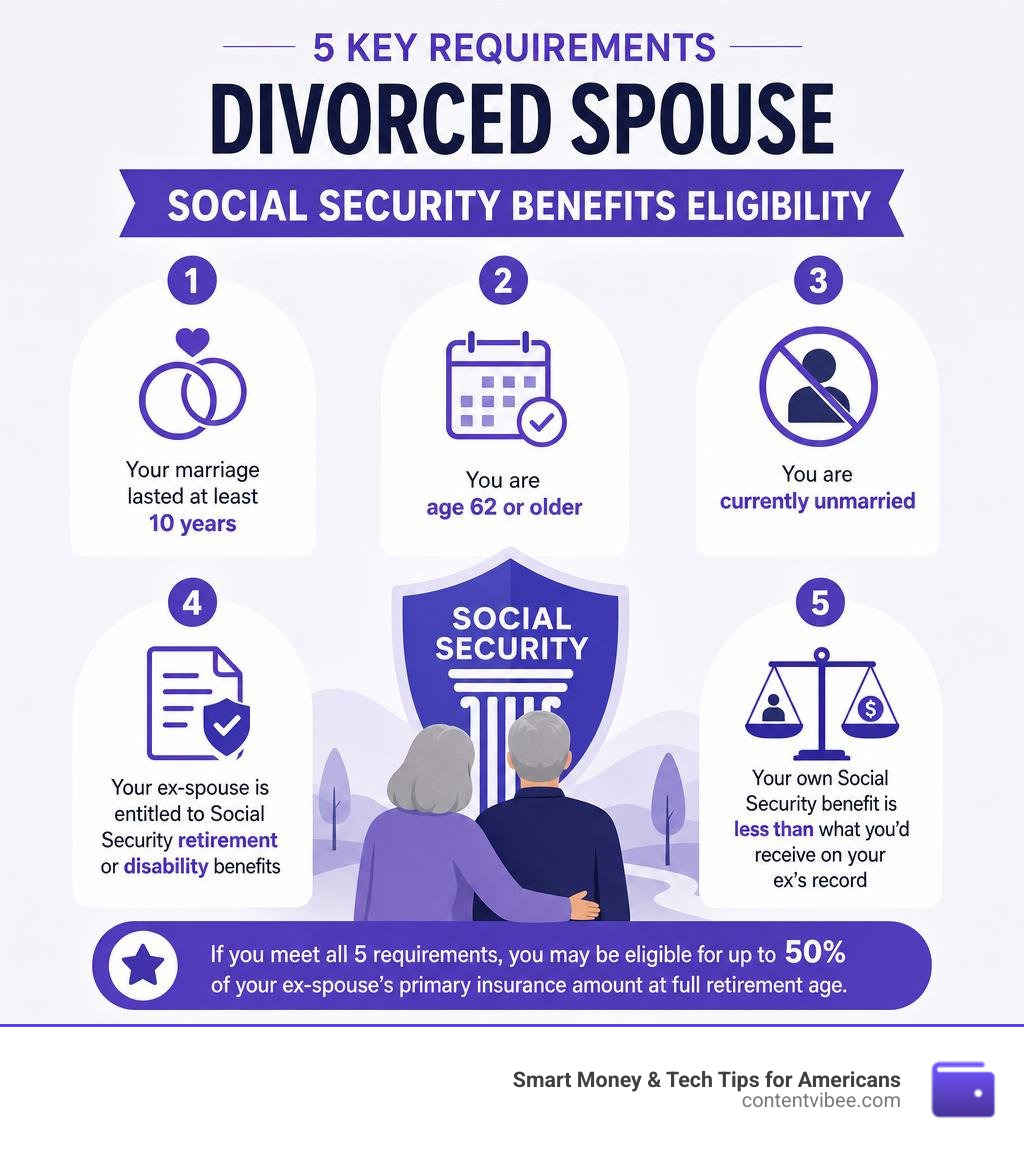
You may qualify for divorced spousal Social Security benefits if you meet all of these conditions:
- Your marriage lasted at least 10 years
- You are age 62 or older
- You are currently unmarried
- Your ex-spouse is entitled to Social Security retirement or disability benefits
- Your own Social Security benefit is less than what you’d receive on your ex’s record
If you meet these requirements, you can receive up to 50% of your ex-spouse’s primary insurance amount at full retirement age — without reducing their benefit or anyone else’s.
This benefit exists whether your ex knows about it, agrees to it, or has already started collecting. It’s your legal right under federal law.
Many divorced Americans — especially those who stepped back from careers during marriage — leave significant money on the table simply because they don’t know these rules exist.
This guide walks you through everything: eligibility, benefit amounts, timing, remarriage rules, survivor benefits, and how to apply.
Can a Divorced Spouse Collect Social Security? The Core Eligibility Rules
Navigating the rules of the Social Security Administration (SSA) can sometimes feel like trying to assemble flat-pack furniture without the instructions. But when it comes to claiming benefits on a former partner’s record, the basic eligibility criteria are actually quite straightforward.
At Smart Money & Tech Tips for Americans, we want to make sure you have the exact roadmap to claim what is rightfully yours. The federal government recognizes that marriage is an economic partnership. Therefore, even if that partnership has dissolved, you may still be entitled to auxiliary benefits based on your ex-spouse’s work history.
To find out where you stand, it is essential to look at the official guidelines outlined in the The Ultimate Guide to Spousal Social Security Eligibility. Additionally, the formal rules are detailed in the SSA’s policy manual under SSA – POMS: RS 00202.005 – Divorced Spouse – 12/24/2014.
To qualify on your ex-spouse’s record, you must meet four core requirements:
- Your marriage to that spouse must have lasted for a continuous decade or more.
- You must currently be unmarried.
- You must be at least 62 years old.
- Your ex-spouse must be entitled to receive Social Security retirement or disability benefits (meaning they have earned at least 40 work credits).
If you meet these criteria, you have a clear pathway to collect. Let’s break down these specific requirements so you can plan your retirement strategy with absolute confidence.
How Marriage Duration Affects Whether Can a Divorced Spouse Collect Social Security
The absolute golden rule of divorced spousal benefits is the 10-year rule. Your marriage must have lasted at least 10 full, continuous years before the divorce was finalized. If your marriage ended at 9 years and 364 days, the SSA will, unfortunately, deny your claim. They are incredibly strict about this timeline.
However, there is a fascinating nuance for those who have walked down the aisle with the same person more than once. Under the SSA’s policy, if you marry, divorce, and then remarry the same person, the years can sometimes be combined. Specifically, if you remarry your ex-spouse no later than the calendar year after the year of the divorce, the SSA treats the marriage as continuous.
For example, if you married in 2010, divorced in 2015, remarried in 2016, and divorced again in 2021, you would meet the 10-year requirement because the gap between the marriages was short enough to keep the chain unbroken. If you are unsure whether your marital timeline qualifies, you can easily find out by reading our walkthrough on How to Check Your Eligibility for Spousal Social Security Benefits.
Age Requirements: When Can a Divorced Spouse Collect Social Security Benefits?
The absolute earliest age you can claim a divorced spousal benefit is 62. However, just because you can claim at 62 doesn’t always mean you should.
Claiming any time before your Full Retirement Age (FRA) will result in a permanent reduction of your monthly payment. As of June 2026, the Full Retirement Age is 67 for anyone born in 1960 or later. If you choose to claim at 62, your benefit will be reduced to roughly 32.5% of your ex-spouse’s primary insurance amount (PIA), rather than the maximum 50% you would receive by waiting until your FRA.
To understand how the clock affects your monthly check, check out our guide on At What Age Can I Claim My Spouses Social Security.
Does Your Ex-Spouse Need to Be Collecting Benefits?
This is one of the most common points of confusion: Does my ex-spouse have to be retired and collecting their check for me to get mine?
The answer is: No, not necessarily.
Under the “independently entitled” rule, if you have been divorced for at least two consecutive years, you can claim benefits on your ex-spouse’s record even if they haven’t filed for their own retirement benefits yet. The only requirements are that your ex-spouse must be at least 62 years old and fully insured (meaning they have worked enough to qualify for retirement benefits).
This is a massive relief for many. It means a cooperative (or uncooperative) ex cannot hold your retirement hostage by delaying their own filing. The official legal parameters for this independence are outlined in SSA – POMS: RS 00202.001 – Definitions and Requirements for Spouse Benefits – 07/24/2017.
Calculating Your Benefit: How Much Can You Receive?
Now, let’s talk numbers. How much cash are we actually talking about?
At your Full Retirement Age, the maximum benefit you can receive as a divorced spouse is 50% of your ex-spouse’s Primary Insurance Amount (PIA). The PIA is the amount your ex-spouse is entitled to receive at their own Full Retirement Age.
For example, if your ex-spouse’s PIA is $3,000 per month, your maximum divorced spousal benefit at your FRA would be $1,500 per month.
It’s important to note that divorced spousal benefits do not earn “delayed retirement credits.” While your own personal retirement benefit increases by 8% for every year you delay claiming past your FRA (up to age 70), a spousal or divorced spousal benefit tops out at your FRA. There is absolutely no financial incentive to wait past age 67 to claim a divorced spousal benefit.
To run the numbers for your specific situation, you can use our Tools Finance Calculator Social Security Spousal Benefit Calculator. For a deeper dive into how the SSA drafts these calculations, you can read the official policy text in SSA – POMS: NL 00711.025 – Wife’s Benefits Paragraphs – 12/22/2003.
The No-Reduction Rule for Ex-Spouses
If you are worried that claiming benefits on your ex-spouse’s record will cause their current family dinner to be a bit more tense, you can breathe a sigh of relief.
Any benefits you receive as a divorced spouse do not reduce the amount your ex-spouse receives. Furthermore, it has absolutely zero impact on the benefits of your ex-spouse’s current husband or wife. The SSA does not divide a single “pie” among everyone; instead, they create a separate auxiliary benefit just for you. Your ex-spouse will never even be notified by the SSA that you have filed on their record.
You can read more about how multiple household members can claim on a single record in our article: Do Both Spouses Collect Social Security.
Government Offsets: WEP and GPO
If you worked in a public service job—such as a teacher, police officer, or firefighter—where you earned a pension and did not pay Social Security taxes, your divorced spousal benefit might be subject to government offsets.
- The Government Pension Offset (GPO): If you receive a pension from a government job where you did not pay Social Security taxes, your divorced spousal benefit will be reduced by two-thirds of the amount of your government pension. In many cases, this can reduce your spousal benefit to zero.
- The Windfall Elimination Provision (WEP): This affects your own retirement benefit calculation if you have a pension from non-covered work, which can indirectly alter the balance when comparing your own record to your ex’s.
Understanding how work and pensions interact with your retirement is crucial. To find out more about how employment affects your benefits, read Working in Retirement Are Spousal Benefits Reduced by Working.
The Impact of Remarriage and Dual Entitlement
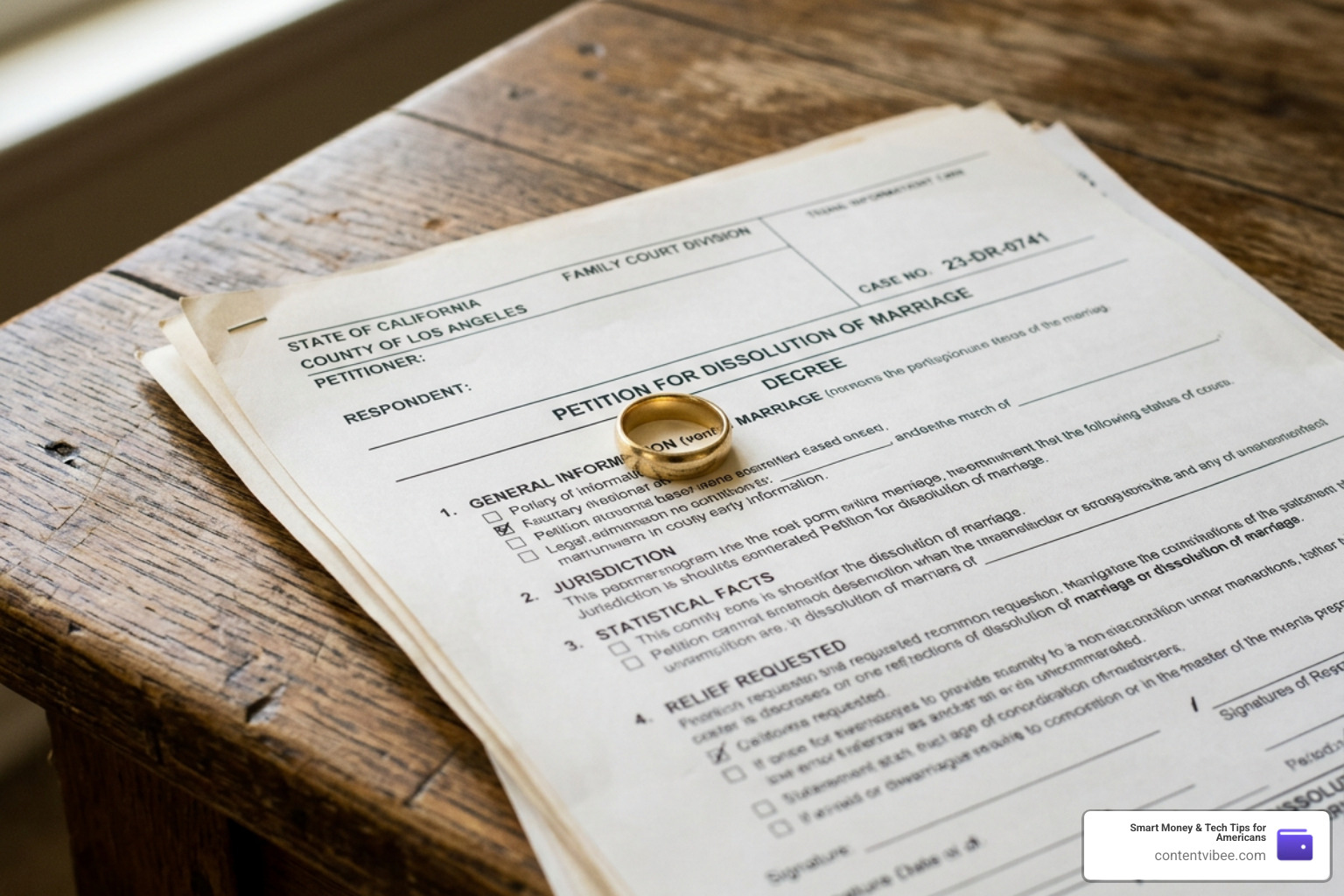
Life doesn’t stop after divorce. Many people go on to find love again, which is wonderful! However, from a financial standpoint, walking down the aisle a second (or third) time can dramatically alter your Social Security options.
Before making any major lifestyle changes, it’s vital to review The Golden Rules Can a Spouse Collect SS Spousal Benefits and understand the termination events outlined in SSA – POMS: RS 00202.040 – Spouse’s Benefits – Termination Events – 08/25/2023.
What Happens If You Remarry?
If you remarry, you generally lose the right to collect divorced spousal benefits on your ex-spouse’s record.
The moment you say “I do” to someone else, your eligibility based on your previous ex-spouse’s record terminates. You cannot collect on your first ex-spouse’s record while you are currently married to someone else.
However, if your subsequent marriage ends—either due to divorce, annulment, or the death of your new spouse—your eligibility to claim on your first ex-spouse’s record can be restored, provided you still meet all the other requirements (like the 10-year marriage duration).
If you are curious about how a new marriage allows you to build spousal benefits with your current partner, take a look at our analysis: Can a Married Couple Both Collect Social Security.
Dual Entitlement: Your Work Record vs. Your Ex’s Record
If you worked and paid into Social Security yourself, you are subject to what the SSA calls deemed filing.
When you apply for benefits, the SSA will automatically look at both your own work record and your ex-spouse’s record. You cannot choose to collect only the spousal benefit and let your own retirement benefit grow. Instead, the SSA will pay you your own benefit first. If your divorced spousal benefit is higher than your own, they will add a “top-off” to make up the difference, ensuring you get the higher of the two amounts.
Essentially, you receive the larger of the two benefit amounts, not both combined. For a detailed breakdown of how the SSA handles individuals with dual eligibility, check out our guide: Both Spouses Collect Social Security.
Divorced Spouse Benefits vs. Survivor Benefits
If your ex-spouse passes away, your financial relationship with the SSA changes. You transition from claiming “divorced spousal benefits” to “surviving divorced spouse benefits.”
This transition is highly beneficial because survivor benefits are much more generous than living spousal benefits. While a living spousal benefit maxes out at 50% of the worker’s PIA, a surviving divorced spouse can receive up to 100% of the deceased ex-spouse’s benefit.
The table below outlines the key differences between the two benefit types:
| Feature | Divorced Spousal Benefit (Ex-Spouse Living) | Surviving Divorced Spouse Benefit (Ex-Spouse Deceased) |
|---|---|---|
| Maximum Benefit | Up to 50% of ex-spouse’s PIA | Up to 100% of ex-spouse’s actual benefit |
| Earliest Claiming Age | Age 62 | Age 60 (or age 50 if disabled) |
| Remarriage Rule | Disqualifies you if you remarry | Does not disqualify you if you remarry after age 60 |
| Marriage Duration | Must have lasted 10+ years | Must have lasted 10+ years (exceptions for caring for ex’s child) |
To learn how to transition to a survivor benefit or claim on a deceased ex’s record, see Claiming Whats Yours A Guide to Deceased Spouse Social Security. The rigid administrative proofs required to establish survivor claims are mapped out in SSA – POMS: RS 00207.004 – Widow(er)’s Benefits – Table of Proofs and Development – Policy – 08/08/2011.
Survivor Benefit Amounts and Age Rules
As a surviving divorced spouse, you are entitled to between 71.5% (if you claim at age 60) and 100% (if you wait until your Full Retirement Age) of what your ex-spouse was receiving.
One of the most valuable rules for survivors is the remarriage exception. If you remarry before age 60, you cannot collect survivor benefits on your deceased ex-spouse’s record (unless that marriage ends). However, if you wait to remarry until after age 60 (or age 50 if you are disabled), your remarriage will not affect your eligibility for surviving divorced spouse benefits.
For more essential details on how women can navigate these complex rules, you can review the official document [PDF] 5 Things Every Woman Should Know About Social Security.
How to Apply: Required Documents and Process

Ready to claim your benefits? You can apply online via the SSA website, call their national toll-free number at 1-800-772-1213, or make an appointment at your local Social Security office.
To ensure your application goes smoothly, we highly recommend utilizing The Ultimate Checklist for Your Application for Spousal Benefits. For a comprehensive legal overview of the application process, refer to the Social Security Benefits for Divorced Spouses – People’s Law Library.
Document Checklist for Your Application
The SSA will require original documents or certified copies—they do not accept photocopies for most vital records. Here is what you need to gather:
- Your birth certificate (to prove your age)
- Proof of U.S. citizenship or lawful alien status (if you were not born in the U.S.)
- Your marriage certificate (to prove you were married to the worker)
- Your final divorce decree (to prove the marriage lasted at least 10 years and is legally dissolved)
- Your ex-spouse’s Social Security number (if you don’t have this, the SSA can look it up using their name, date of birth, and parents’ names)
- Your W-2 forms or self-employment tax returns from the previous year
- Your bank account details (for direct deposit of your monthly checks)
Do not delay applying just because you are missing some of these documents. The SSA is often able to help you obtain them. For more details on preparing your financial portfolio for this step, read the Understanding Social Security Benefits After Divorce – Hartford Funds.
Frequently Asked Questions about Divorced Spousal Benefits
Can my ex-spouse block me from claiming benefits on their record?
No. Your ex-spouse has absolutely no say in whether you claim benefits on their record, and they cannot block you. The transaction is entirely between you and the Social Security Administration. In fact, due to federal privacy laws, the SSA will not even notify your ex-spouse that you have filed a claim on their work history.
What if my ex-spouse has multiple divorced spouses?
If your ex-spouse was married multiple times, and each marriage lasted at least 10 years, every single one of those ex-spouses can independently claim benefits on their record. There is no limit to the number of ex-spouses who can claim, and none of their claims will reduce the benefits of the others or the ex-spouse’s own retirement check.
Can a divorce decree waive my right to Social Security benefits?
No. Even if your divorce attorney drafted a clause in your divorce decree stating that you waive all rights to your ex-spouse’s Social Security benefits, that clause is completely unenforceable. Social Security is a federal statutory right governed by federal law, and private legal agreements or state court judges cannot override federal statutes.
Conclusion
At Smart Money & Tech Tips for Americans, we believe that thorough retirement planning is the key to financial empowerment. Understanding your rights as a divorced spouse ensures you don’t leave vital retirement funds on the table.
Whether you are planning to claim soon or are just mapping out your long-term retirement strategy, knowing how to leverage your ex-spouse’s work record can make a massive difference in your financial security. For a complete look at how to optimize your retirement benefits, make sure to read The Ultimate Guide to Spousal Social Security Eligibility.


