


What You Need to Know Before Applying for Spousal Benefits
Applying for spousal benefits is one of the most valuable — and most misunderstood — moves a couple can make when planning for retirement.
Here’s a quick answer if you’re ready to act now:
How to apply for Social Security spousal benefits:
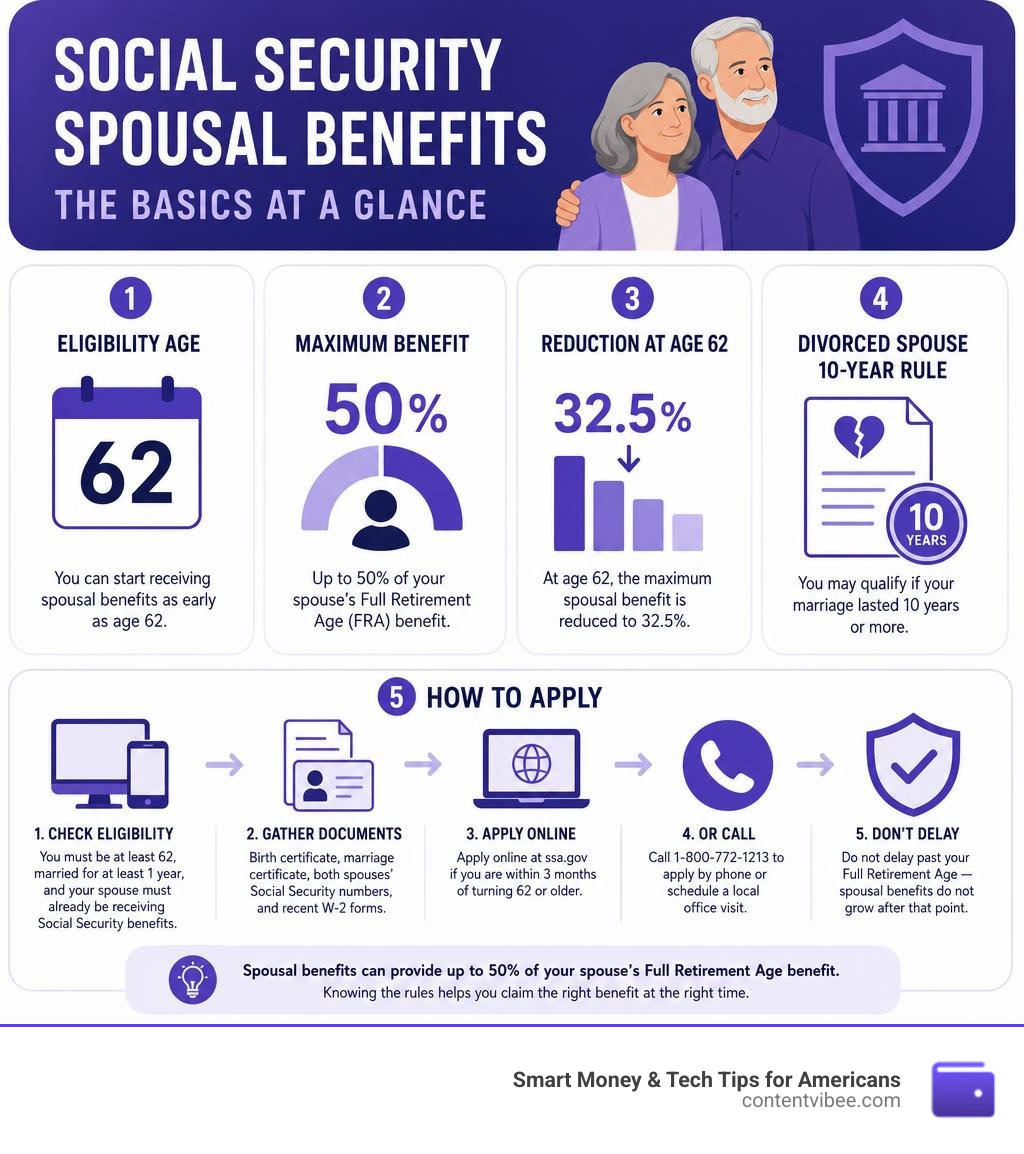
- Check eligibility — You must be at least 62, married for at least 1 year, and your spouse must already be receiving Social Security benefits.
- Gather documents — Birth certificate, marriage certificate, both spouses’ Social Security numbers, and recent W-2 forms.
- Apply online at ssa.gov if you are within 3 months of turning 62 or older.
- Or call 1-800-772-1213 to apply by phone or schedule a local office visit.
- Do not delay past your full retirement age — spousal benefits do not grow after that point.
Millions of Americans leave money on the table simply because they don’t know how spousal benefits work. The benefit can be worth up to 50% of your spouse’s full retirement age benefit — that’s a significant boost to household income, especially if one partner has little or no work history of their own.
But the rules around timing, eligibility, and how your own retirement benefit interacts with a spousal benefit can get complicated fast. Claim too early and your benefit is permanently reduced. Wait too long past full retirement age and you’ve gained nothing extra.
This guide walks you through everything — who qualifies, how much you can expect, and exactly how to file.
Understanding Spousal Benefit Eligibility Rules
Before we dive into the application process, we must look at the foundational rules. The Social Security Administration (SSA) has strict criteria for who qualifies for a spousal benefit. If you do not meet these baselines, your application will be rejected before it even gets off the ground.
To qualify for a spousal benefit under normal circumstances, you must meet the following three conditions:
- Age: You must be at least 62 years old, unless you qualify under the child-in-care exception.
- Marriage Duration: You must generally be married to the worker for at least one continuous year before applying.
- The Worker’s Status: Your spouse must already be receiving their own retirement or disability benefits for you to collect on their record.
The child-in-care rule is a major exception to the age requirement. If you are caring for a child who is under age 16 or disabled, and that child is entitled to benefits on your spouse’s record, you can claim spousal benefits at any age. Furthermore, these child-in-care spousal benefits are not reduced for early claiming.
Navigating these initial barriers is crucial, and we have compiled deep-dive details in The Ultimate Guide to Spousal Social Security Eligibility to help you evaluate your household’s standing.
Who Qualifies When Applying for Spousal Benefits?
The SSA defines a “spouse” using specific legal terms. Under the law, a claimant can qualify as a legal spouse or a “deemed” spouse.
- Legal Spouse: A legal spouse is someone validly married to the worker under the laws of the state where the worker lives (domiciled) at the time of application. For instance, here in California, we look at California state law to determine the validity of the marriage.
- Deemed Spouse: Under the SSA – POMS: RS 00202.001 – Definitions and Requirements for Spouse Benefits – 07/24/2017, a deemed spouse is someone who entered into a marriage ceremony in good faith, believing it was legal, only for a legal impediment (such as an administrative error or an undissolved prior marriage of the partner) to make the marriage technically invalid. The SSA can “deem” this marriage valid for benefit purposes so the innocent spouse is not penalized.
Additionally, the one-year marriage requirement has some nuances. If your first anniversary occurs while your application is being processed (before the final decision or “adjudication” is completed), the SSA can count the requirement as met.
Timing your claim around these rules is essential to avoid permanent payment reductions. If you are wondering about the perfect moment to pull the trigger, check out our guide on At What Age Can I Claim My Spouse’s Social Security.
Same-Sex Marriages and Non-Marital Legal Relationships
The SSA recognizes same-sex marriages and certain non-marital legal relationships (NMLRs) when determining eligibility for spousal benefits. According to the SSA – POMS: GN 00210.100 – Same-Sex Relationships – Spouse’s Benefits – 09/29/2016, the federal government determines marital status based on the laws of the state where the worker is domiciled.
If you are in a same-sex marriage or a registered domestic partnership that grants inheritance rights equivalent to a spouse under state law (as is the case here in California), you are eligible to apply for spousal benefits.
Importantly, the SSA calculates the duration of your marriage from the actual date of your legal ceremony or the establishment of your NMLR, not from the dates of historical Supreme Court rulings. If you have been legally married or in a recognized NMLR for at least one year, you meet the duration requirement.
How Spousal Benefits Are Calculated
Calculating your potential spousal benefit is relatively straightforward, but it relies entirely on your partner’s Primary Insurance Amount (PIA). The PIA is the monthly benefit your spouse is eligible to receive at their Full Retirement Age (FRA).
At your own Full Retirement Age, your maximum spousal benefit is exactly 50% of your partner’s FRA benefit amount.
An important detail to remember: your spousal benefit is capped at 50% of their FRA amount even if your spouse delays claiming past their own FRA to earn delayed retirement credits. While your spouse’s personal benefit grows by 8% per year for every year they delay claiming up to age 70, your spousal benefit does not share in this growth.
To see how these numbers look for your specific household, you can read the official guidelines on Benefits for Spouses – Social Security Administration or run your own numbers directly using our Tools: Finance Calculator: Social Security Spousal Benefit Calculator.
The Cost of Claiming Early vs. Waiting for Full Retirement Age
If you decide to start applying for spousal benefits before you reach your own Full Retirement Age, your monthly check will be permanently reduced. The reduction is calculated based on how many months before your FRA you begin receiving payments.
For example, if your FRA is 67 (which is the case for anyone born in 1960 or later) and you claim at age 62, your spousal benefit is reduced to 32.5% of your partner’s FRA benefit. This is a permanent reduction that remains in place for the rest of your life.
| Claiming Age | Percentage of Spouse’s FRA Benefit (If your FRA is 67) | Example Monthly Payment (If Spouse’s FRA Benefit is $2,000) |
|---|---|---|
| 67 (Full Retirement Age) | 50.0% | $1,000 |
| 66 | 45.8% | $916 |
| 65 | 41.7% | $834 |
| 64 | 37.5% | $750 |
| 63 | 35.0% | $700 |
| 62 (Minimum Age) | 32.5% | $650 |
Choosing when to file is a delicate balance. Claiming early gets money into your bank account sooner, but waiting until your FRA guarantees the maximum possible monthly cash flow. We discuss these trade-offs in depth in The Golden Rules: Can a Spouse Collect SS Spousal Benefits.
Dual Eligibility and the Deemed Filing Rule
What happens if you have worked and paid into Social Security yourself, making you eligible for both your own retirement benefit and a spousal benefit?
Under the SSA’s deemed filing rules, you cannot choose to claim only your spousal benefit while letting your own retirement benefit grow. When you apply for either benefit, you are “deemed” to have applied for both. The SSA will calculate both amounts and pay you a total sum equal to the higher of the two benefits.
Technically, the SSA pays your own retirement benefit first. If your spousal benefit is higher than your own retirement benefit, they will add a “top-off” amount to your check to bring the total up to the spousal benefit level.
For example, let’s say your own retirement benefit at FRA is $1,000, and your spouse’s FRA benefit is $2,400 (making your maximum spousal benefit $1,200).
- The SSA first awards you your own $1,000 benefit.
- Because the spousal benefit of $1,200 is higher, they add a $200 spousal top-off.
- Your total monthly payment is $1,200.
This ensures you always get the largest amount you are legally entitled to. For more scenarios on how this works for working couples, read Can a Married Couple Both Collect Social Security and Do Both Spouses Collect Social Security.
Divorced Spouses vs. Current Spouses: Key Differences
If you are divorced, you may still be eligible to claim spousal benefits on your ex-spouse’s record. However, the rules for divorced spouses differ from those for currently married couples in several key ways.
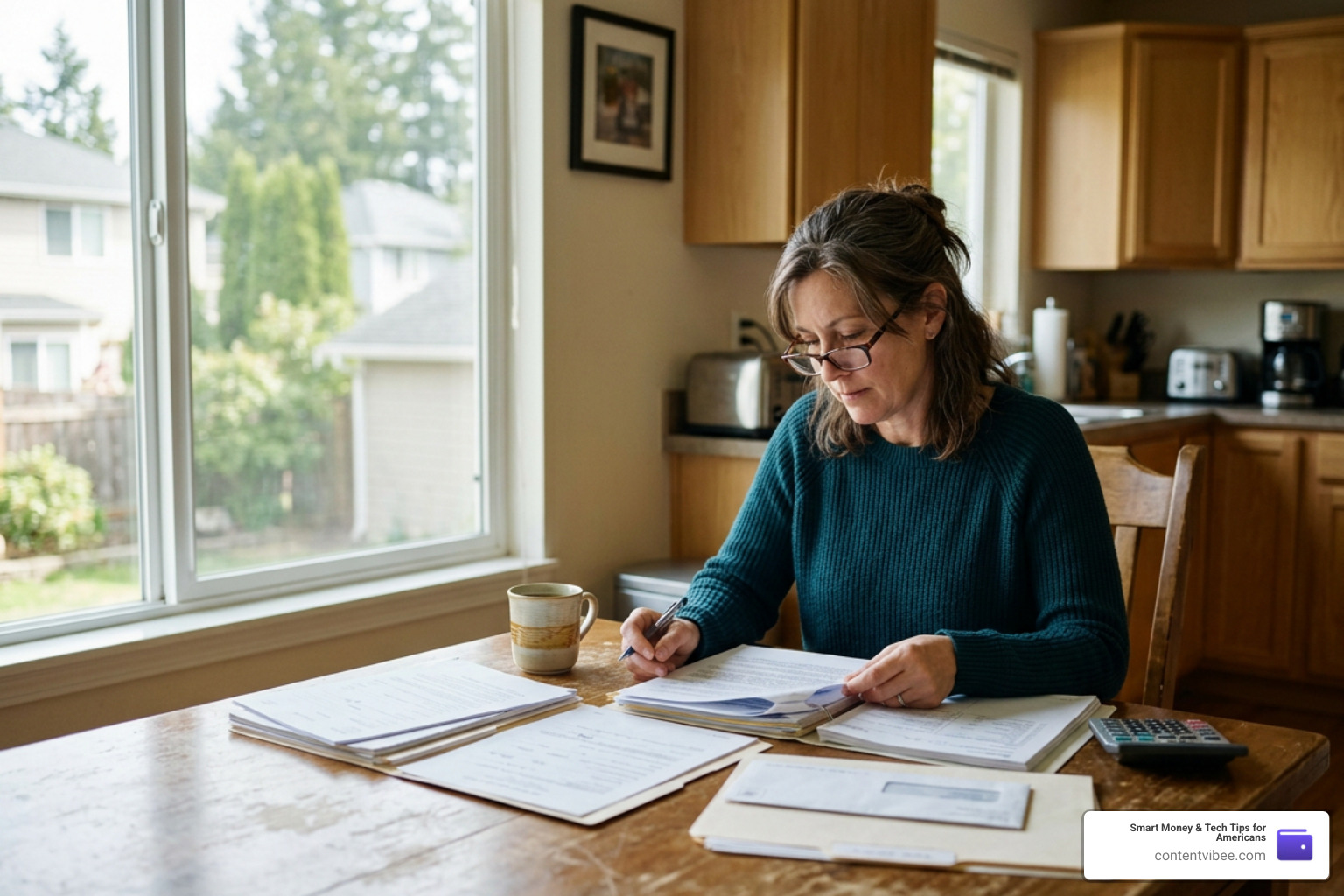
To qualify on an ex-spouse’s record, you must meet these requirements:
- Marriage Duration: Your marriage to your ex-spouse must have lasted for at least 10 consecutive years.
- Marital Status: You must currently be unmarried. If you remarry, you lose eligibility for benefits on your ex-spouse’s record (unless your subsequent marriage ends by death, divorce, or annulment).
- Age: You must be at least 62 years old.
- The “Two-Year” Rule: Unlike current spouses, who must wait for their partner to actively claim benefits, a divorced spouse can claim benefits even if the ex-spouse has not yet filed. However, the divorce must have been finalized for at least two continuous years before you can claim on their record if they haven’t filed yet.
One of the most common worries is whether claiming on an ex-spouse’s record will impact their payments or alert them. Rest assured, your ex-spouse will not be notified by the SSA, and your claim will have absolutely no impact on their monthly benefit or the benefits of their current spouse.
If you are divorced and want to see if this is your best retirement path, we recommend reading How to Check Your Eligibility for Spousal Social Security Benefits.
Modern Claiming Strategies and Policy Changes
The landscape of Social Security claiming strategies changed dramatically following the Bipartisan Budget Act of 2015. Prior to this, couples could use advanced strategies like “file-and-suspend” or “restricted applications” to maximize their lifetime payouts.
- File-and-Suspend: This allowed one spouse to file for retirement benefits and immediately suspend them (allowing their own benefit to earn delayed retirement credits), which unlocked the ability for the other spouse to claim spousal benefits. This strategy has been completely eliminated.
- Restricted Applications: This strategy allowed a spouse at Full Retirement Age to file a “restricted application” for spousal benefits only, while letting their own retirement benefit grow by 8% per year up to age 70.
Today, restricted applications are a thing of the past for almost everyone. The option was phased out based on birth dates, meaning anyone reaching retirement age today in 2026 is subject to the deemed filing rules. When you apply, you get the higher of the two benefits, and you cannot choose to delay your own while collecting spousal payments.
Understanding these modern rules helps prevent costly planning mistakes. You can read more about how these policy changes affect modern retirement planning in Social Security Spousal Benefits: Who Qualifies and How Much?.
Step-by-Step Guide to Applying for Spousal Benefits
Now that you know the rules and calculations, let’s look at the actual step-by-step process of applying for spousal benefits.
You can submit your application up to four months before you want your benefits to start. The SSA recommends applying at least three months in advance to ensure your payments begin on time.
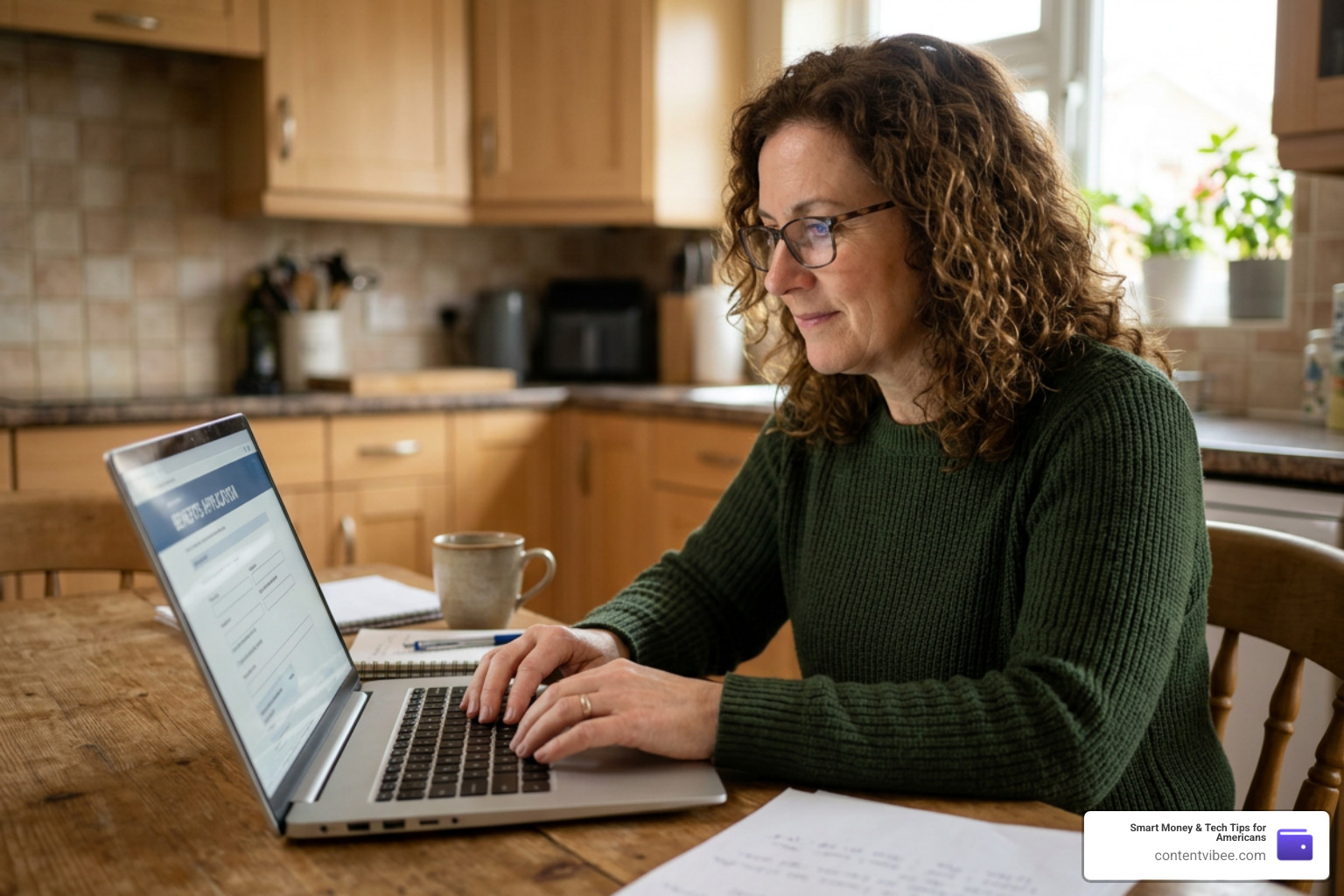
Here is how to apply:
- Decide on your application method:
- Online: This is the fastest and most convenient method. You can apply online if you are within 3 months of turning 62 or older.
- Phone: Call the national toll-free number at 1-800-772-1213 (TTY 1-800-325-0778) to speak with an SSA representative or schedule an appointment.
- In Person: Visit your local California Social Security office. We highly recommend calling ahead to schedule an appointment to avoid hours of waiting in line.
- Review your eligibility: Make sure your spouse is already receiving benefits (or that you meet the divorced spouse exception) and that you have met the marriage duration requirement.
- Gather your documentation: See the checklist in the next section so you have everything ready before you start the process.
- Complete the application: Answer all questions honestly and thoroughly.
- Submit and save: Always print or save your application confirmation page for your personal records.
For official guidance on preparing your application, check out Do You Qualify for Social Security Spouse’s Benefits? | Social Security Matters | SSA.
Required Documents for Applying for Spousal Benefits
When applying for spousal benefits, you must back up your claims with official paperwork. While the SSA accepts photocopies of W-2 forms and self-employment tax returns, they require original documents or certified copies for almost everything else.
According to the official Form SSA-2 | Information You Need to Apply for Spouse’s or … checklist and the SSA – POMS: RS 00202.050 – Spouse’s Benefits – Evidence and Forms Requirements – 02/16/2006 guidelines, you should gather the following documents:
- Proof of Age: Your original birth certificate.
- Proof of Marriage: Your original marriage certificate.
- Proof of Divorce: Your final divorce decree (if you are applying as a divorced spouse).
- Proof of Citizenship or Legal Residency: U.S. birth certificate, naturalization certificate, or alien registration documents.
- Tax Records: Your most recent W-2 forms or self-employment tax returns.
- Military Discharge Papers: Form DD-214 if you had military service prior to 1968.
- Bank Details: Your routing and account numbers to set up direct deposit.
Pro-tip: Do not delay filing your application just because you are missing some of these documents! The SSA will help you obtain the necessary records, and securing your filing date is the most important step to avoid losing back payments.
Troubleshooting Online Application Blocks
While applying online is usually seamless, many applicants hit an unexpected roadblock. If you are already receiving your own retirement benefits and try to log into your my Social Security account to apply for a higher spousal benefit, the online system may block your application.
This is a common system design limitation. The online portal is optimized for first-time applicants. If you are already in the system receiving retirement checks, the software often cannot process the transition to a spousal top-off online.
If you experience an online application block:
- Do not panic: This is a standard system limitation, not a denial of your benefits.
- Call the SSA: Dial 1-800-772-1213 first thing in the morning (between 8:00 AM and 10:00 AM local time is best to avoid long hold times).
- Request a phone appointment: Ask the representative to schedule a phone interview to process your spousal benefit application manually.
To understand more about what a spousal benefit entails and how to navigate these administrative hurdles, read What is a Social Security Spousal Benefit.
Frequently Asked Questions about Spousal Benefits
What should I do if I receive an SSA letter instructing me to file?
If you receive an official letter from the SSA instructing you to file for spousal benefits, you must act quickly. This usually happens if you are receiving another government benefit (like Supplemental Security Income) that requires you to apply for any other benefits you might be eligible for.
These letters typically carry a strict 6-month deadline. Failing to file within this window can result in the suspension or reduction of your current benefits. Treat this letter as a mandatory instruction and contact the SSA immediately to start your application.
Does claiming spousal benefits reduce my partner’s monthly payment?
No, claiming spousal benefits on your partner’s record has absolutely no impact on their monthly payment. They will continue to receive their full retirement or disability benefit.
Additionally, if you are divorced, your claim does not affect what your ex-spouse or their new partner receives. The SSA evaluates each relationship independently. You can find more details on how couples can coordinate their claiming plans in Both Spouses Collect Social Security.
Can I work while receiving spousal benefits?
Yes, you can work, but you must be aware of the Social Security Earnings Test. If you are under your Full Retirement Age and earn more than the annual limit, the SSA will temporarily reduce your benefits.
For every $2 you earn above the annual limit, the SSA will withhold $1 of your benefits. Once you reach the calendar year of your FRA, the deduction drops to $1 for every $3 earned above a much higher limit. After you reach your FRA, the earnings test no longer applies, and you can earn as much as you want with no reduction.
To see how working might affect your monthly check, read our detailed guide: Working in Retirement: Are Spousal Benefits Reduced by Working.
Conclusion
Applying for spousal benefits is a fantastic way to maximize your household’s retirement security. Whether you are currently married, divorced, or navigating complex dual-eligibility rules, taking the time to understand these guidelines ensures you do not leave money on the table.
At Smart Money & Tech Tips for Americans, we want to help you make informed financial decisions. Don’t let the paperwork or system blocks discourage you. Gather your documents, check your timeline, and file when the time is right for your family.
For a final review of your eligibility and to make sure you haven’t missed any critical rules, head over to The Ultimate Guide to Spousal Social Security Eligibility and start planning your next steps today!


