


The Best Robo Advisors in 2026: A Quick Comparison
The top robo advisors available today make it easier than ever to grow your retirement savings without spending hours managing investments yourself. If you’re close to or already in retirement, that kind of hands-off approach can be a real relief.
Here’s a quick look at the leading platforms right now:
| Robo Advisor | Annual Fee | Account Minimum | Best For |
|---|---|---|---|
| Vanguard Digital Advisor | ~0.15% | $100 | Low-cost, long-term investing |
| Fidelity Go | 0% under $25K / 0.35% above | $0 | Beginners and small balances |
| Schwab Intelligent Portfolios | 0% | $5,000 | Zero-fee automated investing |
| Betterment | 0.25% or $4/month | $0 | Goal-based and tax optimization |
| Wealthfront | 0.25% | $500 | Tax-loss harvesting and direct indexing |
The US robo-advisor market now manages over $1.8 trillion in assets. These platforms were once niche tools for young tech-savvy investors. Today, they serve millions of Americans across all age groups — including retirees looking to protect and grow their savings with minimal stress.
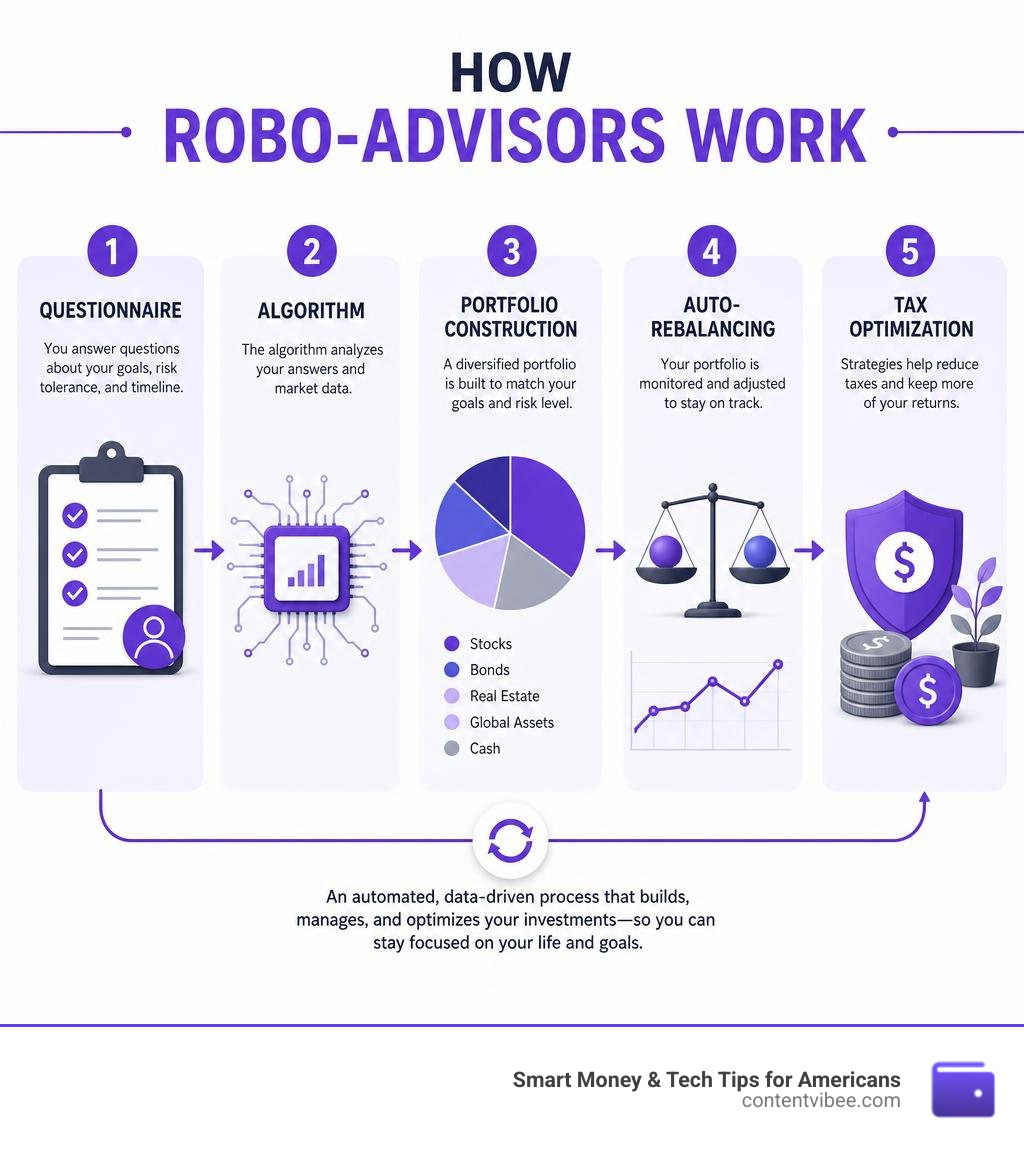
Robo advisors use computer algorithms to automatically build, manage, and rebalance a diversified portfolio based on your goals and risk tolerance. You answer a few questions when you sign up. The platform does the rest.
For someone nearing or in retirement, that means:
- No need to time the market or react to daily news
- Lower fees than most traditional financial advisors (who often charge 1%+ annually)
- Automatic rebalancing to keep your portfolio aligned with your goals
- Tax optimization tools that can improve your after-tax returns
This guide breaks down how each major platform works, what it costs, and which one might fit your retirement situation best.
Glossary for top robo advisors:
What is an Automated Investing Service and How Does It Work?
To understand how these platforms can help you grow your wealth, we first have to answer a simple question: what is robo advisor technology and how does it manage your hard-earned money?
At its core, a robo-advisor is an online platform that provides automated, algorithm-based portfolio management. Instead of sitting down with a human broker who manually picks individual stocks or mutual funds, you interact with an intelligent digital system.
The process starts with a quick onboarding quiz. You will answer questions about your age, retirement timeline, financial goals, and comfort level with market volatility. Based on your answers, the algorithm selects an optimal mix of diversified assets—usually low-cost exchange-traded funds (ETFs) that track major market indexes.
Once your money is deposited, the service takes over. It automatically buys the underlying assets, monitors your portfolio daily, and makes adjustments as the market moves. If you are wondering, “is automated portfolio management right for you,” the answer depends on how much time you want to spend managing your accounts. For hands-off investors, these platforms provide institutional-grade strategies without the high costs or stress of doing it yourself.
Pure vs. Hybrid Robo Advisors
When shopping for the top robo advisors, you will notice they generally fall into two categories: pure and hybrid.
- Pure Robo Advisors: These are entirely digital platforms. There is no human advisor to call when the market takes a dip. Algorithms handle all the asset allocation, dividend reinvestment, and automated rebalancing. Wealthfront is a classic example of this model. It is highly efficient and keeps costs incredibly low, making it a favorite for tech-savvy savers.
- Hybrid Robo Advisors: These platforms combine automated technology with access to human financial planners. If you have complex questions about estate planning, Social Security, or retirement withdrawal strategies, you can book a call with a Certified Financial Planner (CFP).
Choosing between them depends on your personal comfort level. Many investors prefer hybrid robo advisors because they offer a safety net. Knowing you can talk to a real person when the market gets bumpy provides peace of mind that a pure algorithm simply cannot match.
How the Top Robo Advisors Build Portfolios
Robo-advisors do not just guess where to put your money. They rely on Nobel Prize-winning financial theories—specifically Modern Portfolio Theory (MPT). The goal of MPT is to maximize your returns for a given level of risk by diversifying your money across various asset classes.
When analyzing robo advisor asset allocation can robots really gauge your risk tolerance, we find that the best platforms are incredibly thorough. They build diversified portfolios using broad asset classes:
- U.S. Stocks: Equities representing large, mid, and small-cap American companies.
- International Stocks: Equities from developed and emerging markets outside the US.
- Bonds: Government and corporate debt securities that provide stability and income.
- Real Estate & Commodities: Assets like Real Estate Investment Trusts (REITs) to hedge against inflation.
By spreading your money across these different buckets using low-cost exchange-traded funds (ETFs), robo-advisors ensure that a drop in one sector won’t destroy your entire nest egg.
Comparing Fees and Account Minimums of Top Robo Advisors
For long-term investors, fees are one of the most critical factors to consider. Even a seemingly small difference in annual fees can eat away tens of thousands of dollars from your retirement portfolio over a couple of decades.
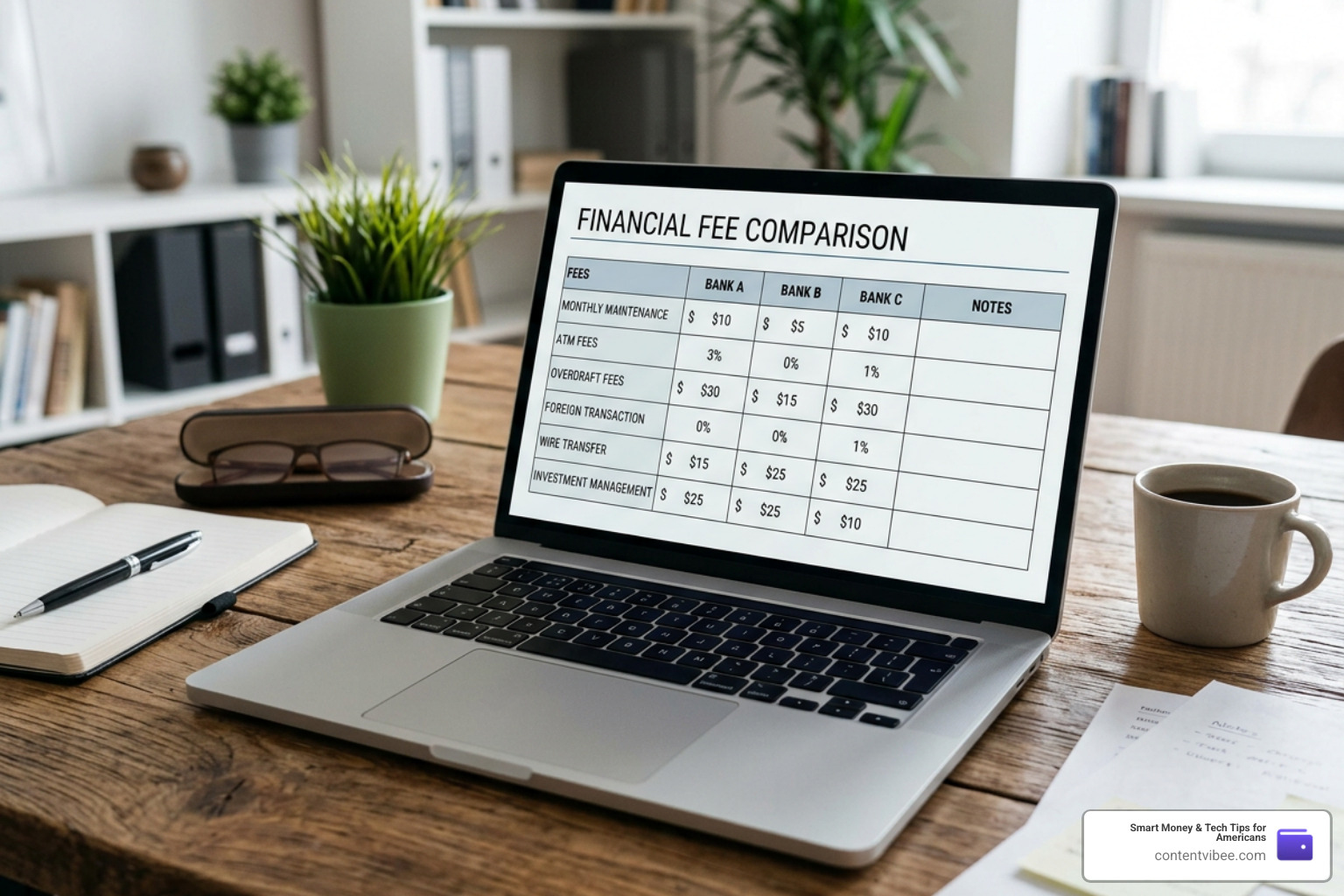
To help you see how the major players stack up, we have broken down the pricing models in the ultimate guide to robo advisor fees. Here is a detailed look at the fee structures and minimum requirements of the industry’s heaviest hitters:
| Provider | Management Fee | Account Minimum | Underlying Fund Expenses (Avg.) |
|---|---|---|---|
| Vanguard Digital Advisor | ~0.15% | $100 | 0.05% – 0.15% |
| Fidelity Go | 0% under $25K; 0.35% for $25K+ | $0 to open ($10 to invest) | 0% (Uses Fidelity Flex Funds) |
| Schwab Intelligent Portfolios | 0% | $5,000 | 0.12% |
| Betterment | 0.25% (or $4/month if under $20K without auto-deposit) | $0 | 0.05% – 0.17% |
| Wealthfront | 0.25% | $500 | 0.08% |
When choosing a provider, it is helpful to look at independent evaluations. For instance, Vanguard Digital Advisor is frequently highlighted as a top choice for low-cost investing, while platforms like Wealthfront and Betterment earn high marks for their comprehensive feature sets.
Understanding Fee Tiers and Hidden Costs
While a flat management fee looks straightforward on paper, you must dig deeper to understand the true cost of your portfolio.
First, let’s look at Fidelity Go. If you are managing a smaller balance, this service is incredibly tough to beat. We outline the details in the no nonsense guide to fidelity robo advisor fees. Fidelity Go charges an advisory fee of 0% for balances under $25,000. Once you cross that $25,000 threshold, the fee becomes 0.35% per year. However, because they build portfolios using proprietary Fidelity Flex funds, you pay a 0% expense ratio on the underlying investments.
Second, watch out for small-balance fee traps. Betterment, for instance, charges a standard 0.25% annual fee. However, if your balance is under $20,000 and you do not set up a recurring monthly deposit of at least $250, you will be charged a flat $4 per month ($48 per year). On a $5,000 balance, that $48 annual charge translates to an effective fee of 0.96%—which is extremely high!
Finally, consider cash drag. Schwab Intelligent Portfolios charges a 0% management fee, which sounds like an unbeatable deal. However, Schwab’s algorithm typically holds a significant portion of your portfolio (sometimes 6% to 10% or more) in cash. While this cash earns interest, it generally underperforms a fully invested stock and bond portfolio over the long run. This “cash drag” is how Schwab makes money on the platform, but it can quietly limit your overall returns.
Key Features of Leading Automated Platforms
The top robo advisors do not just buy and hold assets; they use advanced technology to manage your accounts dynamically.

When comparing the best platforms, look for these three core features:
- Automatic Rebalancing: Over time, some of your investments will grow faster than others. This changes your asset allocation, making your portfolio riskier or more conservative than you intended. The best platforms automatically sell overperforming assets and buy underperforming ones to keep your risk level perfectly on track.
- Goal-Based Investing: Betterment and Wealthfront Excel here. They allow you to create separate “buckets” for different goals—like a rainy-day fund, a down payment for a vacation home, or retirement income. Each bucket has its own customized asset mix and timeline.
- Tax-Coordinated Investing: This feature automatically places high-tax investments (like taxable bonds) into tax-advantaged accounts (like IRAs) while keeping low-tax investments in your taxable brokerage accounts.
Tax Optimization Strategies of Top Robo Advisors
If you are investing through a taxable account, tax optimization is where a robo-advisor truly pays for itself.
The most powerful tool in this department is tax-loss harvesting (TLH). When certain investments in your portfolio experience a temporary dip, the robo-advisor automatically sells them at a loss. It immediately replaces them with highly similar investments to keep your asset allocation identical.
You can then use those harvested losses to offset your capital gains or up to $3,000 of your ordinary income on your tax return. According to the IRS Capital Gains and Losses rules, this is a highly effective way to lower your tax liability.
In fact, independent research shows that automated tax-loss harvesting can add an estimated 0.77% in annual after-tax returns for active taxable accounts. Wealthfront and Betterment are industry leaders in this space, offering daily automated TLH to maximize your savings.
Supported Account Types and Customization
Before opening an account, make sure the robo-advisor supports the specific tax shelters you need. According to the SEC Introduction to Investing, choosing the right account type is crucial for your long-term financial health.
Most major platforms support:
- Taxable Accounts: Individual and joint brokerage accounts.
- Retirement Accounts: Traditional IRAs, Roth IRAs, SEP IRAs, and rollover 401(k)s.
- Trust Accounts: For estate planning purposes.
- Education Accounts: Some platforms, like Wealthfront, also support 529 college savings plans.
Additionally, customization has become a major battleground. Many of the top robo advisors now offer Socially Responsible Investing (SRI) or ESG (Environmental, Social, and Governance) portfolios. These options allow you to grow your wealth while avoiding companies that do not align with your personal values.
Pros and Cons of Automated Investing vs. DIY
Is automated investing really the right move for you, or should you handle your investments yourself?
To help you decide, let’s look at the pros and cons of using a robo-advisor compared to a Do-It-Yourself (DIY) approach:
The Pros:
- True Hands-Off Management: You can set and forget your way to wealth with automated investing. The software handles all the buying, selling, rebalancing, and tax management for you.
- Prevents Emotional Mistakes: When the stock market drops, DIY investors often panic and sell at the worst possible time. A robo-advisor removes human emotion from the equation, keeping you steadily invested through market cycles.
- Lower Costs Than Traditional Advisors: Traditional financial planners often charge 1% or more of your total assets every year. Robo-advisors provide many of the same core management services for a fraction of that cost.
The Cons:
- Lack of Control: You cannot log in and buy individual stocks or choose specific mutual funds within your automated portfolio.
- Annual Fees: While 0.15% to 0.25% is low, it is still an extra cost compared to building a simple three-fund portfolio yourself using free brokerage accounts.
- Inability to Outperform the Market: Robo-advisors build portfolios designed to match market returns, not beat them. If you want to try to beat the market, you will need a self-directed account.
For more details on these platforms, you can research how they perform in real-world scenarios to see which one aligns best with your long-term financial strategy.
Frequently Asked Questions About Automated Investing
Are robo-advisors safe and regulated?
Yes, they are highly regulated. Robo-advisors operating in the United States must register with the Securities and Exchange Commission (SEC) as Registered Investment Advisors (RIAs). This means they have a fiduciary duty to act in your best financial interest.
Furthermore, your money is protected by the Securities Investor Protection Corporation (SIPC). If the brokerage firm holding your assets goes bankrupt, SIPC covers up to $500,000 (including up to $250,000 for cash). That SIPC does not protect you from normal market losses—it only protects you if the financial institution itself fails. If you keep cash in a robo-advisor’s high-yield savings account, that cash is typically protected by FDIC insurance through partner banks. For a deeper look at safety standards, check out the FINRA Robo-Advisors Guide.
How do I choose the best automated platform for my needs?
To find the right fit, ask yourself these four questions:
- What is my account balance? If you have less than $25,000, Fidelity Go is incredibly cost-effective. If you have over $5,000, Schwab is a strong contender.
- Am I investing in a taxable account? If yes, choose a platform with robust tax-loss harvesting, like Wealthfront or Betterment.
- Do I want to talk to a human? If you want access to financial planners, look at hybrid options like Betterment Premium or Vanguard’s hybrid advisory tiers.
- How much customization do I need? If you want to tilt your portfolio toward specific sectors or ESG funds, Betterment or M1 Finance offer excellent customization.
For a comprehensive breakdown of the biggest platforms by assets under management, you can look at industry reports detailing the growth of automated wealth management.
Can I lose money with a robo-advisor?
Yes. Because robo-advisors invest your money in real market securities (like stocks and bonds), your account balance will fluctuate. There is no guarantee of profit, and you can lose money during market downturns. However, because these platforms build highly diversified portfolios, your risk is much lower than if you had put all your money into a few individual stocks. Over the long term, historical market trends show that a diversified portfolio is one of the most reliable ways to grow your wealth.
Conclusion
At Smart Money & Tech Tips for Americans, we believe that taking control of your financial future does not have to be stressful or overly complicated. The top robo advisors of 2026 have democratized wealth management, giving everyday Americans access to institutional-grade portfolios, automated rebalancing, and tax-saving strategies that were once reserved only for the ultra-wealthy.
If you want to start building a stress-free portfolio today, we highly recommend reading our guide on the best autopilot investing strategies for beginners who hate math. It will show you exactly how to set up your investments so you can spend less time worrying about charts and more time enjoying your retirement!
To learn more about automated options directly from the source, you can also explore the Robo-Advisor – Automated Investing Services – Vanguard page to see if their low-cost digital advice fits your long-term goals.


