


How to Claim Spousal Benefits Online: What You Need to Know First
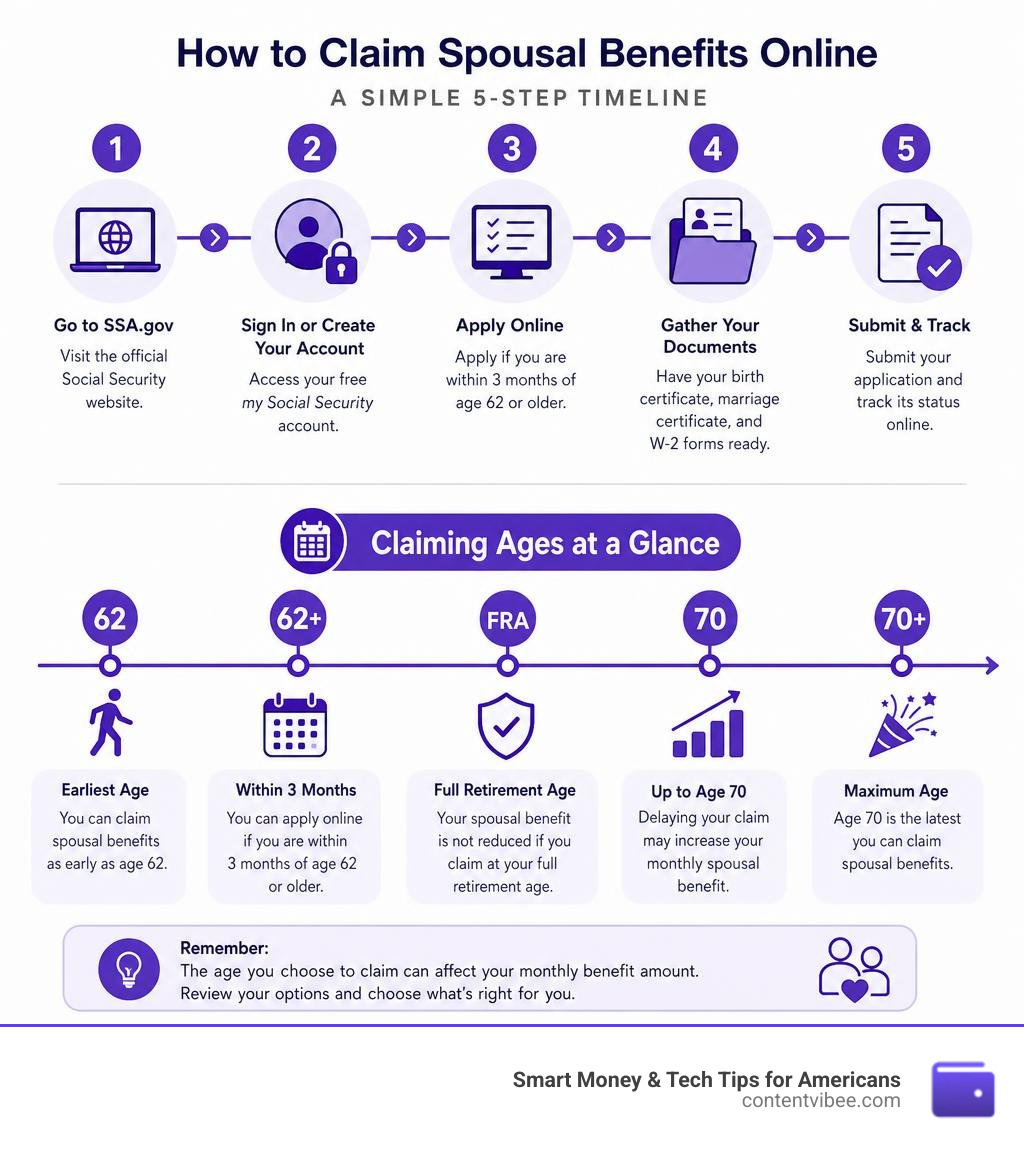
You can claim spousal benefits online by visiting ssa.gov and submitting your application through the Social Security Administration’s online portal. Here’s the quick version:
How to claim spousal benefits online — at a glance:
- Go to ssa.gov
- Create or log in to your free my Social Security account
- Apply online if you are within 3 months of age 62 or older
- Have your documents ready: birth certificate, marriage certificate, and W-2 forms
- Submit your application and track its status online
You can also apply by phone at 1-800-772-1213 or in person at your local Social Security office if you prefer.
Social Security spousal benefits can be worth up to 50% of your spouse’s benefit at their full retirement age. That’s a significant income source — and many people don’t realize how much timing and eligibility rules affect the final amount they receive.
The rules around when to claim, whether deemed filing applies to you, and how your own retirement benefit interacts with the spousal benefit can get complicated fast. Claiming too early can permanently reduce your monthly payment. Waiting too long can mean leaving money on the table.
This guide walks you through every step — from checking your eligibility to submitting your application online — so you can make a confident, informed decision.
Know your claim spousal benefits online terms:
Understanding Spousal Social Security Benefits and Eligibility
Navigating the federal retirement landscape can sometimes feel like trying to solve a puzzle where the pieces keep shifting. However, once you grasp the core concepts, the picture becomes incredibly clear. At the heart of spousal retirement planning is the Primary Insurance Amount (PIA).
The PIA is the base monthly payment a worker is entitled to receive if they claim benefits at their exact Full Retirement Age (FRA). For anyone born in 1960 or later, the FRA is 67. If you are married, you might be eligible to receive a spousal benefit that is worth up to 50% of your partner’s PIA.
But what exactly is this payment? To break it down in plain English, we have put together a detailed guide on what is a social security spousal benefit. Essentially, it is a program designed to provide retirement income to a spouse who may have had lower lifelong earnings or stayed home to care for family members.
Timing is everything. While you can technically claim these benefits as early as age 62, doing so comes with a permanent reduction in your monthly check. If you claim at 62, you might only receive 32.5% to 35% of your spouse’s PIA, rather than the full 50% you would get by waiting until your own full retirement age. To figure out the right milestone for your household, you should ask yourself: at what age can i claim my spouses social security?
To make sure everything is legally sound, the Social Security Administration (SSA) relies on strict internal rules. Under the official policy manual, specifically SSA – POMS: RS 00202.001 – Definitions and Requirements for Spouse Benefits, a legal spouse must be validly married under the laws of the state where the primary worker lives at the time of filing. Additionally, the claimant must meet a duration-of-marriage requirement (usually at least one continuous year) or have a qualifying child in care who is under age 16 or disabled.
Who is Eligible to Claim Spousal Benefits Online?
Before you log onto the portal to claim spousal benefits online, you need to ensure you meet all the baseline criteria. The standard rules require that:
- You are at least 62 years old (or caring for a child who is under 16 or disabled).
- Your spouse is already entitled to receive their own retirement or disability benefits.
- You have been married for at least one continuous year before filing (with some exceptions if you are the parent of your spouse’s child).
If you are unsure where your relationship status or age puts you, we recommend taking a moment to review how to check your eligibility for spousal social security benefits.
A common point of confusion is whether do both spouses collect social security simultaneously. The answer is yes! However, you cannot double-dip by receiving your full personal retirement benefit plus a full spousal benefit. Instead, the SSA uses a dual entitlement rule: they calculate your own benefit first, and if your spousal benefit is higher, they add a supplemental amount to make up the difference.
How to Estimate Your Spousal Benefit Amount
No one likes financial surprises in retirement. That is why we highly recommend running the numbers before submitting your online application.
The easiest way to get an accurate projection is by logging into your personal my Social Security account. Once inside, you can access the interactive Retirement Calculator. The system allows you to plug in your partner’s estimated benefits to see what your potential spousal payments will look like at different claiming ages. For a step-by-step walkthrough of this online tool, you can visit the official Spouse’s Benefit Estimates | SSA page.
The maximum spousal benefit is strictly capped at 50% of your spouse’s PIA. Even if your spouse delays their own retirement past full retirement age to earn delayed retirement credits, your spousal benefit will not increase beyond that 50% threshold.
To help you run these numbers quickly, we have built a dedicated resource to calculate spouse retirement benefits. You can also use our interactive Tools/Finance Calculator/Social Security Spousal Benefit Calculator to compare different age scenarios and see how claiming early affects your monthly household cash flow.
Step-by-Step: How to Claim Spousal Benefits Online
Ready to make your claim? The SSA has made the process incredibly convenient by moving the application portal online. You can complete the entire process from the comfort of your living room.
Here is our step-by-step walkthrough to help you submit your application successfully:
- Create or Log In to Your Account: Go to the official website at ssa.gov. If you do not have a my Social Security account yet, you will need to verify your identity to set one up. This usually takes less than 10 minutes.
- Navigate to the Application: Once logged in, select the option to apply for retirement or spouse’s benefits.
- Verify Your Timing: You can only apply online if you are within 3 months of reaching age 62 or older.
- Fill Out the Questionnaire: The system will guide you through a series of questions regarding your personal details, employment history, and marriage history.
- Submit and Track: After reviewing your answers, submit the application. You can log back into your portal at any time to check the processing status.
For more detailed strategies on navigating the online interface, read our companion guide on applying for spousal benefits.
Checklist of Documents Needed to Claim Spousal Benefits Online
When you apply, the SSA will ask you to verify several key details. The primary form used to process these claims is Form SSA-2. While you do not necessarily need to fill out a physical paper form if you are applying online, the digital portal will ask you for the exact same information.
To ensure your application is processed without delay, you should gather your documentation beforehand. Do not delay your application if you are missing a document; the SSA can often help you obtain verification.
Here is what you will typically need to provide:
- Your Social Security Number (SSN) and your spouse’s SSN.
- Your original birth certificate or other proof of age.
- Proof of U.S. citizenship or lawful alien status.
- Your marriage certificate (proof of marriage is always required).
- W-2 forms or self-employment tax returns for the prior year.
- Bank account routing and account numbers for direct deposit.
For an exhaustive, step-by-step checklist, refer to the ultimate checklist for your application for spousal benefits. For official guidelines on what the SSA requires, you can check the Form SSA-2 | Information You Need to Apply for Spouse’s or … page, as well as the administrative rules outlined in SSA – POMS: RS 00202.050 – Spouse’s Benefits – Evidence and Forms Requirements.
Alternative Ways to Apply: Phone and In-Person
We love technology, but we also know that sometimes you just want to talk to a real human being. If you run into technical issues or have a highly complex marital history, you do not have to claim spousal benefits online.
You can choose one of these alternative routes:
- By Phone: Call the SSA toll-free at 1-800-772-1213 (TTY 1-800-325-0778) between 8:00 a.m. and 7:00 p.m., Monday through Friday.
- In Person: You can visit your local Social Security office. We highly recommend calling ahead to schedule an appointment so you do not spend your afternoon waiting in a long line.
To compare the pros and cons of each filing method, check out our comprehensive breakdown on how to claim spousal benefits.
Deemed Filing and How It Affects Your Retirement Benefits
If you were born on or after January 2, 1954, you must understand a rule called “deemed filing.” Introduced under the Bipartisan Budget Act of 2015, this rule completely changed how couples plan their retirement claims.
In the past, some retirees could file a “restricted application” to claim only spousal benefits at full retirement age, allowing their own personal retirement benefit to grow by 8% each year until age 70. Today, that strategy is gone for almost everyone. Under the modern deemed filing rules, when you apply for either your retirement benefit or your spousal benefit, you are automatically “deemed” to be applying for both. The SSA will evaluate both records and pay you the higher of the two amounts.
This complex interaction is detailed in the official policy guides: SSA – POMS: GN 00204.035 – Deemed Filing and SSA – POMS: GN 00204.004 – Considering Possible Entitlement to Retirement Insurance Benefits (RIB) when a Claimant Files an Application for Spouse’s Benefits.
To help visualize how claiming age impacts your monthly payouts, take a look at this comparison table:
| Claiming Age | Percentage of Spouse’s PIA | Impact on Your Own Retirement Benefit |
|---|---|---|
| 62 (Earliest) | ~32.5% to 35% | Permanently reduced; subject to deemed filing |
| 65 | ~45.8% | Moderately reduced |
| Full Retirement Age (67) | 50% (Maximum) | Full spousal benefit; no early reduction penalties |
What Happens If Your Spouse Has Not Filed Yet?
This is one of the most common hurdles couples face: can you claim a spousal benefit if your partner is still working and hasn’t filed for Social Security yet?
The short answer is no. For a standard married couple, you cannot receive spousal benefits until your spouse has actively filed and is receiving their own retirement or disability benefits.
If you decide to file for retirement at age 62 while your spouse is still working, you will collect your own reduced retirement benefit. Later, when your spouse finally files for their benefits, you can contact the SSA to switch or add the spousal supplement. However, because you initially claimed your own benefits early, your final combined benefit will still be permanently reduced.
To explore this dynamic further, read our guides on can a married couple both collect social security and both spouses collect social security. For official details on how your partner’s status affects your claim, visit Retirement Benefits: Benefits for Your Spouse | SSA.
Special Rules for Divorced and Widowed Spouses
The rules of Social Security change dramatically if you are divorced or widowed. The federal government provides safety nets for these situations, but the eligibility criteria are distinct.

Claiming Spousal Benefits as a Divorced Spouse
If you are divorced, you can still claim spousal benefits on your ex-spouse’s record—and the best part is, they don’t even have to know about it! Your claim will not affect their benefit amount, nor will it impact the benefits of their current spouse if they have remarried.
To qualify, you must meet the following criteria:
- Your marriage to your ex-spouse lasted for at least 10 continuous years.
- You are currently unmarried (if you remarry, you generally lose eligibility unless that subsequent marriage ends).
- Both you and your ex-spouse are at least 62 years old.
- If your ex-spouse has not applied for benefits yet, you can still claim on their record as an “independently entitled divorced spouse,” provided you have been divorced for at least two consecutive years.
To learn more about your rights under these rules, check out our resources on can divorced spouse get social security benefits and our updated divorced spouse social security guide 2026.
Claiming Survivor Benefits as a Widow or Widower
Losing a partner is incredibly difficult, and dealing with financial paperwork during a time of grief can feel overwhelming. However, survivor benefits are a vital resource that can help secure your financial future.
Unlike standard spousal benefits, which max out at 50%, a survivor benefit can be worth up to 100% of your deceased spouse’s benefit. Furthermore, the eligibility age is lower: you can claim survivor benefits as early as age 60 (or age 50 if you are disabled).
If you are a surviving spouse, you have a unique advantage: you can choose to claim survivor benefits early and let your own personal retirement benefit grow until age 70, or vice versa. Deemed filing does not apply to survivor benefits.
To navigate this process with ease, read our guides:
- claiming whats yours a guide to deceased spouse social security
- claim deceased spouse benefits
- calculate survivor retirement benefits
Frequently Asked Questions about Spousal Benefits
Can I work while receiving spousal benefits?
Yes, you can work, but you must keep the SSA’s annual earnings limits in mind if you are under your Full Retirement Age. If you earn more than the yearly limit, the SSA will temporarily withhold a portion of your benefits ($1 for every $2 you earn over the limit). Once you reach your FRA, the earnings test no longer applies, and your benefit will be recalculated upward to account for the withheld amounts.
To see how this might affect your paycheck, check out our guide on working in retirement are spousal benefits reduced by working.
What is the best age to collect spousal benefits?
For most people, the best age to collect is their Full Retirement Age (usually 67). This guarantees you get the maximum 50% spousal benefit without any early claiming penalties. However, your personal health, financial needs, and household retirement strategy might make an earlier claim logical. Read more about finding your perfect timing in our guide on the best age to collect ss.
How does the Government Pension Offset (GPO) affect my spousal benefit?
If you receive a pension from a government job (federal, state, or local) where you did not pay Social Security taxes, the GPO will likely reduce your spousal benefit. The GPO cuts your spousal or survivor benefit by two-thirds of the amount of your government pension. In some cases, this offset can reduce your Social Security spousal benefit to zero. You can read the official rules on the Benefits for Spouses – Social Security Administration page.
Conclusion
Deciding when and how to claim spousal benefits online is one of the most important financial milestones of your retirement journey. By taking the time to understand the rules around deemed filing, estimating your potential payouts, and gathering your documents early, you can secure the maximum possible income for your household.
At Smart Money & Tech Tips for Americans, we are dedicated to helping you make sense of complex personal finance topics. Whether you are filing from California or tracking your benefits online, we want to ensure you have the tools to succeed.
To continue building your retirement roadmap, check out a comprehensive guide to social security benefits and read our pillar article on The Golden Rules: Can a Spouse Collect SS Spousal Benefits? to make sure you aren’t leaving any of your hard-earned money on the table.


