


What Is a 457 Deferred Compensation Plan — and Is It Right for You?
A 457 deferred compensation plan is a tax-advantaged retirement savings account available to employees of state and local governments, as well as certain tax-exempt organizations. Think of it as a close cousin to the 401(k) — but with some powerful differences that can make it especially attractive if you’re a public sector worker looking to retire early or maximize your savings in your final working years.
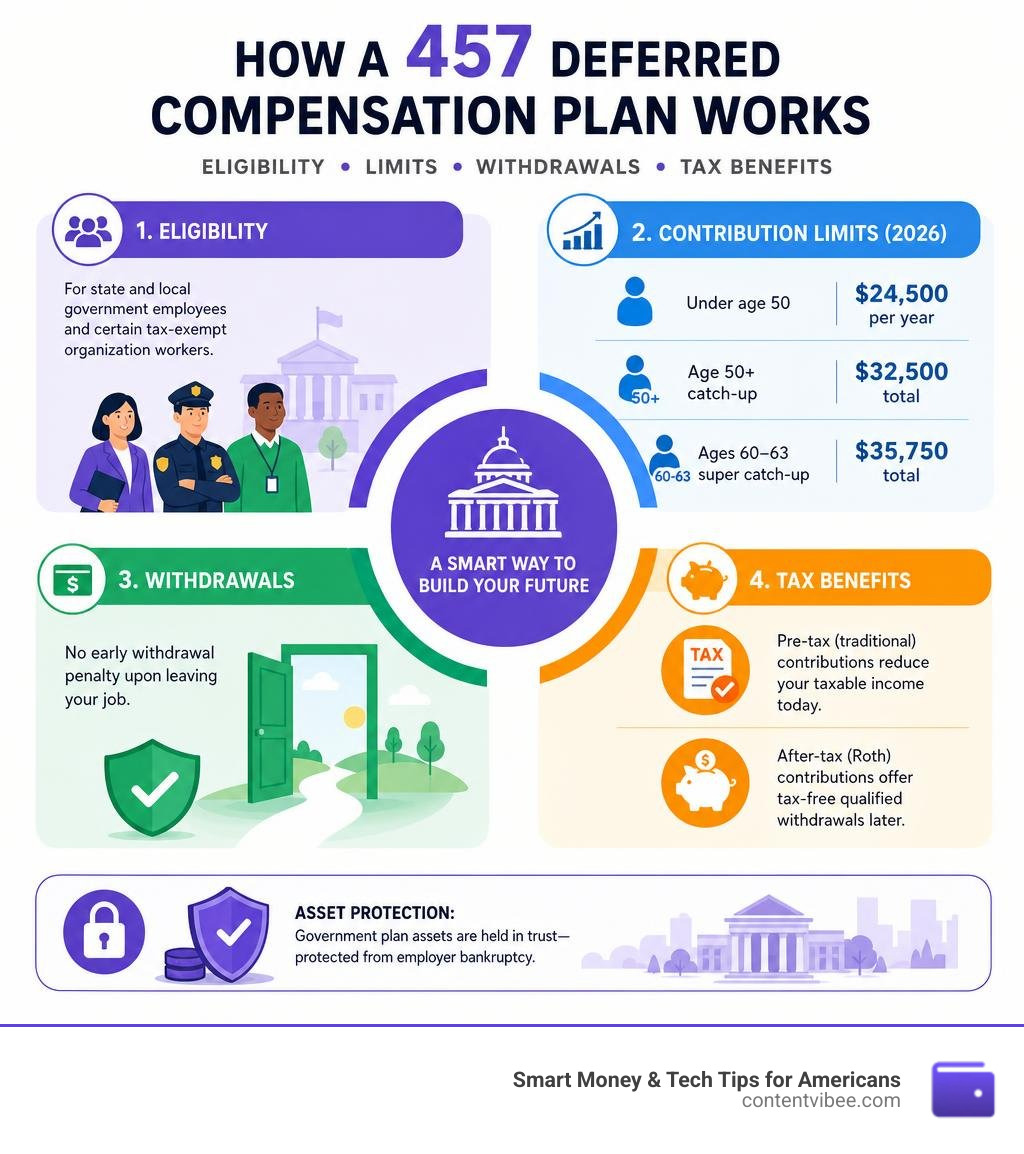
Here’s a quick snapshot of what you need to know:
- Who it’s for: State and local government employees, and some nonprofit workers
- 2026 contribution limit: $24,500 per year (under age 50)
- Age 50+ catch-up: Up to $32,500 total
- Ages 60–63 super catch-up: Up to $35,750 total
- Early withdrawal penalty: None upon leaving your job (unlike a 401(k))
- Tax options: Pre-tax (traditional) or after-tax (Roth) contributions
- Asset protection: Government plan assets are held in trust — protected from employer bankruptcy
Despite being one of the most underrated retirement tools available, many public employees don’t fully understand what their 457 plan can do for them. Eight in ten investors say they’re not sure they’re saving enough for retirement — and a 457 plan could be a key part of closing that gap.
Whether you’re a teacher, a city worker, or a hospital employee nearing retirement, this guide breaks down everything you need to know in plain English.
What is a 457 deferred compensation plan and How Does It Work?
At its core, a 457 deferred compensation plan is a nonqualified, tax-advantaged retirement plan. “Nonqualified” simply means it does not fall under the same ERISA guidelines as a standard 401(k). Instead, it operates under its own special rules set by the federal government.
When you participate in a 457 plan, you agree to defer a portion of your salary before taxes are applied (or on an after-tax Roth basis, if your plan allows). This money goes directly from your paycheck into your investment account, where it grows tax-deferred until you withdraw it.
The legal framework governing these accounts is laid out in the 26 USC 457: Deferred compensation plans of State and local governments and tax-exempt organizations . The IRS further clarifies these operations through specific IRS Section 457 guidelines.
Under federal tax law, there are two primary types of 457 plans:
- Governmental 457(b) Plans: Offered by state and local public entities (like public school districts, police departments, and state agencies).
- Tax-Exempt 457(b) Plans: Offered by non-governmental tax-exempt organizations (such as nonprofit hospitals or charities).
Because these plans are designed to help you save systematically, they are excellent additions to your overall financial strategy. If you are looking to secure your financial future, we recommend reviewing our guide on how to create a monthly budget that works to find the extra cash flow needed to fund your retirement goals.
How a 457 Plan Differs from 401(k) and 403(b) Plans
While 457, 401(k), and 403(b) plans share the same primary goal — helping you build a retirement nest egg — their underlying rules differ significantly.
The biggest differentiator is the early withdrawal penalty. With a 401(k) or 403(b), taking money out before age 59½ usually triggers a 10% IRS penalty. With a governmental 457(b) plan, there is no 10% early withdrawal penalty once you separate from your employer, regardless of your age.
Additionally, 457 plans have unique coordination rules. In the past, contributions to multiple plans had to be shared. Today, you can actually “double-dip” by contributing the maximum limit to both a 401(k)/403(b) and a 457(b) plan simultaneously, effectively doubling your annual tax-advantaged savings.
| Feature | Governmental 457(b) | Traditional 401(k) | Traditional 403(b) |
|---|---|---|---|
| Primary Employers | State & local governments | Private corporations | Public schools, nonprofits |
| 2026 Contribution Limit | $24,500 | $24,500 | $24,500 |
| 10% Early Withdrawal Penalty | No (upon separation from service) | Yes (if withdrawn before 59½) | Yes (if withdrawn before 59½) |
| Double-Dipping Allowed? | Yes (limits do not coordinate) | No (shares limit with 403(b)) | No (shares limit with 401(k)) |
To see how your savings can compound over time across different account types, try using our retirement math made easy with a 401k balance calculator to project your future nest egg.
Who is Eligible for a 457 deferred compensation plan?
Eligibility depends entirely on your employer. If you work for a state government, a county, a city, or a public school system, you are highly likely to have access to a governmental 457(b) plan.
For example, public servants in California can participate in local municipal plans like the LA457 plan for City of Los Angeles employees.
On the other hand, non-governmental tax-exempt organizations (such as 501(c)(3) nonprofits) can also offer 457 plans. However, due to federal ERISA rules, these are structured as “top-hat” plans. This means eligibility is strictly limited to a select group of management or highly compensated employees.
2026 Contribution Limits and the SECURE 2.0 Roth Catch-Up Rules
As we navigate through 2026, the IRS has adjusted retirement contribution limits upward to keep pace with inflation. Keeping track of these limits is vital to ensuring you do not accidentally over-contribute and face tax penalties.

For the 2026 calendar year, the standard contribution limit for a 457 deferred compensation plan is $24,500 for participants under the age of 50. This limit applies to your elective deferrals, whether you choose to make them as pre-tax contributions or after-tax Roth contributions.
Standard and Super Catch-Up Provisions for 2026
If you are closer to retirement, the 457 plan offers some of the most generous catch-up provisions in the financial world:
- Age 50+ Catch-Up: If you are age 50 or older in 2026, you can contribute an additional $8,000, bringing your total allowable contribution to $32,500.
- SECURE 2.0 “Super Catch-Up”: Thanks to recent legislation, participants aged 60, 61, 62, or 63 in 2026 can take advantage of a “super catch-up” limit of $11,250, allowing for a maximum annual contribution of $35,750.
- Standard 3-Year Catch-Up: Unique to 457 plans, you may be eligible to contribute up to twice the normal limit (up to $49,000 in 2026) during the three years prior to your plan’s designated normal retirement age. This option is designed for employees who did not contribute the maximum amount in previous years. You cannot use both the age 50+ catch-up and the 3-year catch-up in the same year; you must use whichever is greater.
For a detailed look at how these complex standard catch-up rules are codified, you can review the structural framework outlined in the North Carolina Public Employee Deferred Compensation Plan (NC 457 Plan) .
The New 2026 Roth Catch-Up Rule for High Earners
A major change taking effect in 2026 under the SECURE 2.0 Act impacts high-earning public servants.
If your FICA wages (or equivalent Medicare wages) exceeded $150,000 in the previous tax year (2025), any age-based catch-up contributions you make in 2026 must be made on a Roth (after-tax) basis. Your standard pre-tax contribution limit remains capped at $24,500, and any additional catch-up amounts must go into a Roth account. If you earned $150,000 or less in 2025, you retain the freedom to choose between pre-tax or Roth catch-up contributions.
Distribution, Rollover, and Investment Rules for 457 Plans
When it comes to accessing your hard-earned money, 457 plans offer unparalleled flexibility compared to other retirement accounts.
Understanding how to access these funds is a major component of retirement planning. For more tips on managing your post-work finances, explore our library of personal finance guides.
Penalty-Free Withdrawals Upon Severance of Employment
This is the “golden ticket” feature of the governmental 457 deferred compensation plan.
If you leave your job — whether you retire early at age 45, transition to the private sector, or simply decide to take a career break — you can begin taking distributions from your governmental 457 plan without paying a 10% early withdrawal penalty. You will still owe regular income tax on any pre-tax distributions, but you won’t be penalized for accessing your money before age 59½.
For independent contractors who participate in a plan, separation from service is generally recognized once all contractual agreements have expired in good faith, usually requiring a 12-month break before payments can begin.
Rolling Over Your 457 deferred compensation plan Assets
If you decide to leave your employer, you have several options for your governmental 457 plan assets:
- Leave it in place: Many plans allow you to keep your money in the plan to benefit from low institutional fees.
- Roll it into an IRA: You can execute a direct transfer to a Traditional or Roth IRA.
- Roll it into another employer plan: You can transfer your balance into a new employer’s 401(k), 403(b), or governmental 457 plan.
Warning: If you roll your governmental 457 plan into a 401(k) or a traditional IRA, those funds lose their “penalty-free early withdrawal” status. Any future withdrawals before age 59½ from that new account will be subject to the standard 10% IRS penalty.
For public employees in California, programs like the CalPERS 457 Plan – CA.gov provide clear pathways for managing and rolling over your assets seamlessly when changing public sector jobs.
Governmental vs. Tax-Exempt Plan Asset Protection
There is a critical legal difference in how your money is protected depending on whether your employer is a government entity or a nonprofit organization.
Under 26 U.S.C. § 457 | Deferred compensation plans of State and local governments and tax-exempt organizations , assets in a governmental 457 plan must be held in an exclusive benefit trust. This means your money is completely safe from your employer’s creditors in the event of municipal bankruptcy.
Conversely, a tax-exempt (nonprofit) 457 plan is legally “unfunded.” The deferred money remains the property of the employer. It is held in a “rabbi trust” or general account and remains subject to the claims of the employer’s general creditors if the nonprofit faces financial distress or bankruptcy. You can read more about this distinction in the IRC Section 457 | Internal Revenue Code Sec. 457 | Tax Notes and 26 USC 457 – Deferred Compensation Plans of State and Local Governments and Tax-exempt Organizations – Internal Revenue Code – US Code .
Investment Choices and Plan Fees
Most 457 plans offer a curated lineup of mutual funds, index funds, and target-date portfolios. Many plans also offer a Self-Directed Brokerage Account (SDBA), which allows experienced investors to buy individual stocks, ETFs, and mutual funds outside of the core lineup.
In California, state workers utilizing the Savings Plus program enjoy highly competitive institutional fees. When comparing plans, always check the annual record-keeping and administrative fees, as keeping these costs low is essential for long-term compounding.
Frequently Asked Questions About 457 Plans
Can I contribute to both a 457(b) and a 401(k) or 403(b) at the same time?
Yes! This is one of the best-kept secrets of public sector employment. Because 457 plans do not share contribution limits with 401(k) or 403(b) plans, you can fully fund both. In 2026, an ambitious saver under age 50 could theoretically defer $24,500 into a 403(b) and another $24,500 into a governmental 457(b), for a grand total of $49,000 in tax-advantaged savings.
What happens to my 457 plan if my employer goes bankrupt?
If you are in a governmental 457 plan, your funds are held in a trust for your exclusive benefit and cannot be touched by creditors. If you are in a non-governmental tax-exempt plan, your assets are not protected and could be lost to creditors in a bankruptcy proceeding.
How are 457 plan distributions taxed?
Pre-tax contributions and their earnings are taxed as ordinary income in the year you withdraw them. Roth contributions, however, are made with after-tax dollars, meaning qualified distributions of both your contributions and their earnings are 100% tax-free.
Coordinating Your 457 Plan with Social Security
As you map out your retirement, it is vital to look at the complete financial picture. For many public sector employees, a 457 plan works hand-in-hand with pensions and Social Security. Depending on your career history, your Social Security benefits might be affected by rules like the Windfall Elimination Provision (WEP).
To calculate exactly where you stand, we recommend using our How Much Social Security Will I Get Calculator to estimate your future monthly payments.
If you are married, coordinating benefits with your partner can dramatically increase your household’s lifetime wealth. Take some time to explore these resources to build a cohesive spousal strategy:
- Calculate Spouse Retirement Benefits to estimate combined income.
- Review our guide on Can A Married Couple Both Collect Social Security to understand the rules.
- Read about Do Both Spouses Collect Social Security and Both Spouses Collect Social Security to maximize your joint filing strategy.
- To make the math simple, use our Tools/Finance Calculator/Social Security Spousal Benefit Calculator.
Understanding how to Claim Spousal Benefits and reviewing The Ultimate Guide To Spousal Social Security Eligibility will ensure you do not leave any money on the table. You can also How To Check Your Eligibility For Spousal Social Security Benefits and learn The Golden Rules Can A Spouse Collect Ss Spousal Benefits to fully prepare.
Finally, because life is unpredictable, it is wise to understand what happens to your benefits under other circumstances. Read our guides on how to Claim Deceased Spouse Benefits or navigate the rules using our Divorced Spouse Social Security Guide 2026.
Conclusion
At Smart Money & Tech Tips for Americans, we believe that navigating your retirement options shouldn’t require a law degree. The 457 deferred compensation plan is uniquely structured to give public employees and select nonprofit workers unparalleled flexibility — particularly the ability to retire early and access their money penalty-free.
By taking control of your 457 plan today, maximizing your 2026 contributions, and understanding the new SECURE 2.0 Roth catch-up rules, you are taking a massive step toward financial independence.
To learn how to weave your employer-sponsored plan into a comprehensive retirement plan, check out our flagship resource: A Comprehensive Guide to Social Security Benefits.


