


Why the Spousal Social Security Eligibility Age Matters More Than Most Couples Realize
Understanding the spousal social security eligibility age could mean thousands of extra dollars in retirement — or thousands less, if you claim at the wrong time.
Here’s the quick answer most people are looking for:
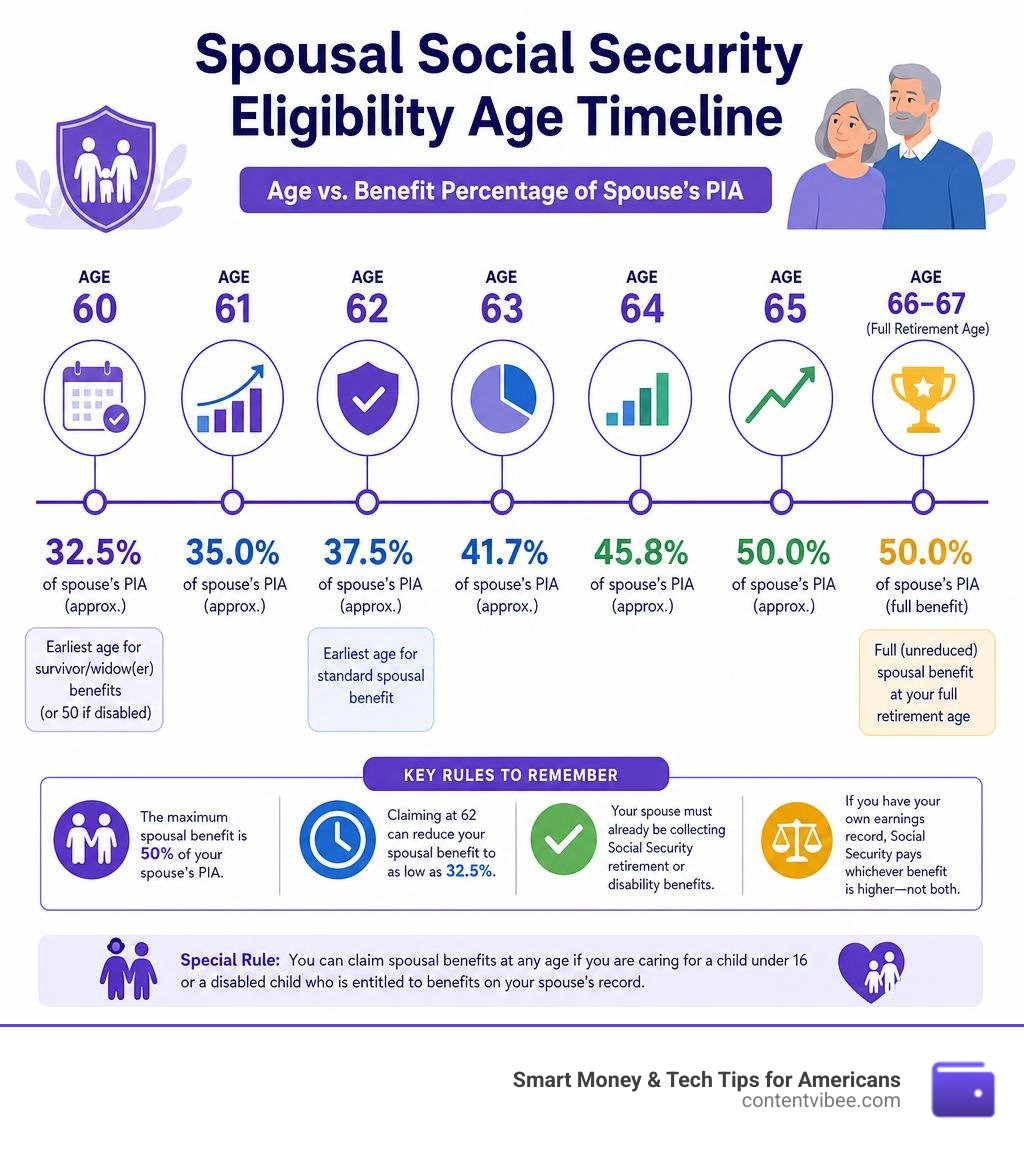
| Situation | Minimum Age to Claim Spousal Benefits |
|---|---|
| Standard spousal benefit | Age 62 |
| Caring for a child under 16 | Any age (no minimum) |
| Caring for a disabled child on spouse’s record | Any age (no minimum) |
| Full (unreduced) spousal benefit | Your full retirement age (66–67 depending on birth year) |
| Survivor/widow(er) benefit | Age 60 (or 50 if disabled) |
A few key facts to know upfront:
- The maximum spousal benefit is 50% of your spouse’s primary insurance amount (PIA) — but only if you claim at your full retirement age.
- Claiming at 62 can reduce your spousal benefit to as low as 32.5% of your spouse’s PIA.
- Your spouse must already be collecting their own Social Security retirement or disability benefits before you can claim spousal benefits.
- If you have your own earnings record, Social Security pays whichever benefit is higher — not both.
The rules are more layered than most people expect. Claiming age, your own work history, your spouse’s PIA, and even a 2015 law change all affect what you’ll actually receive.
Understanding the Spousal Social Security Eligibility Age
When we plan for our golden years, we often focus entirely on our own work history. But for married couples, some of the most powerful financial opportunities lie in coordination. The Social Security Administration (SSA) allows a spouse to receive benefits based on their partner’s earnings record. However, timing is everything.
To make the most of these rules, you first need to understand the concept of the spousal social security eligibility age. The age at which you choose to file dictates the percentage of your spouse’s benefit you will actually receive. To get started, it is highly recommended to learn How to Check Your Eligibility for Spousal Social Security Benefits, which outlines the initial verification steps.
According to the official SSA Handbook § 305, a spouse is entitled to benefits on a worker’s record only if certain conditions are met. First and foremost, the primary worker must already be entitled to and receiving their own retirement or disability benefits. You cannot file for a spousal benefit on a living partner’s record if they have not yet filed themselves. Furthermore, you must have been married for at least one continuous year before filing, or be the natural parent of the worker’s child.
The Minimum Spousal Social Security Eligibility Age of 62
For the vast majority of Americans, the absolute minimum age to claim a spousal Social Security benefit is 62. However, just because you can claim at 62 doesn’t mean you should.
Filing at age 62 triggers a permanent reduction in your monthly payouts. If you choose early retirement, the SSA applies a steep reduction factor to your monthly check. We often talk about these trade-offs in The Golden Rules Can a Spouse Collect SS Spousal Benefits, which highlights how early filing permanently locks in lower monthly income.
Under the regulations outlined in SSA – POMS: RS 00202.001, a spouse must meet the age requirement of 62 for aged spouse benefits unless they qualify for a specific exception. If you choose to claim at 62, and your Full Retirement Age (FRA) is 67, your spousal benefit is reduced by 35%. This means instead of receiving 50% of your partner’s primary insurance amount, you will only receive 32.5%.
Exceptions to the Spousal Social Security Eligibility Age: Caring for a Child
There is a significant exception to the minimum age rule of 62. If you are caring for a qualifying child of the primary worker, you can claim spousal benefits at any age without any early retirement reduction.
According to the official guidelines on Benefits for Spouses, a qualifying child is defined as a child who is:
- Under the age of 16, or
- Disabled (with a disability that began before age 22) and entitled to child’s insurance benefits on the worker’s record.
When you claim under the child-in-care exception, your spousal benefit is not subject to age-based reduction factors. You will receive the full, unreduced spousal benefit (50% of your spouse’s PIA) even if you are only 40 or 50 years old.
However, keep in mind that once the youngest child turns 16, your child-in-care spousal benefits will stop unless the child is disabled and remains in your care. At that point, you must wait until you reach at least age 62 to reapply for aged spousal benefits.
How Spousal Benefits Are Calculated and Reduced for Early Claiming
Calculating your spousal benefit is a two-step process. First, the SSA determines your base eligibility. Second, they apply reduction factors based on how many months prior to your Full Retirement Age you are filing.
If you want to run your own numbers, we suggest using our interactive Tools/Finance Calculator/Social Security Spousal Benefit Calculator to see how different claiming ages affect your monthly cash flow.

The 50% Primary Insurance Amount (PIA) Rule
The baseline for any spousal benefit is the Primary Insurance Amount (PIA) of the working spouse. The PIA is the monthly benefit amount the worker is eligible to receive at their own Full Retirement Age.
Under the rules documented in SSA – POMS: NL 00711.025, the maximum benefit for a spouse is exactly 50% of the worker’s PIA. This 50% cap is only achievable if the spouse waits until their own Full Retirement Age to claim.
Let’s look at an example. If your spouse’s PIA is $2,000 per month, your maximum base spousal benefit is $1,000. If you wait until your FRA to claim, you will receive the full $1,000. If you claim early, that $1,000 baseline is reduced.
Crucially, the spousal benefit is calculated based on your spouse’s PIA, not their actual benefit. If your spouse delayed claiming their own benefit until age 70 to earn delayed retirement credits, their personal benefit might be 124% of their PIA. However, your spousal benefit is still capped at 50% of their FRA PIA. You do not inherit their delayed retirement credits. Conversely, if your spouse claimed their own retirement benefits early at 62 and received a reduced amount, your spousal benefit is still calculated from their unreduced PIA.
Comparing Spousal and Retired-Worker Reduction Factors
The reduction formulas for spousal benefits are actually more aggressive than the reduction factors applied to a worker’s own retirement benefits.
For a worker’s own retirement benefit, the reduction is:
- 5/9 of 1% per month for the first 36 months before FRA.
- 5/12 of 1% per month for any additional months beyond 36 months.
For a spousal benefit, the reduction is:
- 25/36 of 1% per month for the first 36 months before FRA.
- 5/12 of 1% per month for any additional months beyond 36 months.
This difference is highly significant. If you are trying to determine the Best Age to Collect SS, you must compare how these reduction factors interact.
The table below shows the exact reduction differences for someone born in 1960 or later (whose Full Retirement Age is 67):
| Claiming Age | Months Early | Worker’s Own Benefit Reduction | Spousal Benefit Reduction | Resulting Spousal % of Worker’s PIA |
|---|---|---|---|---|
| 67 (FRA) | 0 | 0% (100% of benefit) | 0% (50% of PIA) | 50.0% |
| 66 | 12 | 6.67% reduction | 8.33% reduction | 45.8% |
| 65 | 24 | 13.33% reduction | 16.67% reduction | 41.7% |
| 64 | 36 | 20.00% reduction | 25.00% reduction | 37.5% |
| 63 | 48 | 25.00% reduction | 29.17% reduction | 35.4% |
| 62 | 60 | 30.00% reduction | 35.00% reduction | 32.5% |
As you can see, claiming at age 62 reduces a worker’s own benefit by 30%, but it reduces the spousal benefit by 35%. This is why careful coordination is so vital.
Deemed Filing and Dual Entitlement: Claiming on Your Own Record vs. Your Spouse’s
Many people wonder if they can collect their own retirement check and then add a full spousal check on top of it. The short answer is: no. The SSA does not allow “double dipping.”
Instead, they operate under a system of dual entitlement. If you are eligible for both your own retirement benefit and a spousal benefit, the SSA will pay your own benefit first. If your spousal benefit is higher than your own retirement benefit, they will add an auxiliary payment to make up the difference. The combined total will equal the higher of the two benefits. For a deeper look at how this plays out for couples, see our guide on Do Both Spouses Collect Social Security.
The Impact of the 2015 Bipartisan Budget Act
Historically, couples used complex filing strategies to maximize their benefits. A popular method was the “restricted application.” A spouse who reached Full Retirement Age could file a restricted application to claim only spousal benefits, allowing their own retirement benefit to grow by 8% per year up to age 70.
However, the Bipartisan Budget Act of 2015 permanently eliminated this loophole for anyone born on or after January 2, 1954.
Under the current rules, the SSA enforces “deemed filing.” This means when you apply for either your own retirement benefit or your spousal benefit, you are automatically deemed to have filed for both. You cannot choose to receive only the spousal benefit while delaying your own.
Furthermore, the “file and suspend” strategy was also eliminated. Previously, a worker could file for benefits to allow their spouse to collect spousal benefits, and then immediately suspend their own payments to earn delayed retirement credits. Today, if a worker suspends their benefits, all auxiliary benefits on their record (including spousal benefits) are suspended as well.
The mathematical complexities of these modern rules are analyzed in depth in the Research: Social Security Retirement Benefit Claiming-Age Combinations report, which details the thousands of claiming scenarios couples now face.
How Your Own Earnings Record Affects Your Benefit Amount
Your personal work history is the foundation of your retirement planning. If you have worked at least 10 years (earning 40 Social Security credits), you are entitled to a retirement benefit based on your own earnings.
When you apply, the SSA looks at your PIA and compares it to 50% of your spouse’s PIA.
- If your own PIA is higher than 50% of your spouse’s PIA, you will receive only your own retirement benefit. You do not qualify for a spousal top-off.
- If your own PIA is lower than 50% of your spouse’s PIA, you are dually entitled. You will receive your own benefit plus an additional spousal benefit to bridge the gap.
To understand how these dual records interact when both partners have robust work histories, explore our comprehensive resource on how Both Spouses Collect Social Security.
Special Rules for Divorced Spouses, Same-Sex Couples, and Survivors
Social Security rules are designed to accommodate a wide variety of life paths, marriages, and unfortunate losses. However, the eligibility ages and requirements shift significantly depending on your relationship status. If you are dealing with the loss of a partner, please refer to Claiming What’s Yours A Guide to Deceased Spouse Social Security for specialized claiming steps.
Eligibility Requirements for Divorced Spouses
If you are divorced, you may still be eligible to claim spousal benefits on your ex-spouse’s record. This does not reduce your ex-spouse’s benefit, nor does it affect the benefits of their current spouse if they have remarried.
To qualify, you must meet the following strict criteria:
- Your marriage to your ex-spouse must have lasted for at least 10 consecutive years.
- You must currently be unmarried. (If you remarry, you generally lose eligibility for benefits on your ex-spouse’s record unless your subsequent marriage ends).
- You must be at least 62 years old.
- Your ex-spouse must be at least 62 years old.
There is a major advantage for divorced spouses regarding the timing of the claim. If you have been divorced for at least two consecutive years, you can claim benefits on your ex-spouse’s record even if they have not yet filed for their own retirement benefits. This is a significant departure from the rules for married couples, where the primary worker must file first.
Same-Sex Marriages and Non-Marital Legal Relationships
The SSA recognizes same-sex marriages for all retirement, spousal, and survivor benefits. The policy guidelines in SSA – POMS: GN 00210.100 dictate that same-sex spouses are subject to the exact same age, duration, and calculation rules as opposite-sex spouses.
To qualify, your marriage must be legally recognized in the state or territory where it was performed. If you are in a non-marital legal relationship (such as a civil union or domestic partnership), the SSA will analyze the laws of your state of domicile to determine if the relationship grants you the same inheritance and spousal rights as a legal marriage. If it does, you will be deemed eligible for spousal benefits.
How Survivor Benefits Differ from Spousal Benefits
It is incredibly common to confuse spousal benefits with survivor benefits, but they are entirely different programs with unique rules:
- Eligibility Age: While aged spousal benefits require you to be 62, survivor benefits can be claimed as early as age 60 (or age 50 if you are disabled).
- Benefit Percentage: While the maximum spousal benefit is capped at 50% of the worker’s PIA, a surviving spouse can receive up to 100% of the deceased worker’s actual benefit.
- Deemed Filing Exemption: Deemed filing does not apply to survivor benefits. This is a massive planning opportunity. A surviving spouse can choose to claim a reduced survivor benefit at age 60, allowing their own personal retirement benefit to grow unhindered until age 70, and then switch to their own higher benefit.
How to Apply for Spousal Benefits and Avoid Common Pitfalls
Applying for your benefits requires gathering the correct documentation and understanding how other financial factors might trigger deductions. For example, if you plan to keep working after claiming early, you must understand the earnings test. Read more about this in Working in Retirement Are Spousal Benefits Reduced by Working.
To apply, you can file online at ssa.gov, call the SSA toll-free at 1-800-772-1213, or schedule an appointment at your local Social Security office.
Be prepared to provide the following documentation:
- Your birth certificate or other proof of birth.
- Proof of U.S. citizenship or lawful alien status.
- Your marriage certificate (and divorce decrees if claiming as a divorced spouse).
- Your W-2 forms or self-employment tax returns for the prior year.
Common Pitfalls to Avoid:
- The Earnings Test: If you claim spousal benefits before your Full Retirement Age and continue to work, the SSA will withhold $1 in benefits for every $2 you earn over the annual limit ($22,320 for 2024; check current limits for 2026).
- Missing Out on Divorced Benefits: Many divorced individuals assume they cannot claim on an ex-spouse’s record. If your marriage lasted 10 years, always check this option.
- Filing Too Early: Filing at 62 permanently locks in a 35% reduction in your spousal benefit. If you don’t need the money immediately, waiting can dramatically increase your lifetime guaranteed income.
Frequently Asked Questions about Spousal Social Security
Navigating these rules often brings up specific scenarios. Here are the answers to the most common questions couples ask us.
Can I collect spousal benefits if I have never worked?
Yes. If you have no work history or have not earned the required 40 credits to qualify for your own retirement benefits, you can still receive a full spousal benefit. Your benefit will be calculated as up to 50% of your spouse’s PIA, depending on the age at which you claim.
Does my spouse’s early claiming reduce my spousal benefit?
No. Your spousal benefit is calculated based on your spouse’s Primary Insurance Amount (their benefit at Full Retirement Age). If your spouse claimed their own benefit early at 62, their personal check is reduced, but your spousal benefit is still based on their unreduced PIA. Your spousal benefit is only reduced if you claim your spousal benefit before your own Full Retirement Age.
Can both spouses collect Social Security at the same time?
Yes, absolutely. Both spouses can collect monthly checks simultaneously. If both have strong work records, they will each collect their own retirement benefits. If one spouse has a lower record, they may collect their own benefit supplemented by a spousal benefit. For a detailed breakdown of how couples can coordinate these double payouts, see Can a Married Couple Both Collect Social Security.
Conclusion
Determining the right spousal social security eligibility age for your situation is one of the most impactful financial decisions you will make as a couple. Whether you claim at the minimum age of 62 to start enjoying your retirement early, or wait until age 67 to secure the maximum 50% payout, understanding how these rules interact is key to avoiding costly, irreversible mistakes.
At ContentVibee, we specialize in breaking down complex personal finance and legal guidelines into clear, actionable steps to help you coordinate your claiming ages, maximize your household payouts, and build a bulletproof retirement income strategy.


