


Is Fidelity Brokerage Fractional Shares Worth It for Small Investors?
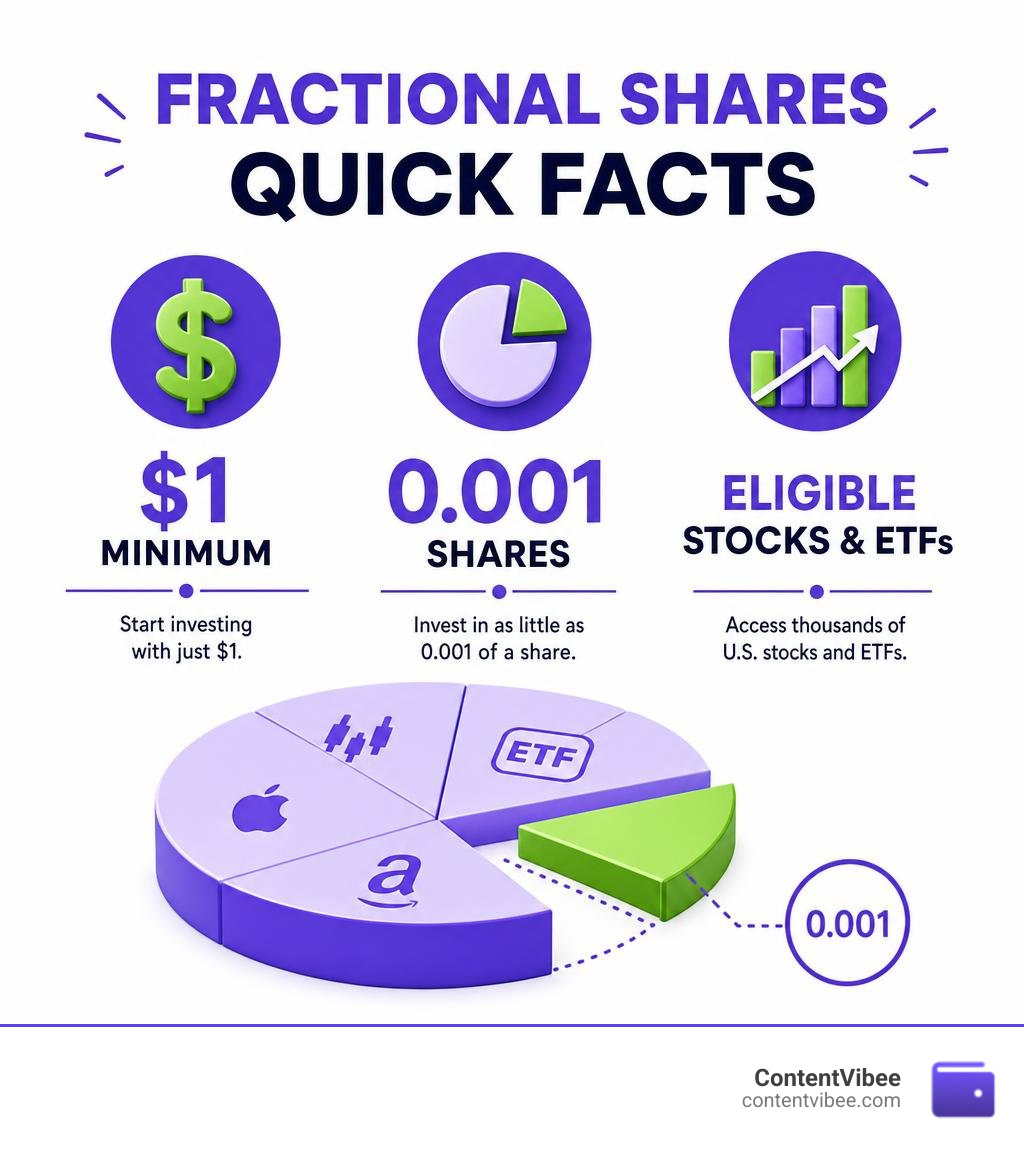
Fidelity brokerage fractional shares are worth considering if you want to invest small, exact dollar amounts in U.S. stocks and ETFs instead of saving up for full shares. You can start with $1, trade more than 7,000 eligible U.S. stocks and ETFs, and pay $0 commission for online U.S. stock and most ETF trades.
| Quick review point | What Fidelity offers |
|---|---|
| Minimum investment | $1 per order |
| Fraction size | As little as 0.001 share |
| Eligible investments | Thousands of U.S. stocks and ETFs |
| Main upside | Invest a fixed dollar amount and diversify sooner |
| Main catch | Fractional positions generally cannot transfer to another broker in kind |
For someone making a careful money decision, the appeal is simple: a high share price does not have to keep you from investing. You can put $25, $50, or $100 into an eligible investment and own the matching slice.
But convenience is not the same as a perfect fit. Fractional orders have regular-market-hours limits, sell-side regulatory assessments, and restrictions around transfers, voting, and some corporate actions. This review explains where Fidelity’s feature is strong, where the fine print matters, and whether it fits your goals.
What Are Fidelity Brokerage Fractional Shares and How Do They Work?
When we look at traditional equity trading, purchasing stock required buying whole shares. If a blue-chip stock traded at $500 per share and you had $100 to invest, you were simply out of luck until you accumulated more capital.
Fidelity’s fractional share offering—often branded as dollar-based trading or “Stocks by the Slice”—changes that math. Instead of buying a specific quantity of full shares, you state the exact dollar amount you wish to spend. Fidelity calculates the corresponding fraction down to three decimal places (.001) and places the order for you.
For additional context on how Fidelity structures this service, check out the official Fidelity Stock Slices Information overview.
Understanding Fidelity Brokerage Fractional Shares Mechanics
Under the hood, fractional share trades operate differently than standard whole-share orders. When you enter a dollar-based order, two main mechanics come into play:
- Decimal Precision: Share quantities are calculated out to three decimal places (.001 shares) as long as the value of the trade meets the $1.00 minimum threshold. Dollar inputs can be specified out to two decimal places (e.g., $250.00).
- Order Execution & Principal Capacity: Orders placed with a fractional component are assigned a “Not Held” status. This grants the brokerage time and price discretion to execute the trade during regular market hours (9:30 a.m. to 4:00 p.m. ET).
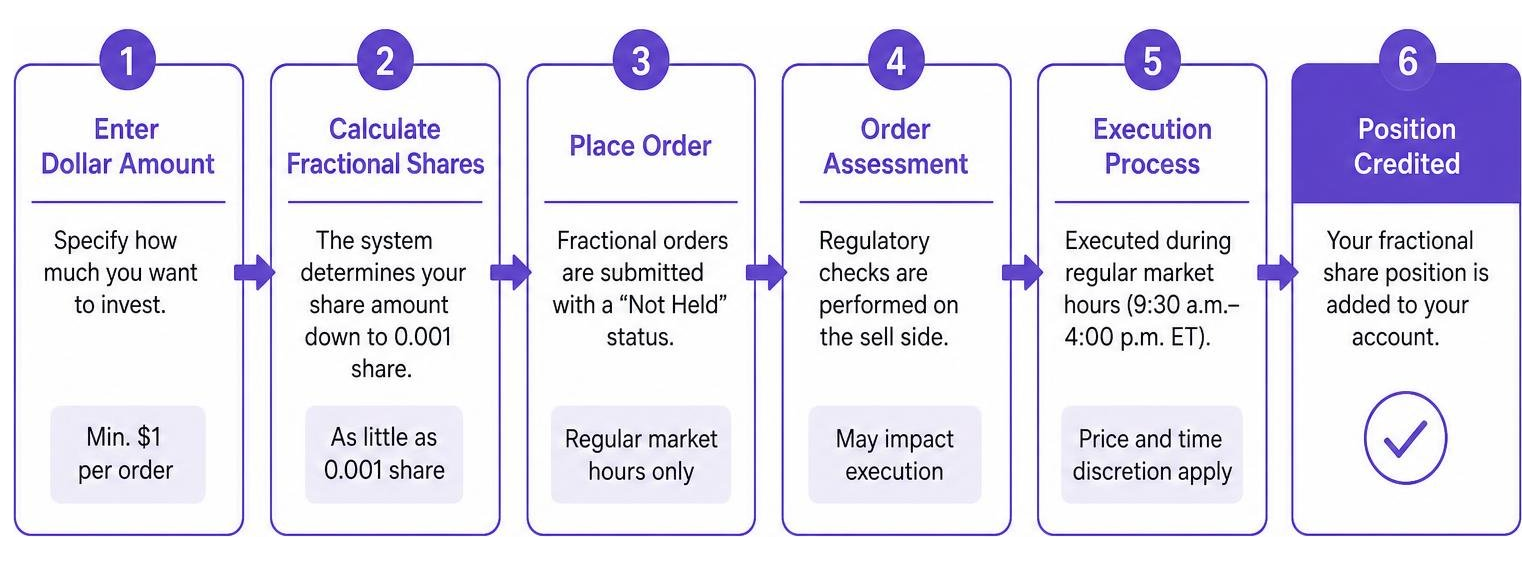
During execution, Fidelity functions in a mixed capacity: acting as an agent for the whole-share portion on the open market and as principal to fulfill the partial decimal share from its internal inventory.
Eligible Securities for Fidelity Brokerage Fractional Shares
You cannot buy fractions of every financial product on the market, but the coverage is substantial. At Fidelity, fractional trading applies to National Market System (NMS) securities listed on major American exchanges like the NYSE and Nasdaq.
- Over 7,000 Securities: Includes a broad universe of U.S. exchange-listed stocks and exchange-traded funds (ETFs).
- Ineligible Securities: OTC (over-the-counter) bulletin board stocks, foreign stocks not listed on NMS exchanges, mutual funds (which have their own minimum dollar structures), options, and fixed-income products cannot be purchased as partial shares under this program.
When Fidelity initially introduced real-time execution for stock slices, it fundamentally changed how retail investors constructed portfolios. You can read the historical release details in the official Fidelity Real-Time Fractional Trading Announcement.
How to Trade Fractional Shares on Fidelity

Placing a fractional share order on Fidelity’s desktop platform or mobile app is designed to feel as straightforward as making a standard digital purchase.
Step-by-Step Order Placement
If you are ready to place a trade, we recommend following these steps:
- Find Your Security: Search for your desired ticker symbol or company name in the search bar.
- Select the Action: Click Buy or Sell.
- Choose Your Order Type: Toggle the order input from “Shares” to “Dollars” (or enter fractional share quantities out to 3 decimal places).
- Enter Your Amount: Type in your target dollar value (minimum $1.00).
- Set Order Parameters: Select either a Market Order or Limit Order. Fractional trades are valid as “Day” orders only and cannot be executed in extended-hours trading.
- Preview and Submit: Review the trade details and confirm execution.
You can also automate this routine by establishing recurring dollar-based buys. This feature automatically pulls funds from your core position or linked bank account at scheduled intervals, promoting disciplined wealth building over time.
Supported Account Types
Fractional share trading is widely available across almost all retail account types at Fidelity. You are not restricted to basic taxable accounts. Eligible accounts include:
- Individual and Joint Taxable Brokerage Accounts
- Traditional IRAs, Roth IRAs, and Rollover IRAs
- Health Savings Accounts (HSAs)
- Fidelity Youth Accounts
- Self-Directed Workplace Retirement Plans (such as BrokerageLink accounts)
Fee Structure and Execution Costs
Understanding brokerage fees is critical for keeping your investment returns intact. Fortunately, Fidelity’s cost structure for dollar-based trading is as lean as it gets for retail investors.
To start, there are $0 account maintenance fees and $0 online commissions for U.S. stocks and ETFs. For a broader analysis of how Fidelity handles pricing across all account types, read our guide on Fidelity Brokerage Account Fees Review.
Regulatory and Activity Assessment Fees
While trading commissions are $0, every online stock sale across the brokerage industry is subject to mandatory regulatory pass-through fees. These are not broker markups; they offset fees levied by the SEC and financial exchanges.
- Assessment Rates: Typically range from $0.01 to $0.03 per $1,000 of principal on sell orders.
- Minimum Charge: If you sell a tiny dollar amount, the fee rounds down to $0.00 or up to a single penny depending on total trade volume.
For more details on commission structures, refer to the official Fidelity Commission and Fee Schedule. You can also explore our breakdown on Are Fidelity Stock Trading Fees Really Zero and check out Does Buying Stock Slices Cost Extra for an in-depth fee inspection.
If you are curious about other trading products like derivatives, read our review on Fidelity Options Fees Explained From Covered Calls To Iron Condors.
Core Cash Settlement Mechanics
When you deposit cash or receive proceeds from a stock sale at Fidelity, the funds sit in your designated core position.
Most individual accounts default to money market funds like SPAXX (Fidelity Government Money Market Fund). Uninvested cash in your core position earns daily interest while remaining liquid. When you execute a fractional share buy, funds are automatically swept from your core position without requiring manual money transfers.
For answers to common cash balance questions, review the official Fidelity Trading FAQs.
Strategic Benefits, Risks, and Limitations

Fractional share investing provides significant advantages, particularly for those building wealth on a regular income. However, investors must balance these benefits against specific platform constraints.
Advantages of Fractional Investing
- Instant Diversification: Instead of sinking $1,000 into a single whole share of an expensive tech stock, you can split that sum across 10 or 20 different companies.
- Elimination of Cash Drag: You never have idle dollars sitting uninvested simply because they fall short of a full share price.
- Seamless Dollar-Cost Averaging: You can invest exact sums—such as $50 every Friday—regardless of fluctuating stock prices.
To explore how these strategic perks stack up overall, take a look at our full Fidelity Fractional Shares Review.
Platform Limitations and Restrictions
While the operational perks are clear, we must address the fine print and technical limitations:
- In-Kind Transfer Restrictions: Fractional share holdings cannot be transferred out to another financial institution via ACATS (Automated Customer Account Transfer Service). If you ever decide to transfer your brokerage account to another firm, all fractional positions must be liquidated into cash first.
- No Physical Certificates: You cannot request physical paper stock certificates for fractional positions.
- Corporate Actions & Proxy Voting: While you receive proportional proxy voting rights on whole-share portions, fractional share quantities generally do not carry voting rights and cannot participate in certain voluntary corporate actions like tender offers.
- Dividend Reinvestment (DRIP): Participating in Fidelity’s Dividend Reinvestment Program automatically converts cash dividends into fractional shares. However, selling positions that combine whole and fractional shares requires careful ticket entry to avoid unexpected unenrollment rules.
For readers comparing features across major online brokers, reviewing services like E*TRADE Fractional Shares offers additional perspective on how institutional policies differ.
Frequently Asked Questions About Fidelity Fractional Shares
What is the minimum investment required for fractional shares?
The absolute minimum investment required to buy or sell fractional shares at Fidelity is $1.00. Orders can be entered in dollar amounts out to two decimal places ($0.01) or share quantities out to three decimal places (.001 shares).
Can fractional shares be transferred out to another broker?
No. Fractional share positions cannot be transferred in-kind through the ACATS network or converted into paper stock certificates. If you initiate a full account transfer to an external brokerage, Fidelity will automatically liquidate any fractional share components into cash and transfer the cash proceeds alongside your whole-share positions.
How are dividend payments handled for fractional shares?
Dividends on fractional share positions are paid out proportionally based on the fraction of the share you own. The payment is calculated out to the nearest cent ($0.01). If you hold 0.5 shares of a stock paying a $1.00 dividend per full share, you will receive $0.50 credited directly to your core money market position.
Conclusion
So, is fidelity brokerage fractional shares worth it? For the vast majority of retail investors, the answer is a resounding yes.
Fidelity has built one of the most accessible, low-cost trading platforms in the personal finance space. By offering $1 minimums, real-time execution, $0 online commissions, and access to over 7,000 stocks and ETFs, the platform removes almost all structural barriers for small-dollar investors.
While you should stay mindful of transfer restrictions and market-hours execution rules, these minor limitations rarely outweigh the immense benefit of immediate portfolio diversification and dollar-cost averaging.
At ContentVibee, our verdict is clear: if you want to start building a custom stock and ETF portfolio without needing thousands in initial capital, Fidelity’s fractional shares feature is an outstanding place to begin.
Ready to dive deeper into trading costs, platform limits, and strategy breakdown? Read Full Fidelity Fractional Shares Review on ContentVibee today!


