


Are Fidelity Brokerage Account Fees Actually Low? Here’s the Quick Answer
Fidelity brokerage account fees are among the lowest in the industry — but “low” doesn’t always mean “zero across the board.” Here’s a fast summary of what you’ll actually pay:
| Fee Type | Fidelity Cost |
|---|---|
| Online stock & ETF trades | $0 |
| Options trades | $0 + $0.65 per contract |
| Account minimum | $0 |
| Annual account fee | $0 |
| Inactivity fee | $0 |
| Account transfer out | $0 |
| Secondary market bonds/CDs | $1 per bond |
| US Treasuries (online) | $0 |
| NTF mutual fund short-term fee | $49.95 (held under 60 days) |
| Margin rates | 7.50% to 11.825% |
| Fidelity Go robo-advisor | $0 under $25,000 / 0.35%/yr above |
So yes — for most everyday investors, Fidelity costs very little to use. But a few fees do exist, and they can catch you off guard if you’re not paying attention.
Think about this: the difference between a 0.25% and a 1.00% expense ratio on a $100,000 portfolio could cost you nearly $30,000 over 20 years. Fees you don’t see often cost more than fees you do.
This review breaks down every major fee category at Fidelity — from trading commissions and margin rates to advisory costs and specialty services — so you know exactly what you’re paying before you invest a single dollar.
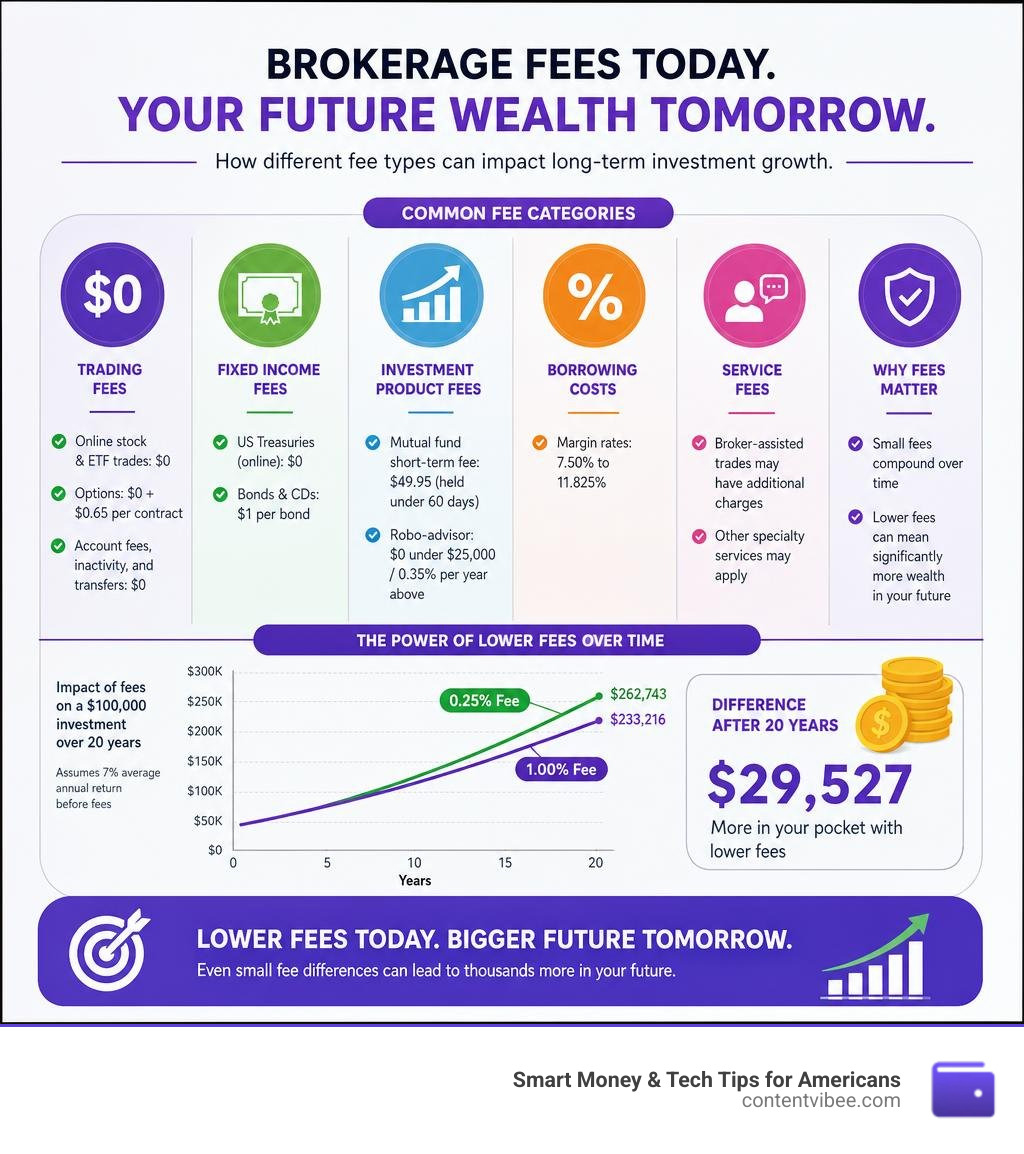
Similar topics to fidelity brokerage account fees:
Understanding Fidelity Brokerage Account Fees: The Core Costs
When we look for a new home for our hard-earned dollars, the last thing we want is to be nickeled-and-dimed just for letting our money sit there. Fortunately, when you open a standard Fidelity Brokerage Account from Fidelity Investments, you are entering a largely fee-free zone for basic account maintenance.
Fidelity charges $0 in annual account fees and has no inactivity fees if you take a break from trading. There are also no minimum balance requirements to open or maintain a retail brokerage account, including Traditional and Roth IRAs.

However, how you place your trades matters. While online DIY investing is free for US stocks and ETFs, utilizing older or more hands-on methods will cost you. If you are wondering is fidelity actually free or are you the product, the answer lies in understanding their tiered service channels.
Here is how trading costs stack up depending on how you execute your transaction:
| Trading Channel | Commission / Fee per Trade |
|---|---|
| Online Self-Directed | $0.00 |
| FAST (Automated Phone) | $12.95 |
| Representative-Assisted | $32.95 |
By sticking to the online portal, the mobile app, or Active Trader Pro, you avoid these heavy transactional markups entirely.
How Fidelity Brokerage Account Fees Apply to Stocks and ETFs
For the vast majority of retail investors, trading stocks and Exchange-Traded Funds (ETFs) online at Fidelity will cost exactly $0.00 in commissions. This applies to any number of shares or trades you place throughout the day.
Fidelity also supports dollar-based investing, which allows you to purchase fractional shares of popular stocks and ETFs. This means you do not need to save up hundreds of dollars to buy a single share of a tech giant; you can invest as little as $1.00.
To understand how these micro-transactions interact with the platform’s cost structures, you can read our breakdown of the fidelity fee per trade. If you want to build a long-term portfolio without giving up a slice of your profits to transaction friction, check out our guide on how to buy and sell stocks without losing your shirt to fees.
Comparing Fidelity Brokerage Account Fees for Mutual Funds
Mutual funds are a core component of many retirement portfolios, and Fidelity is highly competitive in this space. They offer access to thousands of mutual funds, including over 3,200 No-Transaction-Fee (NTF) funds.
Even better, they offer the industry’s first ZERO expense ratio index mutual funds (such as the Fidelity ZERO Large Cap Index Fund). These funds have absolutely no management fees, meaning 100% of your money goes toward tracking the index.
However, “free” mutual fund trading comes with a major caveat. If you buy a No-Transaction-Fee fund and sell it too quickly, you will face a short-term trading fee of $49.95 for shares held less than 60 days. This fee is designed to discourage short-term trading and protect long-term fund shareholders from transaction costs.
For funds that are not on the NTF list, you can expect to pay a transaction fee of up to $49.95 per online purchase. To avoid these charges, we highly recommend reading our analysis of fidelity mutual fund trade fee when is free not actually free and our tips on selling your shares without losing your shirt to fees.
Options and Fixed Income Trading Costs
If you want to trade options or fixed-income products, the fee structure shifts slightly:
- Options Trading: Online options trades carry a $0 base commission, but you will pay a $0.65 per-contract fee. However, Fidelity offers a customer-friendly rule: buy-to-close orders for contracts priced between $0.00 and $0.65 are commission-free and do not incur the contract fee. To understand how these rules work, check out our resource on fidelity options fees explained and demystified.
- Fixed Income (Bonds & CDs): Buying US Treasuries online at Fidelity is completely free. For secondary market bonds and Certificates of Deposit (CDs), Fidelity charges a very reasonable $1.00 per bond or CD.
- Assisted Trades: If you need a broker to place these trades for you over the phone, prepare for a steep fee. You can learn more about these charges in our guide to the broker-assisted trade fee fidelity.
Margin Rates and Specialty Service Fees
For advanced investors looking to leverage their portfolios, trade international assets, or hold physical precious metals, Fidelity charges a variety of specialty fees.

Before engaging in advanced trading strategies, it is highly recommended to review the official Trading Commissions and Margin Rates | Fidelity page as well as the comprehensive Brokerage Commission and Fee Schedule.
Margin Interest Rates Explained
Margin trading allows you to borrow money against your eligible securities to purchase additional stocks or ETFs. This leverage can amplify your gains, but it can also magnify your losses—and it is never free.
Fidelity uses a tiered interest rate structure based on your total debit balance. As of June 2026, these margin rates range from 7.50% to 11.825%. The more money you borrow, the lower your interest rate will be:
- Balances under $25,000: Highest tier (base rate plus premium)
- Balances over $1,000,000: Lowest tier (as low as 7.50%)
That margin rates are variable and tied to the target federal funds rate, so they can fluctuate over time.
International Trading and Foreign Currency Exchange
If you want to trade foreign stocks directly on international exchanges, Fidelity provides access to 25 international markets and 16 currencies. However, this convenience comes with extra costs:
- Foreign Currency Exchange: Fidelity charges a fee of up to 1.00% of the transaction value for converting US Dollars to foreign currency (and vice versa).
- Country-Specific Taxes: Many foreign governments levy transaction taxes or stamp duties that are passed directly to the investor.
- Foreign Ordinary Shares: Trading foreign stocks that trade on US over-the-counter (OTC) markets (known as F-shares) may carry a transaction fee of up to $50 per trade if they are not on Fidelity’s service-fee-exempt list.
Specialized Account Services and Miscellaneous Fees
While everyday account management is free, certain specialized requests carry administrative costs:
- Fidelity Basket Portfolios: If you want to use their unlimited basket trading service—which allows you to manage and trade custom groups of stocks and ETFs as a single investment—Fidelity charges a flat monthly subscription fee of $4.99.
- Precious Metals Storage: If you buy physical gold, silver, platinum, or palladium through your brokerage account, you will pay a quarterly storage fee of 0.125% of the total value (or a $3.75 minimum, whichever is greater). There is also a minimum transaction fee of $44 for precious metals trades.
- Wire Transfers: Domestic bank wires are completely free at Fidelity (a service that competitors often charge $15 to $25 for). However, foreign currency wires can incur fees of up to 3% of the principal.
Advisory Services and Robo-Advisor Costs
Not everyone wants to manage their own portfolio. If you prefer to hand the steering wheel over to professionals, Fidelity offers several tiers of advisory services.
To get a complete overview of what these managed services will cost you over time, we suggest reading the no nonsense guide to fidelity robo advisor fees as well as a complete breakdown of fidelity advisor directed fees.
Robo-Advisor Pricing Structure
Fidelity Go is their digital robo-advisor service designed for hands-off investors. It automatically builds, monitors, and rebalances a portfolio of zero-expense-ratio mutual funds based on your goals and risk tolerance.
Fidelity Go uses a highly competitive tiered pricing model:
- Balances under $25,000: $0 management fee (completely free).
- Balances of $25,000 and above: 0.35% annual asset-under-management (AUM) fee.
This flat AUM fee covers all advisory and rebalancing services, making it an incredibly affordable entry point for newer investors.
Wealth Management and Private Advisory Fees
For high-net-worth individuals who require comprehensive financial planning, tax optimization, and estate planning, Fidelity offers personalized wealth management services.
These services typically require a minimum investment of $500,000 for Wealth Management and $2,000,000+ for Private Wealth Management. The advisory fees for these tiers generally range from 0.50% to 1.50% AUM annually, depending on the complexity of your estate and the size of your portfolio.
Frequently Asked Questions About Fidelity Fees
Are there any hidden inactivity or account closure fees?
No. Unlike several major competitors, Fidelity charges $0 for account inactivity and $0 to close your account or transfer your assets out to another institution (a full account transfer out at some competitors can cost $50 or more).
How much does it cost to trade options online?
Online options trades carry a $0 base commission plus $0.65 per contract. There are no fees for exercising or being assigned on options contracts, and buy-to-close trades on contracts valued under $0.65 are free.
What is the short-term trading fee for mutual funds?
If you buy a No-Transaction-Fee (NTF) mutual fund and sell or exchange it within 60 days, Fidelity charges a flat $49.95 short-term trading fee online. This does not apply to Fidelity’s own mutual funds or transaction-fee funds.
Conclusion
At Smart Money & Tech Tips for Americans, we believe that understanding where your money goes is the first and most important step to building long-term wealth. Fidelity’s commitment to fee transparency and zero-commission core services makes it one of the absolute best brokerages on the market in June 2026.
By sticking to online self-directed trades, avoiding short-term mutual fund flips, and utilizing their zero-expense-ratio index funds, you can run a highly sophisticated investment portfolio virtually for free.
For a deeper look into how they compare to the rest of the industry, read our full fidelity cost transparency review. Ready to take control of your financial future? Minimize your costs, maximize your returns, and keep more of your hard-earned money working for you!


