


The Hidden Cost of Selling Stocks (And Why It Matters More Than You Think)
Is there a fee for selling stocks? Here’s the quick answer:
| Trade Type | Typical Fee |
|---|---|
| Online stock trade (major brokerages) | $0 commission |
| Broker-assisted trade | $25–$32.95 extra |
| Automated phone trade | $12.95 |
| SEC Section 31 regulatory fee | $0.0000206 per $1 of sale |
| FINRA Trading Activity Fee | $0.000195 per share sold |
| OTC stock trade | $4.95–$6.95 |
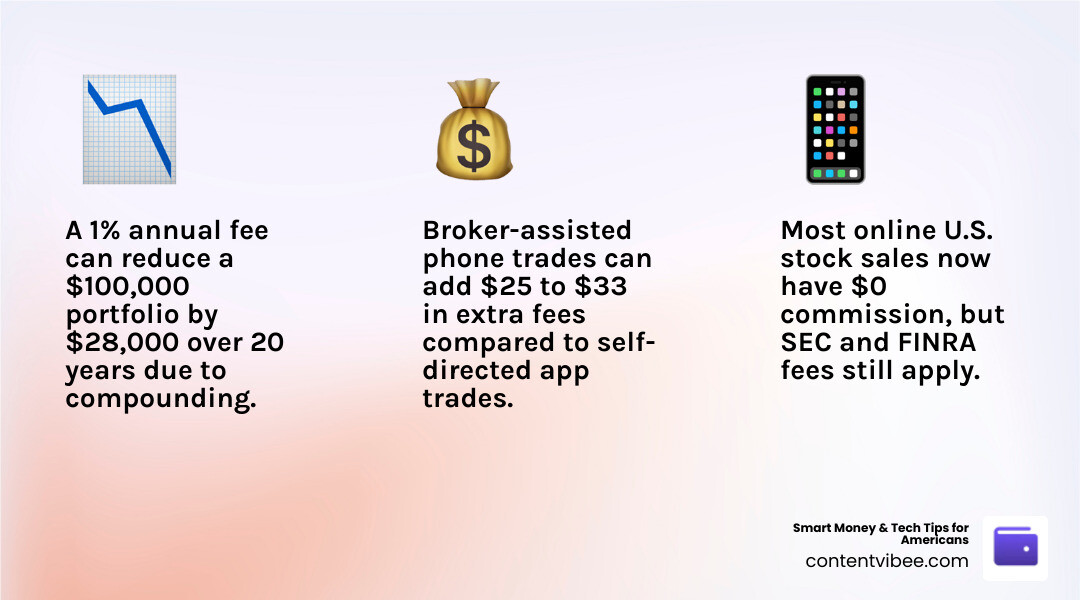
So the short version: most online stock sales cost $0 in commission at major brokerages like Fidelity, Schwab, E*TRADE, Merrill, and Interactive Brokers. But that doesn’t mean selling is completely free.
Small regulatory fees still apply to every sell order. And if you’re trading anything other than standard listed stocks — or picking up the phone instead of clicking a button — the costs jump fast.
Here’s why this matters: fees compound just like returns do, but in reverse. A 1% annual fee on a $100,000 investment earning 4% doesn’t sound like much. But over 20 years, it quietly drains $28,000 from your portfolio — money that was never lost to the market, just to costs.
For a busy professional already frustrated by mutual fund fees eating into returns, understanding exactly what you’re paying to sell stocks — and where the real costs hide — is the first step to keeping more of what you earn.
Is There a Fee for Selling Stocks in 2026?
As we navigate the financial landscape of May 2026, the question of whether you’ll be hit with a bill for hitting the “sell” button is more nuanced than a simple yes or no. For the vast majority of everyday investors using major platforms, the headline commission is a flat zero. We have moved firmly into the era of the “self-directed” trade, where you do the work on your smartphone or laptop, and the brokerage rewards you with a $0 commission.
However, the term “commission-free” can be a bit of a siren song. While you won’t see a $4.95 or $6.95 charge listed as a “commission” on your trade confirmation for a standard U.S. stock, other costs are lurking in the shadows. According to FINRA.org, even “zero-commission” brokerages have to keep the lights on. They do this through margin interest, payment for order flow, and various service fees.
When you are Selling Your Shares Without Losing Your Shirt to Fees, you must distinguish between the commission (what the broker charges for the service) and the transaction fees (what the government or regulators charge to process the trade). In 2026, the commission is usually gone, but the transaction fees remain.

The Shift to Commission-Free Trading
It wasn’t that long ago that every trade felt like a significant dent in your capital. The industry shift toward $0 commissions for online U.S.-listed stocks and ETFs was sparked by a competitive race to the bottom among major firms. Today, if a brokerage wants to attract American investors, they almost have to offer free trades for standard equities.
This shift has been a massive win for the “little guy.” It allows for strategies like dollar-cost averaging into small positions without the Brokerage Fee Stock Market eating 10% of your principal. Whether you are using a mobile app on your commute or a sophisticated desktop platform, the standard for a “self-directed” trade in 2026 is $0. This applies to stocks listed on major exchanges like the NYSE or NASDAQ, as well as most Exchange-Traded Funds (ETFs).
Hidden Costs and Is There a Fee for Selling Stocks via Phone?
While the digital world is mostly free, the “analog” world is anything but. If you find yourself in a situation where you can’t access your app and need to call a human being to execute a trade, prepare for sticker shock.
Is there a fee for selling stocks over the phone? Absolutely. Most major brokerages charge a “Broker-Assisted” fee that typically ranges from $25 to $32.95 per trade. This fee is added on top of any other applicable costs. Even using an automated telephone system (often called “FAST” or IVR) usually carries a fee of around $12.95.
The lesson here is clear: if you want to keep your costs at zero, stay on the app. We always recommend ensuring your digital access is secure and functional so you don’t get Short Changed by Hidden Commission in Stock Market Trades simply because you needed a representative’s help to click a button.
Regulatory and Third-Party Transaction Fees
Even when your broker claims a $0 commission, you will notice a few cents or dollars missing from your final sale proceeds. These aren’t “hidden” fees in the sense that they are a secret; they are “pass-through” costs. These are fees charged by the Securities and Exchange Commission (SEC) and the Financial Industry Regulatory Authority (FINRA) to cover the costs of regulating the markets.

These fees only apply to sell orders. When you buy a stock, you usually don’t pay them. When you sell, the broker collects them from you and passes them along to the government.
SEC Section 31 and FINRA Trading Activity Fees
The two main culprits are the SEC Section 31 Fee and the FINRA Trading Activity Fee (TAF).
- SEC Section 31 Fee: As of our current date in May 2026, this fee is calculated as $0.0000206 per $1 of principal. For example, if you sell $10,000 worth of stock, the SEC fee would be roughly $0.21. The SEC adjusts this rate periodically (at least once a year) to ensure they collect enough to cover their operating budget.
- FINRA TAF: This is a much smaller per-share fee. It is currently $0.000195 per share for equity sales. However, it is capped at $9.79 per transaction. So, even if you sell a million shares of a penny stock, you won’t pay more than $9.79 for the TAF.
| Fee Type | Current Rate (May 2026) | Applies To |
|---|---|---|
| SEC Section 31 | $0.0000206 per $1 of sales | All Sell Orders |
| FINRA TAF | $0.000195 per share | All Sell Orders |
| Options Regulatory Fee (ORF) | Varies by Exchange | Options Sells |
While these amounts seem trivial, they are mandatory. You’ll see them listed on your trade confirmation as “Fees” or “Additional Assessments.” For a high-frequency trader, these can add up, but for the long-term investor, they are usually just a few pennies on the dollar.
Comparing Fees Across Different Investment Types
Not all investments are created equal in the eyes of a brokerage’s billing department. While your Apple or Tesla stock might sell for $0 commission, other assets carry different price tags.
For instance, Options contracts usually come with a “per-contract” fee. While the base commission for the trade might be $0, you’ll often pay $0.65 per contract. If you’re a heavy hitter doing 30+ trades a quarter, some brokers drop that to $0.50.
Then there are OTC (Over-The-Counter) stocks, often referred to as “penny stocks.” Because these aren’t listed on major exchanges, they are harder to trade. Most brokers charge a flat commission for these, often $6.95 per trade. If you are looking for Understanding Investment Advisory Fees, these transaction costs are separate from the annual percentage your advisor might charge.
Is There a Fee for Selling Stocks vs. Mutual Funds?
This is where things get tricky. Selling a mutual fund is a different beast than selling a stock.
Many brokerages offer “No-Transaction-Fee” (NTF) mutual funds. However, if you buy a fund that isn’t on their “free” list, you could pay a $49.95 transaction fee just to sell it. Furthermore, mutual funds often have short-term redemption fees. If you sell a fund within 60 days of buying it, the fund company (not necessarily the broker) might charge you a fee to discourage “market timing.”
We also have to consider the internal Why Investment Manager Software Fees and expense ratios. While not a “selling fee” per se, these costs are deducted from the fund’s assets daily. If you are paying a 1% expense ratio, you are essentially paying a “fee” every single day you hold the fund, which reduces your final payout when you eventually sell.
How to Minimize Costs and Maximize Your Returns
Keeping your hard-earned money requires a bit of strategy. The goal is to avoid the “death by a thousand cuts” that comes from small, avoidable fees.
- Go Paperless: Many brokers now charge a $2.00 per quarter fee just to mail you a paper statement. Over 30 years, that’s $240 wasted. Switch to electronic delivery; it’s faster, more secure, and usually free.
- Watch the Holding Period: To avoid mutual fund redemption fees, check the prospectus. Most funds require you to hold for at least 60 to 90 days to avoid a penalty.
- Use Limit Orders: While not a direct fee, using “Market Orders” can cost you money via the “bid-ask spread.” By using a limit order, you control the price you get, ensuring you don’t “pay” more than you intended through a poor execution price.
- Avoid Inactivity: Some “boutique” brokers still charge inactivity fees if you don’t trade for a year. If you’re a “buy and hold” investor, make sure your broker doesn’t penalize you for your patience.
- Be Mindful of ADRs: If you own foreign stocks via American Depositary Receipts (ADRs), the depositary bank can charge “custody fees” ranging from $0.01 to $0.05 per share annually. This is often deducted directly from your dividends or account balance.
By staying informed on Costs of Investing Breakdown – International Markets, you can ensure that your move into global stocks doesn’t come with unexpected tax or settlement surprises.
Frequently Asked Questions about Stock Selling Fees
Are stock selling fees tax-deductible?
The short answer is: No, not directly. Since the Tax Cuts and Jobs Act of 2018, miscellaneous itemized deductions (which included brokerage fees) have been suspended. However, there is a silver lining. When you sell a stock, the commissions and regulatory fees are typically baked into your “cost basis” or deducted from your “sales proceeds.” This means they effectively reduce your capital gains, which does lower your tax bill. You just don’t list them as a separate deduction on your 1040.
Do fractional shares have different fees?
Generally, no. Most modern brokers treat fractional shares the same as whole shares. If the commission is $0, it’s $0 for 0.5 shares or 500 shares. However, some brokers like Interactive Brokers have a minimum commission (like $0.01) for fractional trades to cover the clearing costs. Always check your broker’s specific “Fractional Share Disclosure.”
What is an inactivity fee?
An inactivity fee is a charge levied by a brokerage if there has been no trading activity or if the account balance falls below a certain threshold for a specific period (usually a year). While major brokers like Fidelity and Schwab have largely eliminated these for retail accounts, some specialized or international platforms still charge $50 to $200 per year. If you plan to hold your stocks for decades without touching them, ensure your broker doesn’t have an “Account Maintenance” or “Inactivity” fee.
Conclusion
At Smart Money & Tech Tips for Americans, we believe that financial literacy is the best defense against portfolio erosion. While the answer to “is there a fee for selling stocks” is technically “yes” due to regulatory pass-throughs, the era of the expensive $50 trade is over for the average American investor.
By choosing a reputable brokerage, trading online, and opting for electronic communications, you can keep your transaction costs to a fraction of a percent. Every dollar you save in fees is another dollar that can benefit from the power of compounding.
Don’t let small costs derail your big dreams. Stay vigilant, review your trade confirmations, and keep Selling Your Shares Without Losing Your Shirt to Fees as a core part of your long-term wealth-building strategy.
Data Disclaimer: Statistics regarding the impact of fees on returns are based on hypothetical 7% annual returns over 30 years with monthly contributions of $500. Actual market returns vary and are not guaranteed. Always consult with a tax professional regarding the deductibility of investment expenses.


