


Why Mutual Fund Fees Can Quietly Drain Your Retirement
Mutual fund fees are the costs you pay — directly or indirectly — to own and operate a mutual fund. They come in two main forms:
- Shareholder fees — one-time charges like sales loads, redemption fees, and account fees
- Annual fund operating expenses — ongoing costs like management fees, 12b-1 fees, and administrative expenses, expressed as an expense ratio
Common mutual fund fee types at a glance:
| Fee Type | What It Is | Typical Range |
|---|---|---|
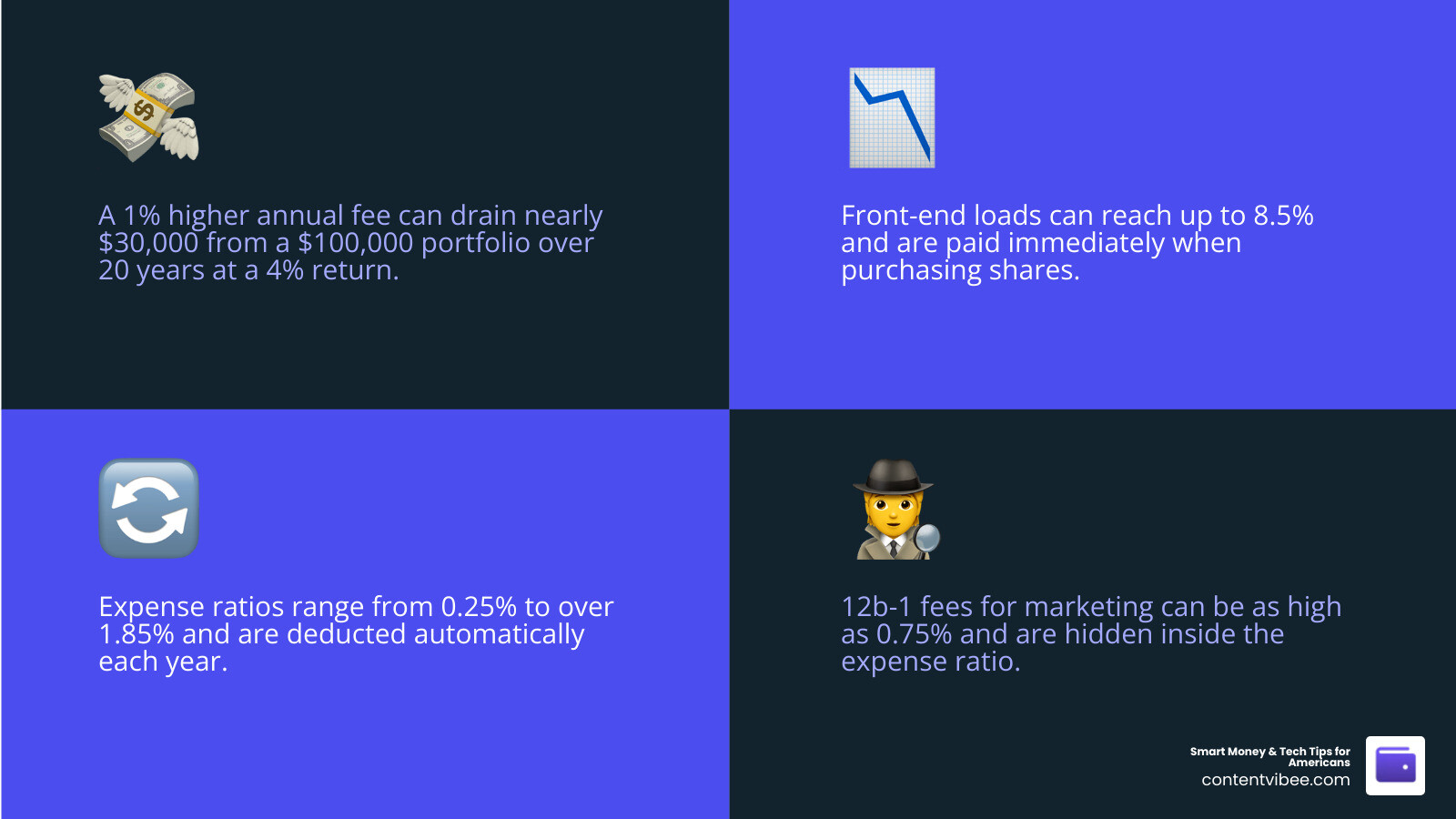
| Front-end sales load | Paid when you buy shares | Up to 8.5% (typically 2–5%) |
| Back-end sales load | Paid when you sell shares | Up to 8.5% |
| Expense ratio | Annual operating costs | 0.25% – 1.85%+ |
| 12b-1 fee | Marketing/distribution cost | Up to 0.75% |
| Redemption fee | Fee to exit the fund | Up to 2% |
| Account fee | Maintenance charge | Varies |
Every mutual fund charges fees. No exceptions. The question is how much — and whether you know what you’re paying.
Here’s why it matters more than most people realize: a 1% difference in annual fees on a $100,000 portfolio can cost you nearly $30,000 over 20 years, even at a modest 4% annual return. That’s not a rounding error. That’s a car, a college semester, or years of retirement income — quietly disappearing in the background.
Most busy investors don’t notice because the fees are never sent as a bill. They’re deducted from fund assets before you ever see your returns. The fund looks like it’s earning less. You assume it’s the market. But often, it’s the fees.
The Anatomy of Mutual Fund Costs: Shareholder vs. Operating Expenses
To compare mutual fund fees like a pro, we first need to split them into the two buckets regulators use in a fund prospectus: shareholder fees and annual fund operating expenses. The SEC’s Mutual Fund Fees and Expenses bulletin uses this same framework, and it is the cleanest way to understand what you are really paying.
Shareholder fees
These are charges you may pay directly when you buy, sell, exchange, or maintain your investment. Common examples include:
- Front-end sales loads
- Back-end sales loads
- Redemption fees
- Purchase fees
- Exchange fees
- Account fees
These charges usually happen at a transaction point. Think of them as toll booths.
Annual fund operating expenses
These are ongoing costs deducted from fund assets, which means you pay them indirectly. They typically include:
- Management fees
- 12b-1 fees
- Other administrative and operating expenses
Together, these usually appear as the fund’s expense ratio. If you want a deeper breakdown of management costs specifically, see Average Management Fee for Mutual Funds and How to Master Management Expense Ratio Mutual Funds Without a Math Degree.
What each fee actually covers
Here is the plain-English version:
- Management fees pay the investment adviser for selecting and managing the portfolio.
- 12b-1 fees cover distribution, marketing, and sometimes shareholder servicing.
- Other expenses can include custody, legal, accounting, transfer agency, and recordkeeping costs.
- Redemption fees are charged when you sell too quickly in some funds, often to discourage short-term trading.
- Purchase fees are charged at the time of purchase, but unlike a load, they usually go to the fund rather than a broker.
- Exchange fees may apply if you switch between funds in the same fund family.
- Account fees can cover maintenance for small balances or special services.
One important nuance: the expense ratio does not include every possible cost. Sales loads, commissions, and some transaction costs are not part of the expense ratio. So if you only compare expense ratios and ignore shareholder fees, you can still miss the full picture.
The Hidden Impact of mutual fund fees on Your Portfolio
Tiny percentages have a talent for looking harmless. Over time, they are not harmless at all.

According to investor education materials cited in the research, a $100,000 portfolio earning 4% annually could grow to roughly:
- $208,000 with 0.25% annual fees
- $198,000 with 0.50% annual fees
- $179,000 with 1.00% annual fees
That means the jump from 0.25% to 1.00% can leave you with nearly $30,000 less over 20 years. Same market return. Different fee drag.
If you want to see how this math plays out in more detail, our Expense Ratio Impact Guide and Expense Ratio Impact Calculator can help.
Why fees hurt more than they seem
Fees do not just reduce returns once. They reduce the base that can compound in future years. So you lose:
- The fee itself
- The growth that fee money could have earned later
- The growth on that missed growth
That is why even a difference that looks tiny on paper can feel very large by retirement.
Fee trends have improved, but comparison still matters
There is good news here. Since 1980, average mutual fund costs have fallen substantially:
- Equity mutual funds: down 45%
- Bond mutual funds: down 42%
- Money market mutual funds: down 38%
Competition, larger fund sizes, and growing interest in lower-cost investing have helped. But “fees have come down” does not mean “all funds are cheap.” There is still a wide gap between lower-cost and higher-cost options, especially across share classes and active vs. passive strategies.
A fund with higher costs must outperform a cheaper fund just to deliver the same net return to you. That is a tough handicap to overcome year after year.
Decoding Sales Loads: Front-End, Back-End, and No-Load Funds
Sales loads are basically commissions attached to mutual fund purchases or sales. They often appear in certain share classes.
Front-end load
A front-end load is charged when you buy shares. If you invest $10,000 in a fund with a 5% front-end load, about $500 goes to the sales charge and only $9,500 gets invested.
That means your investment starts behind the starting line. Not ideal.
Front-end loads are commonly associated with Class A shares.
Back-end load
A back-end load is charged when you sell shares. This is often called a contingent deferred sales charge, or CDSC. You invest the full amount up front, but if you sell during a certain holding period, you pay a fee on the way out.
Example:
- Invest $10,000
- Sell while a 5% back-end load still applies
- You could owe around $500, depending on the calculation method and the fund rules
Back-end loads have historically been associated with Class B shares, often with a schedule that declines over time, such as 5% in year 1, 4% in year 2, and eventually 0%.
Level-load structures
Class C shares often avoid a big front-end charge but may impose ongoing distribution fees and sometimes a smaller short-term back-end charge. They can look cheaper at first and costlier over time. Sneaky, but legal.
No-load funds
A no-load fund does not charge a front-end or back-end sales load. However, no-load does not mean no fees.
A fund may still charge:
- Redemption fees
- Exchange fees
- Account fees
- Purchase fees
- Limited distribution or service fees
Under industry rules, a fund can generally still call itself no-load if distribution and service fees stay within a narrow cap, commonly up to 0.25% annually.
For a good plain-language overview of load structures and related terms, FINRA’s Mutual Funds – Fees and Expenses | FINRA.org is useful. If you are focused on selling costs specifically, our guide Selling Your Shares Without Losing Your Shirt to Fees is worth a read.
Comparing mutual fund fees Across Share Classes
The same underlying mutual fund may be sold in multiple share classes with different pricing.
The most common pattern looks like this:
| Share Class | Typical Fee Style | Best Fit Depends On |
|---|---|---|
| Class A | Front-end load, lower ongoing fees | Larger, longer-term investments |
| Class B | Deferred sales charge, higher ongoing fees | Less common today; holding period matters |
| Class C | Little or no front-end load, higher ongoing fees | Shorter holding periods, sometimes |
| No-load shares | No sales load, operating expenses still apply | Cost-conscious investors comparing net expenses |
The right share class depends on:
- How much you are investing
- How long you plan to stay invested
- Whether you qualify for discounts
- Whether an adviser is being compensated through the share class
Breakpoint discounts and other ways costs can drop
If you invest enough in certain Class A shares, you may qualify for breakpoint discounts, which lower the front-end load. You may also benefit from:
- Rights of accumulation, which count existing holdings toward discount thresholds
- Householding rules, where family accounts may be combined
- Letters of intent, where you commit to investing a certain amount over time
These discounts can materially reduce costs, so they are not minor details. They are money.
For more on comparing fee structures when evaluating providers and account options, see Why Fidelity Investments Fees Comparison.
Active vs. Passive Strategies and Regulatory Limits
One of the fastest ways to understand fund costs is to compare active and passive management side by side.
| Fund Type | Typical Cost Pattern | Why Costs Differ |
|---|---|---|
| Actively managed mutual funds | Usually higher expense ratios | Research, trading, manager oversight, marketing, and higher turnover |
| Passively managed index funds | Usually lower expense ratios | Rules-based tracking and generally lower operating complexity |
Index funds tend to cost less because they are trying to mirror a benchmark, not beat it. Active funds pay for managers, analysts, and usually more trading activity. More moving parts usually means more cost.
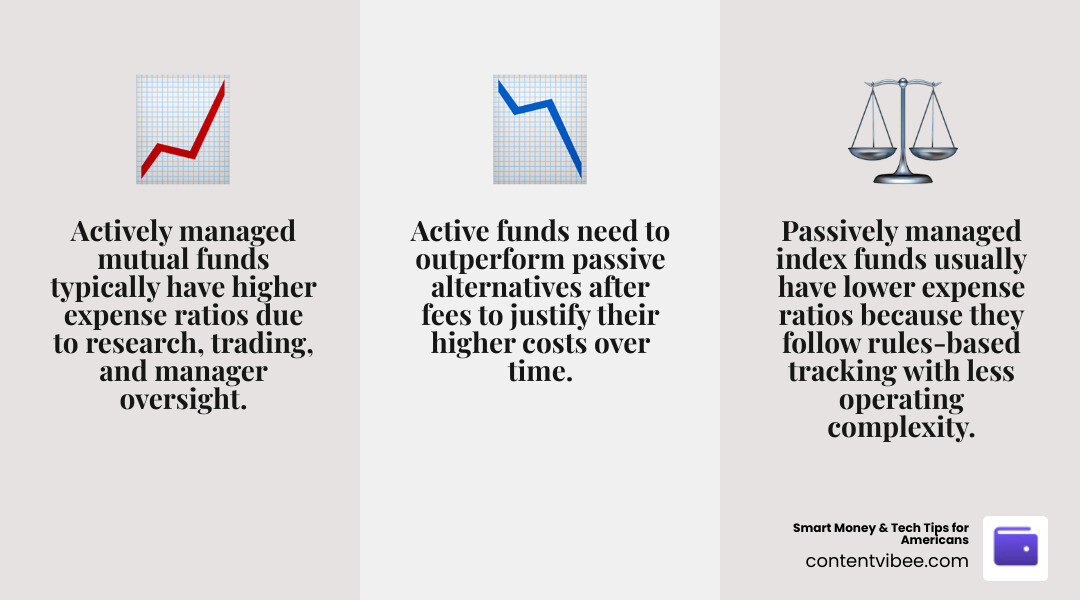
That does not mean active funds are automatically bad. It means they need to earn their keep. If an active fund charges more, we should expect a clear reason for it and compare the results after fees, not before.
For readers weighing broader investment platform and product costs, Why Robo Advisor Fees Comparison Matters can help put mutual fund expenses in context.
What regulators limit and who oversees fees
Mutual fund fees in the U.S. are overseen through a mix of SEC rules, fund board oversight, and FINRA limits on certain sales-related charges.
Key guardrails include:
- The SEC generally limits redemption fees to 2% in most situations.
- FINRA rules generally limit mutual fund sales loads to 8.5% of the initial investment.
- 12b-1 fees used for marketing and distribution generally cannot exceed 0.75% of average net assets per year.
- Shareholder service fees are generally capped at 0.25% annually.
- A no-load fund can still charge up to 0.25% in certain distribution or service fees and still use the no-load label.
So yes, there are limits, but they do not mean every fund is cheap. They simply set the fence line. Funds still have plenty of room inside that fence to charge meaningfully different amounts.
For a concise glossary-style summary, see Mutual Fund and ETF Fees and Expenses – Investor.gov.
Strategies to Minimize mutual fund fees
If we want to keep more of our returns, here is the playbook:
Compare funds with similar objectives
Do not compare a U.S. stock index fund to an emerging markets active fund and call it a day. Compare like with like.Read the prospectus fee table
Look for both:
- Shareholder fees
- Annual fund operating expenses
Focus on the expense ratio, but not only the expense ratio
It is crucial, but it does not include loads and certain transaction charges.Prefer no-load funds when suitable
No-load often removes one major layer of cost, though not all costs.Check for fee waivers and expense reimbursements
Some funds temporarily cap expenses. Great, but always ask when the waiver expires.Use comparison tools
FINRA’s Fund Analyzer is one of the best known tools for estimating and comparing long-term ownership costs.Ask which share class is actually best for your holding period
A fund can have several share classes, and the cheapest one for 2 years may not be the cheapest one for 15.Watch adviser and account-level fees too
Fund fees are only one layer. Depending on where you invest, you may also pay advisory, wrap, or account fees. Our guides on Why Wealthfront Investment Fees and What Are Wealth Management Fees can help you zoom out and see the full stack of costs.
Frequently Asked Questions about Mutual Fund Costs
Does the SEC limit how much a mutual fund can charge?
Not across the board. The SEC generally does not set a universal cap on all mutual fund fees. One important exception is that redemption fees are generally limited to 2% in most cases. Other practical limits come from FINRA rules on sales loads and 12b-1 fees, plus oversight from the fund’s board of directors.
In short: there is regulation, but investors still need to compare costs carefully.
What is the difference between a front-end and back-end sales load?
A front-end load is charged when you buy shares, reducing the amount that gets invested immediately. A back-end load is charged when you sell shares, often only if you exit within a certain number of years.
Quick example:
- Front-end load: invest $10,000 with a 5% load, and about $9,500 goes to work
- Back-end load: invest the full $10,000, but pay the fee later if you redeem during the charge period
Can a fund call itself “no-load” if it still charges 12b-1 fees?
Yes, in limited circumstances. A fund can generally still be called no-load if its distribution and/or service fees stay within the allowed no-load threshold, commonly up to 0.25% annually. But if those fees are higher, calling it no-load would not be accurate.
This is why “no-load” should never be confused with “free.”
Conclusion
Mutual fund fees are not the most exciting part of investing, but they are one of the most important. They affect what gets invested, what stays invested, and how much compound growth you actually keep.
At Smart Money & Tech Tips for Americans, we think the smartest investors are not the ones who memorize every fee acronym. They are the ones who ask simple questions:
- What am I paying?
- When am I paying it?
- Is this share class the best fit?
- Am I getting enough value for the cost?
If you start there, you are already ahead of a lot of people.
For a deeper dive into one of the biggest ongoing costs, check out Average Management Fee for Mutual Funds. The goal is not to eliminate every fee. The goal is to avoid paying more than necessary so more of your money can stay focused on long-term growth instead of quietly vanishing like a retirement ghost.


