


Why the Margin Formula in Accounting Can Make or Break Your Business
Understanding margin formula accounting is one of the most practical financial skills you can have — whether you run a small business, invest in stocks, or are planning retirement income from business assets.
Quick answer: What is the margin formula in accounting?
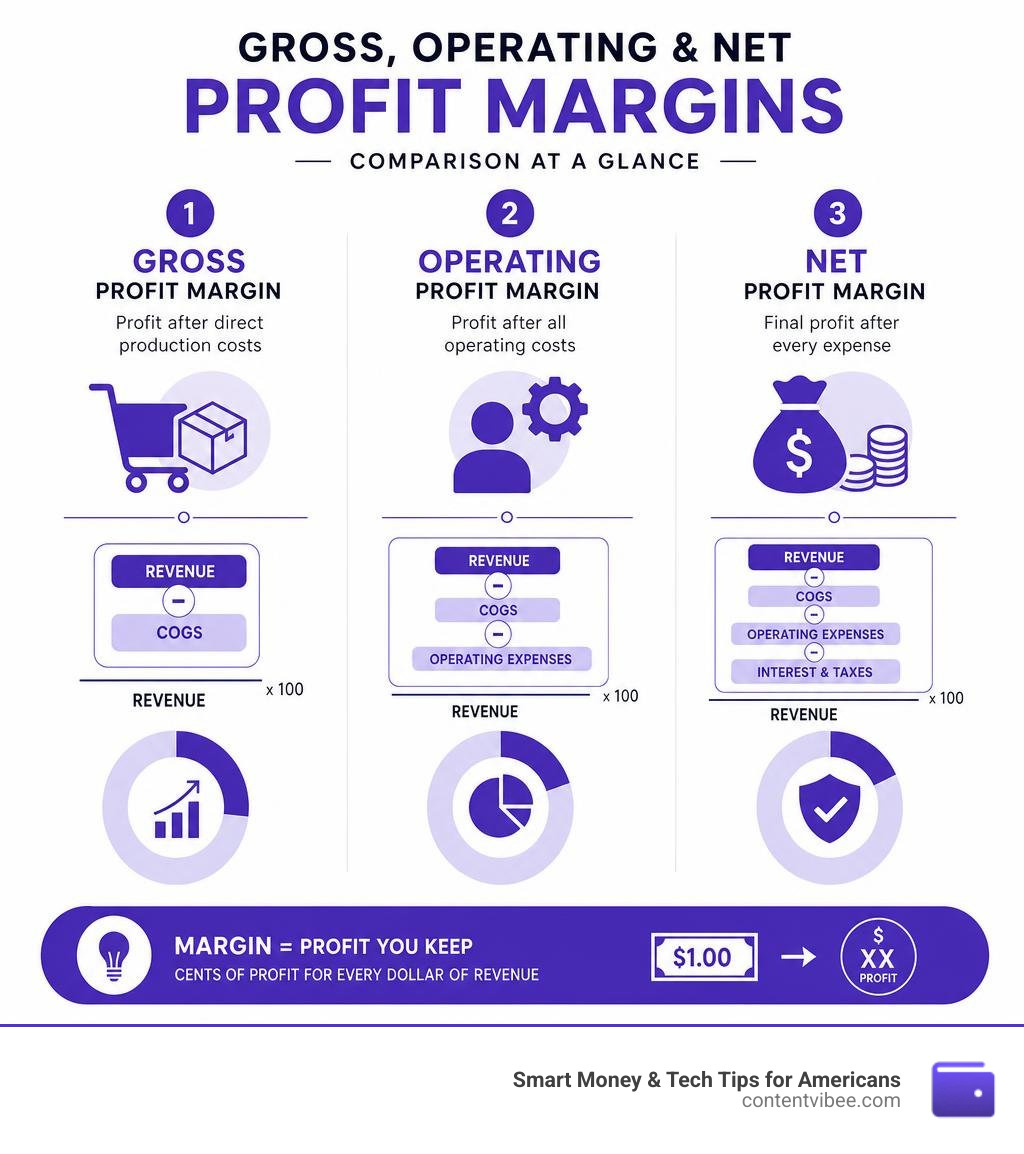
| Margin Type | Formula | What It Measures |
|---|---|---|
| Gross Profit Margin | (Revenue – COGS) / Revenue × 100 | Profit after direct production costs |
| Operating Profit Margin | (Revenue – COGS – Operating Expenses) / Revenue × 100 | Profit after all operating costs |
| Net Profit Margin | (Revenue – COGS – Operating Expenses – Interest – Taxes) / Revenue × 100 | Final profit after every expense |
In plain English: margin tells you how many cents of profit you keep for every dollar of revenue. A 20% net margin means you keep $0.20 from every $1.00 earned.
Most people confuse this with markup — a different calculation that uses cost as the base instead of revenue. That one mistake can quietly destroy pricing strategies and financial projections.
Here is why this matters right now: in 2025, nominal US GDP grew 5.1%, yet small business sales grew only 2.4%. When revenue growth slows, margin discipline becomes your most important financial tool — not just for business owners, but for retirees whose income depends on business performance or dividend-paying investments.
Simple margin formula accounting glossary:
What is the Margin Formula Accounting Standard?
In financial reporting, margins are the ultimate reality check. While revenue (top-line growth) gets all the media glory, margins tell us what actually stays in the bank. In margin formula accounting, we rely on profitability ratios to evaluate how efficiently a business converts its sales into earnings.
At its core, the standard margin formula measures the relationship between sales revenue and the expenses incurred to generate that revenue. By analyzing these ratios, business owners and investors can quickly see if a company is pricing its products correctly, managing its operational overhead, or drowning in indirect expenses.
Understanding this standard is crucial for maintaining financial health. If you want to dive deeper into the basics of setting up these numbers, check out The Easiest Way to Calculate Profit Margin to build a solid foundation.
The Core Margin Formula Accounting Equation
The basic mathematical representation of any margin percentage is straightforward:
Margin (%) = (Profit / Revenue) × 100
To make this formula work in real-world accounting, we must be highly precise about what we use for “Revenue” and “Profit.” On a standard income statement, we use Net Sales (which is gross sales minus any customer returns, allowances, and discounts) as our denominator.
For example, if we want to calculate the most basic profit margin, we subtract the Cost of Goods Sold (COGS) from Net Sales, divide the result by Net Sales, and then multiply by 100 to get a clean percentage. For a detailed breakdown of this calculation, you can read How to Calculate Profit Margin – Investopedia.
Gross Margin vs. Gross Profit: Clearing the Confusion
One of the most common points of confusion in business finance is using “gross margin” and “gross profit” interchangeably. They are closely related, but they are not the same thing:
- Gross Profit is an absolute dollar amount. It represents the raw cash left over after subtracting direct production costs (COGS) from net sales.
- Gross Margin is a percentage. It expresses that raw cash amount as a ratio of net sales.
For instance, if we sell an item for $100 and it costs $60 to make, our Gross Profit is $40. Our Gross Margin is 40% ($40 divided by $100).
It is also worth noting that gross margin includes factory overhead allocations under standard GAAP rules. This makes it structurally different from “throughput” (which only subtracts totally variable costs) or contribution margin. For a deeper look at how these direct costs impact your operational decisions, explore our guide on Gross Margin Cost Demystified for Small Businesses and review the Gross margin definition — AccountingTools.
The Three Pillars of Profitability: Gross, Operating, and Net Margins
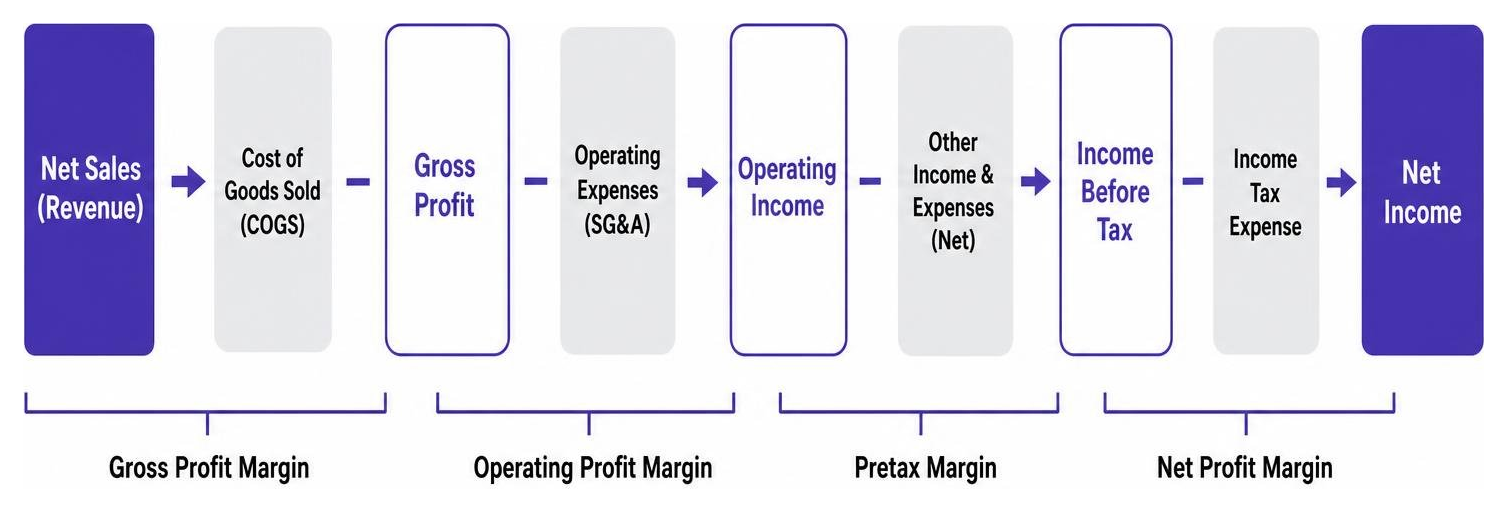
To truly understand how a business is performing, we must look at profitability through three distinct lenses. These three margins act like a financial filter, showing us exactly where money is being spent as we move from the top line (revenue) to the bottom line (net income).
Gross Profit Margin
The first pillar is the Gross Profit Margin. This metric focuses exclusively on direct production costs. It tells us how efficiently we are manufacturing goods or delivering direct services before taking overhead, marketing, or administrative salaries into account.
Direct production costs include raw materials, direct labor, and factory overhead. Because it ignores indirect expenses, gross profit margin varies dramatically by industry. For example, system and application software companies boast massive average gross margins of 72.38%, while lower-margin sectors like auto manufacturing operate at a much tighter 11.11%.
To calculate your own direct efficiency, you can refer to the standard steps outlined in Gross Profit Margin: How to Calculate It & Formula – Salesforce.
Operating Profit Margin
Once we subtract overhead costs from our gross profit, we arrive at the Operating Profit Margin. This pillar takes into account Selling, General, and Administrative (SG&A) expenses, such as office rent, marketing budgets, insurance, and corporate salaries.
Operating margin is a pure test of operational efficiency. It answers a vital question: Is our core business model profitable when we include the cost of keeping the lights on? A healthy operating margin typically ranges between 5% and 20%. If a company has a stellar gross margin but a terrible operating margin, it means its overhead costs are bloated and need immediate optimization.
Net Profit Margin
The final pillar is the Net Profit Margin — the famous “bottom line.” This metric accounts for every single expense, including non-operating items like interest paid on debt, corporate income taxes, and one-time write-offs.
Net profit margin tells us exactly how much of each revenue dollar is left for the business owners or shareholders. While a 10% net margin is generally considered healthy across small businesses, giant tech corporations often perform much higher. For example, Microsoft reported a stellar net profit margin of 37.7% for the three months ending September 30, 2024, generating $24.7 billion in net income on $65.6 billion in net sales.
However, net margins can sometimes be distorted by capital structure choices (such as high debt carrying costs) or unique tax strategies, which is why smart investors always analyze all three pillars together.
Margin vs. Markup: The Costly Pricing Mistake
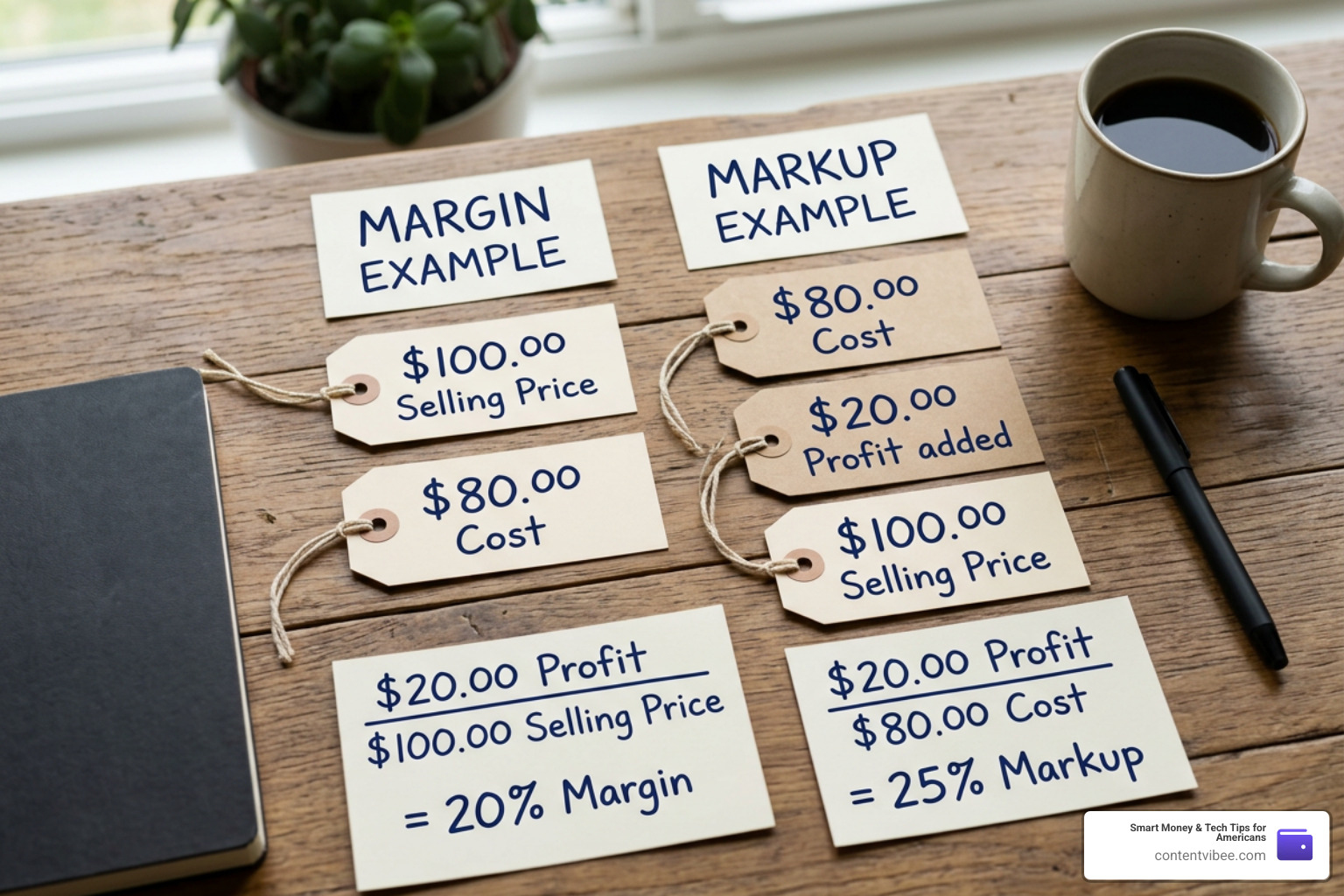
Confusing margin and markup is arguably the most common — and expensive — pricing error a business leader can make. While both terms use the exact same dollar values (cost and selling price), they express them in entirely different ways.
If you set your prices assuming a target margin but accidentally calculate it as a markup, you will consistently underprice your products and leave significant money on the table. To avoid this, we highly recommend bookmarking the Tools Margin Calculator Markup to Margin Calculator to double-check your math instantly.
The Mathematical Difference
The critical difference lies in the denominator of the equation:
- Margin is calculated as profit divided by the selling price. It looks forward at revenue.
- Markup is calculated as profit divided by the cost price. It looks backward at cost.
Let’s look at a concrete example. Suppose we buy an inventory item for $100 and want to sell it for $150.
- Our profit is $50.
- Our Markup is: ($50 / $100) × 100 = 50%
- Our Margin is: ($50 / $150) × 100 = 33.33%
If you tell your team to maintain a “50% margin” on a $100 cost item, but they apply a 50% markup instead, they will sell it for $150. To actually achieve a true 50% margin, the item must be sold for $200! You can see how this confusion quickly eats away at your cash flow. For a deeper breakdown of this pricing dynamic, check out the Margin calculator (how to calculate profit margin) | Sage Advice US.
How to Convert Between Margin and Markup
If you need to switch between these two metrics during vendor negotiations or pricing reviews, you do not have to guess. You can use these simple conversion formulas:
To convert Markup to Margin:
Margin = Markup / (1 + Markup)
(Example: A 50% markup is 0.50 / 1.50 = 33.33% margin)To convert Margin to Markup:
Markup = Margin / (1 - Margin)
(Example: A 20% margin is 0.20 / 0.80 = 25% markup)
To make this process seamless in your daily operations, you can easily build these calculations directly into your tracking sheets by following our guide on how to Stop Eyeballing It Excel Add Margin Formulas Made Easy.
Strategic Margin Management: Improving Your Bottom Line
Improving your margins is not just about blindly slashing expenses or raising prices until customers walk away. It requires a strategic, balanced approach to cost control, pricing power, and product portfolio management.
How to Improve Your Margin Formula Accounting Metrics
If your margin analysis reveals that your profitability is slipping, there are several highly effective strategies we can implement:
- Shift to Value-Based Pricing: Instead of relying on a rigid “cost-plus” model, price your products or services based on the perceived value to the customer. Use ROI documents and case studies to justify premium pricing.
- Establish Discount Approval Workflows: Uncontrolled discounting by sales teams is a primary cause of margin erosion. Implement strict floor prices and require manager approval for any discounts above a certain percentage.
- Optimize Your Product Portfolio: Not all products are created equal. Identify your highest-margin offerings and focus your marketing and sales efforts on them, while phasing out or repricing low-margin, high-effort products.
- Renegotiate Supplier Contracts: Periodically audit your COGS and work with suppliers to secure bulk discounts, better payment terms, or alternative shipping methods.
For professional service providers and accountants looking to stop undercharging and maximize their billing rates, we have created a specialized resource: Margin Calculator for Accountants Stop Undercharging and Start Multiplying Your Profits.
Common Pitfalls in Margin Calculations
Even experienced professionals can make mistakes when calculating or interpreting margins. Watch out for these common accounting traps:
- Accrual Accounting Distortions: Net income is heavily influenced by accrual adjustments, non-cash items, and depreciation schedules. A high net profit margin does not always mean strong physical cash flow.
- Ignoring Inventory Turnover: A product with a massive 70% gross margin might seem like a winner, but if it sits on shelves for twelve months, it drags down your overall return on investment (ROI). Conversely, a lower-margin product that sells out daily can generate superior annual returns.
- Ignoring Seasonal Fluctuations: Many businesses experience massive seasonal shifts in both sales volume and operational costs. Evaluating margins on a single month’s data can lead to dangerous strategic decisions; always look at trailing twelve-month (TTM) trends.
Frequently Asked Questions about Margin Calculations
What is a good net profit margin for a small business?
While a 10% net profit margin is generally considered healthy and 20% is strong, “good” is highly dependent on your industry.
Retail businesses operate on high volume and tight margins, typically averaging 2% to 6%. Restaurants and food services usually see margins between 3% and 9%. On the other end of the spectrum, software and technology firms frequently achieve net margins of 15% to 25%, while professional services enjoy 10% to 20% due to lower physical overhead.
How do year-end adjustments and depreciation affect margins?
Year-end adjustments can dramatically alter your margin calculations. Non-cash expenses like depreciation and amortization reduce your operating and net profit margins, even though no actual cash left the business.
Additionally, choices in inventory accounting (such as FIFO vs. LIFO) and the timing of expense accruals can shift profits between quarters, making a company’s margins look artificially high or low in a given period.
Why did small business margins lag behind GDP growth in 2025?
In 2025, nominal US GDP grew by a solid 5.1%, yet small business sales grew by only 2.4%. This gap highlighted severe economic pressures, particularly cost inflation in raw materials, wages, and borrowing costs.
Because small businesses often lack the massive pricing power of giant corporations, they had to absorb these rising expenses rather than passing them entirely to consumers, resulting in compressed profit margins across many local sectors.
Conclusion
Mastering margin formula accounting is not about memorizing complex equations; it is about gaining a clear, unfiltered view of your financial health. By tracking your gross, operating, and net margins, you can make smarter pricing decisions, control your overhead, and protect your hard-earned profits.
At ContentVibee, we specialize in translating complex financial metrics and regulations into clear, actionable guidance. Whether you are managing a growing business or planning your retirement income under modern frameworks like the SECURE Act 2.0 RMD guidelines, keeping a close eye on your margins is essential for long-term security.
Ready to take the guesswork out of your pricing and profitability? Use our free interactive Tools Margin Calculator to instantly analyze your numbers and keep your business on the path to sustainable growth.


