


The RMD Age Increase Explained: What Every Retiree Needs to Know in 2026
The RMD age increase brought by the SECURE 2.0 Act is one of the biggest retirement rule changes in decades — and if you’re not sure when your withdrawals must begin, you could face a costly IRS penalty.
Here’s the quick answer:
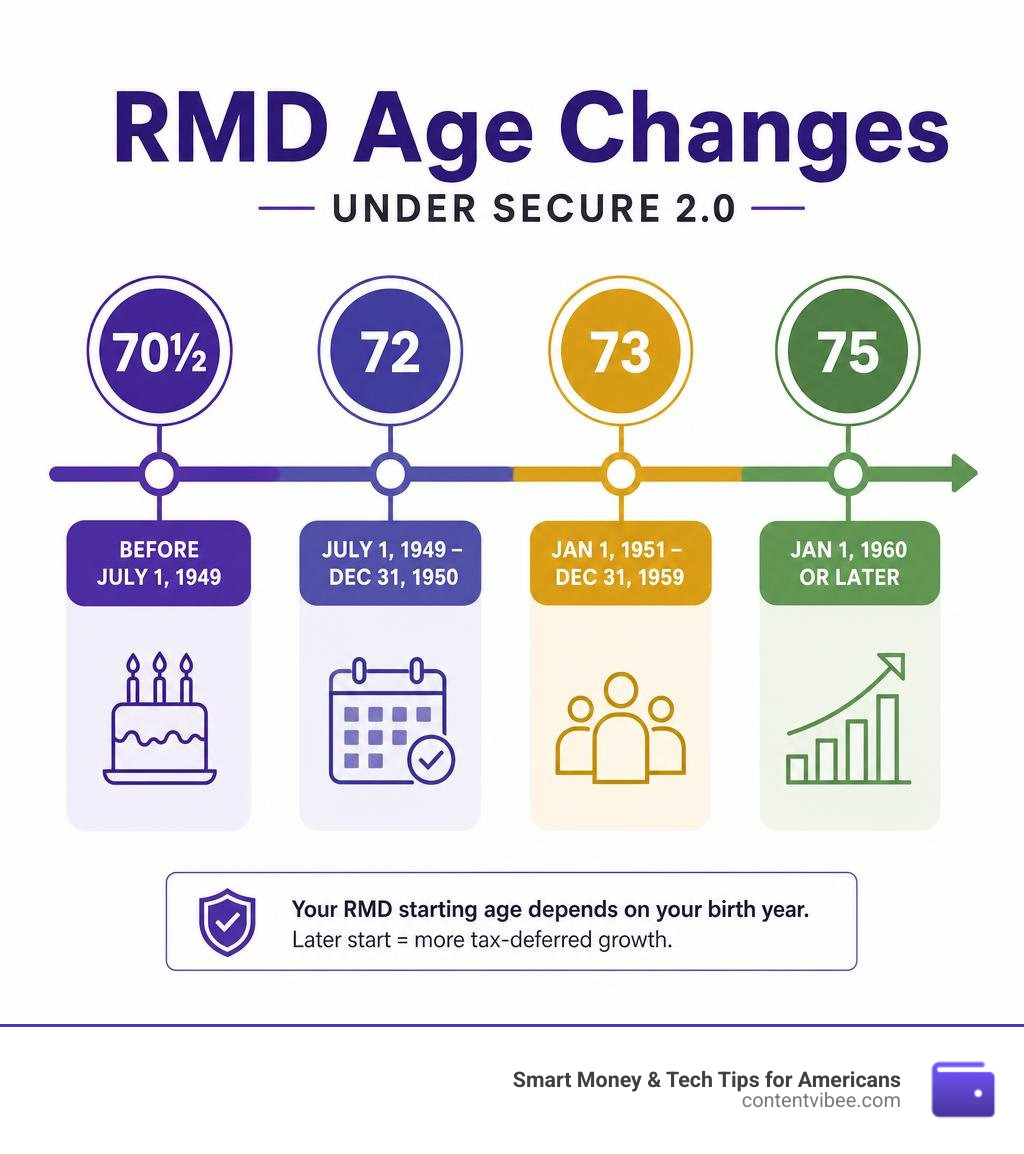
| Birth Year | RMD Starting Age |
|---|---|
| Before July 1, 1949 | 70½ |
| July 1, 1949 – Dec 31, 1950 | 72 |
| Jan 1, 1951 – Dec 31, 1959 | 73 |
| Jan 1, 1960 or later | 75 |
Source: SECURE 2.0 Act, IRS guidance
The short version: if you were born in 1960 or later, you don’t have to start taking Required Minimum Distributions (RMDs) until you turn 75. That’s two to three extra years of tax-deferred growth compared to what previous rules allowed.
But the rules aren’t the same for everyone. Your birth year determines your exact starting age — and one month’s difference in birthday (think: December 1959 vs. January 1960) can mean a three-year gap in when the IRS first requires you to withdraw money.
Missing your RMD deadline is expensive. The penalty is 25% of the amount you failed to withdraw — though SECURE 2.0 did reduce it from the previous 50%. If you correct the mistake within two years, it drops further to 10%.
This guide walks you through exactly when the RMD age goes up to 75, who qualifies, how to calculate what you owe, and smart strategies to reduce the tax hit.
How the SECURE 2.0 Act Drives the RMD Age Increase
To understand why Congress decided to implement a phased rmd age increase, we have to look at the legislative history of retirement policy in the United States. For decades, the standard age for required minimum distributions was locked at 70½. This rule, established in the late 1960s, was designed to ensure that retirees actually spent their tax-advantaged savings during their lifetimes rather than using their accounts as permanent tax shelters for their heirs.
However, times have changed. Americans are living longer, and many are working well into their 60s and 70s. Keeping the RMD starting age at 70½ began to feel outdated and overly restrictive for modern retirees who wanted to leave their money untouched to grow.
Congress first addressed this with the original SECURE Act of 2019, which bumped the starting age to 72. Then came the SECURE 2.0 Act, signed into law on December 29, 2022, as part of the Consolidated Appropriations Act of 2023. This landmark legislation took things a step further, establishing a two-tiered system that raised the RMD age to 73 starting in 2023, with a final scheduled increase to age 75 set to take effect on January 1, 2033.
By pushing the distribution age out, the law gives younger cohorts of retirees up to three additional years of tax-deferred compounding. For a detailed breakdown of how these legislative shifts affect your overall timeline, you can read our deep dive on Mastering the SECURE Act 2.0 RMD Age Shifts.
Birth Year Cohorts and the RMD Age Increase Timeline
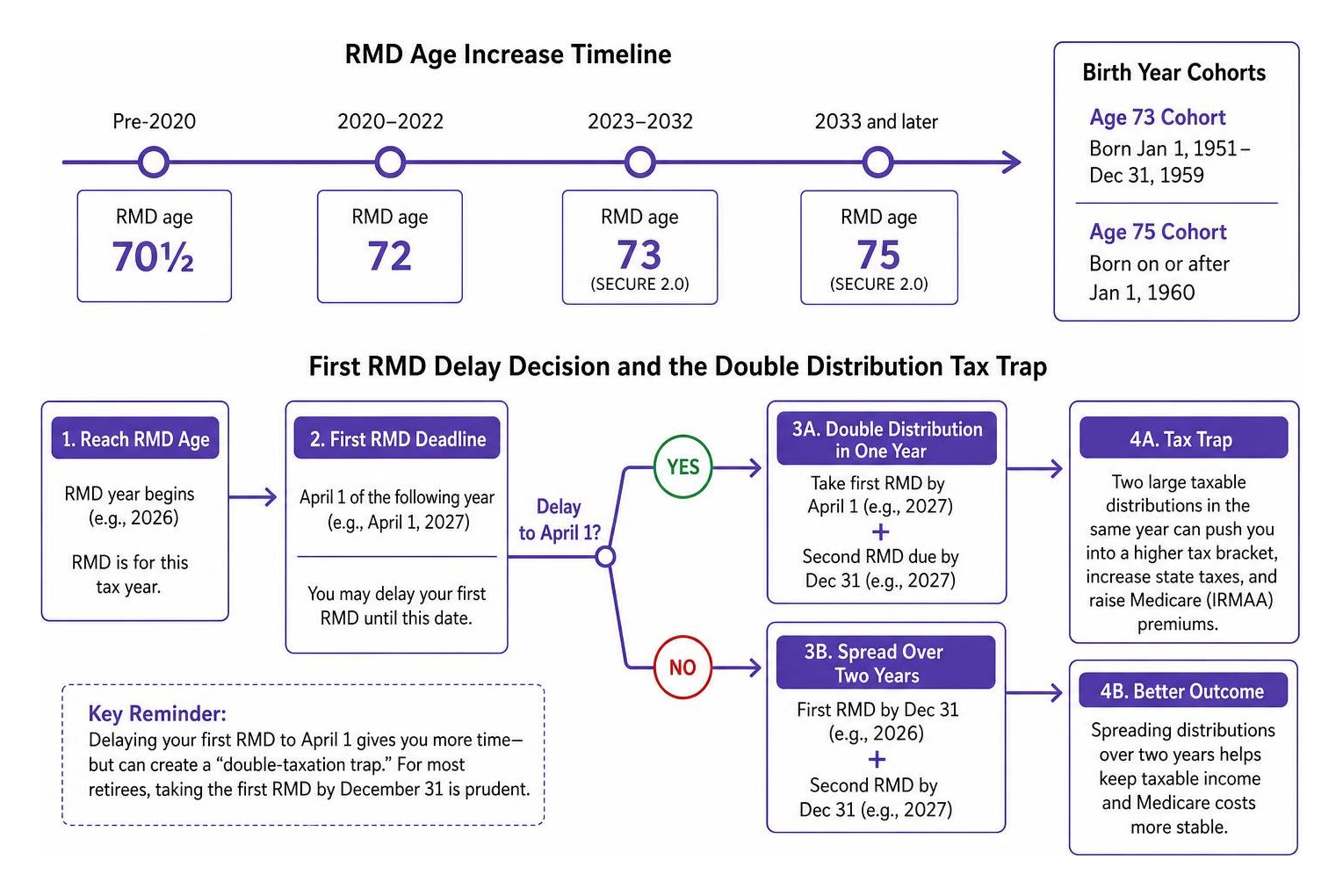
The transition from age 73 to age 75 has a few quirks that have caused plenty of head-scratching. Under the strict text of the SECURE 2.0 Act, two distinct cohorts were created:
- The Age 73 Cohort: Individuals born between January 1, 1951, and December 31, 1959.
- The Age 75 Cohort: Individuals born on or after January 1, 1960.
This structure created a minor legislative drafting error that initially confused tax professionals. Because of the way the bill was originally worded, individuals born in 1959 appeared to be caught in a technical loop, seemingly qualifying for both age 73 and age 75. Thankfully, the IRS and subsequent technical corrections clarified that those born in 1959 must begin their RMDs at age 73.
This creates a fascinating “1959-1960 gap.” Consider two neighbors:
- Bob, born on December 31, 1959, must begin his RMDs at age 73 (which occurs in 2032).
- Linda, born on January 1, 1960, doesn’t have to begin her RMDs until age 75 (which occurs in 2035).
A birth difference of a single day results in a three-year difference in RMD obligations! To make sure you don’t make any wrong assumptions about your own timeline, check out our guide, Don’t Let Uncle Sam Catch You Napping with These 2026 RMD Changes.
Key Deadlines for Your First and Subsequent RMDs
Once you reach your applicable RMD age, timing is everything. For your very first RMD, the IRS grants you a bit of a grace period. Your “Required Beginning Date” is April 1 of the calendar year following the year you reach your RMD age.
For example, if you were born in 1953, you turn 73 in 2026. Under the rules, your first RMD is for the tax year 2026, but you have until April 1, 2027, to actually withdraw those funds.
However, delaying your first RMD to April 1 comes with a major catch: the “double-taxation trap.” If you delay your 2026 RMD until April 1, 2027, you must still take your second RMD (for the tax year 2027) by December 31, 2027.
Taking two large, taxable distributions in a single calendar year can easily push you into a much higher federal income tax bracket. It can also trigger higher state taxes and bump up your Medicare premiums via the Income-Related Monthly Adjustment Amount (IRMAA) surcharges. For most retirees, we generally recommend taking that first distribution by December 31 of your first RMD year to keep your taxable income stable. You can read more about these critical timing rules in the RMD rules, age, and deadlines explained – Vanguard guide.
Calculating Your RMD and Understanding Affected Accounts

Calculating your required distribution doesn’t require an advanced degree in mathematics, but you do need to keep track of two key numbers: your prior-year account balance and your IRS distribution factor.
The basic formula is straightforward:
$$\text{RMD Amount} = \frac{\text{Account Balance as of Dec. 31 of the Prior Year}}{\text{IRS Life Expectancy Factor}}$$
To find your life expectancy factor, the IRS provides specific tables in Publication 590-B. The primary table used by almost all original account owners is the Uniform Lifetime Table (Table III). If your spouse is more than 10 years younger than you and is the sole beneficiary of your account, you get to use the Joint Life and Last Survivor Expectancy Table (Table II), which provides a longer distribution period and results in a lower mandatory payout.
As we get older, our life expectancy factors decrease, which means the percentage we must withdraw increases every year—even if our account balance remains flat. For example, at age 73, your factor is 26.5, meaning you must withdraw roughly 3.77% of your balance. By age 80, the factor drops to 20.2, pushing your required withdrawal up to 4.95%. You can learn to master this formula in our step-by-step walkthrough, How to Calculate Your RMD Amount in 4 Easy Steps, or use our resources to Calculate Your RMD Without the Headache.
Which Accounts Face the RMD Age Increase Rules?
Not all retirement accounts are treated equally when it comes to the rmd age increase. The mandatory withdrawal rules apply to:
- Traditional IRAs
- SEP IRAs (Simplified Employee Pension)
- SIMPLE IRAs
- Traditional 401(k), 403(b), and governmental 457(b) plans
Historically, Roth accounts inside employer-sponsored plans (like Roth 401(k)s and Roth 403(b)s) were subject to lifetime RMDs, even though individual Roth IRAs were exempt. Fortunately, SECURE 2.0 Section 325 fixed this discrepancy. Starting in 2024, designated Roth accounts in employer plans are completely exempt from lifetime RMD rules, aligning them perfectly with Roth IRAs.
If you are holding onto pre-tax funds in an old employer plan, it is vital to know when the clock starts ticking. For a deeper look at employer-sponsored accounts, read our guide on No More Hoarding: And When You Must Start Taking 401k Withdrawals.
The “Still Working” Exception and Inherited IRA Rules
If you are still employed past your RMD age, you might be able to delay taking distributions from your current employer’s plan. This is known as the “still working” exception.
To qualify, you must:
- Still be actively employed by the company sponsoring the 401(k) or 403(b) plan.
- Own 5% or less of the business sponsoring the plan.
If you meet these criteria, you can delay RMDs from that specific employer plan until April 1 of the year after you officially retire. That this exception does not apply to traditional IRAs, SEP IRAs, SIMPLE IRAs, or 401(k) plans from former employers.
Inherited IRAs represent an entirely different set of rules. Under the original SECURE Act of 2019, most non-spouse beneficiaries who inherit an IRA must fully distribute the entire account balance within 10 years (the 10-year rule). SECURE 2.0 and subsequent IRS regulations clarified that if the original owner had already begun taking RMDs before their death, the beneficiary must also take annual RMDs during years 1 through 9 of that 10-year period.
Exceptions to the 10-year rule are reserved for “Eligible Designated Beneficiaries” (EDBs), such as surviving spouses, chronically ill or disabled individuals, and minor children of the deceased owner. Spouses still maintain the most flexible options, including the ability to roll the inherited assets into their own IRA and delay distributions until they reach their own RMD age. To explore how these legacy rules wrap up, check out The Forever Tax: At What Age Do RMDs Finally Stop? and consult When Does the RMD Age Go Up to 75 Years Old? – SmartAsset for additional context.
Penalties and Strategic Planning to Minimize Tax Impact
Missing an RMD is an easy mistake to make, but the IRS has historically treated it as a major offense. Fortunately, SECURE 2.0 brought some welcome relief by lowering the penalties and making the correction process much more forgiving. If you do find yourself in a bind, you can find a clear path forward in our guide on what to do if you Missed Your RMD? Here Is How to Get the Penalty Waived.
Lower Penalties Under SECURE 2.0
Before the passage of SECURE 2.0, the excise tax for failing to take an RMD was a brutal 50% of the shortfall. SECURE 2.0 slashed this penalty in half to 25%.
Furthermore, if you correct the mistake in a timely manner—meaning you withdraw the missed amount and file IRS Form 5329 within the “correction window” (which is generally two years)—the penalty is reduced to just 10%.
The IRS also retains the authority to waive the penalty entirely if you can prove that the oversight was due to “reasonable error” and that you have already taken steps to correct it. To request a waiver, you must file Form 5329, attach a letter explaining the situation, and pay the tax up front (which will be refunded if the waiver is approved). You can review the official parameters on the Retirement plan and IRA required minimum distributions FAQs – IRS page.
Smart Tax Strategies: Roth Conversions and QCDs
The delay in the RMD starting age gives us a valuable window of opportunity. The years between your actual retirement date and your first mandatory distribution year—often called the “gap years”—are the perfect time to execute proactive tax planning.
Here are two of the most effective strategies to consider:
- Roth Conversions: During your gap years, your taxable income may be at an all-time low. You can take advantage of this by systematically converting portions of your pre-tax Traditional IRA into a Roth IRA. You will pay ordinary income tax on the converted amount now, but those funds will grow tax-free and will never be subject to RMDs during your lifetime. This “bracket filling” strategy helps you clear out pre-tax balances before RMDs force you into higher tax brackets later.
- Qualified Charitable Distributions (QCDs): If you are charitably inclined, QCDs are an incredibly powerful tool. Once you reach age 70½, you can transfer up to $111,000 per year (the indexed limit for 2026) directly from your Traditional IRA to an eligible 501(c)(3) charity. The beauty of a QCD is that the transferred amount is excluded from your Adjusted Gross Income (AGI), yet it counts directly toward satisfying your annual RMD obligation once you reach RMD age.
By utilizing these tools, you can protect your hard-earned wealth and maintain control over your tax bracket. For more ideas on managing cash flow and withdrawal rates, read Demystifying the 4 Percent Retirement Withdrawal Calculator.
Frequently Asked Questions About RMD Age Changes
At what age do RMDs start in 2026?
In 2026, the RMD starting age is 73 for anyone born between January 1, 1951, and December 31, 1959. If you turn 73 in 2026, your first RMD is due by April 1, 2027. If you were born in 1960 or later, your starting age will be 75, meaning your first RMDs won’t begin until 2035 or later.
Do Roth 401(k)s have RMDs under the new rules?
No. Thanks to SECURE 2.0, designated Roth accounts in employer-sponsored plans—including Roth 401(k) and Roth 403(b) accounts—are completely exempt from lifetime RMDs. This change took effect on January 1, 2024, bringing them into alignment with Roth IRAs.
Can I delay my first RMD to April 1?
Yes, you can delay your very first RMD until April 1 of the year following the calendar year you reach your RMD age. However, doing so means you will have to take two RMDs in that same calendar year, which can push you into a higher tax bracket and increase your Medicare premiums.
Conclusion
The rmd age increase to 75 represents a massive win for future retirees, offering more flexibility and extra years of tax-deferred compounding. However, navigating the transition years requires careful planning, strict attention to deadlines, and a clear understanding of your birth year cohort.
At ContentVibee, we are dedicated to providing clear, actionable financial and technology advice to help you manage your money with confidence. Don’t let these shifting rules catch you off guard. Take control of your retirement roadmap today by checking out The Essential RMD Age Table Guide for Smart Retirees to map out your long-term tax strategy.


