


What the SECURE Act 2.0 Means for Your Retirement (Quick Answer)
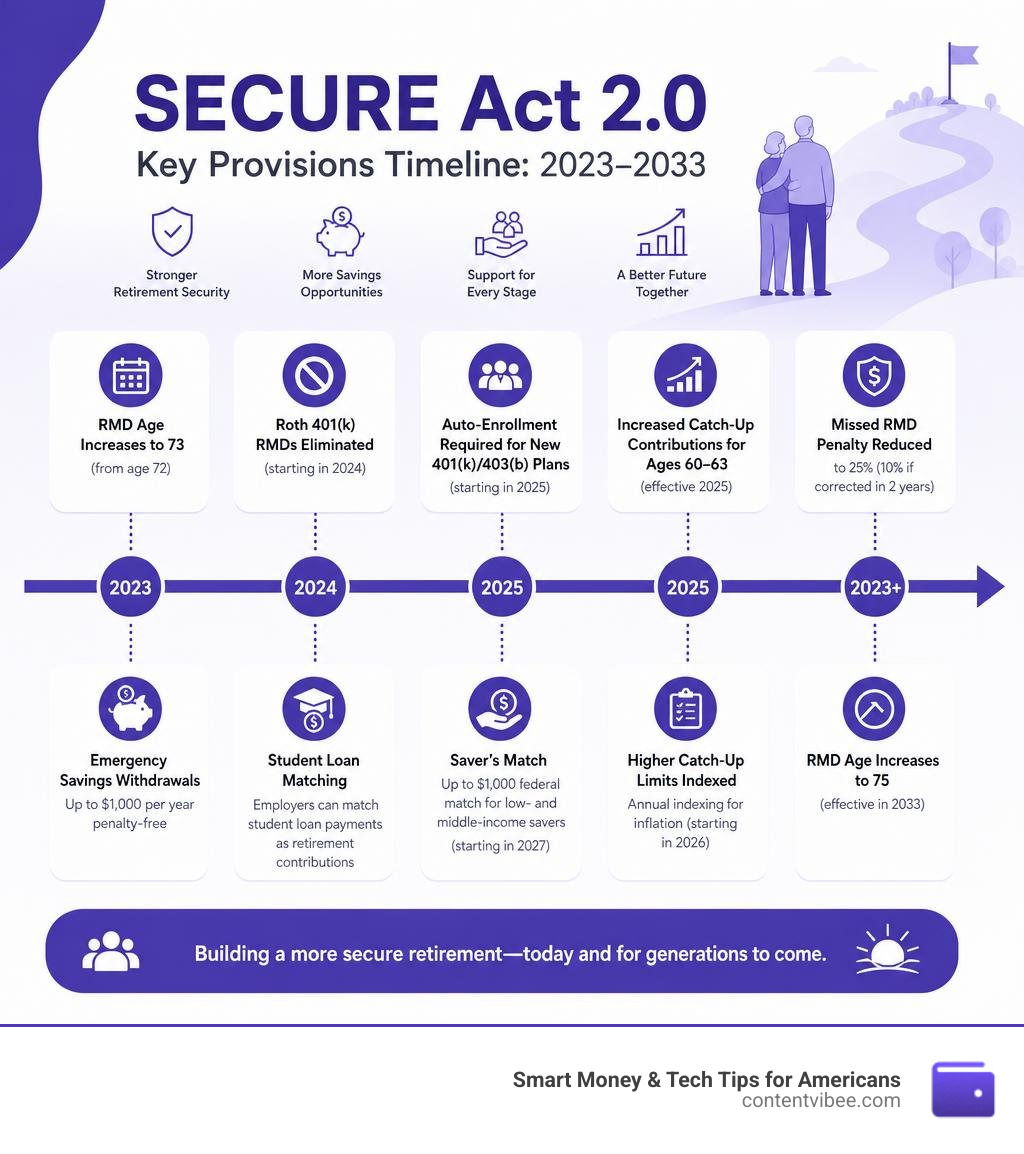
SECURE Act 2.0 retirement rules, signed into law on December 29, 2022, are some of the biggest changes to U.S. retirement savings in decades. If you’re worried about RMD penalties, contribution limits, or whether your 401(k) plan is keeping up — here’s what you need to know at a glance:
| Key Change | What It Means for You |
|---|---|
| RMD age | Starts at 73 now, rises to 75 in 2033 |
| Missed RMD penalty | Dropped from 50% to 25% (10% if corrected in 2 years) |
| Catch-up contributions (ages 60–63) | Up to $11,250 in 2025 vs. $7,500 standard |
| Roth 401(k) RMDs | Eliminated as of 2024 |
| Emergency savings | Penalty-free $1,000 withdrawal per year allowed |
| Auto-enrollment | Required for new 401(k)/403(b) plans from 2025 |
| Saver’s Match | Up to $1,000 federal match starting 2027 |
| Student loan matching | Employers can match student loan payments as retirement contributions |
These changes affect nearly every American with a workplace retirement plan, an IRA, or a 529 account. Some rules are already in effect. Others are still rolling out through 2033.
Whether you’re five years from retirement or already taking distributions, what you don’t know can cost you real money — in missed contributions, avoidable penalties, or tax surprises.
This guide breaks down every major SECURE 2.0 provision in plain language, so you know exactly where you stand.
What is the SECURE Act 2.0 retirement legislation?
The retirement landscape in the United States has undergone a massive transformation. As we navigate through July 2026, the sweeping changes introduced by the SECURE 2.0 Act of 2022 are fully reshaping how we save, invest, and plan for our golden years. But what exactly is this legislation?
Formally passed as part of the Consolidated Appropriations Act of 2023, the SECURE 2.0 Act was designed to directly address the growing retirement savings crisis in America. Too many workers face the prospect of outliving their savings, while others struggle to access employer-sponsored plans altogether. To help savers navigate these shifting sands, we have put together comprehensive resources like The Ultimate Guide to New Retirement Tax Rules to unpack how these tax changes influence your long-term wealth.
By introducing a mixture of mandatory plan updates, tax incentives, and simplified administrative guidelines, SECURE Act 2.0 retirement rules aim to make it significantly easier to accumulate nest eggs while offering greater flexibility on how and when those funds are withdrawn.
Building on the SECURE Act of 2019
To understand SECURE 2.0, we have to look back at its predecessor. The original SECURE Act (Setting Every Community Up for Retirement Enhancement), enacted in late 2019, laid the groundwork by raising the Required Minimum Distribution (RMD) age from 70½ to 72 and allowing savers to contribute to traditional IRAs past age 70½.
However, lawmakers realized that more work was needed to expand retirement coverage. SECURE 2.0 represents the natural evolution of this policy. While the first iteration focused on high-level structural updates, the second version dives deep into the daily realities of savers. It offers robust tax incentives for small businesses, bridges the gap between student loan debt and retirement savings, and provides creative safety valves for emergency expenses. It is not just an update; it is a complete modernization of our retirement infrastructure. For a broader look at this legislation, you can review the SECURE 2.0 Act of 2022, as enacted | Summary of Key Provisions or check out the helpful What is SECURE Act 2.0? – Empower resource.
Key Provisions for Employer-Sponsored Plans: 401(k) and 403(b) Updates
Employer-sponsored plans are the bedrock of retirement planning for millions of Americans. SECURE 2.0 places a heavy emphasis on these plans, introducing changes that require plan sponsors to adapt their systems while giving employees new pathways to build wealth. If you are currently trying to maximize your workplace plan, we recommend consulting The IRS 403b Contribution Limits Guide for Smart Savers as well as The Ultimate Guide to Calculating Your 401k Contributions to ensure your calculations are perfectly aligned with the latest rules.
Mandatory Automatic Enrollment for New Plans
One of the most impactful changes for employer plans is the mandatory automatic enrollment requirement. Effective for plan years beginning after December 31, 2024, any new 401(k) or 403(b) plan established after December 29, 2022, must automatically enroll eligible employees.
- Initial Enrollment Rate: The default contribution rate must be at least 3% but no more than 10% of the employee’s pre-tax earnings.
- Automatic Escalation: To keep your savings growing, the plan must automatically increase this contribution rate by 1% each year until it reaches at least 10% (but no more than 15%).
- The Opt-Out Safeguard: Employees retain complete control. If you do not wish to participate, you can opt out or adjust your contribution rate at any time, and you have a 90-day window from your first contribution to request a refund of any automatically deferred amounts.
- Exemptions: This mandate does not apply to grandfathered plans (established before December 29, 2022), businesses with 10 or fewer employees, or new companies that have been in business for less than three years.
Expanding SECURE Act 2.0 Retirement Access for Part-Time Workers and Small Businesses
Historically, part-time workers were often locked out of workplace retirement benefits. SECURE 2.0 changes this by dramatically shortening the eligibility timeline for long-term, part-time employees.
Under the old rules, part-time employees had to work at least 1,000 hours in a single year or 500 hours per year for three consecutive years to participate. SECURE 2.0 reduces that three-year tracking period to just two consecutive years of 500+ hours of service, which officially went into effect for plan years beginning in 2025. This means that part-time workers who met these hours in 2023 and 2024 are now eligible to make elective deferrals to their employer’s 401(k) or 403(b) plans.
To encourage small businesses to offer these plans, the legislation also expands the small business startup tax credit. Small employers with up to 50 employees can now claim a startup tax credit covering 100% of administrative costs (up to $5,000 per year for the first three years), plus an additional tax credit for direct employer contributions made to employees’ accounts, capped at $1,000 per employee.
Catch-Up Contributions and Roth Requirements
For savers who are rapidly approaching their target retirement date, catch-up contributions are an invaluable tool. SECURE 2.0 introduces both a major boost to these limits and a significant tax structural shift that high-income earners must prepare for. To see how these adjustments fit into your broader strategy, take a look at The Ultimate Guide to Retirement Contribution Catch-Up Limits and The New 2026 Maximum 401k Contribution Limits Explained.
Higher Catch-Up Limits for Ages 60–63
If you are in your early 60s, SECURE 2.0 provides a unique “super catch-up” opportunity. Starting in 2025, the catch-up contribution limit for individuals aged 60, 61, 62, and 63 is increased to the greater of $10,000 ($11,250 for 2025/2026 due to inflation indexing) or 150% of the standard catch-up limit.
This means that instead of being limited to the standard catch-up limit of $7,500, workers in this specific age bracket can tuck away an extra $11,250 per year. After age 63, the catch-up limit reverts to the standard age-50+ catch-up limit, which continues to be indexed annually for inflation.
| Age Bracket | Standard Contribution Limit | Catch-Up Contribution Limit | Total Allowed Limit |
|---|---|---|---|
| Under Age 50 | $23,500 (2026 Standard) | N/A | $23,500 |
| Ages 50–59 | $23,500 (2026 Standard) | $7,500 (Standard Catch-up) | $31,000 |
| Ages 60–63 (Super Catch-Up) | $23,500 (2026 Standard) | $11,250 (Super Catch-up) | $34,750 |
| Ages 64+ | $23,500 (2026 Standard) | $7,500 (Standard Catch-up) | $31,000 |
The Roth Mandate for High Earners
While the higher limits are great news, the government has added a major caveat for high-income earners. This rule is particularly important to understand now that we are in 2026.
Under SECURE 2.0, if your wages (as defined by FICA) from your sponsoring employer exceeded $145,000 (indexed for inflation) in the preceding calendar year, any catch-up contributions you make to an employer plan must be designated as after-tax Roth contributions.
- No Pre-Tax Deduction: This means you will not get an immediate tax deduction on those catch-up contributions.
- Tax-Free Growth: The silver lining is that these funds, along with their investment earnings, will grow completely tax-free and can be withdrawn tax-free in retirement.
- Payroll Implementation: If your employer does not offer a Roth option within their retirement plan, they cannot legally allow catch-up contributions for high earners until they establish one. (Note: The IRS issued an administrative transition relief period, delaying the strict enforcement of this mandate until taxable years beginning after December 31, 2025, making 2026 the critical implementation year for payroll departments nationwide).
Required Minimum Distributions (RMDs) and Penalty Reductions
Required Minimum Distributions (RMDs) are the government’s way of ensuring that you don’t keep your money tax-deferred forever. SECURE 2.0 provides major relief in this area by delaying the age at which you must begin taking these withdrawals and dramatically reducing the cost of making a mistake. For a deeper look at these specific mechanics, check out Mastering the SECURE Act 2.0 RMD Age Shifts and The Ultimate Guide to Retirement Withdrawal Rules.
Navigating the New RMD Age Shifts
SECURE 2.0 implements a phased increase in the RMD starting age, allowing your investments more time to compound tax-deferred:
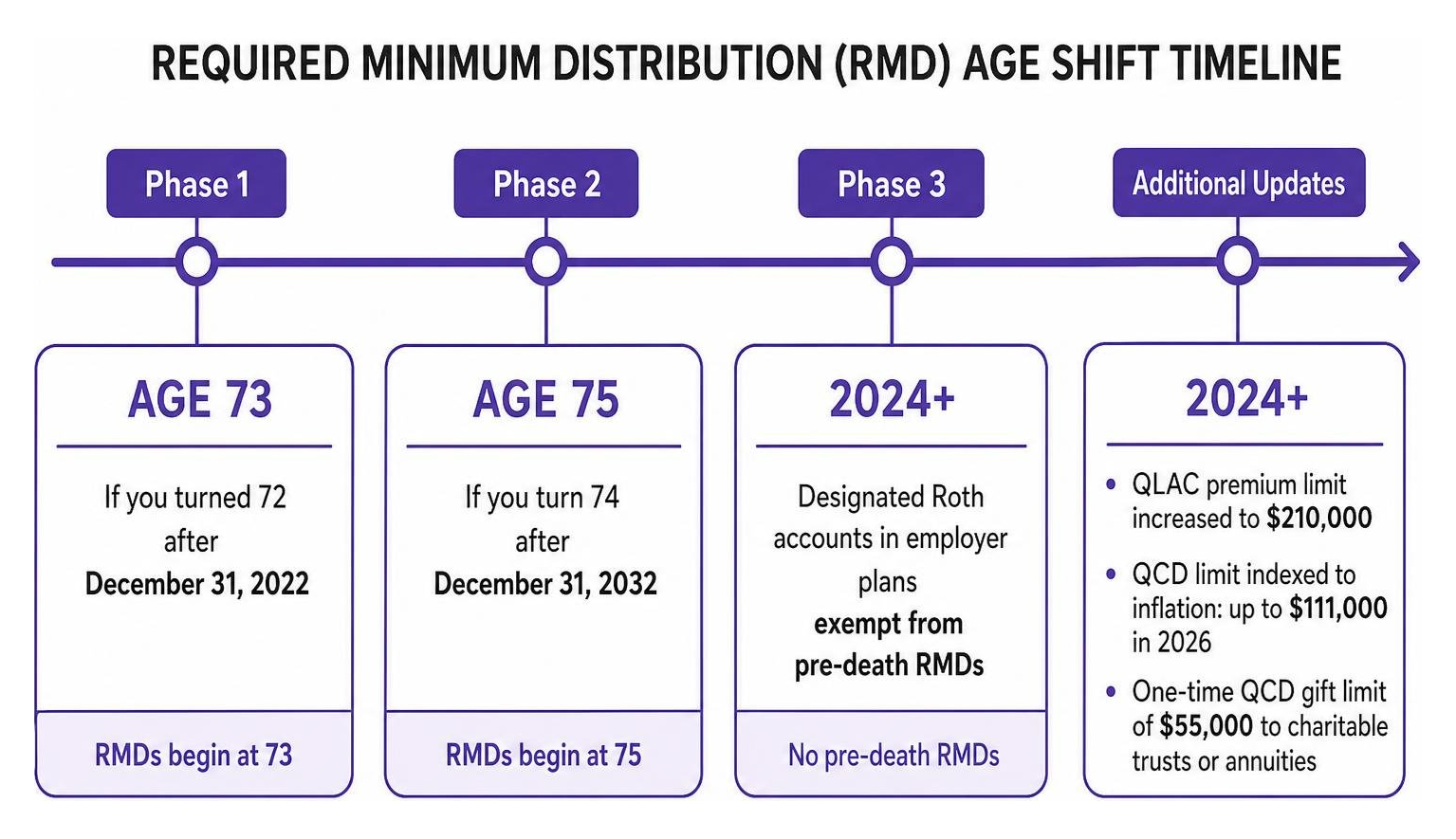
- Age 73: If you turned 72 after December 31, 2022, your RMD age is 73.
- Age 75: If you turn 74 after December 31, 2032, your RMD age increases to 75.
- Roth 401(k) Exemption: In a massive win for savers, starting in 2024, designated Roth accounts in employer-sponsored plans (like Roth 401(k)s and Roth 403(b)s) are completely exempt from pre-death RMD requirements, bringing them in line with Roth IRAs.
- QLAC and QCD Updates: The Qualified Longevity Annuity Contract (QLAC) premium limit was increased to $210,000. Additionally, Qualified Charitable Distributions (QCDs) are indexed to inflation, allowing savers to donate up to $111,000 in 2026 directly from an IRA to an eligible charity, including a one-time QCD gift limit of $55,000 to charitable trusts or annuities.
Reduced Penalties for Missed Distributions
Historically, failing to take your full RMD by the deadline resulted in one of the harshest penalties in the tax code: a whopping 50% excise tax on the amount you failed to withdraw.
SECURE 2.0 slashes this penalty to make honest mistakes less devastating:
- The Standard Penalty: The excise tax is reduced from 50% to 25% of the missed distribution amount.
- The Correction Window Discount: If you correct the mistake in a timely manner — generally within a two-year correction window and before the IRS assesses the tax — the penalty is further reduced to just 10%.
Innovative Matching Options and Emergency Savings Provisions
Beyond standard savings, SECURE 2.0 introduces highly creative provisions aimed at aligning retirement savings with overall financial wellness. You can read more about these features in The SECURE 2.0 Act Guide or Secure Act 2.0 | What the new legislation could mean for you .
Student Loan Matching and Roth Employer Contributions
For younger workers, paying off student debt often leaves no room in the budget to contribute to a 401(k) to earn an employer match. SECURE 2.0 solves this dilemma by allowing employers to treat student loan payments as elective deferrals for matching purposes.
Under this optional provision, if you make a qualified student loan payment, your employer can deposit a matching contribution into your retirement account, exactly as if you had contributed that money to the plan yourself.
Additionally, employers can now give employees the option to receive employer matching or nonelective contributions on a Roth (after-tax) basis. If you choose this option, the matching funds are taxable to you in the year they are contributed, but they will grow and can be withdrawn entirely tax-free in retirement.
Emergency Savings Accounts and Penalty-Free Withdrawals
Recognizing that many Americans avoid retirement accounts out of fear of locking up their cash, SECURE 2.0 includes several emergency savings and penalty-free withdrawal options:
- Pension-Linked Emergency Savings Accounts (PLESAs): Employers can offer non-highly compensated employees a PLESA linked to their 401(k) plan. Contributions are made on a Roth basis and are capped at $2,600 annually for 2026. Participants can make at least one withdrawal per month, penalty-free.
- Emergency Expense Withdrawals: You can make a single penalty-free withdrawal of up to $1,000 per year from your IRA or employer plan for personal or family emergency expenses. You have up to three years to repay this distribution back into the plan to restore your retirement balance.
- Specialized Exceptions: The law also permits penalty-free early withdrawals for domestic abuse victims (up to the lesser of $10,000 or 50% of the account balance), individuals with a terminal illness, and those affected by federally declared disasters (up to $22,000).
Tax Reporting and Administrative Changes for Businesses
Implementing these new retirement features requires careful coordination between businesses, payroll providers, and the IRS. For business owners and entrepreneurs looking to optimize their corporate retirement strategies, we suggest checking out The 2026 Max SEP Contribution Guide for Savvy Entrepreneurs and The Ultimate Guide to Your 2026 Max Roth IRA Contribution.
SECURE Act 2.0 Retirement W-2 Reporting and Roth IRA Changes
The IRS issued detailed guidance in Notice 2024-2 to clarify how businesses must report new Roth contributions on tax documents. For an in-depth breakdown of these tax rules, you can review the official SECURE 2.0 Act changes affect how businesses complete Forms W-2 or check the SECURE 2.0 Frequently Asked Questions | ADP .
- Roth SEP and SIMPLE IRAs: Employers can now offer Roth SEP and Roth SIMPLE IRAs. Employee-elected Roth contributions to these plans must be reported in Boxes 1, 3, and 5 of Form W-2, using Code F for SEP and Code S for SIMPLE IRA contributions in Box 12.
- Employer Contributions: If an employer makes designated Roth matching or nonelective contributions, these are reported on Form 1099-R (using Code G) in the year they are made, rather than on the Form W-2.
- De Minimis Financial Incentives: To boost plan participation, employers can now offer small financial incentives (like gift cards or minor cash bonuses) to employees who sign up for the retirement plan. These incentives are considered taxable income and are subject to standard tax withholding. For more administrative details, plan sponsors can consult SECURE 2.0: What plan sponsors need to know or the Pocket Guide to SECURE 2.0 .
Frequently Asked Questions about SECURE 2.0
What is the Saver’s Match starting in 2027?
Starting in 2027, the existing Saver’s Credit will be replaced by the Saver’s Match. Instead of receiving a non-refundable tax credit, eligible low-to-moderate-income savers will receive a federal matching contribution deposited directly into their designated retirement account (such as an IRA or 401(k)).
The match is 50% of your contributions, up to a maximum match of $1,000 (on $2,000 of contributions). This match phases out for single filers with adjusted gross incomes between $20,500 and $35,500 (and married couples filing jointly between $41,000 and $71,000).
Are Roth accounts in employer plans subject to RMDs?
No. Thanks to SECURE 2.0, starting in 2024, designated Roth accounts within employer-sponsored plans (like Roth 401(k) and Roth 403(b) plans) are exempt from pre-death RMDs. This brings them into perfect alignment with Roth IRAs, allowing your Roth retirement assets to continue growing tax-free for as long as you live.
What is the lifetime limit for 529-to-Roth IRA rollovers?
Under SECURE 2.0, you can roll over leftover funds from a 529 college savings plan into a Roth IRA for the plan beneficiary. This option is subject to a $35,000 lifetime limit.
To qualify, the 529 account must have been open for at least 15 years, and any contributions made to the 529 plan within the last 5 years (and the earnings on those contributions) are ineligible for rollover. The annual rollover amount is also subject to standard Roth IRA annual contribution limits.
Conclusion
The SECURE Act 2.0 has fundamentally rewritten the playbook for retirement planning in America. By expanding access for part-time workers, boosting catch-up contributions, delaying RMD ages, and offering innovative emergency safety valves, this legislation provides savers with unprecedented tools to secure their financial future.
At ContentVibee, we specialize in delivering clear, actionable guidance on complex financial regulations like these SECURE Act 2.0 changes. To learn more about managing your nest egg effectively, read The Ultimate Guide to Retirement Money Management. Ready to see how these new rules impact your personal timeline? Use our interactive retirement calculator to estimate your savings needs and take control of your golden years today!


