


Are Your Social Security Benefits Taxable? Here’s What You Need to Know
Social Security taxable benefits are a reality for roughly 40% of people who receive them — and if you’re nearing retirement, this could directly affect your household income.
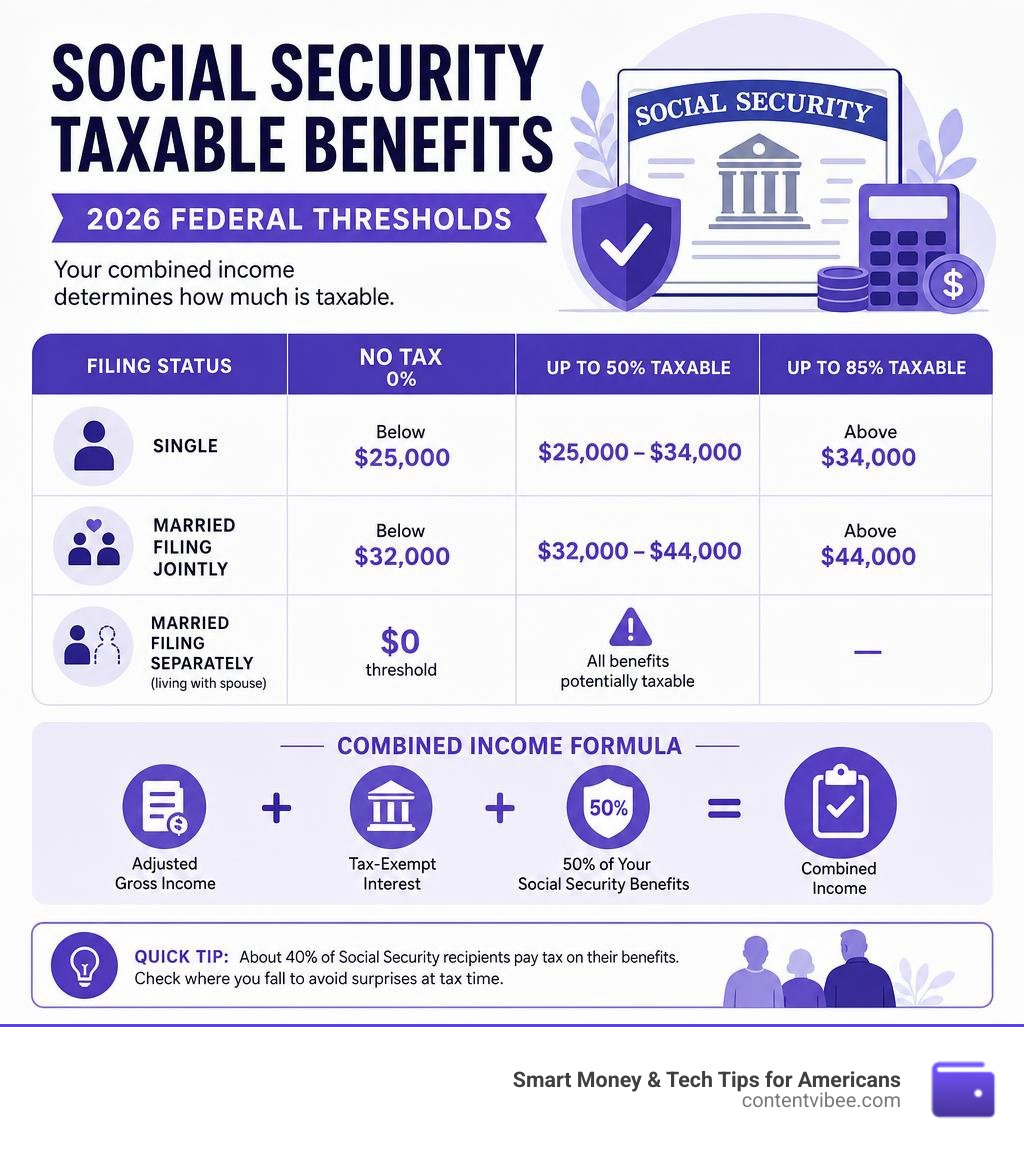
Quick answer: Whether your benefits are taxed depends on your combined income (your adjusted gross income + tax-exempt interest + 50% of your Social Security benefits).
| Filing Status | No Tax | Up to 50% Taxable | Up to 85% Taxable |
|---|---|---|---|
| Single | Below $25,000 | $25,000 – $34,000 | Above $34,000 |
| Married Filing Jointly | Below $32,000 | $32,000 – $44,000 | Above $44,000 |
| Married Filing Separately (living with spouse) | $0 threshold | All benefits potentially taxable | — |
The rules haven’t changed much since Congress first made benefits taxable in 1983 — but a new senior deduction introduced in 2025 is giving many retirees some relief.
If you’re a working spouse planning to claim spousal Social Security benefits, understanding exactly where you fall on these thresholds is critical. Your wages count toward combined income, and crossing even one threshold can trigger a tax bill you didn’t see coming.
This guide walks you through everything — the federal rules, the 2025 senior deduction, state taxes, withholding options, and smart strategies to keep more of what you’ve earned.
Social security taxable benefits terms to remember:
- can you collect a pension and still work full-time
- retirement health insurance options
- retirement passive income ideas
What Are Social Security Taxable Benefits?
To grasp how the IRS looks at your retirement nest egg, we first need to define what counts as “combined income” (often referred to by tax professionals as provisional income). The federal government does not simply look at your gross wages or your Social Security check in isolation. Instead, they use a specific legal formula to determine if you owe taxes on your benefits.
Your combined income is calculated as:
- Your Adjusted Gross Income (AGI) (which includes wages, taxable pensions, interest, dividends, and capital gains)
- Plus any tax-exempt interest (such as interest earned on municipal bonds)
- Plus 50% of your total Social Security benefits
This exact formula is codified under 26 USC 86: Social security and tier 1 railroad retirement benefits.
Historically, Social Security benefits were entirely exempt from federal income tax. This changed with the 1983 Amendments to the Social Security Act, which introduced taxation to shore up the Social Security Trust Funds. Initially, only up to 50% of benefits were taxable for higher earners. In 1993, Congress added a second tier, making up to 85% of benefits taxable for those with even higher combined incomes.
For a deeper dive into how these rules interact with your annual tax return, check out our comprehensive Social Security Taxable Income Guide 2026.
Federal Income Thresholds and Taxable Percentages
Understanding where you land on the federal tax brackets is crucial for retirement planning. The IRS has established two primary income tiers that trigger taxation.
If you are a single filer (or file as Head of Household):
- Combined income under $25,000: You owe $0 in federal income taxes on your benefits.
- Combined income between $25,000 and $34,000: Up to 50% of your Social Security benefits may be subject to federal income tax.
- Combined income above $34,000: Up to 85% of your benefits may be subject to income tax.
If you are married filing jointly:
- Combined income under $32,000: You owe $0 in federal income taxes on your benefits.
- Combined income between $32,000 and $44,000: Up to 50% of your benefits may be subject to federal income tax.
- Combined income above $44,000: Up to 85% of your benefits may be subject to income tax.
If you are married filing separately and lived with your spouse at any time during the year, your base threshold is $0. This means you will almost certainly pay taxes on up to 85% of your benefits.
It is important to emphasize that “up to 85% taxable” does not mean the IRS takes 85% of your check. It simply means that 85% of your benefit amount is added to your taxable income and taxed at your ordinary marginal income tax rate.
Historically, about 40% of Social Security recipients have had to pay federal taxes on their benefits because these thresholds have never been indexed for inflation since they were established decades ago.
Below is a summary table comparing these federal thresholds:
| Filing Status | 0% Taxable (Combined Income) | Up to 50% Taxable (Combined Income) | Up to 85% Taxable (Combined Income) |
|---|---|---|---|
| Single / Head of Household | Under $25,000 | $25,000 to $34,000 | Over $34,000 |
| Married Filing Jointly | Under $32,000 | $32,000 to $44,000 | Over $44,000 |
| Married Filing Separately | N/A | N/A | Over $0 (if living with spouse) |
For more official details on these thresholds, you can review Topic no. 423, Social Security and equivalent Railroad Retirement benefits | Internal Revenue Service.
Calculating Your Social Security Taxable Benefits
To determine your exact taxable portion, the IRS provides Worksheet A in Publication 915. Let’s look at a real-world scenario to see how this works.
Imagine a single retiree in 2026 named Sarah. Sarah receives:
- An annual pension of $18,600
- Part-time wages of $9,400
- Taxable interest of $990
- Annual Social Security benefits of $5,980
First, we calculate Sarah’s other income: $$\$18,600 \text{ (pension)} + \$9,400 \text{ (wages)} + \$990 \text{ (interest)} = \$28,990$$
Next, we add 50% of her Social Security benefits ($2,990) to find her combined income: $$\$28,990 + \$2,990 = \$31,980$$
Since Sarah’s combined income of $31,980 falls between the $25,000 and $34,000 thresholds for single filers, she is in the 50% tax bracket. Using the IRS worksheet, she discovers that $2,990 of her benefits will be subject to federal income tax.
To easily run your own numbers without getting bogged down in manual calculations, use our interactive Social Security Calculator Estimate Your Benefit Amount.
The 2025 Senior Deduction and Its Impact in 2026
The tax landscape for seniors saw a major shift with the passage of the One Big Beautiful Bill Act (OBBBA). This legislation introduced a temporary senior bonus deduction of up to $6,000 for eligible taxpayers age 65 and older, running from 2025 through 2028.
As we navigate the 2026 tax year, this deduction is providing massive relief for middle-income retirees. Thanks to this provision, the percentage of seniors who actually owe federal taxes on their Social Security benefits has plummeted from roughly 40% down to just 12%.
However, there are a few important caveats to keep in mind:
- Phase-outs: The $6,000 deduction begins to phase out once your Adjusted Gross Income (AGI) exceeds $75,000 for single filers and $150,000 for married couples filing jointly.
- Non-refundable: This is a non-refundable deduction. It is designed to lower your overall tax liability, meaning it won’t benefit lower-income seniors who already owe no income tax.
To read more about how this deduction alters the broad retirement landscape, see the analysis on Is Social Security income taxed?.
State-Level Taxation of Social Security
While federal taxes apply nationwide, state taxes are a completely different story. Most states do not tax Social Security benefits at all, but as of 2026, nine states still impose some form of income tax on your benefits.
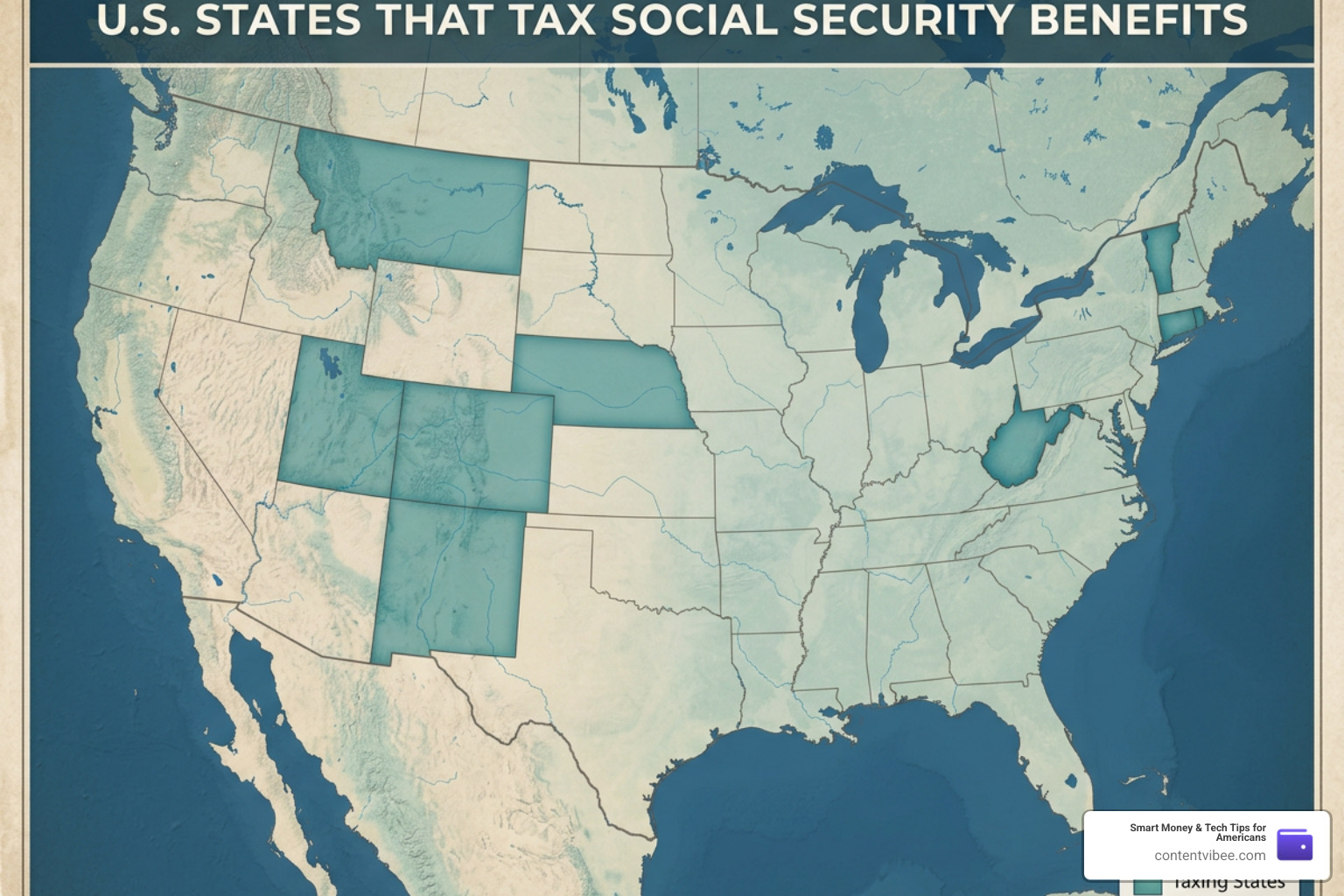
Each of these nine states has its own specific rules and income exemptions:
- Colorado: Offers a $20,000 exemption for beneficiaries under age 65; those aged 65 and older enjoy a full exemption from state tax on their benefits.
- Connecticut: Benefits are fully exempt for single filers with an AGI below $75,000 and married couples filing jointly with an AGI below $100,000. Above those limits, only 25% of benefits are taxable.
- Minnesota: Provides a robust state-specific exemption. Benefits are fully exempt for single filers with incomes below $82,190 and joint filers below $105,380.
- Montana: Taxability is calculated using state-specific thresholds that align closely with older federal rules, but exemptions exist for lower-income households.
- New Mexico: Offers a complete tax exemption for single filers with an AGI under $100,000 and joint filers under $150,000.
- Rhode Island: Social Security is fully exempt from state tax for those who have reached Full Retirement Age (FRA) and have an AGI below $104,200 (single) or $130,250 (joint).
- Utah: Taxes benefits but offers a non-refundable tax credit that phases out once modified AGI exceeds $45,000 for single filers and $75,000 for married couples.
- Vermont: Provides a full exemption for single filers below $50,000 AGI and joint filers below $65,000, with a gradual phase-out.
- West Virginia: Following a multi-year phase-out, West Virginia has completely eliminated state income tax on Social Security benefits starting in the 2026 tax year.
If you are planning a move or trying to decide where to spend your retirement years, check out our guide on Taxing Your Golden Years A Guide To Social Security Tax On Benefits to compare tax-friendly states.
How to Manage and Minimize Taxes on Your Benefits
Fortunately, you are not entirely powerless when it comes to the taxation of your benefits. With careful planning, we can manage our retirement income sources to keep our combined income below the federal thresholds.
Here are a few highly effective strategies:
- Strategic Roth Conversions: Converting traditional IRA or 401(k) funds into a Roth IRA before you begin claiming Social Security can pay off handsomely. Because Roth withdrawals are entirely tax-free, they do not count toward your AGI or combined income calculations.
- Managing IRA Distributions: Taking larger distributions from traditional retirement accounts in years before you claim Social Security can help keep your post-claim annual income lower.
- Voluntary Tax Withholding (VTW): If you know you will owe taxes on your benefits, you can avoid a surprise bill at tax time. You can request that the Social Security Administration withhold federal taxes directly from your monthly checks by filing Form W-4V (Voluntary Withholding Request). You can choose to have 7%, 10%, 12%, or 22% of your monthly benefit withheld.
To build a comprehensive plan for your claiming strategy, take a look at The Ultimate Guide To Social Security Benefit Optimization.
Strategies to Reduce Social Security Taxable Benefits
Another major tax trigger for retirees is the onset of Required Minimum Distributions (RMDs). Once you reach the age where RMDs are mandatory, these forced withdrawals can spike your AGI, pushing your combined income into the 85% taxable tier for Social Security.
To manage this:
- Consider using Qualified Charitable Distributions (QCDs). If you donate directly from your traditional IRA to an eligible charity, the distributed amount satisfies your RMD requirement but is excluded from your AGI.
- Carefully time your claiming age. Claiming benefits later increases your monthly check, but it also gives you a wider window to perform Roth conversions.
For more details on finding the perfect timing for your personal situation, read The Definitive Guide To Social Security Claiming Age.
Special Tax Situations: Lump-Sum Payments and Child Benefits
There are two unique scenarios that frequently catch taxpayers off guard: retroactive lump-sum payments and survivor benefits paid to children.
Retroactive and Lump-Sum Payments
If you applied for benefits late or won a disability appeal, you might receive a large lump-sum back payment covering prior years. If you report this entire lump sum as income in the year you receive it, it could easily push you into a much higher tax bracket.
To prevent this, the IRS allows a lump-sum election method. This allows you to figure the taxable portion of the prior-year benefits using your income from those earlier years, without actually requiring you to file amended returns. You simply check the box on line 6c of Form 1040 to make this election if it results in lower taxes.
Child Survivor Benefits
When a parent passes away, children may be eligible for survivor benefits. For tax purposes, these benefits are taxed based on the legal right of the recipient. This means the benefits belong to the child, not the surviving parent. You must calculate taxability separately using the child’s own personal income. Since most children have little to no other taxable income, these survivor benefits are rarely taxed.
For official worksheets and step-by-step instructions on managing these special cases, consult Publication 915 (2025), Social Security and Equivalent Railroad Retirement Benefits | Internal Revenue Service (or download the PDF directly from the IRS website).
Frequently Asked Questions about Social Security Taxes
Do I have to pay taxes on my Social Security benefits if it is my only income?
No. If Social Security is your only source of income during the tax year, your combined income will consist solely of half of your benefits. This amount will fall well below the $25,000 threshold for single filers and the $32,000 threshold for joint filers, making your benefits completely nontaxable.
You can verify this rule directly via Social Security Income | Internal Revenue Service.
How do I report my Social Security benefits on my tax return?
By early February, you will receive Form SSA-1099 (or Form RRB-1099 for railroad retirement benefits) showing the total amount of benefits paid to you in Box 5.
When filing your taxes:
- Report your net benefits (Box 5) on Form 1040, Line 6a.
- Report the taxable portion (calculated using the IRS worksheet) on Form 1040, Line 6b.
- If none of your benefits are taxable, leave Line 6b blank or enter $0.
Can I change my voluntary tax withholding online?
Yes! The easiest way to start, change, or stop your voluntary tax withholding is by logging into your personal my Social Security account online. Alternatively, you can fill out paper Form W-4V and mail or hand-deliver it to your local Social Security Administration office.
Conclusion
Navigating the rules surrounding social security taxable benefits can feel daunting, but a bit of proactive planning goes a long way. At Smart Money & Tech Tips for Americans (powered by ContentVibee), we are committed to helping you make sense of these complex rules so you can keep more of your hard-earned money.
Your retirement income is a puzzle where every piece—pensions, IRAs, part-time wages, and Social Security—affects the others. If you are currently balancing work and retirement, make sure to read our guide on Are spousal benefits reduced by working? to ensure your household strategy is fully optimized.