


Are You Saving Enough? What a Retirement Calculator Tells You Right Now
A retirement calculator is the fastest way to find out if you’re on track — or how far off you are. Here’s the quick answer most people are looking for:
How much do you need to retire?
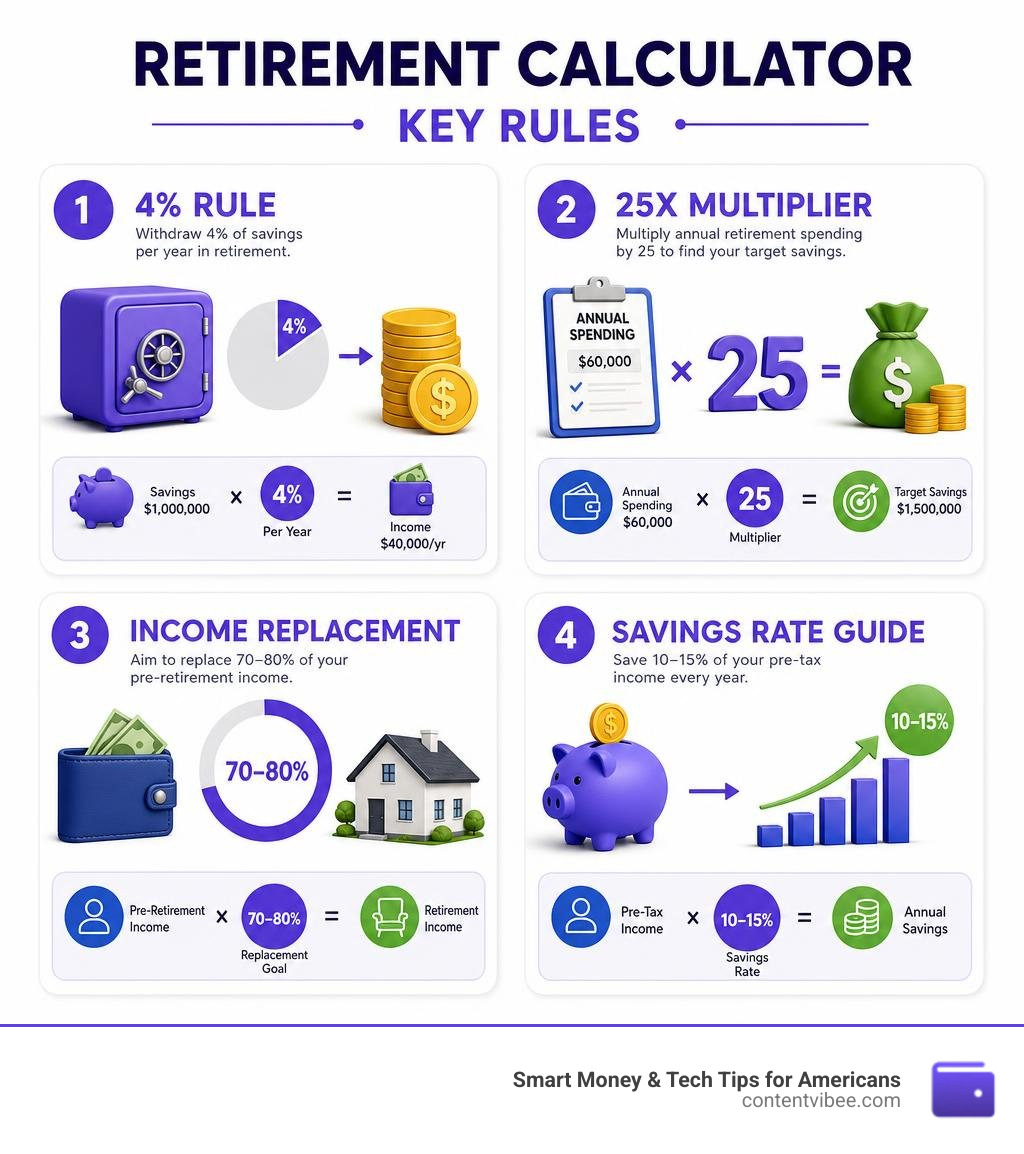
| Rule of Thumb | How It Works | Example |
|---|---|---|
| 70-80% Income Rule | Multiply pre-retirement income by 0.70-0.80 | $80,000 income → need ~$56,000-$64,000/year |
| 25x Multiplier | Multiply annual retirement spending by 25 | $60,000/year needed → save $1.5 million |
| 4% Withdrawal Rule | Withdraw 4% of savings per year in retirement | $1,000,000 saved → $40,000/year income |
| 10-15% Savings Rate | Save 10-15% of your pre-tax income every year | $80,000 income → save $8,000-$12,000/year |
These are starting points, not guarantees. Your actual number depends on your lifestyle, Social Security benefits, retirement age, and how long you live.
Here’s the hard truth: many couples nearing retirement are significantly underfunded — and don’t know it yet. Consider this: a 35-year-old earning $60,000, with $30,000 already saved and contributing $500 a month, would accumulate roughly $879,000 by age 67. But to replace 70% of their income, they’d need about $1.7 million. That’s nearly a $1 million gap.
And that gap only gets harder to close the longer you wait.
Social Security helps — but it was only designed to replace about 40% of your working income. For most couples, that’s not enough to retire comfortably on its own.
The good news? Running your numbers through a retirement calculator takes less than five minutes and shows you exactly where you stand — and what to do next.
What is a Retirement Calculator and How Does It Work?
At its core, a retirement calculator is a digital crystal ball powered by financial math. Instead of guessing how much money you will have in twenty, thirty, or forty years, you feed the calculator a few basic facts about your financial life today, and it projects your future wealth.
But it does not just add up your monthly savings in a straight line. If you save $500 a month for 30 years in a mattress, you will end up with exactly $180,000. A quality calculator models how your money grows when it is invested in the market. It uses the magic of compound interest—where you earn returns on your initial investment, and then earn returns on those returns, creating a snowball effect over time.
Understanding how these tools operate makes planning much easier. To see how these calculations map directly to your workplace accounts, you can explore our guide on Retirement Math Made Easy With A 401K Balance Calculator.
Key Inputs for an Accurate Retirement Calculator
To get a projection that actually reflects reality, you need to provide the calculator with high-quality data. The five foundational inputs every basic tool requires are:
- Current Age: This establishes your starting point and determines your time horizon.
- Target Retirement Age: The age you plan to stop working. For most Americans born in 1960 or later, the Social Security Administration defines the full retirement age as 67.
- Current Retirement Savings: The total balance of all your existing accounts, including 401(k)s, IRAs, and taxable brokerage accounts.
- Monthly Contributions: How much you (and your employer, via matching contributions) plan to save each month moving forward.
- Expected Rate of Return: The annual percentage growth you expect from your investments before retirement. Historically, the U.S. stock market (S&P 500) has returned about 10% annually on average (around 7% when adjusted for inflation). Many conservative planners use a nominal pre-retirement return assumption of 6% to 7% to keep their plans grounded.
Advanced Settings in a Retirement Calculator
While basic inputs give you a rough sketch, the real magic happens in the advanced settings. If you want a plan that survives contact with the real world, you must account for the forces that erode or boost your wealth:
- Expected Inflation Rate: Inflation is the silent assassin of purchasing power. Over the past 30 years, inflation in the U.S. has averaged roughly 2.6% per year. This means a dollar today will buy less than half of what it did three decades ago. Most robust calculators use a default inflation assumption of 3% to show you results in “today’s dollars.”
- Annual Salary Growth: As you progress in your career, your income will likely rise. Modeling a modest 2% annual salary increase helps project how your contributions will naturally scale over time.
- Life expectancy: Planning to live to 75 when you actually live to 95 is a recipe for spending your final two decades broke. We recommend aiming high—planning for a life expectancy of 90 or 95 ensures your nest egg outlives you.
- Post-Retirement Rate of Return: Once you retire, you will likely shift your portfolio into safer, less volatile investments like bonds and fixed-income assets. Because of this, your expected return during retirement should be lower than your working years—typically around 4% to 5%.
The Core Rules of Thumb for Retirement Savings
When you begin using a retirement calculator, the sheer volume of numbers can feel overwhelming. To simplify things, financial planners have developed several classic rules of thumb. These concepts serve as excellent guideposts to help you determine if your target nest egg is realistic.

To help you visualize how these different approaches compare, let’s look at how they stack up side by side:
| Rule of Thumb | Core Objective | Who It Is Best For | Potential Drawback |
|---|---|---|---|
| The 4% Rule | Determines a safe annual withdrawal rate from your portfolio. | Retirees planning a traditional 30-year retirement. | May be too aggressive in prolonged down markets; early retirees may need a 3% to 3.5% rate. |
| The 25x Multiplier | Calculates the absolute size of the nest egg you need. | Anyone looking for a clear, fixed target savings goal. | Does not account for guaranteed income sources like Social Security. |
| 70-80% Income Replacement | Estimates how much annual income you need to maintain your lifestyle. | Mid-career savers with stable, predictable living expenses. | Lifestyle creep or high healthcare costs can easily push your needs past 80%. |
| 10-15% Savings Rate | Sets a target for how much of your current paycheck to invest. | Early-career savers looking to build consistent wealth habits. | Late starters will need to save significantly more than 15% to catch up. |
The 4% Rule and Portfolio Sustainability
The 4% rule is the gold standard of retirement withdrawal strategies. Originating from a landmark 1994 study by financial planner William Bengen, this rule states that you can withdraw 4% of your portfolio’s total value in your first year of retirement, adjust that dollar amount for inflation every year after, and have a near 100% probability of your money lasting at least 30 years.
For example, if you retire with a $1 million portfolio, the 4% rule allows you to withdraw $40,000 in year one. If inflation is 3% that year, you would withdraw $41,200 in year two, and so on.
While Bengen’s research utilized historical U.S. market data spanning major crashes, some modern planners suggest that in low-yield or highly volatile environments, early retirees should aim for a more conservative 3% to 3.5% withdrawal rate to guarantee portfolio longevity.
Income Replacement and the 25x Multiplier
The 25x multiplier is simply the mathematical reverse of the 4% rule. If you want to know how much money you need to save to safely withdraw a specific annual amount, you multiply your desired annual retirement income by 25.
For instance, if you determine that you need $60,000 per year from your portfolio to live comfortably (after subtracting other income sources like Social Security), your math is:
$$\$60,000 \times 25 = \$1,500,000$$
This target nest egg of $1.5 million is your “Freedom Number.”
To find this number, most experts recommend the 70-80% income replacement rule. The theory is that once you retire, certain costs will vanish—you won’t be paying payroll taxes, saving for retirement, or commuting to work, and your mortgage might be fully paid off. Therefore, you can comfortably maintain your lifestyle on 70% to 80% of what you earned while working.
However, if your retirement dream involves extensive luxury travel or moving to a high-cost area, you might want to model a “Fat” retirement using 100% or even 150% of your pre-retirement income in your settings.
How Inflation, Taxes, and Fees Impact Your Projections
If you only look at nominal numbers, your retirement plan is bound to fail. In the real world, three silent forces constantly work to shrink your net returns: inflation, taxes, and investment fees.
Let’s break down how these forces impact a real portfolio over time:
- The Inflation Tax: If you assume a standard 2.5% to 3% annual inflation rate, your purchasing power will cut in half roughly every 25 to 30 years. A retirement income of $5,000 a month feels great today, but in 30 years, you will need nearly $10,000 a month just to buy the exact same basket of goods and services.
- The Drag of Investment Fees: Many investors ignore the expense ratios on their mutual funds or the fees charged by financial advisors. This is a massive mistake. A mere 0.5% difference in annual fees can wipe tens of thousands of dollars out of your portfolio over a 30-year career. Always opt for low-cost index funds where possible to keep more of your compound growth in your own pocket.
- The Tax Man’s Share: Unless your money is entirely in a Roth account, you will owe taxes when you withdraw it. Traditional 401(k)s and IRAs are taxed at ordinary income rates. If you fail to account for taxes, you might think you have a $1.5 million nest egg, only to realize that 15% to 25% of that belongs to the IRS.
Factoring Taxes and Fees into Your Retirement Calculator
To get a true picture of your future, you should look for a retirement calculator that allows you to model after-tax income and fee drag.
When planning your withdrawals, the federal tax system is progressive. For married couples filing jointly, a significant portion of your income falls into lower brackets (like the 10% and 12% brackets), meaning your average tax rate in retirement is often much lower than your marginal tax rate while working.
Additionally, you must prepare for Required Minimum Distributions (RMDs), which the law requires you to start taking from traditional tax-deferred accounts at age 73 or 75, depending on your birth year. A comprehensive planning tool will simulate these RMDs to ensure you aren’t hit with massive tax penalties later in life.
Integrating Social Security and Other Income Sources
Your personal portfolio does not have to do all the heavy lifting. When calculating your target nest egg, you must factor in other guaranteed income sources, with Social Security being the most common.
To get a highly accurate estimate of your future government benefits, you can use official resources like the Benefits Planner: Retirement | Online Benefits Calculator | SSA or run a quick projection using the Social Security Quick Calculator .
Estimating Your Social Security Benefits
Social Security was never meant to be a solo retirement plan; it was designed to replace roughly 40% of an average worker’s career earnings. Yet, nearly half of current retirees rely on it as their primary source of income.
To see how your benefits fit into your broader plan, we recommend checking out our comprehensive How Much Social Security Will I Get Calculator or exploring the Best Free Social Security Calculator Options Your No Cost Retirement Roadmap to map out your guaranteed income streams.
Your monthly benefit is determined by your highest 35 years of inflation-adjusted earnings and the age at which you choose to claim. While you can claim as early as age 62, doing so permanently reduces your monthly check by up to 30% compared to waiting until your Full Retirement Age (67).
Coordinating Spousal Benefits and Timing
For married couples, claiming Social Security is a team sport. Spouses are often eligible for spousal benefits, which can be worth up to 50% of the higher-earning partner’s benefit.
Furthermore, delaying your claim past your Full Retirement Age earns you Delayed Retirement Credits. This increases your monthly payout by approximately 8% for every year you wait, up until age 70.
To maximize your joint lifetime benefits, it is highly beneficial to utilize specialized tools. You can calculate your combined options using our Tools/Finance Calculator/Social Security Spousal Benefit Calculator, evaluate strategies with our guide on Do The Math Top Social Security Calculators For Married Couples, and determine your optimal claiming window using our Timing Is Everything The Best Age To Take Social Security Calculator Guide.
How to Adjust Your Plan If You Face a Shortfall
It happens to almost everyone: you plug your numbers into a retirement calculator, click “calculate,” and stare in horror at a massive red number indicating a shortfall.
First, take a deep breath. A shortfall is not a failure; it is an early warning system. Because you ran the numbers today, you still have time to make adjustments.
The most effective way to start fixing a shortfall is to optimize where your savings go using a “savings waterfall” strategy:
- Capture the Match: Contribute to your employer’s 401(k) or 403(b) up to the maximum percentage they will match. This is literally free money and represents an instant 100% return on your investment.
- Max the Roth IRA: Next, route money into a Roth IRA up to the annual limit ($7,500 in 2026, or $8,600 if you are 50 or older). This money grows entirely tax-free and can be withdrawn tax-free in retirement.
- Return to the Workplace Account: If you still have money to save, go back to your workplace 401(k) and increase your contributions toward the employee limit ($24,500 in 2026).
- Taxable Brokerage: Any overflow savings beyond these limits can go into a standard, taxable brokerage account.
Levers to Close the Retirement Gap
If optimizing your accounts isn’t enough, you have four main levers you can pull to get your retirement plan back on track:
- Increase Your Contribution Rate: Even a tiny change makes a massive difference over time. Increasing your savings rate by just 2% or 3% of your income can add hundreds of thousands of dollars to your final nest egg thanks to compound growth.
- Extend Your Retirement Timeline: Working just two or three years longer is incredibly powerful. It gives your existing portfolio more time to compound, allows you to make additional contributions, and shortens the number of years you need to fund in retirement.
- Delay Social Security Claiming: As mentioned, waiting to claim Social Security increases your guaranteed monthly benefit, which permanently reduces the amount of income your personal portfolio needs to generate.
- Adjust Your Retirement Lifestyle Expectations: If your calculator says you can’t afford a $10,000-a-month retirement, see what happens if you adjust your goal to a highly comfortable $7,000 a month. Downsizing your home or relocating to an area with a lower cost of living can instantly make a “failing” plan successful.
Frequently Asked Questions about Planning Your Future
What is the difference between a simple and a comprehensive tool?
Simple retirement calculators usually treat all your savings as one single bucket of money and apply a flat tax rate and a single rate of return. While useful for a quick check-up, they miss critical real-world nuances.
A comprehensive tool models your different accounts (Traditional 401k, Roth IRA, taxable brokerage) separately. It applies progressive tax brackets, accounts for RMDs, and simulates a tax-aware withdrawal sequence (withdrawing from taxable accounts first to let tax-advantaged accounts grow longer) to minimize your lifetime tax bill.
How often should I update my savings projections?
We recommend running your numbers through a retirement calculator at least once a year. An annual review allows you to adjust for major life events—such as a salary raise, a new job, marriage, or the birth of a child—and helps you keep your plan aligned with long-term financial goals despite short-term market volatility.
Should I include my home equity in my long-term plan?
Generally, it is safest to exclude your primary residence from your retirement portfolio calculations. You will always need a place to live, and home equity is highly illiquid.
However, if your plan definitely involves downsizing to a smaller home or moving to a cheaper region in retirement, you can factor the estimated net cash proceeds into your future savings. Alternatively, some retirees utilize a reverse mortgage to convert home equity into income, though this comes with complex fees and rules that should be reviewed carefully.
Conclusion
At Smart Money & Tech Tips for Americans, we believe that achieving financial independence does not require a degree in finance. It simply requires the right tools, clear data, and the willingness to take action.
Your retirement readiness is entirely within your control. By using a robust retirement calculator, setting realistic assumptions for inflation and returns, and optimizing your savings waterfall, you can build a bulletproof roadmap to your golden years.
Ready to take the next step and see exactly where your numbers land? Explore our comprehensive suite of financial planning resources on our tools/ directory, or jump straight into the action with our interactive Tools/Finance Calculator/ to secure your financial future today.


