Why Retirement Tax Planning Strategies Can Make or Break Your Income
Retirement tax planning strategies are the tools and decisions you use to keep more of your money when you stop — or slow down — working. If you’re nearing retirement while still earning income, the stakes are especially high.
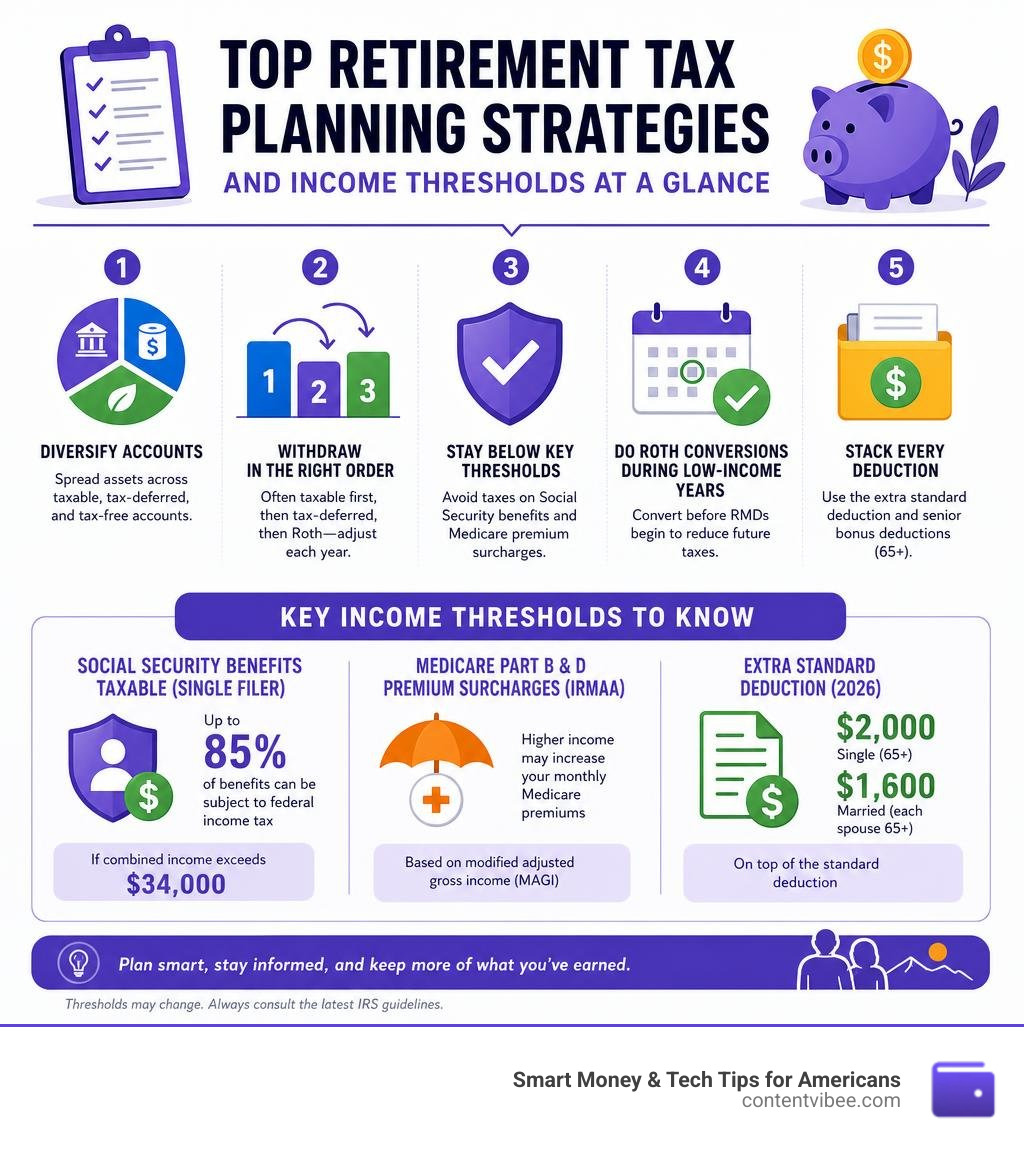
Quick answer: The most effective retirement tax planning strategies are:
- Spread assets across three account types — taxable, tax-deferred (pension/401k), and tax-free (Roth) — to control which income gets taxed and when.
- Withdraw in the right order — often taxable accounts first, then tax-deferred, then Roth — but adjust based on your bracket each year.
- Stay below key income thresholds to avoid triggering taxes on Social Security benefits and Medicare premium surcharges.
- Do Roth conversions during low-income years before Required Minimum Distributions (RMDs) force larger withdrawals.
- Stack every deduction available to seniors — including the extra standard deduction and the 2025 bonus deduction for those 65+.
Here’s what most people miss: retirement doesn’t end your tax bill — it just changes it.
According to research, 73% of Americans worry that higher taxes will erode their retirement income. And that fear is well-founded. Once your regular paycheck stops, every dollar you pull from savings has a tax consequence that depends on where it comes from, how much you take, and when you take it.
For working spouses nearing retirement, this gets even more complicated. Earned income from a job can push your combined income above the thresholds where Social Security benefits become partially taxable — up to 85% of your benefits can be subject to federal income tax if your combined income exceeds $34,000 as a single filer.
The good news? Smart sequencing and planning can dramatically reduce what you owe. One hypothetical example shows that switching from a traditional sequential withdrawal approach to a proportional strategy reduced total lifetime taxes by over 45% and stretched the portfolio by nearly a full year.
This guide walks you through exactly how to do that.
Key terms for retirement tax planning strategies:
The Three-Bucket System: The Foundation of Retirement Tax Planning Strategies
Most of us spend decades focusing entirely on accumulation—watching our account balances climb. But once we reach the distribution phase, we must look at our wealth through a different lens: tax diversification. If all your savings reside in a single account type, you hold zero leverage over your annual tax bill.
To gain control, we recommend using the “three-bucket system.” This framework segments your wealth into three distinct tax treatments: taxed now, taxed later, and never taxed again.

By practicing proactive asset location—placing high-yield, heavily taxed assets inside tax-sheltered accounts while keeping highly tax-efficient assets in taxable brokerage accounts—you can dictate your taxable income on a year-by-year basis. Let’s break down how these three buckets function.
Tax-Deferred Accounts: Comparing Pension and 401k Taxation
The “taxed later” bucket is home to traditional tax-deferred accounts. This includes traditional 401(k)s, 403(b)s, traditional IRAs, and defined-benefit pensions.
Contributions to these accounts are typically made with pre-tax dollars, allowing your investments to grow tax-deferred. However, the taxman always gets his cut. When you withdraw these funds in retirement, every single dollar is treated and taxed as ordinary income.
Pensions follow a similar tax path. Because you did not pay income tax on those pension contributions during your working years, your monthly pension checks are fully taxable at ordinary income rates.
| Feature | Pension Payments | Traditional 401(k) Withdrawals |
|---|---|---|
| Tax Treatment | Taxed fully as ordinary income | Taxed fully as ordinary income |
| Withdrawal Flexibility | Fixed monthly payouts (usually no lump-sum flexibility once started) | Highly flexible; withdraw as much or as little as needed |
| RMD Requirements | Not subject to RMD rules (payouts are automatically distributed) | Subject to RMDs starting at age 73 to 75 under SECURE 2.0 |
| State Tax Treatment | Varies by state; some exempt public pensions entirely | Varies by state; most tax withdrawals as ordinary income |
For those navigating public pensions, such as California’s CalPERS, state-specific adjustments can further complicate your planning. To understand how cost-of-living adjustments and state taxes interact with these accounts, explore The Golden State Guide Deciphering Calpers Cola And California Tax Adjustments.
Roth Accounts and Tax-Free Retirement Tax Planning Strategies
The “never taxed again” bucket is the crown jewel of retirement tax planning strategies. It consists of Roth IRAs, Roth 401(k)s, and Health Savings Accounts (HSAs) used for qualified medical expenses.
Because you fund Roth accounts with after-tax dollars, qualified withdrawals in retirement are 100% tax-free. They do not increase your adjusted gross income (AGI), nor do they trigger the taxation of your Social Security benefits or push you into higher Medicare premium brackets.
If you are currently working, maximizing your after-tax contributions is one of the fastest ways to build this bucket. To learn how to optimize this process, read our comprehensive guide on After Tax Contributions How To Maximize Your Retirement Nest Egg.
Taxable Accounts and Capital Gains Optimization
The “taxed now” bucket contains traditional taxable brokerage accounts, high-yield savings accounts, and certificates of deposit (CDs).
While you pay taxes annually on any interest, dividends, or realized capital gains generated within these accounts, they offer a massive structural advantage: access to preferential long-term capital gains tax rates. If you hold an asset for more than a year before selling it, your profits are taxed at 0%, 15%, or 20% rather than ordinary income rates (which can top out at 37%).
For the 2026 tax year, single filers with taxable income up to $49,450 (and married couples filing jointly up to $98,900) qualify for a 0% long-term capital gains tax rate. This means you can strategically sell appreciated stocks or mutual funds and pay absolutely zero federal tax on those gains, provided your total taxable income remains below that threshold.
Additionally, taxable accounts allow for tax-loss harvesting. You can sell losing investments to offset capital gains, and even use up to $3,000 of excess losses to offset highly taxed ordinary income, such as RMDs or pension payouts.
Withdrawal Sequencing: Traditional vs Proportional Strategies
Once you have established your three buckets, the next challenge is deciding how to pull your money out. The order in which you tap these accounts is called withdrawal sequencing, and it can have a massive impact on your portfolio’s longevity.

Historically, the standard rule of thumb was sequential:
- Drain your taxable accounts first to allow your tax-advantaged accounts to grow as long as possible.
- Empty your tax-deferred (traditional) accounts next.
- Tap your tax-free (Roth) accounts last.
However, modern financial planning has revealed that this rigid sequential strategy often backfires. By ignoring your tax-deferred accounts for a decade or more, you allow those pre-tax balances to compound into a giant tax bomb. When you are finally forced to take Required Minimum Distributions (RMDs) in your 70s, the sudden influx of forced ordinary income can spike your tax bracket, trigger higher Medicare premiums, and heavily tax your Social Security benefits.
A proportional withdrawal strategy, on the other hand, involves pulling a calculated percentage from taxable, tax-deferred, and Roth accounts simultaneously each year. This smooths out your taxable income over your retirement lifetime, preventing dramatic tax spikes.
According to modeling from Fidelity, a proportional withdrawal strategy reduced total lifetime taxes by over 45% in a hypothetical case study, adding an extra year of portfolio longevity compared to the sequential method. You can explore more about this in Savvy tax withdrawals | Fidelity .
The 4% to 5% Rule and Inflation Adjustments
To ensure your money lasts, you must pair your withdrawal sequence with a sustainable spending rate. The traditional 4% rule suggests withdrawing 4% of your portfolio in your first year of retirement, then adjusting that dollar amount annually for inflation.
For example, if you have a $1 million portfolio, you would withdraw $40,000 in Year 1. If inflation runs at 3% that year, you would withdraw $41,200 in Year 2, regardless of how the stock market performed.
While 4% to 5% remains a solid baseline, modern retirees must maintain spending flexibility. Keeping a cash reserve of one to two years’ worth of living expenses allows you to avoid selling equities during a market downturn, protecting your portfolio from sequence-of-returns risk. To dig deeper into adjusting these rules for your situation, check out Tax strategies in retirement? | Vanguard .
Proportional Bracket-Filling to Avoid the Tax Torpedo
Another highly effective strategy is “proportional bracket-filling.” Instead of withdrawing blindly, you intentionally withdraw enough from your tax-deferred accounts each year to fill up the lowest tax brackets (such as the 10% and 12% ordinary income brackets).
For 2026, the 12% federal income tax bracket for married couples filing jointly extends up to roughly $100,800 (plus your standard deduction). If your pension and Social Security benefits total $60,000, you have about $40,800 of “space” left in that low 12% bracket.
By pulling exactly $40,800 from your traditional IRA or 401(k) to fill that bracket, you prevent those funds from compounding into a larger, future RMD that could eventually be taxed at 22% or 24%. Any additional income you need beyond that bracket limit can be pulled tax-free from your Roth bucket. This keeps your marginal tax rate low and defuses the “tax torpedo.”
Minimizing the Impact of RMDs and Social Security Taxation
As we transition into our 70s, tax planning shifts from voluntary bracket management to defensive maneuvering. The IRS forces us to take money out of our tax-deferred accounts, and these forced withdrawals can trigger a cascading chain reaction of taxes.
First, let’s look at how the IRS calculates “provisional income” to determine if your Social Security benefits are taxable:
$$\text{Provisional Income} = \text{Adjusted Gross Income (AGI)} + \text{Tax-Exempt Interest} + 50\% \text{ of Social Security Benefits}$$
If your provisional income crosses certain thresholds, up to 85% of your benefits become subject to federal income tax. For a deeper dive into this calculation, read Uncle Sams Cut Understanding Taxes On Social Security.
Managing Required Minimum Distributions Under SECURE 2.0
Thanks to the SECURE 2.0 Act, the age at which you must begin taking Required Minimum Distributions (RMDs) has increased. For those reaching age 72 after December 31, 2022, the RMD age is 73. For those who turn 74 after December 31, 2032, the RMD age increases to 75.
If you fail to take your RMD, the penalty is steep: 25% of the amount that should have been withdrawn (which can be reduced to 10% if corrected quickly).
To minimize the impact of RMDs, consider these strategies:
- Qualified Charitable Distributions (QCDs): If you are 70½ or older, you can direct up to $105,000 per year (for 2026) directly from your traditional IRA to an eligible charity. This transfer satisfies your RMD requirement but is completely excluded from your adjusted gross income, keeping your tax bracket and Medicare premiums low.
- In-Kind RMDs: If you don’t want to sell your investments, you can transfer shares directly from your traditional IRA to a taxable brokerage account to satisfy your RMD. You will still owe ordinary income tax on the value of the shares, but you won’t have to liquidate your positions.
How Working Past Retirement Affects Social Security Taxes
If you choose to work in retirement, your earned income will directly impact your provisional income, making it far more likely that your Social Security benefits will be taxed.
For single filers:
- If your combined (provisional) income is between $25,000 and $34,000, up to 50% of your Social Security benefits may be taxable.
- If your combined income is above $34,000, up to 85% of your benefits may be taxable.
For married couples filing jointly:
- If your combined income is between $32,000 and $44,000, up to 50% of your benefits may be taxable.
- If your combined income is above $44,000, up to 85% of your benefits may be taxable.
To see how these rules apply directly to the 2026 tax landscape, review our Social Security Taxable Income Guide 2026 and Taxing Your Golden Years A Guide To Social Security Tax On Benefits.
Leveraging Roth Conversions and Senior Tax Deductions
To actively lower your lifetime tax bill, you should look for opportunities to convert highly taxed pre-tax assets into tax-free Roth assets, while taking advantage of every deduction the IRS offers to older adults.
Timing Roth Conversions During Low-Income Gap Years
The years between your retirement date and the start of your RMDs (often ages 60 to 73) represent your “gap years.” During this window, your earned income drops, but you aren’t yet forced to take RMDs. This is the absolute prime window for executing strategic Roth conversions.
By converting a portion of your traditional IRA or 401(k) to a Roth IRA during these low-income years, you pay income tax on the converted amount at your current, lower tax rate. Once inside the Roth IRA, that money grows 100% tax-free and is exempt from lifetime RMDs.
However, you must size your conversions carefully. Converting too much in a single year can push you into a higher marginal tax bracket and trigger Medicare IRMAA surcharges (which have a two-year lookback period). For more tips on executing this, see Taxes in Retirement: 7 Tax Tips for After You Retire – TurboTax .
Maximizing Deductions and Credits with Retirement Tax Planning Strategies
Don’t leave money on the table. The IRS offers several tax breaks specifically designed for seniors:
- Extra Standard Deduction: If you are 65 or older, you can claim an additional standard deduction ($1,950 for single filers in 2026, or $3,100 for married couples if both spouses are 65+).
- Senior Bonus Deduction: Seniors 65 and older can claim a special bonus deduction of $6,000 ($12,000 if both spouses qualify), which phases out at higher modified adjusted gross incomes (MAGI) and is set to expire after 2028.
- Deductible Medicare Premiums: If you are self-employed or run a small business in retirement, you may be eligible to deduct your Medicare Part B, Part D, and Medigap premiums directly from your self-employment income.
Frequently Asked Questions About Retirement Tax Planning
How are pension payments taxed compared to 401k withdrawals?
Both pension payments and traditional 401(k) withdrawals are taxed as ordinary income at your marginal tax bracket. The primary difference is flexibility: pension payments are typically fixed monthly distributions, whereas 401(k) withdrawals can be adjusted dynamically based on your annual tax planning needs.
When must I start taking Required Minimum Distributions (RMDs)?
Under SECURE 2.0, if you turn age 72 after December 31, 2022, you must begin taking RMDs by age 73. Your very first RMD can be delayed until April 1st of the year following the year you turn 73, but subsequent RMDs must be taken by December 31st of each year.
How does working in retirement affect my tax bracket?
Earning a paycheck in retirement adds to your ordinary income, which can push you into a higher tax bracket (bracket creep). This earned income also increases your provisional income, which can cause up to 85% of your Social Security benefits to become taxable and trigger Medicare IRMAA premium surcharges.
Conclusion
At ContentVibee, we believe that a successful retirement is built on clear, actionable advice. Managing your income in retirement is no longer just about saving; it is about how efficiently you distribute your wealth. By coordinating your three buckets, timing your Roth conversions, and carefully managing your tax brackets, you can protect your hard-earned savings from unnecessary taxation.
If you are currently working or planning to work during your transition, it is vital to know how your earned income interacts with your retirement benefits. Learn how working in retirement affects your spousal benefits to ensure your joint tax strategy remains highly efficient.